
Expert report review
When does a court exclude a patent expert's testimony?
A court excludes a patent expert's opinion when the party offering it cannot show, more likely than not, that the opinion meets Rule 702. In district court decisions between 2014 and 2025 the opinions that fell were built on a claim construction the court had rejected, compared the product with the patent's embodiment instead of its claims, relied on theories the contentions did not disclose, or addressed law and intent. Disputes over facts stayed for cross-examination.
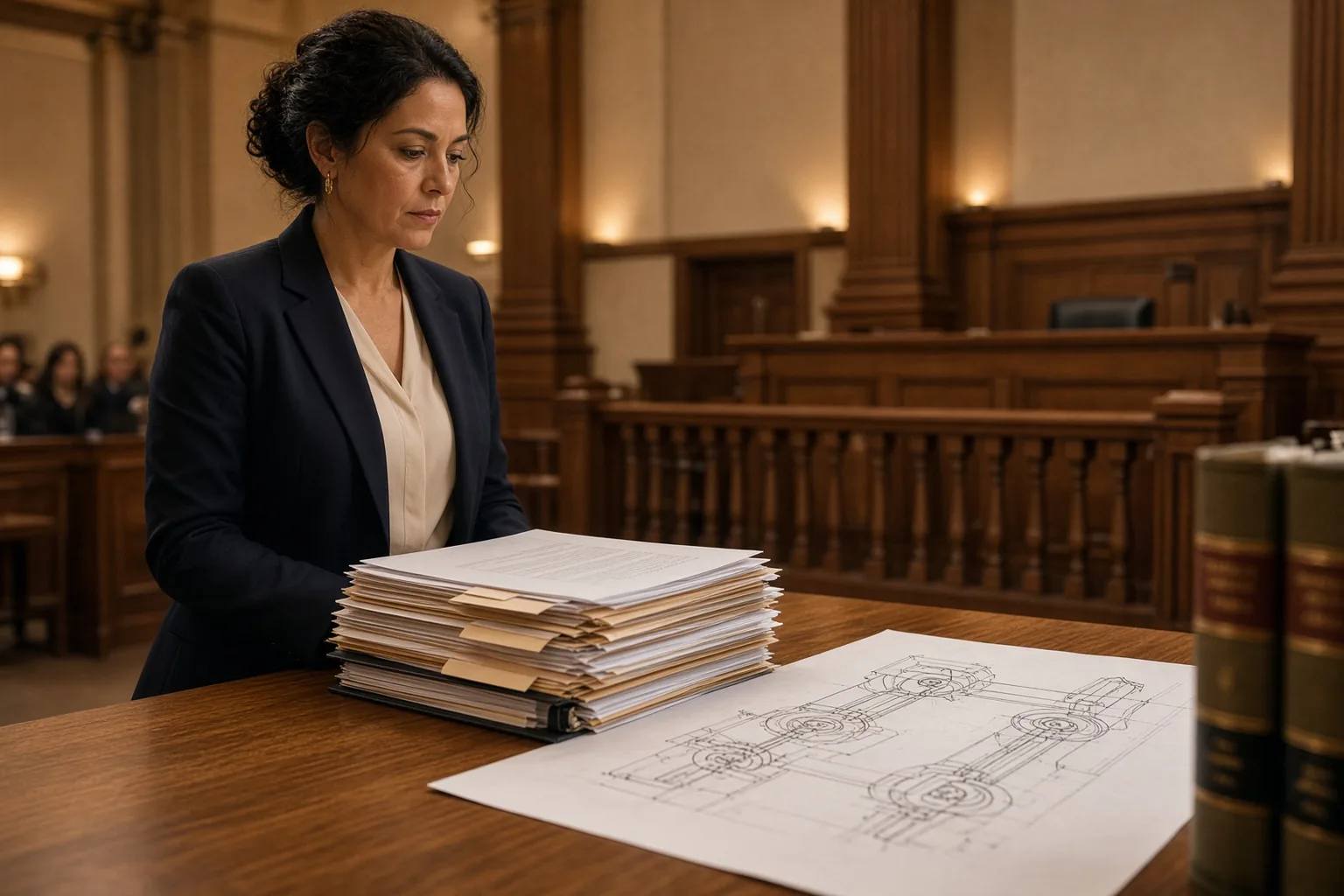
What standard does the court apply to a motion to exclude?
Rule 702 as amended in 2023. The proponent must establish that it is more likely than not that the testimony rests on sufficient facts or data and reliable methods and that the opinion applies them reliably to the case.
Under Rule 702, a witness qualified as an expert by knowledge, skill, experience, training or education may testify if the proponent establishes to the court that it is more likely than not that the expert's specialized knowledge will assist the trier of fact, that the testimony is based on sufficient facts or data, that it is the product of reliable principles and methods, and that the opinion applies those principles and methods reliably to the facts of the case.
The Committee Note to the 2023 amendment says expert testimony may not be admitted unless the proponent meets that burden for each admissibility requirement, and that each opinion must stay within the bounds of what can be concluded from a reliable application of the expert's basis and methodology.
Daubert v. Merrell Dow Pharmaceuticals, decided on June 28, 1993, listed questions a court may ask about a method: whether it can be and has been tested, whether it has been subjected to peer review and publication, its known or potential rate of error, the existence and maintenance of standards controlling its operation, and general acceptance. The Court wrote that "The focus, of course, must be solely on principles and methodology, not on the conclusions that they generate."
In the patent decisions below the motions turned on a narrower question than method: whether the opinion answers the claims as the court construed them, on the theories the party disclosed, with facts that concern the accused product. The sections below follow the decisions that excluded opinions and those that did not.
Is an opinion built on a rejected claim construction excluded?
Yes, to the extent it rests on that construction. In Persawvere v. Milwaukee Electric Tool the District of Delaware excluded indefiniteness opinions that relied on constructions inconsistent with the court's and allowed a supplemental report.
In a November 2023 memorandum order in Persawvere, Inc. v. Milwaukee Electric Tool Corp., Judge Gregory B. Williams excluded the opinions of the defendant's expert that the terms "between," "substantially weight balanced" and "outwardly" were indefinite, because those opinions rested on constructions inconsistent with the court's. The court gave the defendant until November 27, 2023 to serve a supplemental report on two of the terms. In the same order it rejected a challenge to the plaintiff's expert, finding that the movant had failed to show that his opinions were contrary to the court's claim construction.
The rule behind such rulings is stated in TQ Delta v. ADTRAN, an October 2019 decision of the District of Delaware: "No party may contradict the court's construction to a jury." The court treated expert testimony inconsistent with the court's claim construction as unreliable and unhelpful to the finder of fact, then denied the motion because the expert had not added a "purposeful" limitation to the claims.
A ruling can also limit testimony without excluding it. In Network-1 Technologies v. Alcatel-Lucent, on October 27, 2017, the Eastern District of Texas barred the defendant's expert from opining that a "secondary power source" originates power or must originate power, and left to the jury the factual dispute about whether particular components met the term.
What if the expert never says which construction he applied?
The report can lose its value for the factfinder. In Magnolia Medical v. Kurin the District of Delaware precluded an expert's testimony on anticipation and obviousness because he did not disclose the construction he relied on.
The memorandum order in Magnolia Medical Technologies, Inc. v. Kurin, Inc., Civil Action No. 24-1124-CFC, dated November 3, 2025, resolved a Daubert motion against the plaintiff's invalidity expert. The parties disputed the meaning of "a housing that defines," and the expert did not say which construction he applied.
The court quoted an earlier decision for the rule that the failure to disclose a clear construction of each disputed claim element makes a report less than helpful to the trier of fact, in contravention of Federal Rule of Evidence 702. Because the term appeared in both asserted independent claims, the court called the failure fatal and precluded the expert from testifying that the patent is invalid on anticipation or obviousness grounds.
A reviewer looks for this gap before any other: a list of every disputed term in the opposing report, and next to each, the construction the expert states he applied. A blank in that column is a ground for a motion.
Can an expert compare the product with the patent's embodiment instead of the claims?
No. On September 12, 2017 the Eastern District of Texas excluded, under Rule 702, an expert's opinions that compared the accused products with an embodiment disclosed in the patent rather than with the claims.
In the September 12, 2017 order in Network-1 Technologies v. Alcatel-Lucent, Magistrate Judge K. Nicole Mitchell found that the expert directly compared the accused instrumentalities with an embodiment disclosed in the patent. The court quoted Atlantic Thermoplastics Co. v. Faytex Corp.: "The infringement inquiry compares properly construed claims with the accused product or process," and a court may not compare the accused product with a preferred embodiment described in the patent. It also cited SRI International v. Matsushita: "It is the claims that measure the invention."
The same error appears in narrower form. In Not Dead Yet Manufacturing v. Pride Solutions, decided on November 28, 2016, Judge Rebecca R. Pallmeyer of the Northern District of Illinois excluded an expert's opinion on the structural integrity of a component because it was irrelevant and based on a preferred embodiment, and excluded his opinions about pivoting because "pivoting itself is not a claimed element of the invention."
For a reviewer the test is mechanical. Each sentence of the opposing comparison either cites claim language as construed or cites the specification; sentences of the second kind that carry the conclusion are the motion.
Are theories missing from the contentions excluded?
In courts with patent local rules they can be struck. Verinata Health v. Sequenom struck an undisclosed invalidity theory and undisclosed obviousness combinations, while allowing undisclosed references as background.
In Verinata Health v. Sequenom, decided on August 20, 2014, Judge Susan Illston of the Northern District of California quoted earlier decisions: "a party may not use an expert report to introduce new infringement theories," and "Any invalidity theories not disclosed pursuant to Local Rule 3-3 are barred." She struck an expert's opinions on the prior activities of a person not named in the invalidity contentions as an improper new theory of invalidity, and struck obviousness combinations using a reference that had not been disclosed for the patents at issue.
The order did not strike everything new. Experts could use undisclosed references as foundational or background material. The court also declined to strike the Lo '438 provisional reference, writing that any confusion should have been resolved by compelling an amendment of the contentions, and kept the obviousness combinations with the Seo reference.
The Northern District of California sought public comment until April 2, 2026 on proposed changes to Patent Local Rules 3-1 and 3-6, the rules on infringement contentions and their amendment. A reviewer checks the version of the local rules that applied when the contentions were served.
Can an expert testify about the law or a party's intent?
No. Courts excluded expert opinions on the substantive law of inequitable conduct, on a party's intent and on how claim limitations may be grouped, while admitting testimony on Patent Office procedure and on technical facts.
In Persawvere the court excluded the legal opinions and analysis of an inequitable conduct expert and his opinions on the intent of the person who filed a declaration. It admitted his opinions on materiality and on the patent system and Patent Office procedures, and warned that he would not be permitted to testify on matters of substantive patent law.
In Singular Computing v. Google, decided on December 20, 2023, Chief Judge F. Dennis Saylor IV of the District of Massachusetts wrote that the plaintiff's technical expert "cannot testify as to its intent or the state of mind of its employees" and limited his commercial success testimony to general terms. On another objection the court wrote: "Whether that opinion is correct is properly the subject of cross-examination, not grounds for excluding it entirely."
In Not Dead Yet the court excluded an expert's view that grouping claim limitations under the doctrine of equivalents is impermissible, because it was "not an opinion related to a fact in issue about which he has expertise." The same expert's attempt to define "support member" was excluded as "an improper attempt at claim construction."
What happens to an opinion built on a misquoted standard or an unclaimed feature?
The affected part is excluded and the rest can stay. In Not Dead Yet the court excluded the part of a bending opinion that relied on a misquoted ASTM standard and kept the remainder for the jury.
Judge Pallmeyer described the excluded basis as "a non-existent quotation" from an ASTM standard. The bending opinion was otherwise admitted, as were the expert's opinions on the retention means and the shape of the retention member, with weight left for cross-examination.
Opinions about features outside the claims met the same treatment. The court held that whether the defendants' products require a pin when not in use was irrelevant, and excluded testimony about bushings and a welded plate on the same ground.
The reviewer copies every standard, datasheet or article the opposing report quotes and compares the quotation with the source. In Not Dead Yet the exclusion reached only the part of the opinion that relied on the misquotation, so the motion has to name that part.
Which challenges go to weight instead of admissibility?
Factual disputes about how components are arranged, how an expert used another expert's data, and how a reliable analysis was carried out. Courts in Network-1, Chrimar and Persawvere left those to cross-examination.
In its October 27, 2017 order in Network-1 the court called the dispute over whether certain components were secondary power sources "a factual dispute for the jury and not for Daubert," because it depended on how particular electronic components are arranged in the accused instrumentalities.
In Chrimar Systems v. ADTRAN, decided on November 7, 2016, the Eastern District of Texas denied a motion to exclude a technical expert's opinions on commercial success and on non-infringing alternatives. It wrote that "Defendants' arguments go to the weight of Dr. Madisetti's opinions, not the admissibility" and that the defendants could address them during cross-examination.
In Persawvere the court admitted opinions based on saws built for the litigation, writing that "Experimental evidence is not de facto inadmissible," and denied challenges to both sides' royalty experts. Daubert names what remains after such a ruling: "Vigorous cross-examination, presentation of contrary evidence, and careful instruction on the burden of proof are the traditional and appropriate means of attacking shaky but admissible evidence."
What does a reviewer prepare for a motion to exclude?
A paragraph-by-paragraph map of the opposing report against the construction order, the contentions and the cited evidence, with each defect tied to a Rule 702 condition. Motions without that map have been denied.
In Personal Audio v. Google, Magistrate Judge Christopher J. Burke of the District of Delaware denied a motion on January 24, 2022 that accused the plaintiff's expert of applying an understanding of "sequencing file" inconsistent with the court's construction. The court found that the deposition excerpts did not clearly show a conflict, that the motion did not identify the report paragraphs at issue and that it did not explain the conflict with the construction.
The map starts from the opposing report itself. Rule 26(a)(2)(B) requires a complete statement of all opinions and the basis and reasons for them and the facts or data considered, so every opinion the expert may give at trial has a paragraph number. Each entry in the map names that paragraph, the claim element, the construction or contention it departs from and the Rule 702 condition it fails.
The same map serves the rebuttal report. When the court denies the motion, the defects that did not reach exclusion become the contrary evidence and the cross-examination outline that Daubert describes.
What does IAE do when a party challenges the opposing technical expert?
An IAE expert reviews the opposing technical expert's report or prepares a report on the client's questions about infringement, validity or trademark confusion, for district court and PTAB cases, in up to 5 business days.
The review checks whether every opinion is tied to the claim language and the evidence: whether each element is mapped to the product or the prior art, whether the expert applied the claim construction in the case and whether the opinion rests on sufficient facts or data under Rule 702(b). IAE expert reports cover infringement through claim charts and equivalents, validity over prior art and obviousness, and trademark likelihood of confusion.
IAE chooses the expert by the technical field of the patent or by the goods the mark covers, and confirms the patent, the asserted claims and the questions before work starts. The secretariat confirms receipt the same day. Within one business day IAE confirms the format, the cost, the deadline and the expert from its registry, and the client approves the candidate and the CV. The signed PDF is issued in up to 5 business days after the format and cost are confirmed; cases with tight deadlines have a 48-hour rush.
Every expert is a member of the public IAE registry and passed the council's attestation under the published Criteria Matrix; the Member ID or QR code in the document opens the record. The expert confirms in the document that he or she has no interest in the outcome of the case. Materials are not passed to third parties without the client's consent. A review is evidence that the court weighs with the other evidence, and neither IAE nor the expert guarantees the outcome. IAE is not a law firm and does not advise on case strategy.
Sources
- Federal Rules of Evidence, Rule 702, Testimony by Expert Witnesses, with Committee Notes (LII)
- Federal Rules of Civil Procedure, Rule 26, Duty to Disclose; General Provisions Governing Discovery (LII)
- Daubert v. Merrell Dow Pharmaceuticals, Inc., 509 U.S. 579 (1993) (LII)
- Persawvere, Inc. v. Milwaukee Electric Tool Corp., C.A. No. 21-400-GBW (D. Del. 2023), memorandum order
- TQ Delta, LLC v. ADTRAN, Inc., C.A. Nos. 14-954-RGA, 15-121-RGA (D. Del. 2019)
- Network-1 Technologies, Inc. v. Alcatel-Lucent USA, Inc., No. 6:11-cv-492 (E.D. Tex. Sept. 12, 2017) (Justia)
- Network-1 Technologies, Inc. v. Alcatel-Lucent USA, Inc., No. 6:11-cv-492 (E.D. Tex. Oct. 27, 2017) (Justia)
- Magnolia Medical Technologies, Inc. v. Kurin, Inc., C.A. No. 24-1124-CFC (D. Del. Nov. 3, 2025), memorandum order
- Verinata Health, Inc. v. Sequenom, Inc., No. C 12-00865 SI (N.D. Cal. Aug. 20, 2014) (Justia)
- U.S. District Court for the Northern District of California, Seeking Public Comment on Proposed Changes to Patent Local Rules 3-1 and 3-6
- Not Dead Yet Manufacturing, Inc. v. Pride Solutions, LLC, No. 13 C 3418 (N.D. Ill. Nov. 28, 2016) (Justia)
- Singular Computing LLC v. Google LLC, No. 19-12551-FDS (D. Mass. Dec. 20, 2023) (GovInfo)
- Personal Audio, LLC v. Google LLC, C.A. No. 17-1751-CFC-CJB (D. Del. Jan. 24, 2022)
- Chrimar Systems, Inc. v. ADTRAN, Inc., No. 6:15-cv-00618-JRG (E.D. Tex. Nov. 7, 2016)
Read also
All articles

Enablement and written description in the opposing invalidity report: what does a reviewer check after Amgen v. Sanofi?
An invalidity report under 35 U.S.C. 112 says that the patent's specification does not describe the invention or does not teach a skilled person Sergei Voronin

Is the opposing patent expert a person of ordinary skill in the art, and what follows if not?
Claim construction, obviousness and infringement are all judged through the eyes of a person having ordinary skill in the art. In Kyocera SencoSergei Voronin
Amended, reissued or published claims: which version must the opposing expert compare with the product?
An infringement comparison is only as good as the claim it uses. Claims change after filing: they are published in an application, allowedSergei VoroninExpert report review
Ready to discuss your case?
Send the materials: the secretariat will confirm the format, cost, deadline and the specialist within one business day.
