


IAE· IAE Review· Continuous Publication · October 2, 2026
Green Building in Residential Development: Principles, Certification Systems and Economic Rationale
This page is the Version of Record of the article (English). A DOI is registered through Crossref (DOI Prefix 10.68034) for the Version of Record. An official Russian translation is available: iaexperts.com/journal/zelenoe-stroitelstvo-v-zhilom-developmente.

2026 · IAE Review


Published online: October 2, 2026

Double-Anonymous Peer Review · at least two independent reviewers

Зелёное строительство в жилом девелопменте: принципы, системы сертификации и экономическое обоснование
Abstract
In this article, we examine how green building principles work in residential development and what they cost the builder. A comparison is made across six assessment systems — LEED, BREEAM, DGNB, EDGE, the Chinese GB/T 50378-2019 and the interstate GOST 35329-2026, which replaced GOST R 70346-2022 in Russia — as well as the mandatory energy efficiency requirements in the EU, the USA and Russia. We also consider separately water use measures, engineering solutions and data on the price premium for green real estate. The criteria of the systems are largely shared, whereas their calculation methods are not; the outcome is therefore determined by the choice of technologies for a specific project, market and climate rather than by the certificate as such.
Introduction
According to UNEP’s current estimate, buildings and construction account for about 37% of global CO₂ emissions and almost half of all materials extracted worldwide [1]. Moreover, a very substantial share of this footprint arises long before anyone moves in. The World Green Building Council breaks it down as follows: 28% of global energy-related emissions occur at the building operation stage, while a further 11% is attributable to “embodied” carbon, that is, to cement, steel, glass and construction itself [2]. Estimates from different organisations may diverge slightly, but the conclusion is the same — a building can no longer be judged by its heating bills.
Housing long remained on the periphery of this topic, since green certification was aimed at and focused on offices and shopping centres. Now, however, this is changing, albeit unevenly. The European Union is enshrining requirements in law, China is developing its own “star” rating system, and the simplified EDGE is gaining ground in emerging markets.
In Russia, the situation is taking a shape of its own. In 2022, LEED, BREEAM and WELL stopped working with Russian clients, even though by then the country had 243 LEED-certified and 186 BREEAM-certified projects, mostly commercial [3]. In housing, their place was taken by the national standard GOST R 70346-2022 [4], and from 1 July 2026 it was superseded by the interstate GOST 35329-2026, adopted by the Euro-Asian Council for Standardization, Metrology and Certification (EASC) [5].
The aim of our article is to compare these approaches and to understand which solutions actually pay off in a residential project. The material comprises regulatory documents, certification system manuals and empirical studies.
Housing long remained on the periphery of this topic, since green certification was aimed at and focused on offices and shopping centres. Now, however, this is changing, albeit unevenly. The European Union is enshrining requirements in law, China is developing its own “star” rating system, and the simplified EDGE is gaining ground in emerging markets.
In Russia, the situation is taking a shape of its own. In 2022, LEED, BREEAM and WELL stopped working with Russian clients, even though by then the country had 243 LEED-certified and 186 BREEAM-certified projects, mostly commercial [3]. In housing, their place was taken by the national standard GOST R 70346-2022 [4], and from 1 July 2026 it was superseded by the interstate GOST 35329-2026, adopted by the Euro-Asian Council for Standardization, Metrology and Certification (EASC) [5].
The aim of our article is to compare these approaches and to understand which solutions actually pay off in a residential project. The material comprises regulatory documents, certification system manuals and empirical studies.
1. Mandatory Regulations and Voluntary Assessment
Let us begin with a distinction between requirements that is often overlooked. There are mandatory requirements, which are set by the state, and there are voluntary ones, which the developer chooses on its own.
In terms of mandatory requirements, the European Union has made the most progress. Under the recast directive on the energy performance of buildings, new buildings owned by public authorities must be zero-emission from 2028, and all other new buildings from 2030 [6]. On paper, everything looks good. Member States were due to transpose the directive into national law by 29 May 2026, yet as early as July the European Commission opened infringement procedures against all 27 EU countries [7].
The Russian model is built differently. The procedure is determined by Government Decree No. 1628 [8], the requirements are approved by Order of the Ministry of Construction No. 1550/pr [9], and thermal protection is regulated by SP 50.13330.2024 [10]. Specific energy consumption is regulated, whereas requirements for the carbon footprint are still under consideration. In the USA, the same role is played by energy codes: ASHRAE 90.1 for multi-storey buildings [11] and the IECC for low-rise housing.
Voluntary certification is adopted in addition to the mandatory regulations. Why is it needed if the law is already complied with? All of this is done for the sake of the market: price, green loans and “environmental” arguments for the buyer. At the same time, applying voluntary standards raises the quality bar. And as soon as requirements are tightened, a voluntary criterion becomes mandatory. LEED v5, for example, reflects this trend: every project must now assess embodied carbon, and the Platinum level cannot be achieved without reducing it by at least 20% [12].
In terms of mandatory requirements, the European Union has made the most progress. Under the recast directive on the energy performance of buildings, new buildings owned by public authorities must be zero-emission from 2028, and all other new buildings from 2030 [6]. On paper, everything looks good. Member States were due to transpose the directive into national law by 29 May 2026, yet as early as July the European Commission opened infringement procedures against all 27 EU countries [7].
The Russian model is built differently. The procedure is determined by Government Decree No. 1628 [8], the requirements are approved by Order of the Ministry of Construction No. 1550/pr [9], and thermal protection is regulated by SP 50.13330.2024 [10]. Specific energy consumption is regulated, whereas requirements for the carbon footprint are still under consideration. In the USA, the same role is played by energy codes: ASHRAE 90.1 for multi-storey buildings [11] and the IECC for low-rise housing.
Voluntary certification is adopted in addition to the mandatory regulations. Why is it needed if the law is already complied with? All of this is done for the sake of the market: price, green loans and “environmental” arguments for the buyer. At the same time, applying voluntary standards raises the quality bar. And as soon as requirements are tightened, a voluntary criterion becomes mandatory. LEED v5, for example, reflects this trend: every project must now assess embodied carbon, and the Platinum level cannot be achieved without reducing it by at least 20% [12].
2. Certification Systems: Common Ground and Differences
If one compares the main guidance documents of the principal systems, it turns out that there are more similarities between them than differences (Table 1): energy, water, materials, indoor environment, site and transport are present everywhere — it is the methods of determining them that diverge.
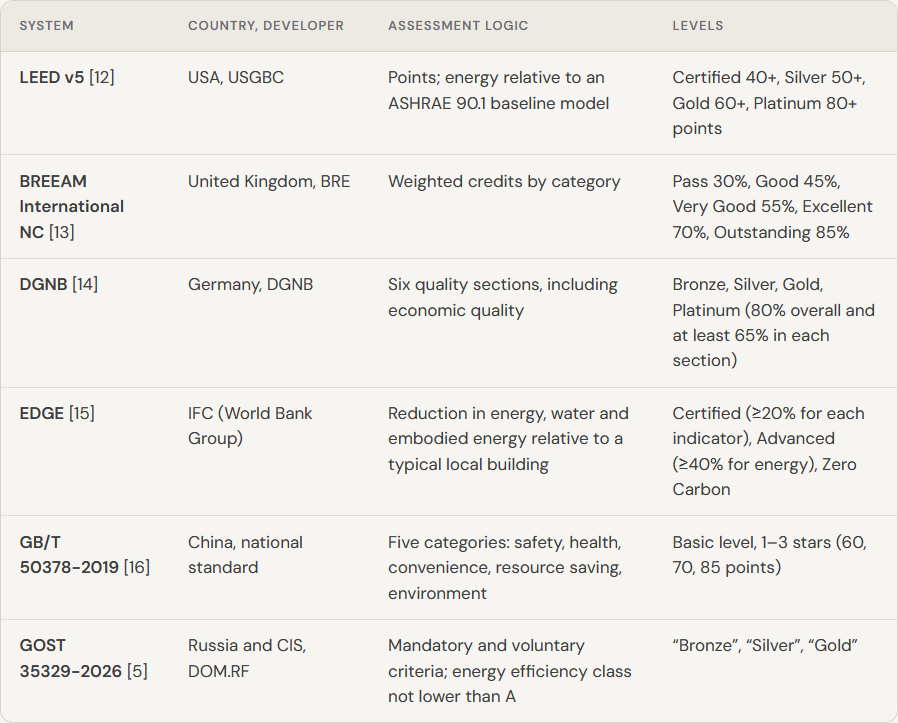
Table 1. Comparison of green building assessment systems
Three differences matter to the developer.
1) Baseline. LEED compares the project with a calculation model based on ASHRAE 90.1, EDGE with a typical building in the same region, and the Russian standard with domestic regulations. The same “30% energy savings” carry different meanings in the two systems and cannot simply be carried over without recalculation.
2) Procedural complexity. EDGE was designed for emerging markets and is calculated in an online app [15]; a small developer finds it easier to work with.
3) The place of economics. DGNB treats economic quality as a separate assessment section [14]. In BREEAM, life cycle cost is addressed by just one of the criteria in the Management category [13].
The Russian standard is closest in structure to LEED and BREEAM but covers only multi-apartment buildings. In GOST 35329-2026, the assessment levels “satisfactory”, “good” and “excellent” have been replaced by “Bronze”, “Silver” and “Gold”, and an energy efficiency class not lower than A has appeared among the requirements [5]. For other types of real estate, the general standard GOST R 54964-2012 remains in force [17].
1) Baseline. LEED compares the project with a calculation model based on ASHRAE 90.1, EDGE with a typical building in the same region, and the Russian standard with domestic regulations. The same “30% energy savings” carry different meanings in the two systems and cannot simply be carried over without recalculation.
2) Procedural complexity. EDGE was designed for emerging markets and is calculated in an online app [15]; a small developer finds it easier to work with.
3) The place of economics. DGNB treats economic quality as a separate assessment section [14]. In BREEAM, life cycle cost is addressed by just one of the criteria in the Management category [13].
The Russian standard is closest in structure to LEED and BREEAM but covers only multi-apartment buildings. In GOST 35329-2026, the assessment levels “satisfactory”, “good” and “excellent” have been replaced by “Bronze”, “Silver” and “Gold”, and an energy efficiency class not lower than A has appeared among the requirements [5]. For other types of real estate, the general standard GOST R 54964-2012 remains in force [17].
3. Water Use and Surface Runoff
Water is a somewhat simpler matter. Investment in the system is small, and the result can be seen in the very first bills. Plumbing fixtures bearing the US WaterSense label use at least 20% less water than conventional ones, with no loss of quality [18].
More significant in scale is the issue of greywater reuse. Water from showers, baths and washbasins accounts for 50–80% of household wastewater, and if, after treatment, it is used for toilet flushing, a household saves up to 30% of its water [19]. The flip side is a separate pipe network and regular filter replacement; in a multi-apartment building these costs can eat up the savings on utility tariffs.
Stormwater runoff is a matter for the site rather than the building. In dense urban development, rainwater drains quickly into the municipal network and overloads it; permeable paving, on-site runoff retention, and green and blue roofs take off part of the load, and relevant criteria are present in all the systems listed in Table 1.
More significant in scale is the issue of greywater reuse. Water from showers, baths and washbasins accounts for 50–80% of household wastewater, and if, after treatment, it is used for toilet flushing, a household saves up to 30% of its water [19]. The flip side is a separate pipe network and regular filter replacement; in a multi-apartment building these costs can eat up the savings on utility tariffs.
Stormwater runoff is a matter for the site rather than the building. In dense urban development, rainwater drains quickly into the municipal network and overloads it; permeable paving, on-site runoff retention, and green and blue roofs take off part of the load, and relevant criteria are present in all the systems listed in Table 1.
4. Engineering Solutions in Housing
CLT structures. In 2022, the 25-storey Ascent residential tower, 86.6 m tall, was completed in Milwaukee; a hybrid of mass timber and a concrete core, it is, according to CTBUH, the tallest timber building in the world [20]. The main argument in favour of CLT is lower embodied carbon [2]. The drawbacks are also well known: cost, limited production capacity (especially in Russia) and stricter fire safety requirements.
Automation (BACS/BMS). Savings percentages quoted in catalogues should be treated with particular caution. Simulation according to the EN ISO 52120-1 method gives a spread of 19 to 71% for heating control, and this spread is explained by building type, glazing ratio and thermal protection [21]. Admittedly, the calculations under this method were made for offices, whereas in a residential building automation mainly controls the common building systems and the heating substation, and the upper bound is far out of reach here.
Heat pumps and solar panels. The story is similar with heat pumps and solar panels. According to the IEA, heat pumps are 3–5 times more efficient than gas boilers [22], but ground-source units involve high costs owing to expensive drilling, while the coefficient of performance of air-source units drops in freezing weather. In the EU, solar systems have effectively become mandatory, since new buildings must be solar-ready [6]. Elsewhere, everything depends on insolation, tariffs and, in a multi-apartment building, the modest roof area per apartment.
Automation (BACS/BMS). Savings percentages quoted in catalogues should be treated with particular caution. Simulation according to the EN ISO 52120-1 method gives a spread of 19 to 71% for heating control, and this spread is explained by building type, glazing ratio and thermal protection [21]. Admittedly, the calculations under this method were made for offices, whereas in a residential building automation mainly controls the common building systems and the heating substation, and the upper bound is far out of reach here.
Heat pumps and solar panels. The story is similar with heat pumps and solar panels. According to the IEA, heat pumps are 3–5 times more efficient than gas boilers [22], but ground-source units involve high costs owing to expensive drilling, while the coefficient of performance of air-source units drops in freezing weather. In the EU, solar systems have effectively become mandatory, since new buildings must be solar-ready [6]. Elsewhere, everything depends on insolation, tariffs and, in a multi-apartment building, the modest roof area per apartment.
Practical takeaway: expensive solutions are best introduced in stages — first a single building section, a year or two of monitoring, then extension to the remaining sections.
5. Economics: What It Costs and What Comes Back
How much does a green building cost?
The source most often cited here is G. Kats’s report for California. For 33 LEED-certified projects, the cost premium averaged no more than 2%, while life-cycle savings proved more than ten times greater [23]. It should be noted that the sample was non-residential and that LEED requirements have risen since then.
On the revenue side, the data are more plentiful and more reliable. Green-labelled offices in the USA rent for about 3% more and sell for 16% more than comparable non-green buildings [24]. In housing the percentages are more modest, but they recur from market to market: in the Netherlands, apartments and houses with A–C energy labels sell at higher prices, and the premium grows with the class [25]; in California, certified homes sell at a premium of about 2–4% [26].
Therefore, what needs to be compared is the difference in capital costs against the discounted savings and the possible price premium for a specific region, housing class and tariffs. By our estimate, façade systems with enhanced thermal protection combined with an individual heating substation and automatic control pay back in about 6–8 years.
The source most often cited here is G. Kats’s report for California. For 33 LEED-certified projects, the cost premium averaged no more than 2%, while life-cycle savings proved more than ten times greater [23]. It should be noted that the sample was non-residential and that LEED requirements have risen since then.
On the revenue side, the data are more plentiful and more reliable. Green-labelled offices in the USA rent for about 3% more and sell for 16% more than comparable non-green buildings [24]. In housing the percentages are more modest, but they recur from market to market: in the Netherlands, apartments and houses with A–C energy labels sell at higher prices, and the premium grows with the class [25]; in California, certified homes sell at a premium of about 2–4% [26].
Therefore, what needs to be compared is the difference in capital costs against the discounted savings and the possible price premium for a specific region, housing class and tariffs. By our estimate, façade systems with enhanced thermal protection combined with an individual heating substation and automatic control pay back in about 6–8 years.
Conclusion
Comparing the six systems leads to a simple observation. Their criteria are largely shared, but their baselines and methodologies differ so much that their figures cannot be compared directly.
For Russia, the picture is a distinct one. After the departure of LEED and BREEAM, housing moved to a national, and as of now an interstate, standard; whether it takes root will be decided by economic performance. The cost increase is moderate and the gain in value is confirmed, but its size depends on the market.
Ultimately, what decides the outcome is the choice of technologies for a specific project and climate. And until real operational data have been accumulated, any payback period remains a calculated one.
For Russia, the picture is a distinct one. After the departure of LEED and BREEAM, housing moved to a national, and as of now an interstate, standard; whether it takes root will be decided by economic performance. The cost increase is moderate and the gain in value is confirmed, but its size depends on the market.
Ultimately, what decides the outcome is the choice of technologies for a specific project and climate. And until real operational data have been accumulated, any payback period remains a calculated one.
Declarations
Funding
This research received no external funding.
Conflict of interest
The author declares no conflict of interest.
Data availability
No new empirical datasets were created within this review. All quantitative values are drawn from the regulatory documents, certification manuals and published studies cited.
Peer review
The manuscript underwent Double-Anonymous Peer Review by at least two independent subject-matter reviewers in accordance with the current editorial policy of IAE Review. The author is not affiliated with the journal's editorial office or publisher; the final publication decision was made by the editorial office.
References
- Global Status Report for Buildings and Construction 2025–2026 / UNEP, GlobalABC. — Nairobi, 2026. — URL: unep.org.
- Bringing Embodied Carbon Upfront / World Green Building Council. — London, 2019. — URL: worldgbc.org.
- “Green” construction. How Russia is fitting into the global trend // N + 1. — 2023. — 11 Dec. — URL: nplus1.ru. (In Russ.)
- GOST R 70346-2022. “Green” standards. “Green” multi-apartment residential buildings. Assessment methodology and criteria for design, construction and operation. — Introduced 2022-11-01. (In Russ.)
- GOST 35329-2026. “Green” standards. “Green” multi-apartment residential buildings. Assessment methodology and criteria for design, construction and operation. — Introduced 2026-07-01. (In Russ.)
- Directive (EU) 2024/1275 of the European Parliament and of the Council of 24 April 2024 on the energy performance of buildings (recast) // Official Journal of the European Union. — 2024. — L 2024/1275.
- The Commission calls on EU countries to transpose the reinforced rules on the energy performance of buildings / European Commission. — 2026. — 15 July. — URL: energy.ec.europa.eu.
- On approval of the Rules for establishing energy efficiency requirements for buildings, structures and facilities and requirements for the rules for determining the energy efficiency class of multi-apartment buildings : Decree of the Government of the Russian Federation of 27.09.2021 No. 1628. (In Russ.)
- On approval of the Energy Efficiency Requirements for Buildings, Structures and Facilities : Order of the Ministry of Construction of Russia of 17.11.2017 No. 1550/pr. (In Russ.)
- SP 50.13330.2024. Thermal protection of buildings. Updated version of SNiP 23-02-2003 : approved by Order of the Ministry of Construction of Russia of 15.05.2024 No. 327/pr. (In Russ.)
- ANSI/ASHRAE/IES Standard 90.1-2022. Energy Standard for Sites and Buildings Except Low-Rise Residential Buildings. — Atlanta : ASHRAE, 2022.
- LEED v5 Reference Guide. Building Design and Construction / U.S. Green Building Council. — Washington, 2025.
- BREEAM International New Construction Version 6. Technical Manual SD250 / BRE Global. — Watford, 2021.
- DGNB System: Assessment and award / German Sustainable Building Council. — URL: dgnb.de.
- EDGE Certification / IFC, GBCI. — URL: edgebuildings.com.
- GB/T 50378-2019. Assessment standard for green building. — Beijing, 2019.
- GOST R 54964-2012. Conformity assessment. Environmental requirements for real estate objects. (In Russ.)
- About WaterSense / U.S. Environmental Protection Agency. — URL: epa.gov.
- Greywater reuse as a key enabler for improving urban wastewater management / A. Van de Walle, M. Kim, M. K. Alam [et al.] // Environmental Science and Ecotechnology. — 2023. — Vol. 16. — Art. 100277. — DOI: 10.1016/j.ese.2023.100277.
- Council on Tall Buildings Declares Milwaukee’s Ascent as the World’s Tallest Timber High-Rise // Engineering News-Record. — 2022. — URL: enr.com.
- Vandenbogaerde L., Audenaert A., Verbeke S. Assessing energy-saving potential of building automation and control systems: contrasting the application of EN ISO 52120-1 with advanced numerical simulations // Energy Efficiency. — 2026. — Vol. 19. — Art. 7.
- The Future of Heat Pumps / International Energy Agency. — Paris : IEA, 2022.
- Kats G. The Costs and Financial Benefits of Green Buildings : A Report to California’s Sustainable Building Task Force. — 2003.
- Eichholtz P., Kok N., Quigley J. M. Doing Well by Doing Good? Green Office Buildings // American Economic Review. — 2010. — Vol. 100, No. 5. — P. 2492–2509.
- Brounen D., Kok N. On the economics of energy labels in the housing market // Journal of Environmental Economics and Management. — 2011. — Vol. 62, No. 2. — P. 166–179.
- Kahn M. E., Kok N. The capitalization of green labels in the California housing market // Regional Science and Urban Economics. — 2014. — Vol. 47. — P. 25–34.
Article history
PUBLISHED
October 2, 2026 · online
October 2, 2026 · online
About the author
Chief Project Engineer, Smart Construction LLC (Moscow) · data center and residential design · Author ID: IAE-2026-00011
Google Scholar profile
Google Scholar profile


Article details
ARTICLE ID
IAE-2026-GRB-001
IAE-2026-GRB-001
DOI
Pending registration · Crossref, DOI Prefix 10.68034
Pending registration · Crossref, DOI Prefix 10.68034
JOURNAL
IAE Review · Continuous Publication
IAE Review · Continuous Publication
PUBLICATION YEAR
2026
2026
ARTICLE TYPE
Review article
Review article
PUBLISHER
International Association of Experts, Inc.
International Association of Experts, Inc.
LANGUAGE OF THIS VERSION
English · Version of Record
English · Version of Record
VERSION STATUS
Version of Record (this page) · official Russian translation
Version of Record (this page) · official Russian translation
LICENSE
CC BY 4.0
CC BY 4.0
PEER REVIEW
Double-Anonymous · at least two independent reviewers
Double-Anonymous · at least two independent reviewers


Cite this article
© 2026 International Association of Experts (IAE). All rights reserved.
Miami, Florida, USA · iaexperts.com