
Expert report review
The opposing audio report rests on a compressed file from a messaging app or a phone: what does a reviewer check?
Most recordings in disputes today reach the examiner as compressed files: voice messages, call recordings, memos made on a phone. Compression discards part of the signal, and every new encoding changes the file. SWGDE says a transcoded version is not an original recording. A review of the other side's audio report asks which file was examined, what the codec removed and whether the conclusions survive those limits.
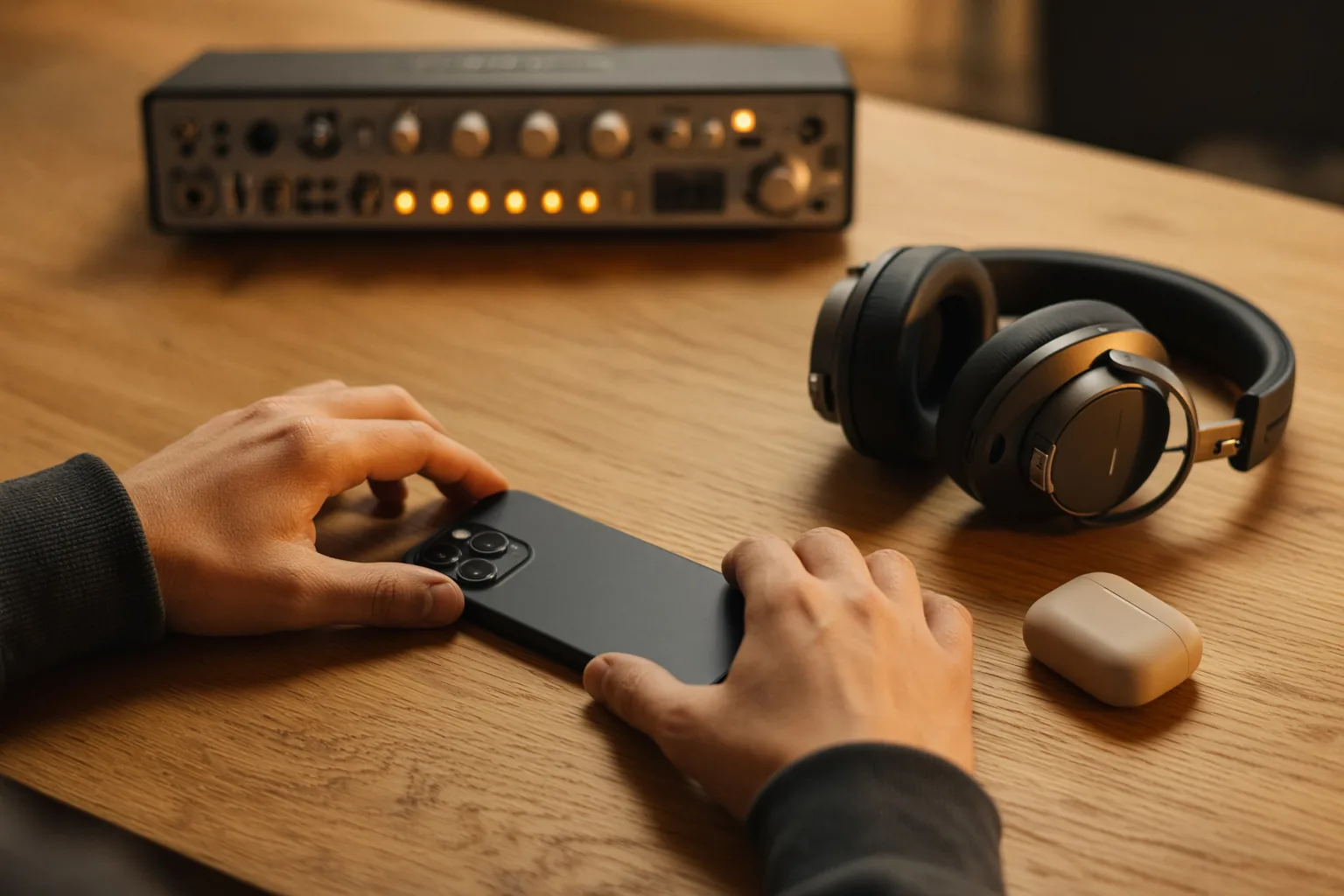
Why does compression matter in a forensic audio report?
Lossy codecs keep the part of the signal a listener needs and discard the rest. The measurements an examiner relies on, and the traces of editing, live partly in what is discarded or rewritten.
A phone that records a voice memo, a messaging app that sends a voice note and a service that stores a call all encode the sound to save space. Each codec decides which frequencies, which quiet passages and which fine details to keep. The decoded sound is a reconstruction.
The Opus codec, defined by the IETF in RFC 6716, is a published example. It combines a speech layer based on SILK with a music layer based on CELT. Its narrowband mode codes audio up to 4 kHz, and the standard states that Opus never codes audio above 20 kHz.
For an examiner, the questions are practical. Which frequency band survived? Were silent passages coded at all? Did the file pass through more than one encoder before it reached the lab? The answers set the limits of every later measurement.
Which file did the opposing examiner actually examine?
The report should identify the file by name, size, format, codec and hash value, and say where it came from. SWGDE says a transcoded or re-encoded version of an original recording is not an original recording.
The SWGDE Best Practices for Digital Audio Authentication state: "Transcoded or re-encoded versions of an original recording are not original recordings." After decoding, "file format analysis regarding the original format becomes impossible." For open file formats SWGDE says it "should be mandatory to supply the purportedly original file."
The file in an opposing report can be an export: a voice note saved out of a chat, a recording emailed to counsel, a clip cut for a filing. Each step may re-encode the sound or rewrite the metadata. A reviewer traces each step between the device and the examiner's workstation.
Rule 26(a)(2)(B)(ii) of the Federal Rules of Civil Procedure requires a retained expert's report to list "the facts or data considered by the witness in forming" the opinions. The identity of the file examined is part of those facts or data, and a report that does not pin it down gives the reviewer the first point.
What happens to a voice note when it passes through a messaging app?
The app encodes the sound and writes its own file structure. Researchers who sent hundreds of files through WhatsApp detected a model of the audio compression the app applied to transmitted audio.
Risemberg, Grigoras and Smith presented their WhatsApp study at the American Academy of Forensic Sciences meeting in 2021. They built a dataset of hundreds of image and audio files, sent and downloaded through different methods and devices, and analyzed the hex data of the transmitted audio. For audio, "a model of the audio compression applied by WhatsApp was detected."
The purpose of that work was source identification: telling from the file how it was created and transmitted. The same traces matter in a dispute. If the opposing report describes a file as an original phone recording while its structure matches a file transmitted through an app, the description is wrong.
A voice note forwarded several times may pass through the same encoder again. The SWGDE Best Practices for Forensic Audio warn that re-encoding may introduce audible artifacts. The opposing report should say how many generations of the file the examiner could identify.
Can a compressed file be checked for editing at all?
Yes, with methods built for compressed formats, such as analysis of the encoding structure and the compression level. The report should say which methods were used and what each one can and cannot detect.
Grigoras and Smith described in 2019 a framework for AAC files from Apple iPhone Voice Memo recordings. It combines frequency analysis, MDCT analysis, long term average sorted spectrum and compression level analysis, and it reports results as likelihood ratios and error rates. The reference database covered AAC, AC3, MP3, OGG and WMA samples from more than 100 mobile phones collected over five years.
The framework was designed to check whether an AAC file "is consistent with an original or edited Apple iPhone Voice Memo.M4A recording" and to discriminate between MDCT and upsampling artifacts. The authors described the work as preliminary.
SWGDE notes that "some compressed audio files exhibit sample-to-sample correlation in the form of periodicity," and that the global average DC offset alone "is not typically enough for a conclusive examination." A report that rests on one such test, on a compressed file, conflicts with the SWGDE statement that no single analysis shall be relied upon solely.
Does compression affect a voice comparison?
It can. The codec limits the frequency band and alters fine detail. A report comparing a compressed questioned recording with high quality exemplars should explain how it dealt with the mismatch.
Cenceschi, Meluzzi and Trivilini tested listeners in 2021 with recordings of one speaker made through a high quality microphone, as WhatsApp audio messages and as phone calls recorded by an app. Among 426 respondents, same-speaker identification was 83.9% for spontaneous speech and 68.1% for read speech when the audio quality differed.
The authors also found that "self-declared experts in audio analysis or transcriptions behave similarly to lay speakers." The study is perceptual and involves one female speaker, so it says nothing about acoustic measurement error; it does show that a change of channel alone changed how listeners judged the same voice.
When the questioned recording is a voice note and the exemplars are studio recordings, the reviewer checks whether the examiner made comparable exemplars: recorded or passed through the same channel, at the same settings. SWGDE describes exemplar recordings from the evidence recorder or from test recorders of the same manufacturer and model.
Did the examiner's own processing add another layer of compression?
SWGDE advises a bit-stream duplicate as the working copy, conversion to uncompressed formats such as PCM where possible, and documentation of every conversion. Re-encoding and resampling should be avoided.
The SWGDE Best Practices for Forensic Audio say: "To preserve the integrity of a digital original, make a bit stream duplicate to use as a working copy." They advise to "Convert to or between uncompressed formats (e.g., PCM) whenever possible" and warn that "Re-encoding and resampling should be avoided due to the possible introduction of audible artifacts."
The same document lists what to record: the codec, the file format, the format conversions, the sampling rate and the bit depth. It adds that the anti-aliasing filter used when resampling and its settings should be documented. If a compressed output format is requested, "it should be noted in the documentation."
A reviewer compares the opposing examiner's workflow with that list. An enhanced clip exported as MP3 and then measured is a different object from the evidence file, and the report must say which of them each figure comes from.
Can compression explain a gap or a change in background noise?
It can explain some. Opus with discontinuous transmission encodes one frame every 400 milliseconds during silence or background noise. A reviewer checks whether the report considered codec behavior before calling a change a splice.
RFC 6716 describes discontinuous transmission, or DTX, which lowers the bitrate during silence or background noise. The standard states: "When DTX is enabled, only one frame is encoded every 400 milliseconds." A change in background noise during a pause is therefore a point where the examiner has to rule out codec behavior.
Opus encodes frames of 2.5, 5, 10, 20, 40 or 60 ms and can combine frames into packets of up to 120 ms. It also has forward error correction and packet loss concealment for networks that drop packets. In a call recorded over a network that dropped packets, the decoder may have concealed some of the losses.
None of this means a disputed gap is innocent. It means the examiner must rule out codec behavior and transmission loss with tests, and the report must describe those tests. SWGDE warns that language implying 100% certainty should be avoided unless the examiner speaks about known alterations or deletions.
Why should the report state the codec, bitrate and sampling rate?
Because they set what the file can contain. A narrowband voice note at a low bitrate holds less of the voice than a fullband recording, and a file coded in narrowband holds no audio above 4 kHz to measure.
RFC 6716 lists five audio bandwidths for Opus: narrowband up to 4 kHz, medium-band up to 6 kHz, wideband up to 8 kHz, super-wideband up to 12 kHz and fullband up to 20 kHz. The lowest bitrate in the standard is 6 kbit/s, for narrowband mono speech, and the highest is 510 kbit/s, for fullband stereo music.
An opinion about features in a band the codec removed has no data behind it. The reviewer reads the file header or container, compares it with the measurements in the report and lists any measurement that falls outside the coded band.
SWGDE also says the choice of metadata application "should be based on testing with known data prior to use in cases." A report that relies on a metadata tool should name it and its version, so that the reading can be repeated.
How do these points fit a Rule 702 challenge?
Rule 702 requires sufficient facts or data, a reliable method and a reliable application to the case. An unidentified file, an untested method for compressed audio or measurements outside the coded band each go to one of those conditions.
Since the amendment effective December 1, 2023, Rule 702 requires the proponent to show the court that it is more likely than not that the testimony is based on sufficient facts or data, is the product of reliable principles and methods, and applies them reliably to the facts of the case.
Each point of the review is tied to one condition. A report about "the recording" that examined a forwarded copy goes to sufficient facts or data. A splice finding that ignores DTX goes to reliable application. A voice comparison with mismatched channels goes to the method as applied.
The committee note to the 2023 amendment warns that forensic experts should avoid assertions of absolute or one hundred percent certainty when the method is subjective and potentially subject to error. The same note says each expert opinion must stay within the bounds of what can be concluded from a reliable application of the expert's basis and methodology.
What should a client send for a review of a report based on a compressed file?
The opposing report, the file the examiner received if it was produced, the original device or the original file as stored on it, and a description of every transfer of the file before it reached the examiner.
The reviewer needs the same file the opposing examiner had, and if possible the earlier generations of it: the copy on the phone, the copy in the app's storage, the export sent to counsel. Comparing their hash values and structures reveals where the file changed.
If the original device is available, test recordings can be made on it or on a device of the same make and model, at the settings the app used. Those exemplars show what an unedited file from that path looks like.
Rule 26(a)(2)(D)(ii) sets 30 days after the other party's disclosure for a report intended solely to rebut it, absent a stipulation or court order. A review that starts on the day the opposing report arrives leaves time for a request for the file.
What does IAE do when the opposing audio report rests on a compressed file?
An IAE examiner reviews the opposing audio report: which file was received, which tests were run and documented, whether the exemplars were comparable and whether the conclusion stays within the method. Up to 5 business days.
The IAE review of the opposing forensic audio report is for a party facing the other side's examiner on whether a recording was edited, whose voice is on it or what was said. The reviewer checks which file the examiner received, which tests were run and documented, whether the voice exemplars were comparable and whether the conclusion stays within the method. Each point in the review is tied to a page of the opposing report and to a rule, a standard or a published study.
The document can take the form of a review of the opposing report, a rebuttal report or a statement of grounds for a Rule 702 motion. The client sends the opposing report and the case materials and describes what to check. The secretariat confirms receipt the same day, and within one business day IAE confirms the format, the cost, the deadline and the specialist from its registry. The client approves the candidate and the CV before work starts. The signed PDF is issued in up to 5 business days after the format and cost are confirmed, and a 48-hour rush is available for tight deadlines.
Specialists are members of the public IAE registry, and the Member ID or QR code in the document opens the specialist's record. The specialist confirms in the document that he or she has no interest in the outcome. A review is evidence the court weighs with the other materials; neither IAE nor the reviewer guarantees the outcome, and IAE is not a law firm.
Sources
- RFC 6716, Definition of the Opus Audio Codec (IETF, September 2012)
- SWGDE Best Practices for Digital Audio Authentication, Version 1.3 (September 20, 2018)
- SWGDE Best Practices for Forensic Audio, Version 2.5 (June 9, 2022)
- Risemberg H. L., Grigoras C., Smith J. M., File Structure Analysis of Media Files Transmitted and Received Over WhatsApp, AAFS Proceedings 2021, C29
- Grigoras C., Smith J. M., Forensic Audio Analysis of Apple iPhone Voice Memo Recordings, AAFS Proceedings 2019, C18
- Cenceschi S., Meluzzi C., Trivilini A., Audio compression and speaker's discrimination: perspectives for forensic phonetics in the Italian setting, Indagatio Didactica 13(5), 2021
- Federal Rules of Evidence, Rule 702, Testimony by Expert Witnesses, with Committee Notes (LII)
- Federal Rules of Civil Procedure, Rule 26, Duty to Disclose; General Provisions Governing Discovery (LII)
- Rule 702 as amended, effective in the Federal Rules of Evidence on December 1, 2023 (U.S. Court of Appeals for the Armed Forces, conference handout, PDF)
Read also
All articles
ShotSpotter evidence: is it admissible, and how does a reviewer test the other side's acoustic gunshot report?
An acoustic gunshot report tells the jury how many shots were fired, when and where, on the basis of sound picked up by sensors. Courts have admitted Sergei Voronin
Was the opposing audio examiner told what to find, and how does a reviewer check for contextual bias?
An audio examiner who knows that the suspect confessed, or that other evidence points to him, is working with information that the examination doesSergei Voronin
The other side says the voice on the recording is yours: how do you challenge the identification?
When the other side offers a recording and says the voice on it is yours, it has to authenticate that claim under Federal Rule of Evidence 901Sergei VoroninExpert report review
Ready to discuss your case?
Send the materials: the secretariat will confirm the format, cost, deadline and the specialist within one business day.
