
Examinations
Surgical item left inside a patient: when is negligence presumed, and what does the medical expert still have to prove?
A sponge, needle or clamp found inside a patient after surgery is one of the few malpractice events where the law begins on the patient's side. Florida treats the discovery as prima facie evidence of negligence, and New York lets a jury infer negligence without expert testimony. The inference does not finish the case. Someone still has to prove which operation left the object, what harm it caused and when the patient could have found it.
What counts as a retained surgical item?
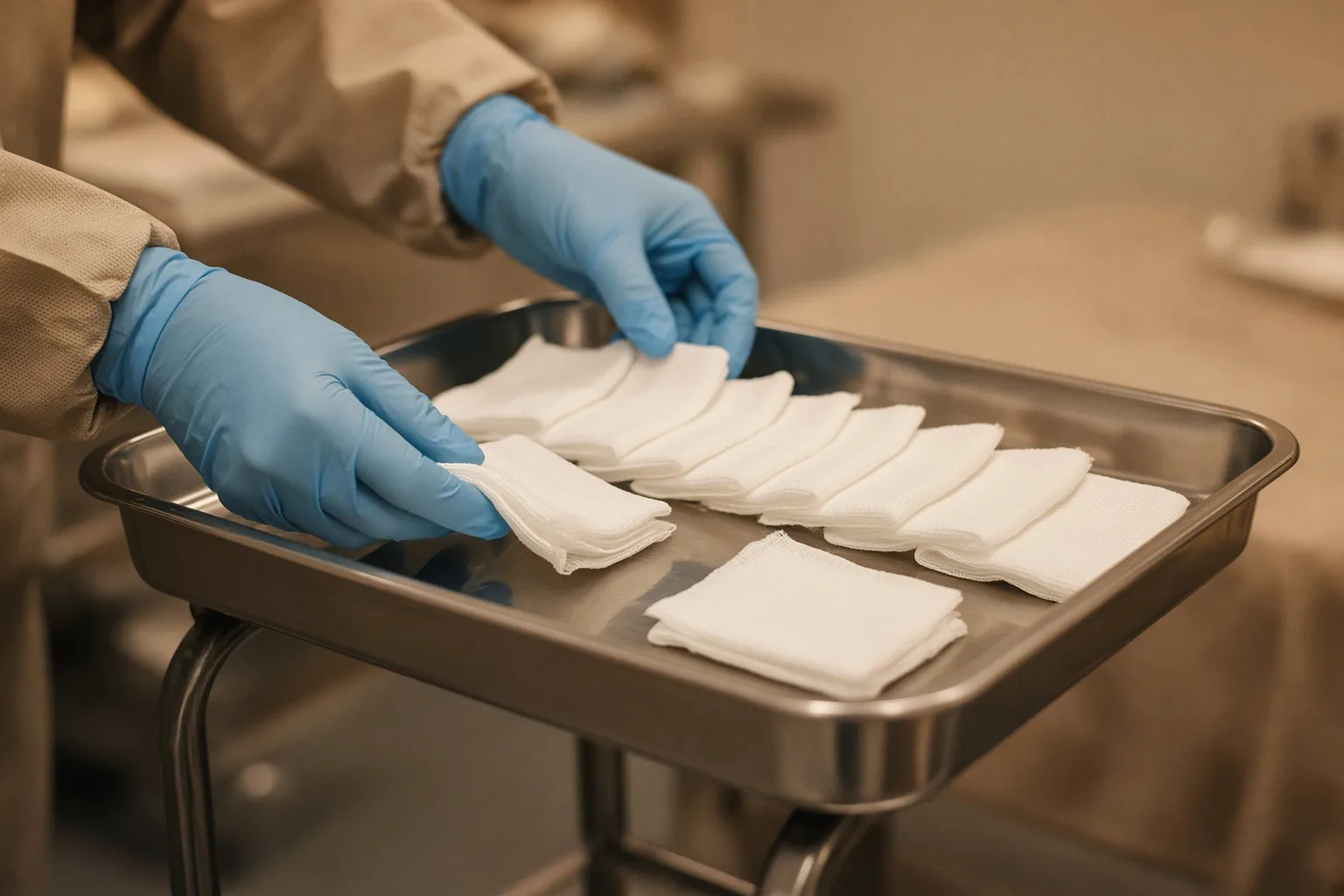
An object used during a procedure and unintentionally left in the body. The Joint Commission groups such objects into soft goods like sponges and towels, small device fragments, needles and other sharps, and instruments.
The Joint Commission calls the event an unintended retained foreign object and issued Sentinel Event Alert 51 about it on October 17, 2013. Its sentinel event database received 772 reports of such incidents in the years 2005 through 2012. Sixteen patients died. About 95 percent of the incidents led to additional care, an extended hospital stay or both.
The alert sorts the objects into four groups. Soft goods such as sponges and towels come first. The second group is small miscellaneous items: device fragments, stapler components, parts of trocars, guidewires, catheters and pieces of drains. Needles and other sharps are the third. Instruments are the fourth, and the instrument the alert names as left behind more often than others is the malleable retractor.
The alert also says how these objects are most commonly detected: immediately after the procedure, by X-ray, during routine follow-up visits or from the patient's report of pain or discomfort. In the New York case discussed below, a pad left during an August operation was found in December.
Is leaving a sponge or instrument inside a patient automatically negligence?
In Florida the discovery of a foreign body such as a sponge, clamp, forceps or surgical needle is prima facie evidence of negligence under section 766.102(3)(b). New York reaches a similar result through res ipsa loquitur.
Florida starts with the ordinary rule. Under section 766.102(1) the claimant must prove by the greater weight of evidence that the provider's actions breached the prevailing professional standard of care, defined as the level of care, skill and treatment recognized as acceptable and appropriate by reasonably prudent similar health care providers. Paragraph (3)(b) adds that "the existence of a medical injury does not create any inference or presumption of negligence against a health care provider."
The same paragraph then carves out one event. The discovery of the presence of a foreign body, "such as a sponge, clamp, forceps, surgical needle, or other paraphernalia commonly used in surgical, examination, or diagnostic procedures, shall be prima facie evidence of negligence on the part of the health care provider."
The wording is prima facie evidence. The statute does not say that the provider is liable, and the same paragraph keeps on the claimant the burden of proving that an injury was proximately caused by a breach of the standard of care. The retained object opens the case for the patient. The injury and its link to the object still have to be proved.
How does res ipsa loquitur apply when an object is left inside?
A jury may infer negligence if the event ordinarily does not occur without negligence, the instrumentality was in the defendant's exclusive control and the patient did not contribute. New York's highest court applied it in Kambat (1997).
The facts of Kambat, 89 N.Y.2d 489, were these. In August 1986 a surgeon performed an abdominal hysterectomy at St. Francis Hospital while the patient was unconscious. On December 5, 1986 an 18-by-18-inch laparotomy pad was found fully or partially inside her bowel and removed. She died on December 29, 1986 of infection-related illnesses, and her husband and children sued the surgeon and the hospital.
The defense said the staff followed standard procedures and counted the pads accurately, and argued that the patient had swallowed the pad. The trial court refused to instruct the jury on res ipsa loquitur, the jury found for the defendants and the Appellate Division affirmed with two Justices dissenting. On February 13, 1997 the Court of Appeals reversed and ordered a new trial.
Chief Judge Kaye's opinion states the three conditions. "First, the event must be of a kind that ordinarily does not occur in the absence of someone's negligence; second, it must be caused by an agency or instrumentality within the exclusive control of the defendant; and third, it must not have been due to any voluntary action or contribution on the part of the plaintiff." The plaintiffs' evidence that laparotomy pads are not accessible to patients supported the second and third conditions. The defendants' competing account did not remove the doctrine from the case. In the court's words it "merely raised alternative inferences to be evaluated by the jury," and the plaintiffs "were not obligated to eliminate every alternative explanation for the event."
Texas limits the doctrine by statute. Section 74.201 of the Civil Practice and Remedies Code provides that res ipsa loquitur applies to health care liability claims only in the categories of cases to which Texas appellate courts had applied it as of August 29, 1977.
Is a medical expert still needed when the object speaks for itself?
Often yes. In Kambat a lay jury needed no expert to infer negligence from the pad, but that inference covers the breach. Which operation left the object, what it damaged and what the defense's explanation is worth are medical questions.
On the first condition the Court of Appeals was direct: "Manifestly, the lay jury here did not require expert testimony" to conclude that an 18-by-18-inch pad is not ordinarily found inside a patient after a hysterectomy unless someone was negligent. The opinion quotes Prosser and Keeton on an operation that leaves a sponge or implement in the patient: "the thing speaks for itself without the aid of any expert's advice." The court left open whether the doctrine applies where experts are needed to establish that first condition.
The physician's work begins after that. Where the patient has had more than one operation in the same part of the body, someone has to read the operative reports and the imaging in date order and say which procedure used the kind of item that was removed. The removed object, the pathology report and the surgeon's note from the removal are the starting material.
Causation comes next. The expert separates what the object caused, such as an infection, an obstruction or a second operation, and what the underlying disease caused. In Florida the claimant keeps the burden of proving that the injury was proximately caused by the breach even when the foreign body supplies prima facie evidence of negligence.
In federal court the opinion has to pass Rule 702. The proponent must show that it is more likely than not that the testimony is based on sufficient facts or data, is the product of reliable principles and methods, and applies those principles and methods reliably to the facts of the case.
Who is responsible when the count was recorded as correct?
A correct count on paper does not end the inquiry. The Joint Commission reported that 80 percent of retained sponges occur with what staff believe is a correct count, and that sponge counting has a 10-15 percent error rate.
Sentinel Event Alert 51 describes cavity sweeps and manual counts as "prone to human error." It recommends a standardized counting system in which two people count audibly and visibly and the surgeon verbally verifies the result. Among the root causes in the sentinel event data the alert lists the absence of policies and procedures, failure to comply with existing ones, problems with hierarchy and intimidation, failures in communication with physicians and inadequate education of staff.
The defense in Kambat rested on accurate counts and standard procedure, and the Court of Appeals still held that the jury could infer negligence. The surgeon and the hospital were both defendants.
For the reviewing physician this turns into a document comparison. The count sheets, the intraoperative nursing record and the operative report are read against the hospital's own counting policy: who counted, at which points of the operation, whether a discrepancy was called out and whether an X-ray was taken before the patient left the room. Federal conditions of participation require the operative report to be written or dictated immediately following surgery, to be signed by the surgeon and to describe "techniques, findings, and tissues removed or altered" (42 CFR 482.51). The operating room register must be complete and up to date.
How long does a patient have to sue after the object is found?
New York gives one year after discovery of the object or of facts that would reasonably lead to discovery, whichever is earlier. California lifts its three-year outer limit for a foreign body with no therapeutic or diagnostic purpose.
New York's CPLR 214-a sets the general period for medical, dental and podiatric malpractice at two years and six months after the act or omission, or after the last treatment where there was continuous treatment for the same condition. For a foreign object left in the body the action may be commenced within one year of the date of discovery, or of the date of discovery of facts which would reasonably lead to such discovery, whichever is earlier.
California's Code of Civil Procedure section 340.5 gives three years after the date of injury or one year after the plaintiff discovers, or reasonably should have discovered, the injury, whichever occurs first. The statute adds that in no event shall the time exceed three years unless it is tolled on one of three grounds: proof of fraud, intentional concealment, or the presence of a foreign body which has no therapeutic or diagnostic purpose or effect in the person of the injured person.
Both statutes make the discovery date a fact to be proved. The record supplies the dates: the first imaging report that mentions an unexpected object, the day the patient was told and the complaints that came before. A physician reading the chart can say when the symptoms were such that imaging would have been ordered.
What if the object was an implant or was left in on purpose?
Then the foreign object rules may not apply. New York excludes chemical compounds, fixation devices and prosthetic aids or devices from the term, and California's tolling covers only a foreign body with no therapeutic or diagnostic purpose or effect.
CPLR 214-a states that the term foreign object "shall not include a chemical compound, fixation device or prosthetic aid or device." A claim about a fixation device or a prosthesis therefore falls outside the one-year discovery rule. Florida's presumption refers to items "commonly used in surgical, examination, or diagnostic procedures," and its listed examples are a sponge, a clamp, forceps and a surgical needle.
The medical question is what the object was for. It may be a device placed to remain, an item meant to be taken out at a later date or an item that had no function once the wound was closed. The operative report and the implant records answer that question, and a claim about a device placed on purpose falls under the general rule. In Florida that is section 766.102(1): the claimant proves a breach of the prevailing professional standard of care by the greater weight of evidence.
Does Medicare pay the hospital more when it treats a retained object?
No. Foreign object retained after surgery is the first of 14 hospital-acquired condition categories listed by CMS. Since October 1, 2008 a case where the object was not present on admission is paid as though that diagnosis were absent.
Section 5001(c) of the Deficit Reduction Act of 2005 required the Secretary of Health and Human Services to identify conditions that, among other criteria, result in assignment of a case to a DRG with a higher payment when present as a secondary diagnosis. For discharges occurring on or after October 1, 2008 a hospital receives no additional payment for a case in which one of the selected conditions was not present on admission. CMS explains the effect: the case is paid as though the secondary diagnosis were not present.
A patient's lawyer may want to use that determination as proof. In Florida the statute closes the door. Section 766.102(3)(b) provides that records, policies or testimony of an insurer's reimbursement policies or reimbursement determination regarding the care provided to the plaintiff are not admissible as evidence in a medical negligence action, and subparagraph (3)(a)1. defines an insurer to include the Centers for Medicare and Medicaid Services.
Which records does the medical expert need in a retained object case?
The operative report and count sheets from the first operation, the intraoperative nursing record, every imaging study with its report, the operative and pathology reports from the removal, and the notes and bills for the treatment in between.
The hospital's counting policy in force on the day of surgery belongs in the same set, because the count sheets are read against it. So do the records of any other operation in the same part of the body, since the defense may point to another surgeon.
A patient obtains the chart through the HIPAA right of access. A covered entity must act on a request no later than 30 days after receipt and may extend the time once by no more than 30 days with a written explanation (45 CFR 164.524(b)(2)). The right does not reach information compiled in reasonable anticipation of, or for use in, a civil, criminal or administrative action or proceeding (164.524(a)(1)).
What does IAE do in a retained surgical item case?
A physician in the relevant specialty from the IAE registry writes an expert report on the client's questions or a review of the opposing expert's report. Delivery takes up to 5 business days after the format and cost are confirmed.
The IAE medical expert report page covers standard of care, causation and the medical record in malpractice, wrongful death and personal injury cases. The physician builds a timeline from orders, vital signs, nursing notes and imaging, then compares each decision with the specialty's guidelines in force at the time of care, and checks the record set for missing notes and gaps in orders. The questions are framed from the chart, the operative notes and the opposing expert's report.
The client sends the records listed above and, where there is one, the opposing expert's report, and describes the task. The secretariat confirms receipt the same day. Within one business day IAE confirms the format, the cost, the deadline and the specialist from its registry, and the client approves the candidate and the CV before work starts. Cases with tight deadlines have a 48-hour rush.
Every specialist is a member of the public IAE registry, can be verified by Member ID or QR code and confirms in the document that he or she has no interest in the outcome. Materials are not passed to third parties without the client's consent. A report is evidence that the court weighs with the other materials. Neither IAE nor the physician guarantees the outcome, and IAE is not a law firm and does not advise on case strategy.
Sources
- Florida Statutes 2026, section 766.102, Medical negligence; standards of recovery; expert witness (The Florida Senate)
- Kambat v. St. Francis Hospital, 89 N.Y.2d 489 (N.Y. Feb. 13, 1997) (LII, Cornell Law School)
- New York Civil Practice Law and Rules section 214-a, Action for medical, dental or podiatric malpractice (New York State Senate)
- California Code of Civil Procedure section 340.5 (california.public.law)
- Texas Civil Practice and Remedies Code section 74.201, Application of Res Ipsa Loquitur (Texas.Public.Law)
- The Joint Commission, Sentinel Event Alert 51: Preventing unintended retained foreign objects, October 17, 2013
- Centers for Medicare and Medicaid Services, Hospital-Acquired Conditions
- 42 CFR 482.51, Condition of participation: Surgical services (LII, Cornell Law School)
- 45 CFR 164.524, Access of individuals to protected health information (LII, Cornell Law School)
- Federal Rule of Evidence 702 and committee notes (LII, Cornell Law School)
Read also
All articles

Lack of informed consent lawsuit: what does the medical expert have to prove?
A patient can sue when a doctor performed a procedure without disclosing a risk that later caused harm, even if the procedure itself was done well Sergei Voronin

Telemedicine malpractice: what standard of care applies to a virtual visit?
A video or app visit is judged by the same yardstick as an office visit. Florida's telehealth statute requires the remote provider to meetSergei Voronin
Plastic surgery malpractice: when is a bad result negligence?
A disappointing result after cosmetic surgery is not negligence by itself: the patient shows, through a surgeon's testimony, that the techniqueSergei VoroninExpert examinations
Ready to discuss your case?
Send the materials: the secretariat will confirm the format, cost, deadline and the specialist within one business day.
