
Expert report review
Common errors in accident reconstruction reports: what does a reviewer look for?
Reviews of accident reconstruction reports find the same defects again and again: inputs assumed instead of measured, a perception-reaction time taken from averages, calculations that appear only at deposition, tests run under conditions unlike the crash, and opinions on fault. Federal Rule of Evidence 702 requires sufficient facts or data and a reliable application of the method, and courts have excluded or limited reports on each of these grounds.
Which errors do reviewers find most often in reconstruction reports?
Assumed inputs, reaction times taken from averages, missing calculations, tests unlike the crash, damage opinions without matching documents and opinions on fault. Each one maps to a condition of Rule 702.
Rule 702 admits an expert opinion only if the proponent shows the court that it is more likely than not that the testimony "is based on sufficient facts or data," that it "is the product of reliable principles and methods," and that the opinion applies those principles and methods reliably to the facts of the case. The 2023 amendment took effect on December 1, 2023. Its committee note says that rulings treating the sufficiency of the basis and the application of the method as questions of weight "are an incorrect application of Rules 702 and 104(a)."
The 2000 committee note lists further questions a court may ask. Has the expert "adequately accounted for obvious alternative explanations"? Is there "too great an analytical gap between the data and the opinion proffered"? Has the expert reached "an unfounded conclusion" through an unjustified extrapolation? A reconstruction review puts these questions to every figure in the report.
The sections below take the defects one at a time. For each there is a court ruling that turned on it, so counsel can see how the point has been argued and decided.
Are the inputs measured, or assumed?
A reviewer traces every value to a measurement or a document. The Supreme Court of Virginia ordered a new trial where the expert's figures rested on assumptions about the driver that had no factual basis in the record.
In Keesee v. Donigan, Record No. 990181 (Va., January 14, 2000), Justice Barbara Milano Keenan wrote that "expert testimony is inadmissible if it is founded on assumptions that have an insufficient factual basis." The assumption in that case concerned the driver's perception and reaction, discussed in the next section.
Albert G. Stoll Jr. described a different set of assumed inputs in Plaintiff magazine (May 2015), using the Solis case, a collision between a left-turning bus and a pedestrian. The reconstructionist took no on-scene measurements of the final positions of the bus and the plaintiff relative to the crosswalk and assumed that the photographs showed where the bus and the plaintiff came to rest, although where the bus stopped depended in part on the driver. He used an assumed friction figure for the wet street and relied on a speedometer with no showing that it was accurate.
The reviewer builds a table for the opposing report. Each row holds one value, its source, whether it was measured or assumed, and what happens to the result when the assumed value moves within a plausible range. Values without a source in the record and values that change the conclusion when they move go first in the review.
Is the perception-reaction time tied to this driver?
It has to be. In Keesee v. Donigan an expert put the driver into an "average" category of 1.5 seconds without testing him, and the Supreme Court of Virginia held that the testimony lacked an adequate factual basis.
In Keesee the defense expert, accident reconstructionist Stephen B. Chewning, testified that a driver needs about 0.75 seconds to perceive a hazard and another 0.75 seconds to react, 1.5 seconds in total, with individual variation of up to 0.4 seconds. He calculated that a vehicle at 35 mph covers 51.3 feet per second. He had not tested the driver's vision, physical condition or cognitive abilities. Asked whether he had tested the driver's perception time, he answered: "No, I've put him into an average category."
Defense counsel used the 1.5-second figure in closing to argue that the driver had no time to avoid the collision. The court held that, without evidence placing this driver's physical and mental characteristics within the average range, the testimony had no adequate factual basis. Chewning was the only expert on the subject and the figure was stressed in closing, so the error was not harmless. The judgment was reversed and the case remanded for a new trial.
The court distinguished earlier Virginia cases in which experts described general principles without applying them to a particular driver or vehicle. A report may explain what perception-reaction time is. Once it applies a number to the driver in the case, the number needs a basis in that driver's facts.
The opposite defect appeared in Fields v. Ashford, No. 17-cv-11812 (E.D. Mich., November 5, 2019). The plaintiff's reconstructionist did not factor in perception time at all, and the court noted that his drag-factor calculation gave a stopping distance of 192 feet at 70 mph "without perception time reaction." A stopping distance without any reaction interval understates the distance a driver needs.
Does the report show a method at all?
A conclusion without calculations cannot be tested. A federal court in Michigan excluded a reconstructionist whose one-page report contained no analysis and whose calculations were done after the report.
In Fields v. Ashford, Judge Matthew F. Leitman reviewed a one-page report by Gary McDonald, a former Michigan State Police officer. The report concluded that the defendant "was the cause of [the] crash" by entering the plaintiff's lane, and the court found that it "contains no analysis whatsoever to support or explain that conclusion."
At deposition McDonald gave a two-second merge estimate worked out "in [his] head." Most of his handwritten calculations were made nearly a year after the report, and some addressed conditions he said did not exist at the crash. He did not calculate the speed of the plaintiff's Ford Edge, rejected a 92 mph speedometer reading as unusable and did no speed-of-impact or crush analysis. The vehicle's ACM "black box" was damaged and could not be downloaded. He did no testing, modeling, simulation or exemplar inspection.
The court excluded the testimony in its entirety. It held that the absence of a methodology made the testimony patently unreliable, and that the plaintiff had not shown that McDonald used generally accepted methods, techniques that had been tested or whose error rates had been determined, or peer-reviewed approaches.
A deposition does not repair a report of this kind. In Koenig v. Beekmans (W.D. Tex., January 4, 2018) the court held that the plaintiff's reconstructionist "cannot cure deficiencies in his report by supplementing the report with deposition testimony after the expert-designation deadline."
Does the speed calculation fit the marks on the road?
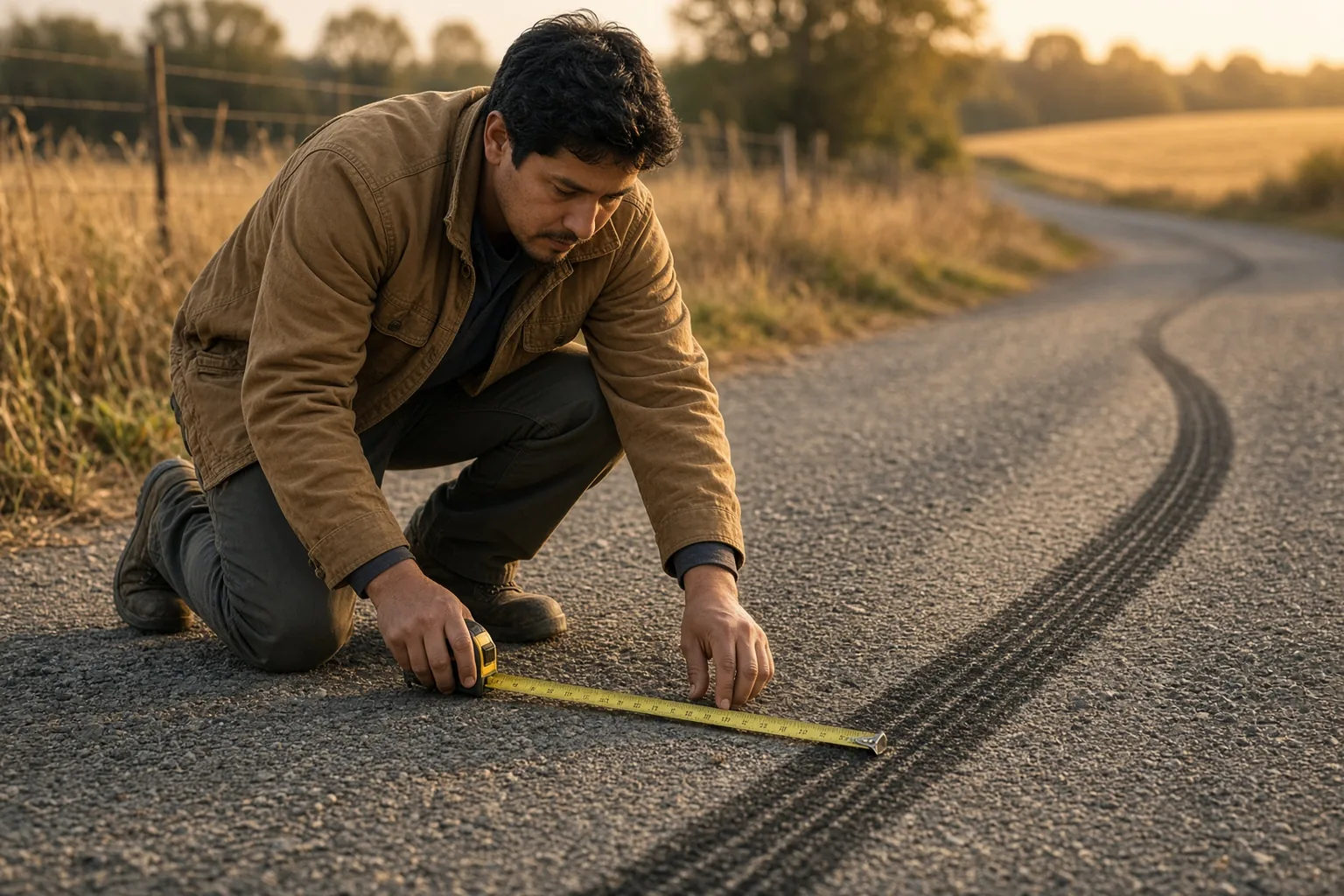
The reviewer checks each mark and the source of the drag factor. An Illinois appellate court upheld a speed estimate built from 60 feet of skid marks and a drag factor derived for that road surface.
In Coffey v. Hancock, 122 Ill. App. 3d 442 (Ill. App. Ct., 3d Dist., March 6, 1984), the defense called Williard A. Alroth, a consulting traffic engineer. He worked from 60 feet of skid marks, photographs and a site visit, derived a drag factor of .5 to .6, and accounted for melting tar acting as a lubricant and for the yaw effect of the road crown. His estimate was 29 to 32 mph when the brakes were applied.
The plaintiff argued that the testimony invaded the jury's province. The court disagreed. Reconstruction testimony is disfavored where eyewitnesses can testify to speed, but an exception applies where the jury needs "knowledge and application of principles of physics and chemistry" to interpret the physical evidence. The defendant was the only eyewitness, and the foundation was adequate under Federal Rules of Evidence 703 and 705, which the Illinois Supreme Court adopted in Wilson v. Clark.
Coffey is a model of what the reviewer looks for in the opposing report: a measured mark, a drag factor tied to the actual surface and its condition, and the road geometry that changes the path of the vehicle. Where the opposing report takes the drag factor from a table, the reviewer asks why no test was made at the scene and reruns the speed with the plausible range of values for that surface.
The reviewer also checks the other side of the calculation: whether the mark belongs to the vehicle in question, whether it is a straight skid or a curved mark left while the vehicle rotated, and whether the length in the report agrees with the police diagram and the photographs.
Do tests and simulations match the conditions of the crash?
They must. The District of Delaware excluded a mock-up test whose conditions bore little resemblance to the accident, while the District of Montana admitted HVE simulations backed by a report that answered the criticisms of their basis.
In Withrow v. Spears (D. Del., August 22, 2013), reconstructionist John Desch ran a mock-up test. The court found that "the conditions associated with the Mock-Up Test bear little resemblance to the conditions of the actual accident here" and held that "for that reason alone" his testimony about the test should be precluded (pp. 18-19).
In Guinnane v. Dobbins (D. Mont., August 13, 2020), crash reconstructionist Harry Townes based his opinion partly on HVE 3-D simulations. His rebuttal report addressed specific criticisms of the factual basis of his conclusions and his methodology, and the court allowed both the testimony and the simulations.
Stoll's account of the Solis case in Plaintiff magazine lists two more mismatches: speed tests were run with a bus that could not perform as the bus did on the day of the collision, and they were run on a dry road although the collision happened in rain.
For any test, video recreation or simulation in the opposing report, the reviewer lists the conditions of the crash next to the conditions of the test: the vehicle and its load, the tires, the road surface and its wetness, the light, the driver. Each difference that can change the result is a point for the review.
Does the damage analysis rest on documents that match?
Repair estimates, invoices and photographs have to agree with the claimed impact. In Delgado v. Schwab the court barred testimony about undocumented damage that rested on the gap between an estimate and the final invoice.
In Delgado v. Schwab, Inc. (D. Kan., March 13, 2017), the defense reconstructionist Cleve Bare estimated a delta-V of 2 to 4 mph using conservation of momentum and energy. The court admitted his testimony in its entirety.
The plaintiff's engineer John Smith argued that the vehicle had damage beyond what was documented, based on the difference between the repair estimate and the final invoice. The court found that headlamps and sales tax explained the difference and excluded that part of his testimony.
The lesson for a review runs both ways. A low-speed opinion built on documented crush and a stated method survived. An opinion about hidden damage that rested on an unexplained difference between two documents did not. The reviewer reads every line of the estimate and the invoice against the photographs and the crash mechanics and notes which lines the claimed impact can explain.
How are arithmetic and unit errors caught and corrected?
By repeating each calculation from the inputs stated in the report. A corrected figure goes out as a supplement under Rule 26(e), and courts limit what a late supplement may add.
Arithmetic errors are found by recalculation. In a letter to the Forest Park Review published on March 17, 2015, a Forest Park police officer explained that a speed-calculation error in his reconstruction report was a unit-conversion mistake that he had found and corrected himself. The reviewer recalculates every figure in the opposing report from the inputs it states, with the units written out at each step.
Under Rule 26(e)(1)(A) a party must supplement or correct a disclosure "in a timely manner if the party learns that in some material respect the disclosure or response is incomplete or incorrect." For a reporting expert the duty covers both the report and the deposition, and changes are due by the time of the pretrial disclosures under Rule 26(a)(3).
Courts read the duty narrowly. In Guinnane the court struck a tire expert's supplemental report filed on August 10, 2020, because a supplement may only correct inaccuracies or fill gaps based on information that was not available at the initial disclosure. The same expert was barred from testifying that the defendant's Dodge was in the incorrect lane of travel, because his lateral-displacement calculations were not in his reports.
Does the reconstructionist stay within engineering?
Opinions on injury causation, fault and the law fall outside it. Courts have barred reconstructionists from biomechanics, excluded percentage-of-fault opinions and limited conclusory legal language.
In Fields, McDonald testified that the defendant "failed to yield," "took away Ms. Fields' right-of-way" and was at fault "a hundred percent." The court excluded his opinion that the defendant drove below the minimum speed, because it required no specialized knowledge and would not help the jury. In a footnote the court cited "at least some authority" against letting an expert testify that a party violated a state's motor vehicle code, because that states a legal conclusion.
In Withrow, the reconstructionist was barred from opinions on hand and body position and the cause of the hand injuries, which the court placed in biomechanics. He was also barred from saying that the plaintiff violated particular Delaware motor vehicle laws, because experts "may not testify as to what the law requires."
In Guinnane the court limited a reconstructionist's opinion that there was "no comparative negligence" on the plaintiff's part, because it used conclusory legal language on an ultimate issue. The 2023 note to Rule 702 states the general limit: each opinion "must stay within the bounds of what can be concluded from a reliable application of the expert's basis and methodology."
What does IAE do when a reconstruction report has to be checked for errors?
IAE prepares a review of the opposing expert's report or an expert report on the client's questions for injury and property damage cases in US courts. Delivery takes up to 5 business days.
The engineer matches crush on both vehicles with tire marks, gouges, the police diagram and video, sets the point of impact, the impact angle and pre-crash speeds, and checks the event data recorder download against the scene evidence. He compares each line of the repair estimate with photos and the crash mechanics and marks damage that came from an earlier or a different impact. Where the other side's vehicle has to be inspected, he lists for counsel what needs to be measured and downloaded.
A review answers six questions about the opposing report: whether the method fits the object and was followed at every stage, whether all objects, materials and questions were examined, whether the conclusions follow from the examination, whether the expert's education and experience match the subject, whether the report meets the formal requirements of the jurisdiction, and whether the report can be relied on. IAE confirms the questions with the client before work starts.
The secretariat confirms receipt the same day. Within one business day IAE confirms the format, the cost, the deadline and the specialist from its registry, and the client approves the candidate and the CV. Cases with tight deadlines have a 48-hour rush. Every specialist is a member of the public IAE registry, verified by Member ID or QR code, and confirms in the document that he or she has no interest in the outcome.
Materials go through the contact form or to info@iaexperts.com and are not passed to third parties without the client's consent. The court weighs a review with the other evidence, and neither IAE nor the engineer guarantees the outcome. IAE is not a law firm and does not advise on case strategy.
Sources
- Federal Rules of Evidence, Rule 702, Testimony by Expert Witnesses, with Committee Notes (LII)
- Federal Rules of Civil Procedure, Rule 26, Duty to Disclose; General Provisions Governing Discovery (LII)
- Keesee v. Donigan, Record No. 990181 (Va. Jan. 14, 2000)
- Fields v. Ashford, No. 17-cv-11812 (E.D. Mich. Nov. 5, 2019), ECF No. 88 (Justia)
- Coffey v. Hancock, 122 Ill. App. 3d 442 (Ill. App. Ct. 1984)
- Withrow v. Spears, Civil Action No. 12-06-LPS-CJB (D. Del. Aug. 22, 2013), Memorandum Order
- Guinnane v. Dobbins, No. CV 19-85-M-DWM (D. Mont. Aug. 13, 2020), Doc. 125 (Justia)
- Delgado v. Schwab, Inc., No. 14-CV-01262-JAR (D. Kan. Mar. 13, 2017), Doc. 113 (Justia)
- Koenig v. Beekmans, No. 5:15-cv-00822 (W.D. Tex. Jan. 4, 2018), Doc. 145 (Justia)
- Stoll A. G. Jr., Does the accident-reconstruction expert's work measure up? Plaintiff magazine, May 2015
- Forest Park Review, Change in report merely corrected an error, March 17, 2015
- U.S. District Court for the Middle District of Pennsylvania, Amendments to Federal Rules Effective December 1, 2023 (Evidence rules among them)
Read also
All articles

Left-turn collision: how does a reviewer check the opposing reconstruction of the oncoming vehicle's speed and the turning driver's gap?
In a left-turn crash each side blames the other: the turning driver failed to yield, or the oncoming driver was speeding. State statutes require Sergei Voronin

The police accident report is wrong: how is it checked, and what weight does it carry in court?
A police crash report is written by an officer who usually arrived after the vehicles stopped moving. It records what the officer saw, measuredSergei Voronin
Rear-end collision: how does a reviewer check the opposing reconstruction of a sudden stop or chain crash?
In a rear-end crash the law starts against the rear driver: New York treats the collision as a prima facie case of negligence, and Florida presumesSergei VoroninExpert report review
Ready to discuss your case?
Send the materials: the secretariat will confirm the format, cost, deadline and the specialist within one business day.
