
Expert report review
The police accident report is wrong: how is it checked, and what weight does it carry in court?
A police crash report is written by an officer who usually arrived after the vehicles stopped moving. It records what the officer saw, measured and was told, and often names a contributing factor or a driver at fault. Insurers read it first. In court its weight depends on the rules of evidence, on state statutes that bar parts of it, and on whether its diagram and conclusions hold up against the physical evidence.
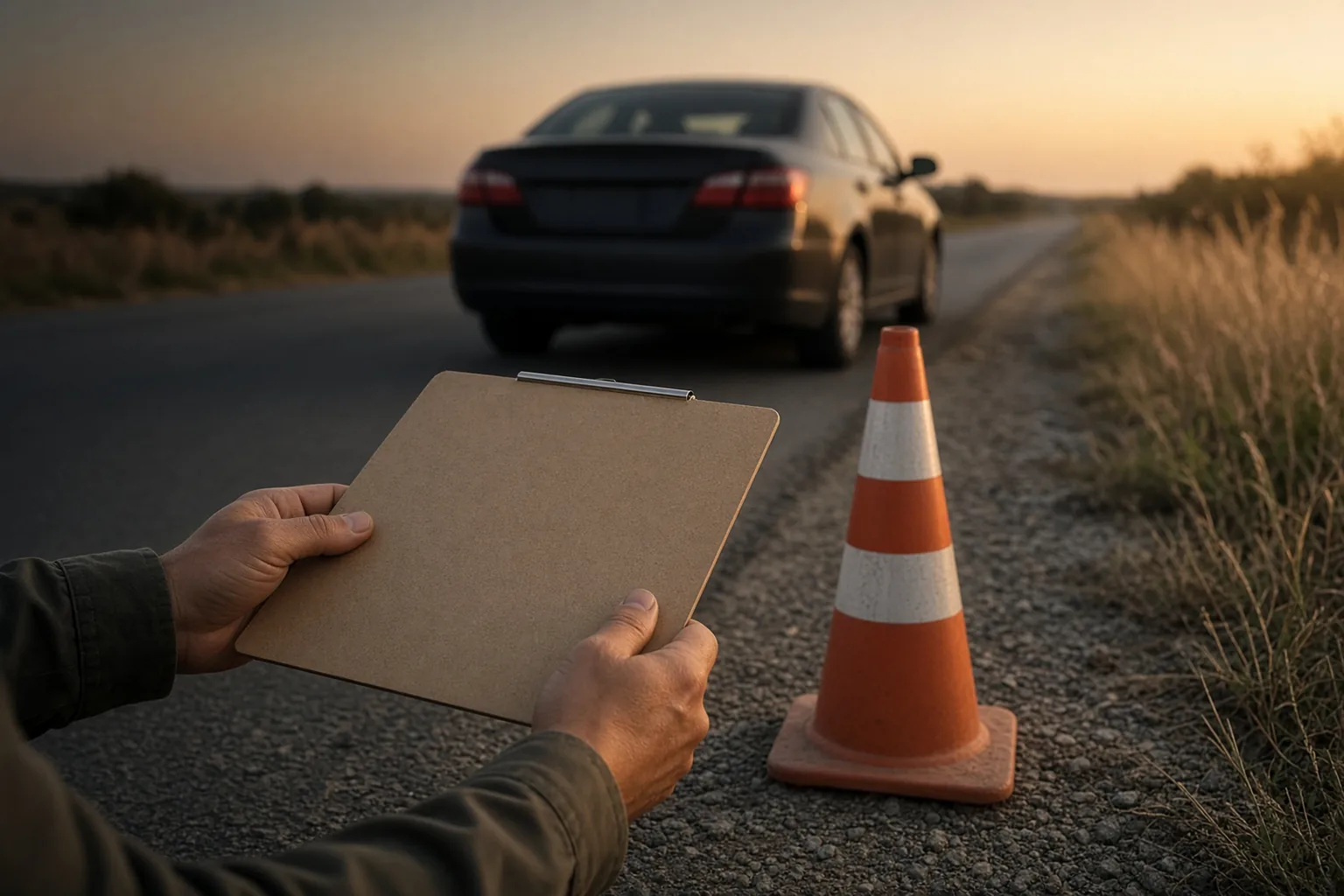
What is a police crash report based on?
On what the officer saw at the scene after the crash, the measurements and photographs taken, and the statements of drivers and witnesses. In Florida a long-form report is required for crashes with injury, a tow-away or a commercial vehicle.
Under Florida Statutes 316.066(1), an officer who investigates a crash completes a long-form Florida Traffic Crash Report when the crash caused death, personal injury or any complaint of pain or discomfort, involved a violation of section 316.061(1) or section 316.193, left a vehicle inoperable to the point that it needed a wrecker, or involved a commercial motor vehicle. The report goes to the department within 10 days after the officer completes the investigation. Other states set their own thresholds and forms.
The officer rarely sees the crash happen. The report is built from the rest positions of the vehicles, the visible damage, marks on the road, debris, the drivers' statements, any witnesses who stayed and the officer's own measurements. The diagram is often drawn by hand or from a few measurements, sometimes at night or in traffic, with the vehicles already moved.
Each of those sources can be wrong in its own way. A driver who hit someone else has a reason to describe the crash in his or her own favor. A witness may have looked up only after the sound of the impact. Vehicles moved to clear the lane no longer show their rest positions. A reviewer reads the report with each source in mind and asks which statements the officer saw and which the officer was told.
Can a wrong police report be corrected?
Clerical errors such as a wrong plate number, insurer or vehicle description can be raised with the agency that wrote the report, with documents. The officer's conclusions about fault are rarely rewritten, so they are answered with evidence instead.
There are two kinds of errors. The first is clerical: a wrong name, address, plate, insurance policy, vehicle make or direction of travel. A driver raises these with the agency that wrote the report and attaches the document that proves the correct entry, such as the registration, the insurance card or photographs of the scene. Agencies have their own procedures and forms for this.
The second kind is the officer's judgment: who caused the crash, which driver failed to yield, what speed was involved. An officer who wrote a conclusion is unlikely to change it on a driver's request without new facts.
For the judgment errors, the practical step is to build the evidence that answers them: photographs, video, the event data recorder download, witness statements and, where the stakes justify it, a reconstruction or a review of the report by an engineer. That evidence goes to the insurer during the claim and to the court if the case is filed.
Is a police accident report admissible in a civil trial?
It depends on the court. Under federal Rule 803(8) factual findings from a legally authorized investigation are admissible in civil cases unless shown untrustworthy, while Florida and California statutes bar certain crash reports from evidence.
Federal Rule of Evidence 803(8) excepts from the hearsay rule a record or statement of a public office that sets out the office's activities, a matter observed while under a legal duty to report, or, in a civil case, factual findings from a legally authorized investigation. The exception applies only if the opponent does not show that the source of information or other circumstances indicate a lack of trustworthiness. In a criminal case, matters observed by law-enforcement personnel are excluded from clause (ii).
In Beech Aircraft Corp. v. Rainey, 488 U.S. 153 (1988), the Supreme Court held that portions of investigative reports are not inadmissible merely because they state a conclusion or opinion. As long as the conclusion is based on a factual investigation and satisfies the trustworthiness requirement, it is admissible along with the other portions of the report. The Court left the trial judge to decide whether a report, or any portion of it, is trustworthy enough to admit, and to exclude whole reports or specific parts.
State statutes can bar what the federal rule admits. Florida Statutes 316.066(4) provides that each crash report made by a person involved in a crash, and any statement that person made to a law enforcement officer, is without prejudice to the person reporting and may not be used as evidence in any trial, civil or criminal. The officer may testify at a criminal trial about such a statement if the person's privilege against self-incrimination is not violated. California Vehicle Code section 20013 provides that no such accident report shall be used as evidence in any trial, civil or criminal, arising out of an accident; the only exception is a certificate showing whether a report was made.
Where the report itself stays out, the officer can still be called as a witness about what he or she saw and measured. The fight then moves to the officer's testimony and to whether any opinion about fault needs expert qualification.
What does a reviewer check in a police crash report?
Whether the diagram matches the photographs and measurements, how the point of impact was fixed, which facts the officer saw and which came from statements, and whether the stated cause follows from the physical evidence.
A reviewer works through the report in a fixed order:
The diagram is often the weakest part. A hand sketch that puts the point of impact in the wrong lane, or draws a skid mark that no photograph shows, carries the same visual force as a measured plan. The reviewer marks every element of the diagram that has no measurement or photograph behind it.
The contributing factor field deserves the same reading. A code such as failure to yield or excessive speed is a conclusion. If the narrative records that the officer took it from one driver's statement, the code has no independent support. Under Rule 803(8)(B) that kind of circumstance is what the opponent points to when arguing that the conclusion lacks trustworthiness.
- The time the officer arrived and whether the vehicles had been moved before measurements were taken.
- Each measurement: from which reference point, with which tool and whether it appears in a photograph.
- How the point of impact was fixed: gouges, debris, tire marks or a driver's statement.
- Which statements came from which person, and whether the narrative mixes the officer's observations with what drivers said.
- Whether the stated speed, lane position and cause follow from the marks and damage, or from statements alone.
- Whether the report mentions an event data recorder, video cameras or witnesses who were not interviewed.
Can the officer testify about who caused the crash?
Only if the court finds the officer qualified and the opinion reliable under Rule 702 or the state rule. An officer who did not reconstruct the crash can describe what he or she saw.
Federal Rule of Evidence 702 lets a witness qualified by knowledge, skill, experience, training or education give an opinion if the proponent shows the court that it is more likely than not that the opinion will help the trier of fact, rests on sufficient facts or data, comes from reliable principles and methods, and applies those methods reliably to the facts of the case.
A patrol officer who arrived after the crash, took a few measurements and talked to the drivers can testify about what he or she saw and did. An opinion about which driver was going faster or who entered the intersection first is a different matter. The questions for the officer at deposition follow from that line: training in crash reconstruction, the calculations made, the data used, whether the officer downloaded any recorder and whether the conclusion rests on anything other than statements.
Where a department's reconstruction unit returned to the scene, surveyed it and downloaded the recorders, its report is closer to an expert report and is reviewed as one, against the inputs, the method and the calculation.
What evidence can contradict the police report?
The event data recorder download, video from dashcams and nearby cameras, the vehicles themselves, scene photographs and measurements taken later, and witnesses the officer did not interview. Rule 34 lets a party inspect and test the other side's vehicle.
The event data recorder is often the strongest answer to a disputed speed. Under 49 CFR 563.7, Table I, a recorder covered by Part 563 stores the vehicle's indicated speed, accelerator position and service brake status before the event, together with the change in velocity during it. The table sets a pre-crash interval of 20 seconds at 10 samples per second. Under its footnote, vehicles manufactured before September 1, 2031 may keep the earlier 5 seconds at 2 samples per second, except that 25, 50 and 75 percent of each manufacturer's EDR-equipped production must meet the 20-second values from September 1 of 2028, 2029 and 2030.
Video is the second. A traffic camera, a bus camera or a store camera can show the order of events that the officer had to infer from statements. Recordings are overwritten on fixed schedules, so preservation letters go out in the first days.
The vehicles are the third. Federal Rule of Civil Procedure 34(a)(1) lets a party request that the other side produce and permit it to inspect, copy, test or sample tangible things and electronically stored information in its possession, custody or control. The response is due in writing within 30 days after service under Rule 34(b)(2)(A). Crush depth, the direction of the damage and the recorder data can then be set against the report's diagram.
A reviewer who has these materials writes which statements in the police report they confirm, which they contradict and which they cannot test. That list becomes the basis for cross-examination of the officer and for the reconstructionist's own opinion.
What does IAE do when a police crash report is disputed?
An engineer from the IAE registry reviews the police report or the opposing reconstruction against the recorder data, the scene evidence and the vehicles. Up to 5 business days, with a 48-hour rush.
The IAE accident reconstruction review is for counsel facing the other side's reconstructionist, or a police report that the other side relies on, in an injury or property damage case in a US court. The engineer checks the inputs, reaction times, calculations and opinions that go past engineering. Each point is tied to a page of the report and to a rule, a ruling or a published method.
The client sends the report and the case materials and describes the task. The secretariat confirms receipt the same day. Within one business day IAE confirms the format, cost, deadline and the specialist from its registry, and the client approves the candidate and the CV before work starts. The signed PDF is issued in up to 5 business days; cases with tight deadlines have a 48-hour rush.
Every specialist is a member of the public IAE registry and passed the council's attestation under the published Criteria Matrix. The Member ID or QR code on the document opens the specialist's category, specialization, attestation date and record status. The specialist confirms in the document that he or she has no interest in the outcome of the case. A review is evidence that the court weighs with the other materials; neither IAE nor the reviewer guarantees the outcome, and IAE is not a law firm.
Sources
- Florida Statutes 316.066, Written reports of crashes (2024), Florida Senate
- California Vehicle Code section 20013
- Federal Rules of Evidence, Rule 803 (LII, Cornell Law School)
- Beech Aircraft Corp. v. Rainey, 488 U.S. 153 (1988), Justia
- Federal Rules of Evidence, Rule 702 (LII, Cornell Law School)
- 49 CFR 563.7, Data elements (LII, Cornell Law School)
- Federal Rules of Civil Procedure, Rule 34 (LII, Cornell Law School)
Read also
All articles
Left-turn collision: how does a reviewer check the opposing reconstruction of the oncoming vehicle's speed and the turning driver's gap?
In a left-turn crash each side blames the other: the turning driver failed to yield, or the oncoming driver was speeding. State statutes require Sergei Voronin
Rear-end collision: how does a reviewer check the opposing reconstruction of a sudden stop or chain crash?
In a rear-end crash the law starts against the rear driver: New York treats the collision as a prima facie case of negligence, and Florida presumesSergei Voronin
Seat belt defense: how does a reviewer check the opposing expert's opinion that a belt would have prevented the injuries?
When the defense says the plaintiff was not wearing a seat belt, the argument stands on two expert findings: that the plaintiff was unbeltedSergei VoroninExpert report review
Ready to discuss your case?
Send the materials: the secretariat will confirm the format, cost, deadline and the specialist within one business day.
