
Expert report review
How accurate is Google location data as evidence, and how does a reviewer test the other side's location analysis?
Google records a phone's location as a point and a radius, and the radius is a probability. Google represents, as the Fourth Circuit recorded in 2024, that there is a 68% chance that the user is inside it. A study at the Netherlands Forensic Institute found the true position inside the radius in 52% of GPS tests and 7% of Wi-Fi tests. A review of the other side's location report starts from those numbers.
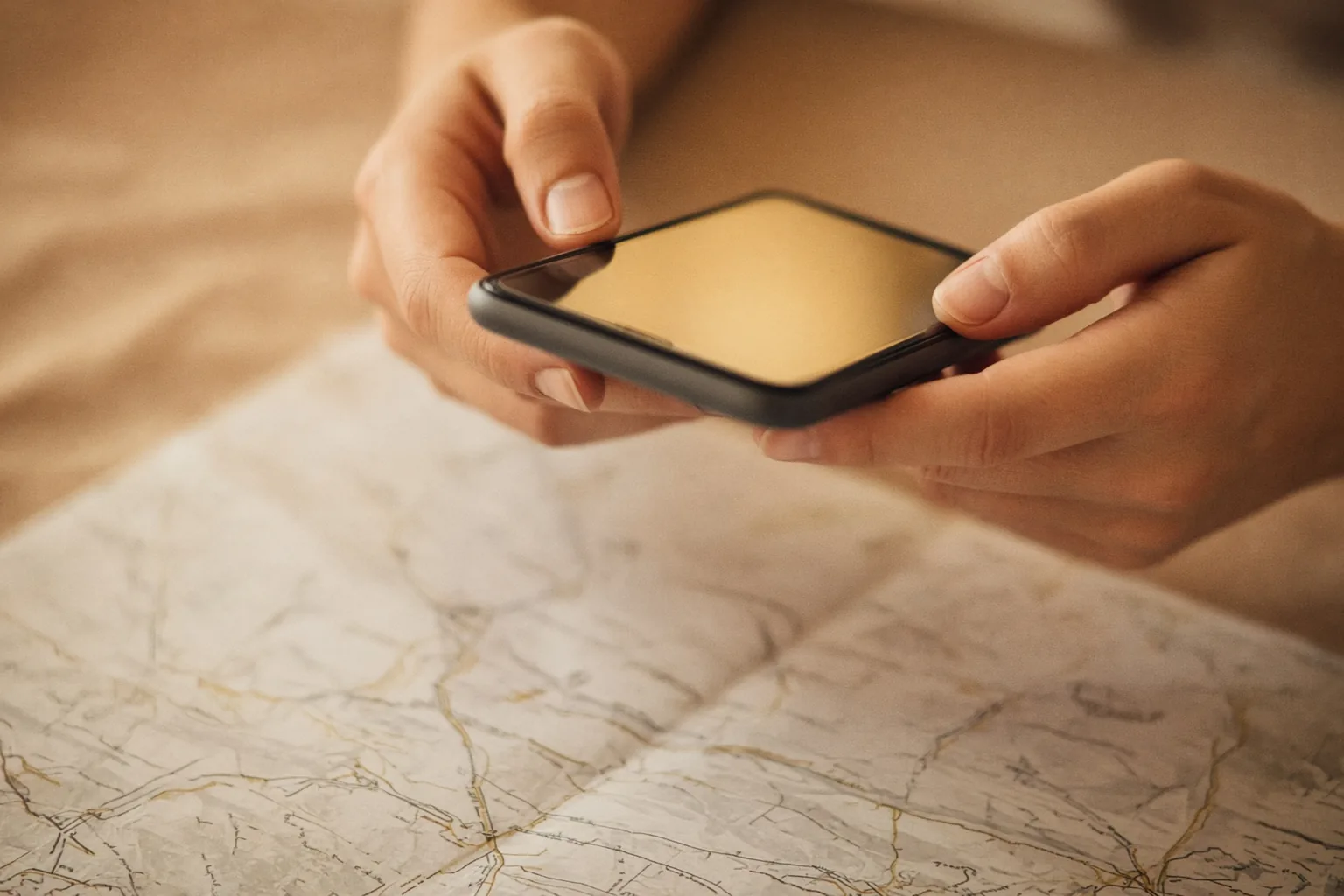
How accurate is Google location data?
Each point has a radius that Google describes as a 68% chance that the user is inside it. In field tests published in 2018 the true position fell inside the radius in 7% to 52% of cases.
The Fourth Circuit described the radius in United States v. Chatrie, decided July 9, 2024. Each Location History record includes a value, measured in meters, called a "confidence interval," which represents Google's confidence in the accuracy of the estimate. The court added: "Google represents that for any given location point, there is a 68% chance that a user is somewhere within the confidence interval."
The Supreme Court, deciding the same case on June 29, 2026, wrote that "the signals tracked can determine a cell phone's location within 20 meters." The Fourth Circuit majority, for its part, wrote that Location History "is only an estimate of a device's location."
Both statements are true of different points. A point computed with GPS in open sky and a point computed from a cell tower in a city carry different radii and different errors. A review of a location report therefore works point by point: which source produced the point, what radius Google gave, and whether the report treated the radius as a boundary or as a probability.
What does a Location History record contain?
Coordinates, a time, an accuracy value in meters and the source of the estimate, such as GPS or Wi-Fi. The Supreme Court wrote that Location History logs a phone's location every two minutes or so.
The Supreme Court described the service in Chatrie: "every two minutes or so" Location History logs a cell phone's location, drawing on an array of sources. The sources include nearby Wi-Fi networks, Bluetooth beacons and cell sites, as well as GPS and IP address information. Over 500 million users worldwide enabled the service after Google's prompts.
Describing the protocol Google generally followed for geofence warrants, the Court wrote that the data produced at its first step generally include each phone's coordinates and timestamp, "an estimate of that information's accuracy" and "a description of the information's source." The Fourth Circuit listed the same field: Google's disclosures include "the source of the stored Location History (such as GPS or Wi-Fi)."
For a reviewer those two fields are the start of every check. A report that shows only dots on a map has dropped the radius and the source. The original production, as Google or the phone delivered it, is the first thing the reviewer asks for.
What did the Netherlands Forensic Institute study find?
The true position was inside Google's radius in 52% of tests with GPS, 38% with 3G, 33% with 2G and 7% with Wi-Fi. On phone networks the radius covered the actual error in only about 35% of experiments.
The study was published as Google timeline accuracy assessment and error prediction by Andrea Macarulla Rodriguez, Christian Tiberius, Roel van Bree and Zeno Geradts in Forensic Sciences Research, volume 3, issue 3 (2018), pages 240-255. It grew out of a 2017 master's thesis at Delft University of Technology written with the Netherlands Forensic Institute.
Phones with Google Location History ran in the field while a reference GPS receiver "with a superior order of accuracy" recorded the true position. The distance between Google's position and the true one was called the Google error, and "If this Google error distance is less than the radius provided, we define it as a hit." The thesis names the equipment: two Huawei G6-U10 phones, a Garmin GPSmap 76Cx reference receiver and a u-blox EVK-M8 receiver.
The hit rates were 52% with GPS available, 38% on 3G, 33% on 2G and 7% on Wi-Fi. By means of transport, on 2G or 3G the worst result was a phone standing still, with 9%, and the best a phone in a car, with 57%. The thesis states that for 2G and 3G the radius bounded the actual error "only in about 35% of the experiments," and in the other 65% the actual error was larger than the radius. Weather and traffic had no influence.
The authors also tried to predict the error using the distances and angles to the three nearest cell towers. The best model, for 2G accuracy, had 76% model hits; the next best, for 3G, had 23%. The thesis judged the models insufficient and called for a larger dataset.
What does a 68% radius mean for a point near a boundary?
By Google's own figure, roughly one point in three falls outside its circle. A point drawn just inside a geofence, a property line or a crime scene may belong to a phone that was outside it.
A 68% chance of being inside the circle leaves a 32% chance of being outside it. The Netherlands results for Wi-Fi and phone networks were lower than Google's figure. A report that says a phone "was at" an address because a point lies on that address states more than the record holds.
The Chatrie geofence was a circle with a radius of 150 meters around a credit union. Judge Wynn, dissenting on the Fourth Circuit panel, wrote that "Location History can inaccurately sweep more ground than police requested." The same uncertainty works in both directions: phones outside the circle can appear inside it, and phones inside can appear outside.
The reviewer measures, for each point that the opposing report relies on, the distance between the point and the boundary and compares it with the radius of that point. Where the radius is larger than the distance, the report should say that the point is consistent with positions on both sides.
What happened in Chatrie?
After a credit union robbery in Midlothian, Virginia on May 20, 2019, police obtained a geofence warrant for Google Location History. Google's data narrowed 19 users to 9 and then to 3, one of them Chatrie.
The robbery took place at about 4:50 p.m. On June 14 the police applied for the warrant. The geofence was a circle with a radius of 150 meters surrounding the credit union.
The warrant had three steps. At step one Google produced anonymized data for all devices in the geofence between 4:20 and 5:20 p.m., which covered 19 users. At step two police obtained anonymized data for a narrowed list over a two-hour window between 3:50 and 5:50 p.m., inside and outside the geofence; nine users remained. At step three Google gave names and phone numbers for three users, including Chatrie. The location data showed that he "entered the geofenced area about ten minutes before the robbery."
At each step the data identified accounts and estimated positions, not people: names and phone numbers came only at step three.
What did the Supreme Court decide in 2026?
On June 29, 2026 the Court held that police conduct a Fourth Amendment search when they access a user's Location History. It vacated the Fourth Circuit's judgment and left the reasonableness of the warrant to that court.
Justice Kagan wrote for the Court, joined by Chief Justice Roberts and Justices Sotomayor, Kavanaugh and Jackson. The holding reads: "we hold that police officers invade a cell-phone user's reasonable expectation of privacy when they access his Location History." Justice Jackson, joined by Justice Sotomayor, concurred. Justice Gorsuch concurred in the judgment. Justice Alito dissented, joined in parts by Justices Thomas and Barrett, and Justice Barrett filed a separate dissent.
The Court did not decide whether the warrant was reasonable at each step and did not reach the good-faith exception. "We leave all of those questions to the Court of Appeals to decide in the first instance." The judgment of the Fourth Circuit sitting en banc, reported at 136 F.4th 100, was vacated and the case remanded.
The holding concerns when obtaining the data is a search. Whether a given point in a production is accurate is not part of it; in each case an expert and a reviewer answer that question from the record.
Can Location History still be obtained from Google?
Not by a geofence warrant, according to Google. In July 2025 Google began storing Location History on users' devices, and it told the Supreme Court that it can no longer respond to geofence warrants for that data.
Footnote 3 of the Chatrie opinion records the change: "Except that in July 2025, years after the geofence warrant used in this case, Google made a change: It now stores Location History data on individual users' devices rather than on its own servers." The Court cited Google's amicus brief for the statement that Google "is no longer capable of responding to geofence warrants that seek Location History data."
After that change, Location History for a new case would have to come from the phone itself. The opposing report then rests on a device extraction, and the reviewer adds the checks that apply to any extraction: whether the work began from the original or a copy, whether the image and the source have matching hash values, which tool and version read the data and in which time zone each timestamp was read.
Older productions from Google remain in pending cases. For those the reviewer asks for the production itself, with its accuracy and source fields, and compares it with the exhibits.
What does a reviewer check in the opposing location report?
Whether each point keeps its radius and source, whether the map draws circles or only dots, whether times are in the right time zone and whether the conclusion claims more precision than the points support.
The IAE review page states the method: each finding is tied to a page of the opposing report and to a rule or a published practice. For location data the published practice includes the Chatrie record of the 68% confidence interval and the Netherlands hit rates.
The checks run in this order. The reviewer obtains the data as produced, with the accuracy value and source for every point. He or she compares the points on the opposing maps with the production and notes any point drawn without its circle. For each point the report relies on, the reviewer records the source, the radius and the distance to the place that matters. The two-minute logging rhythm the Supreme Court described means that a gap of an hour in the points is a gap in the data, and the report should not fill it with a line.
Times come next. A reviewer checks in which time zone the analyst read each timestamp, because a one-hour error moves a phone to the scene or away from it. The last check is the language: "was at," "entered" and "left" are conclusions about a person, while the record says that an account's estimated position was within a radius with a stated probability.
How does Rule 702 apply to location testimony?
The party offering the analyst must show that it is more likely than not that the opinion rests on sufficient data and a reliable application of the method. The 2023 note keeps each opinion within what the method can support.
Rule 702 lets a qualified witness testify as an expert only if the proponent shows the court that it is more likely than not that the expert's knowledge will help the trier of fact, that the testimony "is based on sufficient facts or data," that it is "the product of reliable principles and methods," and that the opinion applies those principles and methods reliably to the facts of the case.
The 2023 committee note says that "Rule 702(d) has also been amended to emphasize that each expert opinion must stay within the bounds of what can be concluded from a reliable application of the expert's basis and methodology." It also says: "Forensic experts should avoid assertions of absolute or one hundred percent certainty" or to a reasonable degree of scientific certainty if the methodology is subjective and thus potentially subject to error.
A location opinion that drops the radius claims a certainty that Google's own representation does not support. The rebuttal report puts the radius back and states, for each point that matters, what range of positions the record permits.
What does IAE do when the other side relies on Google location data?
IAE reviews the opposing digital forensics report and can prepare a rebuttal expert report and deposition questions. Format, cost, deadline and specialist are confirmed before work starts; the document is issued in up to 5 business days.
The IAE review page is addressed to attorneys who received the other side's digital forensics report on messages, files, phones or computers. The reviewer checks whether another examiner could repeat the work: matching hash values, the tool and version that extracted the data, the time zone of each timestamp and whether each conclusion follows from the data. The review can start from the report, its exhibits and the facts or data the expert must list; with a hash-verified copy of the image the reviewer can repeat the extraction.
The secretariat confirms receipt the same day. IAE then confirms the format, the cost, the deadline and the specialist from its registry within one business day, and the client approves the candidate and the CV before work starts. The document is issued in up to 5 business days after the format and cost are confirmed; cases with tight deadlines have a 48-hour rush.
Every specialist is a member of the public IAE registry, can be verified by Member ID or QR code and confirms in the document that he or she has no interest in the outcome of the case. IAE is not a law firm and does not advise on case strategy, including motions to suppress. A review is evidence that the court weighs with the rest of the record, and neither IAE nor the reviewer guarantees the outcome.
Sources
- Chatrie v. United States, No. 25-112 (U.S. June 29, 2026), opinion of the Court and separate opinions (LII, Cornell Law School)
- United States v. Chatrie, No. 22-4489 (4th Cir. July 9, 2024), panel opinion (copy published by EPIC)
- Macarulla Rodriguez A., Tiberius C., van Bree R., Geradts Z., Google timeline accuracy assessment and error prediction, Forensic Sciences Research 3(3), 2018, pp. 240-255 (DOAJ record with abstract)
- Macarulla Rodriguez A., Google Timeline Geolocation Accuracy, MSc thesis, Delft University of Technology, 2017 (TU Delft repository)
- Federal Rules of Evidence, Rule 702, Testimony by Expert Witnesses, with 2023 committee notes (LII, Cornell Law School)
Read also
All articles

Cell tower location evidence: how does a reviewer test the other side's cell-site analysis?
A cell-site report plots the towers a phone used and argues that the phone, and its owner, were near a place at a certain time. The records behind Sergei Voronin
Does an IP address identify a person, and how does a reviewer test the other side's expert who ties an IP address to a defendant?
An IP address identifies a network connection at a moment in time. The internet service provider can name the subscriber who pays for thatSergei Voronin
Who pays for a review of the opposing digital forensics report, and can the fee be recovered?
The party that retains a reviewer of the opposing digital forensics report pays the reviewer. The other side pays only for the time it spendsSergei VoroninExpert report review
Ready to discuss your case?
Send the materials: the secretariat will confirm the format, cost, deadline and the specialist within one business day.
