
Expert report review
Neutral forensic examination of a device: when can a court order one, and how is the result reviewed?
Rule 34 of the Federal Rules of Civil Procedure lets a party ask to inspect, copy, test or sample the other side's electronically stored information, but its 2006 committee note says this is not meant to create a routine right of direct access to a party's electronic information system. Where access to a phone or a computer is justified, the order or the parties' agreement decides who examines the device, under what protections and how the results reach both sides.
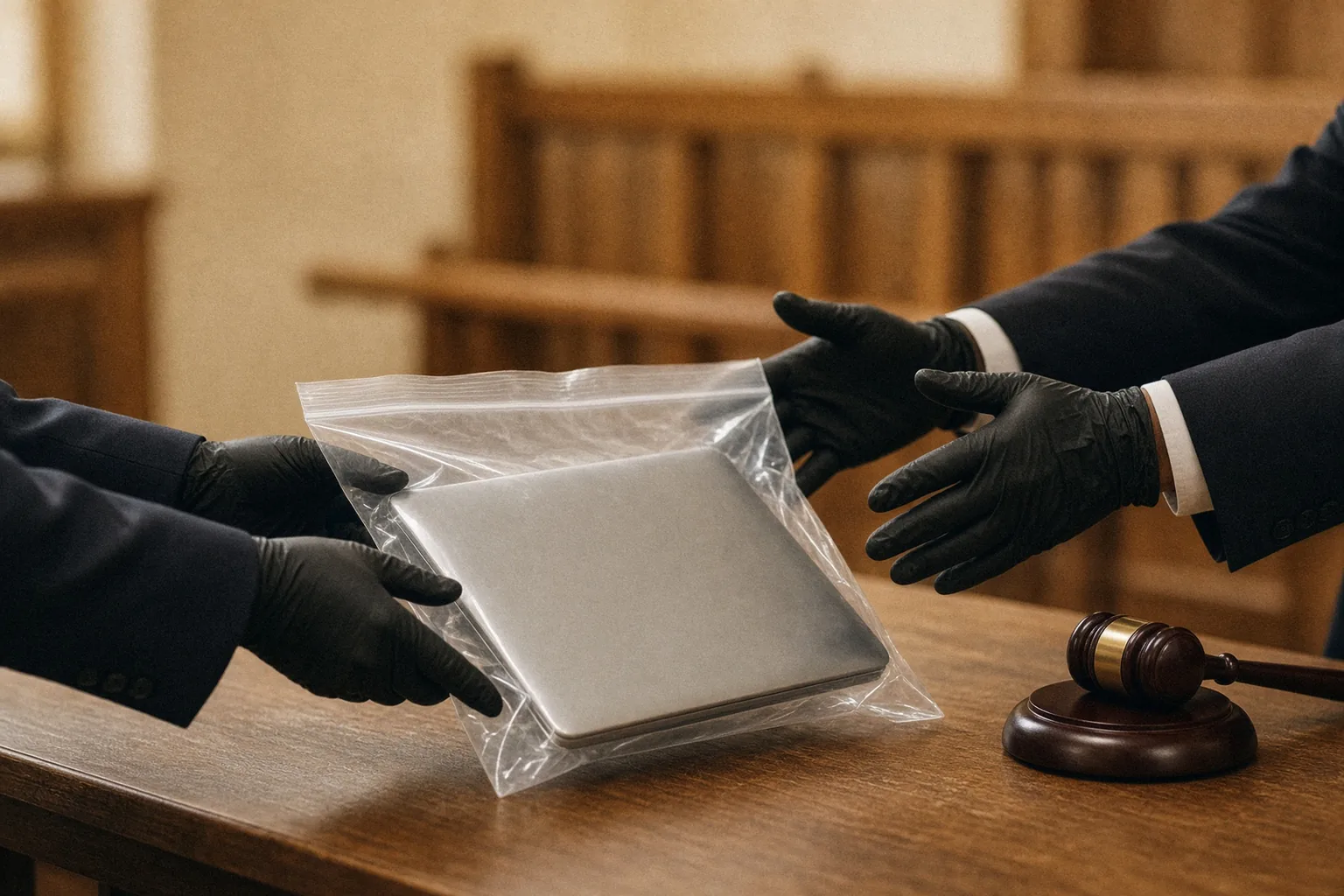
What is a neutral forensic examination of a device?
An examination of a phone, a computer or an account by an examiner whom the parties agree on or the court appoints, who reports to both sides. Any party may depose and cross-examine an expert appointed under Rule 706.
Rule 706 of the Federal Rules of Evidence lets the court, on its own or on a party's motion, order the parties to show cause why expert witnesses should not be appointed, and ask them to submit nominations. The court may appoint an expert the parties agree on or one of its own choosing, but "the court may only appoint someone who consents to act."
The appointed expert must advise the parties of any findings. Any party may depose the expert, the court or any party may call the expert to testify, and the expert "may be cross-examined by any party, including the party that called the expert." Under Rule 706(c) "The expert is entitled to a reasonable compensation, as set by the court," and in ordinary civil cases the parties pay it in the proportion and at the time the court directs. The court may tell the jury that it appointed the expert, and Rule 706(e) leaves each party free to call its own experts.
A court can also appoint a master. In Keating v. Jastremski the Southern District of California appointed a Special Master "pursuant to Rule 53" to prepare a report and recommendation on spoliation. The Special Master held a six-day evidentiary hearing, and on April 9, 2020 the court reviewed the findings de novo and adopted them. The examiners in that case were retained by the parties, TRG's examiner Allan Sevel and the advisers' examiner Ashraf Massoud; the master weighed their work.
Does Rule 34 give a party access to the other side's phone or computer?
It permits a request to inspect, copy, test or sample electronically stored information and tangible things. The 2006 committee note adds that this is not a routine right of direct access and that courts should guard against undue intrusiveness.
Rule 34(a)(1) lets a party serve a request to "inspect, copy, test, or sample" designated items. Under Rule 34(b)(1)(C) the request "may specify the form or forms in which electronically stored information is to be produced," and under Rule 34(b)(2)(A) the responding party "must respond in writing within 30 days after being served."
The 2006 committee note explains the addition of testing and sampling: "parties may request an opportunity to test or sample materials sought under the rule." It then sets the limit. The addition "is not meant to create a routine right of direct access to a party's electronic information system, although such access might be justified in some circumstances." "Courts should guard against undue intrusiveness resulting from inspecting or testing such systems," and such inspection or testing "may raise issues of confidentiality or privacy."
A request for exported messages or files is a request for documents. A request to image the phone or the laptop reaches the system itself, with every other account, photograph and message stored on it. The note's limits apply to the second request, and the motion has to explain why the exports do not answer the question in dispute.
What does the requesting party have to show?
That the examination is relevant to a claim or defense and proportional to the needs of the case. If the source is not reasonably accessible because of undue burden or cost, the court may still order discovery for good cause.
Rule 26(b)(1) reaches information that "is relevant to any party's claim or defense and is proportional to the needs of the case," weighing among other factors "the importance of the issues at stake in the action, the amount in controversy." The 2015 committee note says the change is not "intended to permit the opposing party to refuse discovery simply by making a boilerplate objection that it is not proportional."
Rule 26(b)(2)(B) lets a party withhold electronically stored information from sources "not reasonably accessible because of undue burden or cost." The court may still order discovery from such sources for good cause. The 2006 committee note lists the considerations: "the specificity of the discovery request"; "the quantity of information available from other and more easily accessed sources"; "the failure to produce relevant information that seems likely to have existed but is no longer available"; "the likelihood of finding relevant, responsive information that cannot be obtained from other, more easily accessed sources"; "predictions as to the importance and usefulness of the further information"; "the importance of the issues at stake in the litigation"; and "the parties' resources."
The third consideration fits a dispute over deleted data. The same note says that "The requesting party may need discovery to test this assertion," for example by "requiring the responding party to conduct a sampling of information" or by "allowing some form of inspection of such sources." The conditions the court sets "may also include payment by the requesting party of part or all of the reasonable costs."
How does a dispute over deleted data change the request?
Rule 37(e) first asks whether lost information can be restored or replaced through additional discovery. An examination of the device is one form of that discovery, and without it the court may lack a record of what was lost.
The 2015 committee note to Rule 37(e) states that "the initial focus should be on whether the lost information can be restored or replaced through additional discovery." Sanctions under (e)(1) require prejudice, and the severe measures under (e)(2) require a finding of intent to deprive.
In Storz Management Co. v. Carey the plaintiffs accused former officers of copying company files, deleting the originals and losing the drives. The magistrate judge noted that they "failed to execute a forensic plan to examine what might have been stolen," and a drive turned over to defense counsel had not been examined as of that order. On February 9, 2021 Judge Troy L. Nunley of the Eastern District of California found no clear error in the denial of sanctions: the record was insufficient to establish "the degree of prejudice suffered."
Where examinations were made, they supplied the facts. In Leon v. IDX Systems Corp. the defendant's examiner found the unallocated space of the returned laptop "intentionally wiped" and more than 2,000 files deleted, and on September 30, 2004 the Western District of Washington dismissed the plaintiff's claims with prejudice. In Keating examiners found a DBAN program on a flash drive wiped about six days before hand-over. In Moore v. Gilead Sciences the defendant's forensic analysis found "the erasure of 10,040 deleted items," and on February 29, 2012 the court allowed an adverse inference on the plaintiff's disability claims.
How are privacy and privilege protected during the examination?
Through a protective order and an examination protocol. Under Rule 26(c)(1) the court may, for good cause, protect a party or person from annoyance, embarrassment, oppression, or undue burden or expense.
Rule 26(c)(1) lets the court issue an order for good cause to protect a party or person from "annoyance, embarrassment," oppression or undue burden or expense. The Rule 34 note names the risk for device inspections directly: inspecting or testing an information system "may raise issues of confidentiality or privacy."
A reviewer reads the protocol before the report. The protocol should state which devices and accounts are covered, the date range, the search method, who reviews results for privilege before anything is disclosed, what the examiner reports and to whom, and what happens to the image when the case ends.
Cost is part of the order. For sources not reasonably accessible, the conditions named in the 2006 note to Rule 26(b)(2)(B) include payment by the requesting party of part or all of the reasonable costs. For a court-appointed expert, Rule 706(c) lets the court set the compensation and divide it between the parties.
Can each party still use its own examiner?
Yes. Rule 706(e) does not limit a party in calling its own experts, and a consulting expert's facts and opinions are generally protected from discovery under Rule 26(b)(4)(D).
Rule 26(b)(4)(D) generally bars discovery of the facts known and opinions held by an expert retained only for trial preparation "by interrogatories or deposition," subject to the exceptions in the rule. A party can therefore have its own examiner read the neutral's report and prepare questions without disclosing that work, unless it later designates the examiner to testify.
Examinations also happen by agreement. In Keating one party "agreed to have Sevel duplicate all of his computer devices," and Sevel, TRG's examiner, "was able to mirror the data." The advisers' own examiner, Ashraf Massoud, reviewed Sevel's report and images and "concurred insofar as he found at least 50, and possibly more than 100, 'hard deletions.'"
In criminal cases the defense examiner is a separate expert. In United States v. Babichenko the District of Idaho held a Daubert hearing on May 14, 2021 and on May 29, 2021 denied the government's motion to exclude two defense experts on the functionality of Apple and Samsung phones.
How is a neutral examiner's report challenged?
By deposition and cross-examination under Rule 706(b), by a motion under Rule 702, and, where a master made findings, by objections that the court reviews de novo unless the parties stipulated otherwise.
Rule 702 contains no exception for an expert the court appointed. The 2023 committee note states that the court must find it "more likely than not that the proffered testimony meets the admissibility requirements," and that "each expert opinion must stay within the bounds of what can be concluded" from a reliable application of the expert's basis and methodology.
In Keating the Ardent Group, the firm the advisers had moved to and the people around it, objected to the Special Master's recommendation. Absent a stipulation, the court applied de novo review under Rule 53(f), overruled the objections and adopted the recommendation. It relied on the examiners' "uncontroverted testimony" and rejected the arguments that files had only been moved to the cloud and that a hard drive had been destroyed by accident.
An objection carries weight when it points to a specific step: a copy without a verified hash value, a search outside the protocol, a conclusion about a person drawn from a record about an account.
What does a reviewer check in the neutral's report?
Whether the examiner stayed within the protocol, whether the copy is verified by hash value, which tool and version produced each finding, and whether each conclusion stays within what the data show about the device.
The 2017 committee note to Rule 902(14) states that "identical hash values for the original and copy reliably attest to the fact that they are exact duplicates," and that a certification under the rule "can only establish that the proffered item is authentic." The reviewer checks that the image the neutral analyzed matches the acquisition and that each finding is tied to a record in it.
A neutral's conclusions have the same limits as a party expert's. An account record shows which account acted on a device at a given time; a neutral report that names the person who deleted the files on the strength of that record goes past what the record shows.
The reviewer also lists what the neutral did not do: devices or accounts in the protocol that were not examined, tools that could not parse a data source, and questions the protocol posed that the report leaves unanswered.
When should the request for an examination be made?
Before the data change. The Keating order records that deleted cloud files usually become unrecoverable after 30 days, and a response to a Rule 34 request is due 30 days after service.
The duty to preserve under Rule 37(e) attaches to information that "should have been preserved in the anticipation or conduct of litigation." In Leon the district court found that the duty arose no later than April 30, 2003, and the wiping came in the week before Leon shipped the laptop back; IDX's examiner received it on February 5, 2004. In Moore the court tied it to the spring of 2006, when the plaintiff first contacted an attorney.
The calendar of an examination request is long. A Rule 34 response is due within 30 days, a dispute over the scope goes to the court, and the protocol has to be agreed or ordered before anyone touches the device. In Keating the flash drive was wiped about six days before it reached the examiner, and deleted cloud files usually become unrecoverable after 30 days.
A preservation letter that names the devices and accounts, followed by an early request to agree on a neutral and a protocol, puts the dates on record. If the data are lost after that point, the record shows when the duty and the request came.
What does IAE do when a forensic examination of a device is in dispute?
IAE prepares a digital forensics expert report on the client's questions or a review of the forensic report the other side relies on, with questions for the examiner's deposition. The document is issued in up to 5 business days.
Before work starts IAE confirms the questions, the devices and how the data reach the examiner. The reviewer checks whether another examiner could repeat the work: matching hash values, the tool and version that extracted the data, the time zone of each timestamp and whether each conclusion follows from the data. IAE works on civil, criminal, employment and trade secret cases.
Work can start without the forensic image. The review can rest on the report, its exhibits and the facts or data the expert must list under Rule 26(a)(2)(B)(ii). With a second copy of the image verified by hash value, the reviewer can repeat the extraction.
The secretariat confirms receipt the same day. Within one business day IAE confirms the format, the cost, the deadline and the specialist from its registry, and the client approves the candidate and the CV before work starts. Cases with tight deadlines have a 48-hour rush.
Every specialist is a member of the public IAE registry and passed the council's attestation under the published Criteria Matrix; the Member ID or QR code in the document opens the specialist's record. The specialist confirms in the document that he or she has no interest in the outcome. Materials are not passed to third parties without the client's consent. IAE is not a law firm and does not advise on case strategy; neither IAE nor the reviewer guarantees the outcome.
Sources
- Federal Rules of Civil Procedure, Rule 34, with 2006 committee note (LII)
- Federal Rules of Civil Procedure, Rule 26, with 2006, 2010 and 2015 committee notes (LII)
- Federal Rules of Civil Procedure, Rule 37, with 2015 committee note (LII)
- Federal Rules of Evidence, Rule 706, Court-Appointed Expert Witnesses (LII)
- Federal Rules of Evidence, Rule 702, with committee notes (LII)
- Federal Rules of Evidence, Rule 902, with 2017 committee note (LII)
- Keating v. Jastremski, No. 3:15-cv-00057-L-AGS, Dkt. 467 (S.D. Cal. Apr. 9, 2020) (GovInfo)
- Storz Management Co. v. Carey, No. 2:18-cv-00068-TLN-DB (E.D. Cal. Feb. 9, 2021)
- Moore v. Gilead Sciences, Inc., No. C 07-03850 SI (N.D. Cal. Feb. 29, 2012)
- United States v. Babichenko, No. 1:18-cr-00258-BLW (D. Idaho May 29, 2021) (GovInfo)
- Leon v. IDX Systems Corp., No. C03-1158P, order on sanctions, Dkt. 285 (W.D. Wash. Sept. 30, 2004), full text of the order on the K&L Gates site
Read also
All articles

Cell tower location evidence: how does a reviewer test the other side's cell-site analysis?
A cell-site report plots the towers a phone used and argues that the phone, and its owner, were near a place at a certain time. The records behind Sergei Voronin
Does an IP address identify a person, and how does a reviewer test the other side's expert who ties an IP address to a defendant?
An IP address identifies a network connection at a moment in time. The internet service provider can name the subscriber who pays for thatSergei Voronin
Who pays for a review of the opposing digital forensics report, and can the fee be recovered?
The party that retains a reviewer of the opposing digital forensics report pays the reviewer. The other side pays only for the time it spendsSergei VoroninExpert report review
Ready to discuss your case?
Send the materials: the secretariat will confirm the format, cost, deadline and the specialist within one business day.
