
Expert report review
Can a footwear or toolmark report be reviewed from its photographs alone?
Defense counsel often receives a footwear or toolmark report with a few pages of photographs and nothing else. A reviewer can test several things from those images: whether each has a scale, whether perspective was handled, whether the features the examiner marked are visible at all. Other questions need the shoe, the tool or the marked item, and Rule 16 of the Federal Rules of Criminal Procedure gives the defense a way to inspect them.
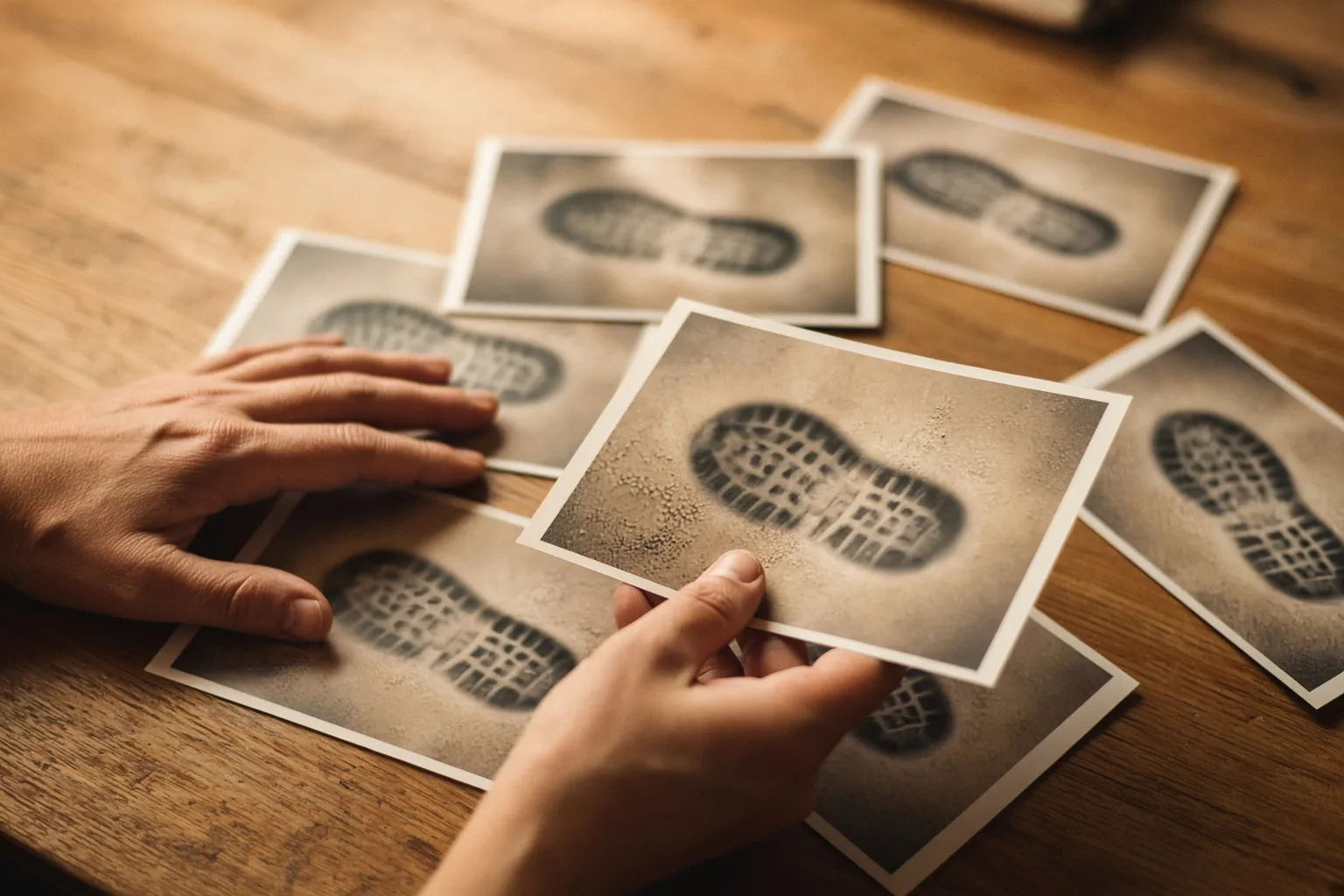
What can a reviewer check from the photographs in a report?
Whether each image has a suitable scale, whether perspective needed correction, whether the marked features are visible, whether test impressions were imaged the same way, and whether the images support the stated level of conclusion.
Laboratories run the same checks on their own images. The Footwear and Tire Examination Process Map, published by the NIST Forensic Science Research Program and the OSAC Footwear and Tire Subcommittee on June 8, 2022, tells the examiner to "Evaluate images of questioned impression(s) for quality." Its image assessment checklist asks "Scale present?" and "Scale type appropriate?" and whether correction is needed, with perspective given as the example. Step 3408 asks: "Is detail present?"
A reviewer applies the same list to the images the report contains, image by image. A missing scale, an uncorrected angle or a feature too faint to see is recorded with the page or figure number.
The 2006 Guide for the Examination of Footwear and Tire Impression Evidence of SWGTREAD requires that "Examinations conducted, procedures utilized, evidence photographed, and conclusions reached should be documented." The list of photographs in the file tells the reviewer what exists beyond the pages printed in the report.
Why do the scale and the camera angle matter to a review?
Because size is part of the comparison. The SWGTREAD guide tells an examiner who finds a difference in physical size to consider scaling and perspective first, and a reviewer without a scale cannot check the measurements at all.
Under section 6.7.2.1 of the SWGTREAD guide a questioned impression differs from a known shoe or tire if the "specific design and/or physical size and shape of design" differ. The note to that section reads: "If physical size is different, consider scaling, perspective and other issues."
The OSAC process map asks the same question in the comparison stage: is the impression shown at natural size, 1:1? It also asks whether significant limitations exist. An image printed in a report without a scale, or reduced to fit a page, cannot answer either question.
The scene photograph matters for the same reason. Evidence guidance titled "Tools and Tool Marks," posted on the Maine State Police website, asks that a mark be photographed with a scale before anyone handles it and that its location and orientation in the scene be recorded. A reviewer compares the report's scene images with those instructions.
Do the examiner's markings on the photographs affect the review?
Yes. Arrows and outlines show what the examiner saw but can also guide the reader. The OSAC map describes blind verification in which the second examiner receives non-annotated images, and a reviewer asks for the same.
The process map gives laboratories a choice in the verification stage. The question "Conduct blind verification?" leads, if answered yes, to the instruction "Provide next examiner with non-annotated impression images." In non-blind verification the verifier may receive everything, including the marked features and the case notes.
For a review, annotated images record the examiner's reading: which features were counted and where. Unmarked images let the reviewer form a reading first and compare it with the examiner's afterwards. The map's verification considerations also mention providing all examination documentation, such as layers and markups, so the file can hold both versions.
The request to the prosecution or the laboratory therefore names both: the annotated comparison images and the same images without annotation.
What cannot be checked from photographs?
Microscopic striations compared under a comparison microscope, three-dimensional detail in a cast examined under changing light, the condition of a lift, and whether the items examined are the items seized. Those need the evidence or the file.
Toolmark comparison is microscopic work. The crime laboratory of the Missouri State Highway Patrol describes how the examiner makes test marks with the suspect tool and compares the "minute scratches (striations)" on them with those on the evidence under a comparison microscope. A printed photograph shows one field of view chosen by the examiner. The comparison itself can be repeated only with the marked item and the test marks.
Casts are examined under lighting after they are dried, cleaned and, if needed, reassembled, according to step 3000 of the OSAC map. Gel lifts and electrostatic lifts are assessed for damage, debris and handling. A photograph of a cast or a lift carries none of that assessment with it.
Identity of the items is a separate question. In the technical assessment stage of the map the laboratory documents the evidence, checks packaging and chain of custody and inventories the items. Those records, not the photographs, show that the shoe in the images is the shoe that was seized.
Does a toolmark examiner photograph the whole comparison?
Not as a rule. A laboratory procedure quoted in the AFTE Journal in 2003 required at least one photograph of a significant identification match and said that not every match needs a photograph.
Bruce Moran of the Sacramento County District Attorney Laboratory of Forensic Services made the case for photo documentation in the AFTE Journal, volume 35, number 2, spring 2003, in an article titled "Photo Documentation of Toolmark Identifications" with the subtitle "An Argument in Support." He quotes his laboratory's procedure: "At least one photograph illustrating an identification match that is significant to the case must be taken." The same procedure states that "it is not necessary to photograph every identification match in a case."
Moran describes his own practice in the same terms. Photographs are "not intended as a primary means of effecting a toolmark identification." He writes that "photographing the entire toolmark comparison is seldom necessary to provide sufficient documentation" and that "I photograph agreement, not disagreement."
The images in a toolmark file are therefore a selection the examiner made to show agreement. Areas the examiner examined and set aside do not appear in them. The procedure Moran quotes says that photographs "are inherently limited in their ability to record all detail observed by the examiner," and a review based on photographs states the same limit in its own text.
Moran himself asks for more than the minimum. He writes that "other examiners must be able to repeat the work and come to the same conclusions," that his laboratory takes several photographs so that peer reviewers "will have a reasonable expectation of seeing what the opinion was based upon," and that "I believe that photographic documentation should be a requirement for all toolmark examiners."
What can a reviewer check in toolmark comparison photographs?
Whether the right items were compared, whether the marks were viewed in the same plane, whether the lighting was similar on both items, and where on the item the compared area lies.
Moran lists what photographs give a reviewer. They provide "verification that the correct evidence items were actually compared and not inadvertently mixed up." For fired bullets they record whether "the shoulders of rifling impressions in question" were properly aligned when the agreement was observed. For toolmarks they record whether the marks were "being viewed in the same plane (indexed properly)." A reviewer can also ask, in Moran's words, "were the lighting conditions similar between the exhibits being compared."
Orientation is a separate check. Moran takes "photographs at low magnification to orient the jury to the specific location(s)" of the agreement, and he cites California guidelines of 1991 under which "class characteristics or other easily recognized reference points should be included" in the field of view. A close-up without a reference point cannot be placed on the item, and the reviewer records that for each such image.
Annotation is the third check. Moran lays "clear transparent overlays over the photos" and makes "notations of consecutive matching striae with marking pens on the overlays." The marked overlay records the examiner's count of matching striae. Where the file holds both, the reviewer compares that count with the unmarked photograph under the overlay.
What limits of photographs have toolmark examiners themselves described?
A photograph is two-dimensional while the mark is three-dimensional, and one frame records one field of view. Moran quotes both objections and answers them with iris adjustment and overlapping photographs.
Moran collects the objections that earlier authors raised against photographing toolmark comparisons. He quotes Roberts: "the actual identification is three-dimensional while a photograph is only two-dimensional." Roberts also called photography "time consuming and unnecessary to accurate analysis in the average case." Moran then quotes Jury and Weller: "You photograph only what you can see at one single time." Jury and Weller also wrote that "these pictures were not understood by juries."
Moran answers each point. Adjusting the iris diaphragm often brings the whole field into focus, and he writes that "Depth of focus is then, really a non issue." For the single field of view he uses overlapping photographs. Where fine detail cannot be captured, "I photograph what I can, and describe the limitations due to fine/subtle detail present."
Jury and Weller warned that "Clever defense attorneys, by stressing lines in photographs that do not match, create a doubt." Moran's reply is that the examiner explains in advance that the photographs show only a minimum basis for the opinion. A reviewer who points to lines that do not match in a printed photograph is testing the record, and the next question goes to the bench notes made at the comparison microscope.
Roberts also saw supervisory checks of photographs as "a way to allow a supervisor the easy way out of doing a thorough job." Moran rejects that view and says photographs let a reviewer find the critical areas again. On cost he writes that a digital image costs "a few cents" and that a Polaroid photograph takes a few minutes.
What must a footwear examiner's notes contain for a review from the file?
Under the 2008 SWGTREAD documentation guide, enough detail for another competent examiner or supervisor to evaluate the work fully, including the characteristics that formed the basis of the opinion and a description of the images used.
The Guide for Casework Documentation issued by SWGTREAD in March 2008 sets the level in section 6.5.1: the notes give detail sufficient "to allow another competent examiner or supervisor to fully evaluate" the examination and the conclusions. They document the class, wear and individual characteristics "that were observed and formed the basis for the examiner's opinion."
Images belong to that record. For digital media, negatives, prints and video used in the examination, the guide asks for the format and a description of the content (sections 6.3.4 through 6.3.7). Under section 6.5.2 the comparison may be recorded in annotated photographs, with arrows, lines or symbols marking the details used, or in overlays of test impressions on photographs of the questioned impression.
Known shoes are described by brand, size, outsole design, condition and label information, with the date of collection and the person they were collected from (section 6.4.1). Tires are described by manufacturer, model, size, DOT number, design, condition and mold number, with the date of collection, the vehicle and the position of the tire (section 6.4.2). Test impressions are described by medium, source, shoe or tire information and quality (sections 6.4.3 and 6.4.4). A reviewer working from photographs checks whether each image in the report can be matched to an item described in the notes.
Which images should the file of a footwear comparison contain?
Images of each questioned impression with its own identifier, images of the known items and test impressions, the side-by-side or overlay comparison images, and the table of images and contact sheets of the draft report.
The OSAC process map follows the images through the examination. Under step 3400 multiple questioned impressions are labeled with unique identifiers and the images can be archived. For known items the examiner reviews submitted images for quality and asks: "Do the submitted images contain sufficient detail for further examination?" Test impressions are made by 2D methods, such as powder, adhesive overlays and ink, or by 3D methods, such as sand, dirt and Biofoam, and are then imaged.
In the comparison stage, step 8202 compares the questioned impression with the test impression or the outsole or tire "using side by side and/or overlaying." Step 8218 asks whether the examiner is confident that the impression is at natural size, 1:1, and step 8222 whether there are significant limitations, such as limited quality or quantity. Step 8244 asks whether the randomly acquired characteristics have enough quality, quantity and complexity that the examiner would not expect the same combination on a different shoe or tire.
Step 9042 lists the parts of the draft report, among them images, a table of images and contact sheets. The table of images names the images that exist beyond those printed in the report, and the request for the file lists them by number.
How does a reviewer tie the photographs to the items that were seized?
Through the records around the images: packaging and inventory notes, descriptions that set each item apart, the date and source of each known shoe or tool, and the chain of custody entries of the laboratory.
The SWGTREAD documentation guide asks for the original packaging, its condition and source information (section 6.1), an inventory marked under laboratory policy (section 6.2) and a description of each item good enough for it "to be distinguished from other similar items" (section 6.3). For known shoes the notes record when they were collected and from whom.
The OSAC map has the laboratory "Document chain of custody information" and "Open package (outer container) and inventory all items received" during the technical assessment. For tools, the Maine State Police guidance asks that the tool be photographed before handling, with its location and condition recorded.
Moran names the same purpose for photographs: "verification that the correct evidence items were actually compared and not inadvertently mixed up." A reviewer matches each image in the report to an inventory entry and an item description. An image that matches no entry is listed with its figure number, and the request for the file names it.
What does a reviewer write when a feature in the report is not visible in the images?
That the conclusion cannot be verified from the materials provided, with the figure number and the feature. The finding is about the record. It does not prove the feature absent from the shoe or the mark.
The SWGTREAD guide warns in the other direction too: "Due to varying circumstances, not all individual characteristics will reproduce in every impression," and "the absence of an individual characteristic is not a basis for elimination." A reviewer who cannot see a feature in a photograph therefore does not claim that the feature does not exist.
What the reviewer can state is that the report's record does not support its conclusion at the level stated. Under Rule 702(b) the testimony must be based on sufficient facts or data, and the 2023 committee note treats the sufficiency of the basis as a question of admissibility for the judge. A report whose decisive features cannot be seen in its own images raises that question.
Under Rule 705 an expert may state an opinion without first testifying to the underlying facts or data, but the expert "may be required to disclose those facts or data on cross-examination." A list of invisible features with figure numbers turns into cross-examination questions.
How does a laboratory report itself describe items without useful detail?
It says so. In a sample toolmark report used in the Firearm Examiner Training course, a padlock shackle "bears no microscopic marks of value for comparison purposes," and other items had only limited marks of value.
The sample report, credited to the National Forensic Science Technology Center (2008), reports on 37 items. A telephone cord had "only extremely limited microscopic marks of value for comparison purposes," and no conclusion was reached about the two knives submitted with it. Chain links cut by a pinching-action tool were not identified to the submitted bolt cutters because of "a lack of corresponding microscopic marks." Copper power line sections compared with each other gave no conclusion: "Due to a lack of sufficient corresponding microscopic characteristics, no conclusion could be reached."
Those sentences give a reviewer a vocabulary. When a report under review reaches an identification on an item that its own photographs show as worn, smeared or out of focus, the reviewer compares the claimed detail with what similar reports call no marks of value or insufficient correspondence.
How does the defense get access to the shoe, the tool or the marked item?
In a federal criminal case, by a request under Rule 16(a)(1)(E). The government must let the defendant inspect and copy or photograph items material to preparing the defense, intended for use at trial or obtained from the defendant.
The same rule covers reports. Under Rule 16(a)(1)(F) the government lets the defense inspect and copy or photograph the results or reports of scientific tests that are in its control and that the attorney for the government knows of or could know of through due diligence. Under Rule 16(a)(1)(G) the government gives a signed written disclosure of each expert's opinions, the bases and reasons for them and the witness's qualifications. The court sets that time by order or local rule, and it "must be sufficiently before trial to provide a fair opportunity" for the defense to meet the evidence. Rule 16(a)(1)(E) covers items "within the government's possession, custody, or control."
Disclosure runs both ways. If the defense requested and received the government's reports and expert disclosure, Rule 16(b)(1)(B) and (C) require it, at the government's request, to provide the reports and expert information it intends to use. A reviewer whom the defense calls at trial falls under those provisions.
A request based on a photographic review is specific. It names the items, the images that could not be assessed and the reason: no scale, no unmarked version, insufficient detail, or a feature that only the original item can show.
May a reviewing expert rely on the other side's photographs at all?
Yes. Rule 703 lets an expert base an opinion on facts or data in the case that the expert was made aware of. If experts in the field reasonably rely on such data, it need not be admissible.
The rule reads in part: "An expert may base an opinion on facts or data in the case that the expert has been made aware of or personally observed." The rule continues that if experts in the particular field would reasonably rely on those kinds of facts or data in forming an opinion on the subject, "they need not be admissible for the opinion to be admitted." Photographs taken by the opposing laboratory are facts or data of that kind. The reviewer's report says which images were used and what they could and could not show.
The limits of a photographic review are part of the opinion. The 2023 note to Rule 702 asks forensic experts to avoid assertions of absolute or one hundred percent certainty where the method is subjective and potentially subject to error. A review that states what the photographs could not show keeps to that limit.
What should be sent to a reviewer working from photographs?
The report, every image in the file in the best available copy, the unmarked versions of comparison images, scene and lift images, images of test impressions or test marks, the bench notes and any verification record.
The OSAC map lists the documentation that a verifier receives: all examination documentation, such as layers and markups, and the comparison conclusion. A reviewer needs the same set. The scene images taken before lifting, the lift images and the test impression images make the comparison readable step by step. Under section 6.5.2 of the 2008 SWGTREAD documentation guide a footwear examiner's notes may consist of annotated photographs and overlays, so the request names those as well.
The trial date, the disclosure deadlines and the date on which the defense received the report go with the materials. They set the time for any request to inspect the items.
Will a crime laboratory compare a footwear impression from photographs alone?
Yes, if the photographs are of examination quality. The Florida Department of Law Enforcement says its analysts use examination quality photographs first and that general scene photographs often lack the detail a proper comparison needs.
The footwear and tire FAQ of the Florida Department of Law Enforcement (FDLE) describes the order of work in its laboratory. Analysts "will use examination quality photographs first." Photographs of the scene help recreate it and show where an impression lies, but they "often do not contain the level of detail needed for a proper comparison." For tires the FAQ adds that photographing a tire "limits the comparison but may be helpful in eliminating a tire."
The Indiana State Police Physical Evidence Bulletin PEB-12, Footwear and Tire Impressions, version 12 issued on October 20, 2025, explains in section G what each result means. Under G.5 an impression agreed in shape and tread design with the submitted shoe or tire, "however, due to the lack of a scale present in the photographs, the size of the impression was unable to be compared."
The Footwear Manual of the Alaska Scientific Crime Detection Laboratory, version 9.0, effective May 6, 2024, lists the factors behind its conclusion of Limited Association of Class Characteristics. They include "insufficient detail, lack of scale, improper position of scale, improper photographic techniques." A reviewer who finds the same faults in the images of a report asks why the conclusion was not limited in the same way and records the figure numbers.
What should the scene photographs of an impression or a tool mark show?
Where the mark lies, the mark with and without a scale, and the mark before anyone lifts, casts or processes it. The Indiana State Police bulletin and a 2016 handbook chapter by the Petracos set these steps.
Nicholas Petraco and Nicholas D. K. Petraco wrote the chapter on footwear and tool mark evidence in the Forensic Science Handbook, Volume II (CRC Press, 2016). Their crime scene procedure asks for four kinds of photographs, the widest first and macrophotographs last, and tells the photographer to "take photographs with and without using a scale." The location of each item is documented in its original position by measuring and sketching. For tool marks the chapter repeats the series of views and provides for a NIST traceable scale in the field of view.
The Indiana bulletin asks that each item of evidence be photographed with a photo evidence marker and "both with and without a scale" (section A.2). Under section A.3, "All impressions should be photographed prior to any attempt to lift or cast them." FDLE asks for scales that carry identifying markers, numbers or letters, so that analysts can match the photographs with the lift or cast recovered afterwards. For tire tracks longer than 24 inches a tape measure runs along one side to join overlapping photographs, and a separate marked scale is still placed at the depth of the impression.
A reviewer reads the scene images of a report against these steps. The review notes whether a view with a scale exists for each mark, whether the marker in the photograph matches a lift or cast in the file, and whether the mark was photographed before lifting, casting or chemical treatment. A close-up without a wider view cannot be placed in the scene, and the review lists it by number.
What makes a footwear photograph examination quality?
A scale in the plane of the impression, a camera directly overhead on a tripod, the impression filling the frame, the highest resolution, lossless files and light from several angles. The Indiana bulletin lists each requirement.
Section A.4 of PEB-12 sets out comparison quality photographs. "A scale should always be included in comparison quality photographs," and "The scale should be in the same plane as the impression," which may mean digging a trench next to the impression. The photographs are "taken from directly overhead using a tripod so that the back of the camera is parallel to the impression," and that position lets the photograph be sized to 1:1. The bulletin recommends F/11 or F/16, a shutter speed of 1/60 of a second when a tripod cannot be used, the highest resolution setting of the camera and an impression that fills the frame of the viewfinder.
Files have their own rule. Images "should be captured, stored, and transmitted without compression or with lossless compression." The bulletin explains that JPG "can result in pixels being altered in the image" and should not be used to capture an image meant for comparison. Digital photographs submitted to the laboratory must be at least 1000 pixels per inch, and any deviation in image quality needs the approval of the Microanalysis (Trace) Unit Supervisor or an Electronic Evidence Custodian (section A.4.i.iv).
For three-dimensional impressions a detachable flash is held about three feet away at angles of about 25, 45 and 65 degrees. At least one photograph is taken at each angle while the flash is moved around the sides of the impression, "for a total of nine photographs of the impression" (section A.4.h).
A reviewer compares the images of a report with this list. A JPG file, a photograph taken at an angle, a scale lying above the floor of a deep impression or a single direction of light is recorded with its figure number and its consequence: an error in size, a distortion of shape or detail left in shadow.
How can a reviewer tell whether an image was enhanced?
From the file. Under the Alaska footwear manual the captured image is the permanent record, the History function records each Photoshop step, and enhanced versions are stored so they cannot be altered.
The footwear procedure in the Petraco chapter reads: "If Chemical enhancement is necessary, ALL Questioned Footwear PRINTS SHOULD BE PHOTOGRAPHED AS RECEIVED AT THE LABORATORY BEFORE ENHANCING." The chapter warns that the procedure "MAY RESULT IN DESTRUCTION OF THE ORIGINAL EVIDENCE" and draws the rule: "THEREFORE, ALL PHOTOGRAPHS MUST BE TREATED AS EVIDENCE."
The Alaska manual sets the file rules. "All casework imaging for examination purposes should be captured in RAW file format (digital photography) or in the TIFF file format (scanning)," and these images are acquired to the ADAMS repository "as the permanent record." "All Photoshop installations used for digital processing must have the History function enabled," and "Enhanced versions of images used in analysis/comparison will be stored in such a way that the image and metadata are maintained in an unalterable fashion." Scanned evidentiary images are taken at the maximum resolution of the scanner, with nothing below 500 ppi recommended.
The Indiana bulletin puts the burden on the agency that took the pictures: "Agencies need to prove that the digital images have not been altered prior to submission to the FSD." The Interpol review of marks and impression evidence for 2019-2022 describes a case published by Daniel and colleagues in 2021. After amido black processing a bloodstained shoe impression blended into the flooring; the laboratory isolated the print with the channel mixer in Photoshop, and that led to an identification. The review cites the case for photographing impressions before chemical processing.
A review therefore asks for three things: the image as captured, the enhanced image used in the comparison and the record of the steps between them. A report that prints only the enhanced image does not let the reviewer see what the processing added or removed.
Is there a general standard for comparing photographs?
Yes. SWGDE Best Practices for Photographic Comparison for All Disciplines, document 15-i-002, version 1.1 of July 18, 2017, names footwear, tire tread and tool marks among the disciplines that use photographic comparison.
The Scientific Working Group on Digital Evidence approved the document on June 22, 2017. It lists firearms and tool marks, document examination and footwear and tire tread among the disciplines that "utilize photographic comparisons" and leaves the photographic process to each of them: "Specific disciplines may have different standards for the photographic process for use in comparison."
The analyst identifies "issues of image formation, such as resolution, lighting, focus, and camera-to-subject geometry." The analyst makes copies of the selected imagery for use as working copies and "safely stores the received data." Images are enhanced as necessary with reference to ASTM Guide E2825 for Forensic Digital Image Processing, and "The use of these techniques are documented per the unit's SOP."
Section 6.4 states: "Similarities and differences should be documented." The document adds: "The repeatability of the procedure and documentation of the workflow is of paramount importance." A report that lists only points of agreement, or gives no record of the steps between the received image and the compared image, falls short of that practice, and a reviewer cites the section.
Does a photograph of a three-dimensional impression show what a cast shows?
Not always. In a 2021 study by Larsen and Bennett, casts and 3D photogrammetry showed randomly acquired characteristics better than 2D photographs. FDLE notes that casts can capture random characteristics that photographs miss.
Hannah J. Larsen and Matthew R. Bennett of Bournemouth University published "Recovery of 3D footwear impressions using a range of different techniques" in the Journal of Forensic Sciences in 2021. Five shoes and their three-dimensional impressions in sand and soil were recovered by casting, 2D photography and structure-from-motion (SfM) photogrammetry. The authors conclude: "Casting and 3D SfM provide better visualization of randomly acquired characteristics." Of one damaged area they wrote: "The damage is visible in the 2D photograph but not as clearly visualized."
For the class descriptors of the sole pattern casting scored lowest, although its difference from 2D photography was not statistically significant (p = 0.97). SfM had a marginal advantage over photography, and the authors wrote that "these recovery methods are superior to casting." They also described the limit of a single photograph: "A light source from one direction may enhance some features and cast others into shade. This therefore requires multiple pictures to gain better visualization of the whole impression."
FDLE gives its own reasons for lifting and casting. Lifts record the accurate physical size of two-dimensional impressions, and black gelatin lifts "often capture the highest level of detail in an impression." Casts record the size of three-dimensional impressions and can capture random characteristics that photographs miss, and lifting or casting "can eliminate some photographic phenomena."
Where a report rests on detail in a three-dimensional impression, the request for the file names the cast, or photographs of the cast lit at several angles, as well as the scene photographs.
What have studies found about examiners who compare shoeprint images?
In studies summarized in the Interpol review of 2019-2022 literature, examiners compared shoeprint images under test conditions. Added case context changed how footwear examiners looked at the prints and raised consensus and accuracy.
Jonathan Charron, Catherine Currier, Philip Hess, Patrick Jacobs and Jeremy Zerbe wrote the Interpol Review Paper of Marks and Impression Evidence 2019-2022, published in Forensic Science International: Synergy, volume 6, article 100308, in 2023. Section 1.4 summarizes an eye-tracking study by Yu and colleagues (2021): "Twenty-three forensic footwear examiners performed an examination of 22 sets of shoeprints images." Additional contextual information changed how the examiners looked at the prints; consensus and accuracy rose, and the examiners rated the task as harder. The review states that "contextual information does influence the examiner's decision-making process."
Section 1.5 summarizes a study by Busey and colleagues (2022) in which examiners in fingerprint, footwear and toolmark work each "conducted 60 casework-like comparisons in their discipline using images" to compare strength-of-support conclusion scales with traditional scales. For footwear the two kinds of scale showed no large differences.
A reviewer working from photographs is in the position of the examiners in these studies. The review therefore records what case information the reviewer received with the images and in what order, and whether the reviewer saw the examiner's annotations before forming a reading of the unmarked images.
What does a laboratory's own technical reviewer get to see?
In the Alaska laboratory, the bench notes, test impressions, scaled photographs of impressions and, on request, the original items. Verification of High Degree of Association and Identification opinions uses the analyst's unmarked digital composite.
The Alaska Footwear Manual separates technical review and verification. In technical review, "The reviewing analyst will have access to the bench notes, test impressions, scaled photographs of impressions and the original items upon request." For an opinion of Association of Class Characteristics, "the technical review should confirm the calibration of the questioned impression and that the size of the known footwear is in correspondence."
For High Degree of Association and Identification, "verifications will be performed using the unmarked digital composite created by the original case Analyst." "The verifier will select the verification tag which will show them only the images in need of verification," marks findings on the composite and saves it as the verification composite. The manual does not describe this verification as blind: disagreements are discussed between analysts, and the verifier specifies the conclusion for each verification.
An outside reviewer works with less. The technical reviewer inside the laboratory could ask for the original items, while a reviewer holding the printed report has the images that were printed. The review states both sets: what the internal review had available under the manual and what the outside reviewer received, item by item.
Did a federal court exclude footwear testimony because the verification was not shown to be blind?
No. In United States v. Mahone (2006) the First Circuit found no evidence that ACE-V mandates blinded verification and held that the argument went only to weight, not admissibility.
On November 10, 2003, a man attempted to rob the Gardiner Federal Credit Union in Maine. Cynthia Homer, a forensic scientist of the Maine State Police Crime Laboratory, testified that a shoe found with Mahone's DNA "had made the impressions found on a stairway and a teller counter inside the credit union." She described the ACE-V method (analysis, comparison, evaluation and verification) and said that she "had made more than 11,000 footwear comparisons." On October 4, 2004, the jury convicted Mahone of attempted bank robbery and interstate transportation of a stolen vehicle.
Before trial, Judge Woodcock of the District of Maine held a Daubert hearing and admitted the testimony (United States v. Mahone, 328 F. Supp. 2d 77, August 6, 2004). The defense argued, among other points, that the qualifications of the peer reviewer were not shown and that there was no evidence the review was blind. In footnote 12 the court wrote that Homer's uncertainty about whether a reviewing examiner knows the first examiner's conclusions "is not a sufficient basis to determine the methodology is unreliable." In the text it wrote that the examiner "functions like a radiologist," directing attention to the relevant features.
On appeal (No. 05-1492, decided July 5, 2006), Senior Judge Hug wrote for the First Circuit. Homer had stated that she "had no idea whether the verifying examiner was 'blinded'", that is, whether he had not reviewed her report before his examination, and the government did not call the verifying examiner at trial. The court answered: "There is no evidence that ACE-V mandates blinded verification," and the argument "goes only to weight, not admissibility." It repeated from Daubert that "[v]igorous cross-examination, presentation of contrary evidence, and careful instruction on the burden of proof are the traditional and appropriate means of attacking shaky but admissible evidence."
When a court treats such points as weight, a review's findings about missing scales, invisible features or a verifier who saw annotated images supply the questions for cross-examination and the contrary evidence that the opinion names.
Has a court excluded a mark identification that left no photographs or notes?
Yes. In Ramirez v. State (2001) the Supreme Court of Florida held a knife mark identification inadmissible under Frye. The expert made no photographs of the casts and no notes of the basis for identification.
The case concerned the 1983 stabbing of a night courier. Robert Hart, a criminalist of the Miami-Dade Police Department, made a test incision with the suspected knife, made solid casts of the cut surfaces of the test incision and of the wound in the victim's chest cartilage, and compared the casts under a firearms comparison microscope. He concluded "to a degree of scientific certainty that both incisions were made by the suspected knife to the exclusion of every other knife in the world."
The opinion records the state of the file: "No photographs are made of the casts, Hart explained, because lay persons and those not trained in this procedure would be unable to understand the comparison process; similarly, no notes are made describing the basis for identification." The court added that the determination "is entirely subjective" and that "there is no minimum number of matching striations or percentage of agreement or other objective criteria that are used in this method."
In the opinion of December 20, 2001 (No. SC92975), written by Justice Shaw, the Supreme Court of Florida called the procedure "a subjective, untested, unverifiable identification procedure that purports to be infallible" and held that the testimony did not reach the threshold for admissibility under Frye. It wrote that under Hart's method a team of technicians trained by him "would be virtually impossible to challenge." The convictions for first-degree murder, armed robbery and armed burglary with an assault were reversed, and the knife itself could still be admitted "as conventional evidence of guilt."
Moran's AFTE article of 2003, quoted in the sections above, cites Ramirez in its argument for photo documentation. A review of a toolmark report whose file holds no images of the compared areas and no notes on the basis of identification names both gaps and cites the Ramirez opinion for them.
What if the impression was not preserved and only photographs remain?
Then the photographs carry the comparison. Under Arizona v. Youngblood (1988), failure to preserve potentially useful evidence is not a denial of due process unless the defendant shows bad faith on the part of the police.
The Indiana bulletin covers tires that cannot be kept. Tire test impressions are made while the tires are still on the vehicle, and "If tires are unable to be retained, high quality photographs of each section of each tire" are taken. The bulletin warns: "Not submitting the tires or photographs of the tires will limit the analyst's examination and conclusions."
In Arizona v. Youngblood, decided November 29, 1988, the police had collected the underwear and T-shirt of the boy victim, but "This clothing was not refrigerated or frozen," and it was not examined until January 1985. Chief Justice Rehnquist wrote for the Court: "unless a criminal defendant can show bad faith on the part of the police, failure to preserve potentially useful evidence does not constitute a denial of due process of law." The failure to refrigerate the clothing and to test the samples "can at worst be described as negligent," and "The police do not have a constitutional duty to perform any particular tests."
The dissent quoted the test of California v. Trombetta, 467 U.S. 479 (1984), for evidence whose exculpatory value was "apparent before the evidence was destroyed" and which the defendant could not replace with "comparable evidence by other reasonably available means." Illinois v. Fisher, a per curiam decision of February 23, 2004, applied the bad faith rule to a substance the police destroyed under established procedures and added that the Court had "never held or suggested that the existence of a pending discovery request eliminates the necessity of showing bad faith on the part of police."
Where an impression or a tire exists only in photographs, the defense has no item to inspect under Rule 16, and the review is written on the images alone. For each image it states what the image can support and which limit stops the comparison, such as size without a scale or detail without a second direction of light.
What does IAE do when the defense has only the report and its photographs?
IAE reviews the opposing examiner's report and file in US criminal defense and cargo loss cases where a shoe, a tire or a tool is linked to a mark, in up to 5 business days.
The IAE review page describes work for cases where the other side's examiner links a shoe, a tire or a tool to a mark. The review checks the case file against the standard for that kind of mark, including whether the verification is recorded and who performed it. Each point is tied to a page of the report or the bench notes and to a standard, a Justice Department rule or a ruling.
The client sends the report and whatever images and notes were received, and describes the task. The secretariat confirms receipt the same day, and within one business day IAE confirms the format, the cost, the deadline and the specialist from its registry. IAE confirms the questions and the specialist with the client before work starts.
Every specialist is a member of the public IAE registry, can be verified by Member ID or QR code and confirms in the document that he or she has no interest in the outcome. A review is evidence that the court weighs with the other materials, and neither IAE nor the reviewer guarantees the outcome. IAE is not a law firm: whether to request inspection of the items is counsel's decision.
Sources
- NIST Forensic Science Research Program and OSAC Footwear and Tire Subcommittee, Footwear and Tire Examination Process Map (Current Practice), June 8, 2022
- SWGTREAD, Guide for the Examination of Footwear and Tire Impression Evidence (03/2006)
- SWGTREAD, Guide for Casework Documentation (03/2008)
- Maine State Police, Tools and Tool Marks (evidence collection and packaging guidance)
- Missouri State Highway Patrol, Crime Laboratory Division, Firearms and Toolmarks section: Toolmarks
- Sample toolmark laboratory report, Firearm Examiner Training (2008), courtesy of the National Forensic Science Technology Center
- Federal Rule of Evidence 702 and committee notes (LII, Cornell Law School)
- Federal Rules of Evidence, Article VII, Rules 701-706 (28a U.S. Code, LII, Cornell Law School)
- Federal Rules of Criminal Procedure, Rule 16, Discovery and Inspection (LII, Cornell Law School)
- Moran B., Photo Documentation of Toolmark Identifications: An Argument in Support. AFTE Journal, vol. 35, no. 2, Spring 2003, pp. 174-189
- Florida Department of Law Enforcement, Forensic Submission FAQ: Footwear and Tire (Impression Evidence)
- Indiana State Police, Forensic Services Division, Physical Evidence Bulletin PEB-12, Footwear and Tire Impressions, version 12, issued 10/20/2025
- Alaska Scientific Crime Detection Laboratory, Footwear Manual, version 9.0, effective 5/6/2024
- Petraco N., Petraco N. D. K., Impression Evidence: Footwear and Tool Marks Cases from the Crime Scene to the Courtroom (chapter), in: Forensic Science Handbook, Volume II, CRC Press, 2016 (author's copy, John Jay College)
- SWGDE Best Practices for Photographic Comparison for All Disciplines, 15-i-002, version 1.1, July 18, 2017
- Charron J., Currier C., Hess P., Jacobs P., Zerbe J., Interpol Review Paper of Marks and Impression Evidence 2019-2022, Forensic Science International: Synergy, vol. 6, 100308 (2023)
- Larsen H. J., Bennett M. R., Recovery of 3D footwear impressions using a range of different techniques, Journal of Forensic Sciences, 2021, doi:10.1111/1556-4029.14662
- United States v. Mahone, No. 05-1492 (1st Cir. July 5, 2006)
- United States v. Mahone, 328 F. Supp. 2d 77 (D. Me. 2004) (Justia)
- Ramirez v. State, No. SC92975 (Fla. Dec. 20, 2001) (Justia)
- Arizona v. Youngblood, 488 U.S. 51 (1988) (LII, Cornell Law School)
- Illinois v. Fisher, 540 U.S. 544 (2004) (LII, Cornell Law School)
Read also
All articles
Can the prosecution use a toolmark or footwear report without calling the examiner who did the comparison?
A toolmark or footwear report rests on a comparison that a particular examiner made, and the case file can show who else made test marks, verified Sergei Voronin
Footwear and toolmark conclusion scales: what do identification, probably made and inconclusive mean in the examiner's report?
A footwear report can end with one of seven conclusions under the SWGTREAD standard of 2013 or one of six under the Department of Justice languageSergei Voronin
Contextual bias in footwear and toolmark examinations: what was the examiner told, and what does a reviewer check?
A footwear or toolmark examiner who knows that the suspect confessed, has a record or was linked by other evidence has received informationSergei VoroninExpert report review
Ready to discuss your case?
Send the materials: the secretariat will confirm the format, cost, deadline and the specialist within one business day.
