


Class and subclass
Under OSAC Proposed Standard 2024-S-0002, agreement of subclass characteristics cannot support a same-source conclusion. People v. Ross (N.Y. 2020) limited a firearm toolmark examiner to class characteristics.
 OSAC
 Subclass
Expert report review · Trace evidence
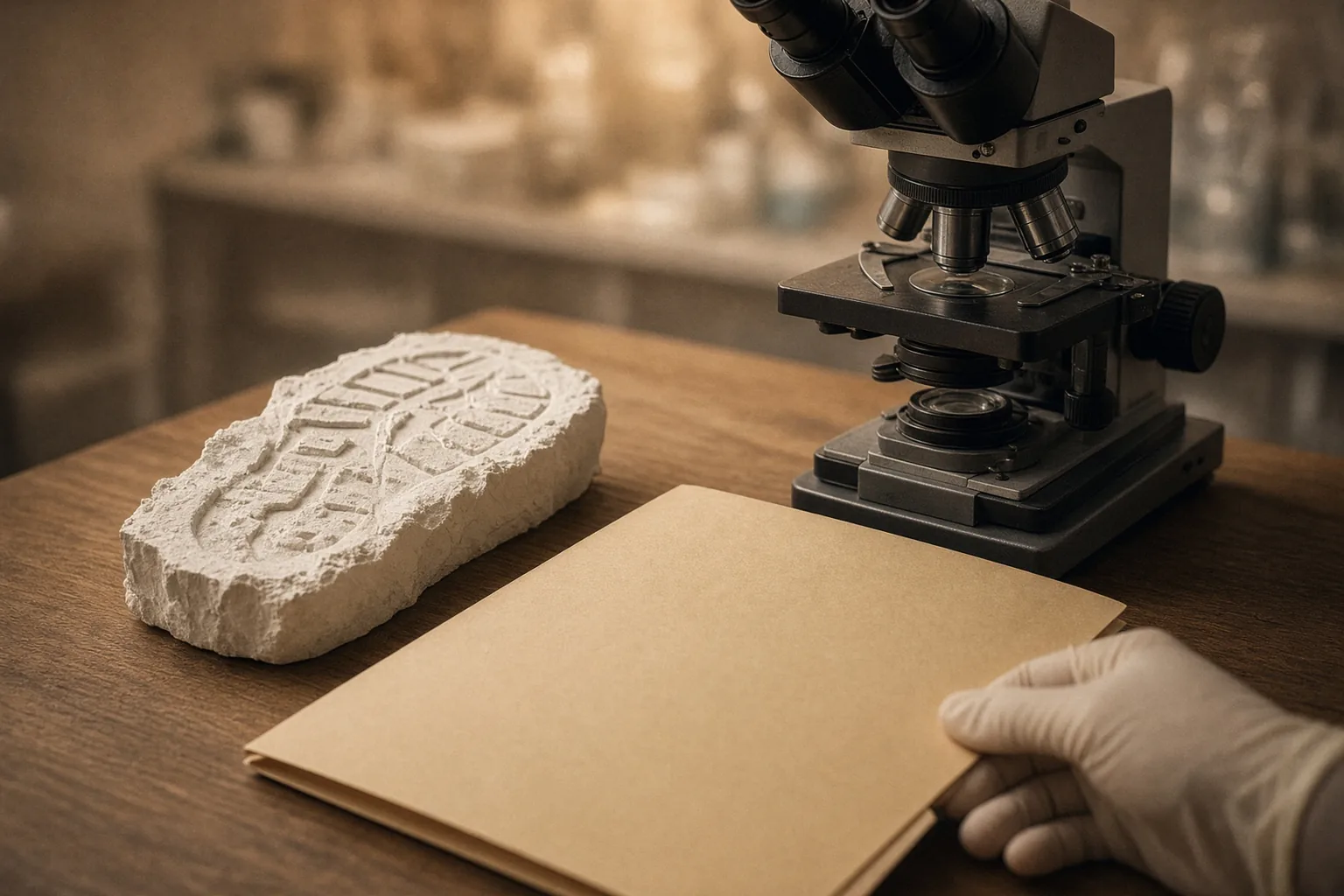
In US criminal defense and cargo loss cases where the other side's examiner links a shoe, a tire or a tool to a mark. The review checks the case file against the standard for that kind of mark, including whether the verification is recorded and who performed it. Up to 5 business days, or 48 hours on rush.

business days, rush 48 hours
Each point is tied to a page of the report or the bench notes and to a standard, a DOJ rule or a ruling.
Under OSAC Proposed Standard 2024-S-0002, agreement of subclass characteristics cannot support a same-source conclusion. People v. Ross (N.Y. 2020) limited a firearm toolmark examiner to class characteristics.
OSACSubclass
The OSAC draft requires notes that let another examiner understand the analysis without the specimens. A 2024 Rhode Island review, reported by the Rhode Island Current, faulted a verification that was not blind.
Notes Verification

The DOJ firearms/toolmarks ULTR (2023) bars claims of uniqueness, exclusion of all other sources, a zero error rate and absolute certainty. The ABA Journal reported that a Colorado judge rejected a 1993 opinion that pliers were the only tools in the world.
 ULTR
 Certainty

ULTR 2023DOJ language
Source identification, source exclusion or inconclusive. DOJ examiners may not cite their number of examinations as proof of accuracy or give statistics without relevant and appropriate data.

ULTR 2020footwear language
Source identification, two kinds of inclusion, inconclusive, support for exclusion and source exclusion. An inclusion must say that other indistinguishable footwear could have made the print.

2024-S-0002OSAC draft
Exemplars are made with appropriate materials and methods, compared with each other before comparison with the questioned mark, and preserved when used for a conclusion. Both are examined at the same magnification.

7022023 note
Forensic experts should avoid assertions of absolute or 100 percent certainty, or of a reasonable degree of scientific certainty, if the methodology is subjective and potentially subject to error.
IAE confirms the questions and the specialist with you before work starts.
How do I order?
Deadlines are confirmed at order and depend on the volume of materials. For cases with tight deadlines there is a 48‑hour rush.
Step 1
Send the report or the case materials and describe the task: what to check or examine. The secretariat confirms receipt the same day.
Step 2
IAE confirms the format, cost, deadline and the specialist from the registry within one business day. You approve the candidate and the CV before work starts.
Step 3
The specialist prepares the document; the draft is checked for facts. The signed PDF is issued in up to 5 business days; the expert is verified in the registry by QR code.
Error rates, claims of certainty, limits set by courts.
In a 2022 black-box study by Hicklin and colleagues, 84 examiners made 6,610 comparisons. Erroneous identifications were 0.2 percent of conclusions on non-mated pairs and erroneous exclusions 6.0 percent on mated pairs. Most erroneous identifications came from one participant, and examiners often disagreed on whether an impression was suitable for comparison.
Not under DOJ rules. The 2023 firearms/toolmarks ULTR bars any statement that two marks share a source to the exclusion of all other sources. The ABA Journal reported that in July 2023 a Colorado judge found that such a 1993 opinion about pliers and wire cutters would be rejected by the relevant scientific community today.
In Abruquah v. State (Md. 2023) the court barred an unqualified opinion that bullets came from the defendant's revolver and allowed testimony that marks are consistent or inconsistent with a firearm. People v. Ross (N.Y. 2020) limited testimony to class characteristics, while State v. Caneiro (N.J. 2025) admitted full identifications.
No. A review, an examination and a specialist opinion are independent expert opinions. IAE is not a law firm and does not advise on case strategy; legal questions are for your attorney.
Members of the public IAE registry with the relevant specialization: professors, doctors of science, holders of international certifications. The candidate and the CV are agreed with you before work starts.
Enter the Member ID from the document on the status check page or scan the QR code: the category, specialization, attestation date and record status open.
Request
Review of the opposing reportDeposition questionsNot sure
Hello, I am Sergei Tkach, Executive Director of IAE. Describe the case and the questions for the expert: within one business day we will reply with the right document, an available expert, the time frame and the fee.
Choose the field to see what the reviewer checks and how a review is used in court.

An engineer reviews the opposing construction expert's report: causation, testing, the data considered and the repair estimate.
RebuttalRule 702
A reviewer tests the opposing handwriting examiner's report against the examiner's file, the originals and ANSI/ASB Standard 070.
ReviewRebuttal
A reviewer tests the opposing examiner's report on alterations, ink and dating against ASB 011, ASB 035 and the SWGDOC ink standard.
ReviewInk
A physician in the relevant specialty checks the opposing medical expert report against the chart and Rule 702.
RebuttalRule 702
A psychologist reviews the opposing evaluation against the court order, the court rules for evaluators and the 2022 APA guidelines.
Work product reviewAPA 2022
An engineer checks the opposing reconstruction: inputs, reaction times, calculations, tests and simulations, and opinions that go past engineering.
RebuttalRule 702
A linguist reviews the opposing linguist's report: the texts considered, the method, and whether the conclusions go beyond the data.
RebuttalRule 702
A land surveyor reviews the opposing survey: record research, monuments, measurements and the reasoning behind the line.
RebuttalRule 702
A specialist checks the opposing defect report: what was inspected and tested, which causes were ruled out and how the goods were valued.
ReviewRebuttal
An accountant rebuilds the opposing damages or solvency report from the record and writes a rebuttal within the court's schedule.
RebuttalDamages model
An appraiser recomputes the opposing valuation step by step and prepares a rebuttal report or questions for cross-examination.
RebuttalUSPAP reviewA specialist checks the opposing origin and cause report: the data behind the origin, the hypotheses ruled out and the artifacts examined.
ReviewRebuttal
A reviewer checks whether another examiner could repeat the opposing work on messages, files or device data from the report alone.
Hash valuesRebuttalAn examiner reviews the opposing audio report: the file and its hash, the tests run, the voice exemplars and the wording of the conclusion.
RebuttalSWGDE
A technical expert checks the opposing report on infringement or validity against the claim construction, the contentions and the evidence cited for each element.
Claim constructionRebuttal
 Sergei Voronin
 Sergei Voronin
 Sergei Voronin


