
Examinations
Forensic image authentication: how does an examiner show that a photo was edited?
A photograph offered in federal court must be shown to be what the party claims it is, under Rule 901(a) of the Federal Rules of Evidence. When the other side says the picture was edited, a forensic examiner reads the file's structure and metadata, looks for traces of alteration in the image itself and compares it with pictures from the claimed camera or phone. SWGDE published version 2.0 of its image authentication best practices on March 3, 2025.
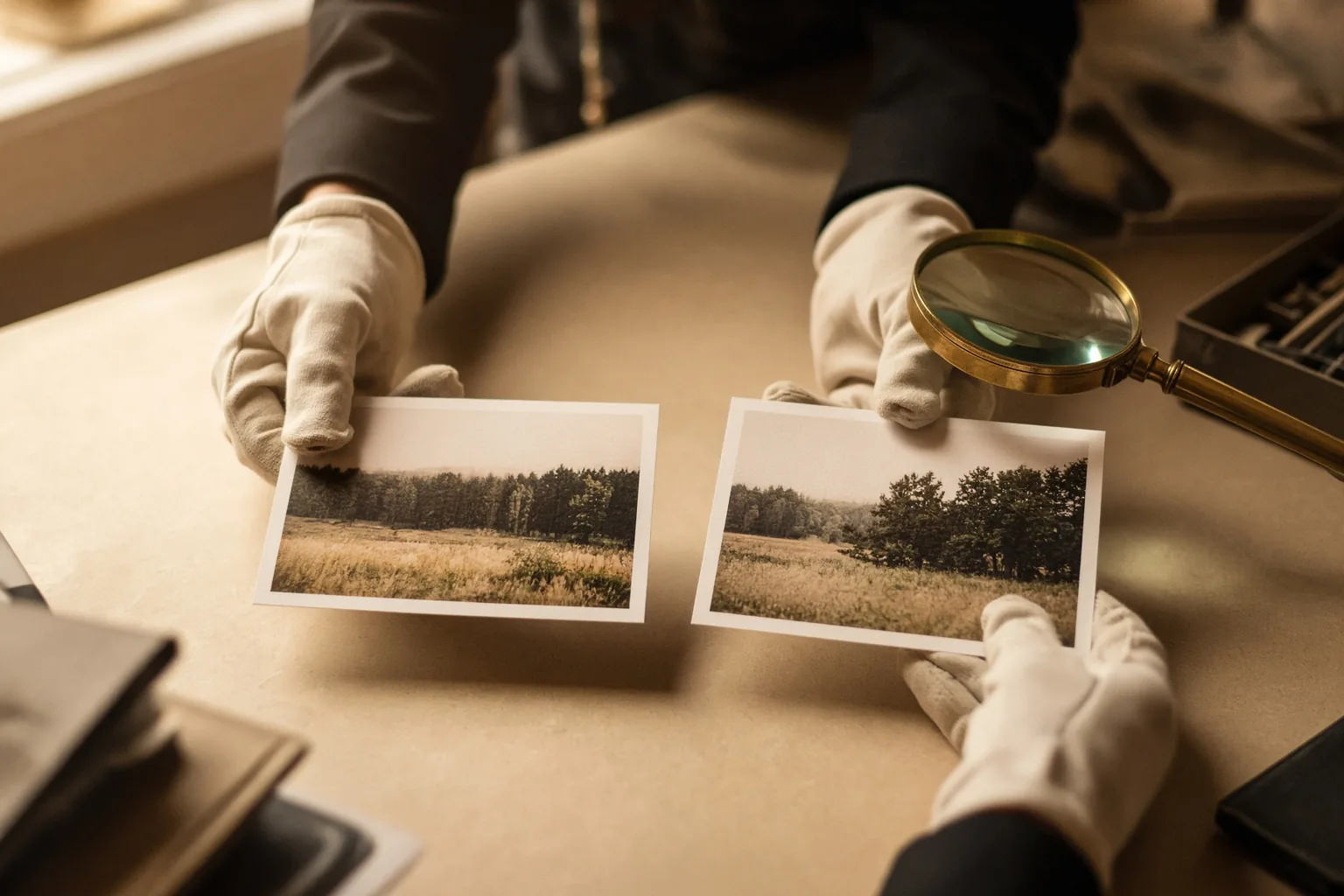
What does forensic image authentication answer?
Whether a questioned image is an accurate representation of the original data, and where it came from. It does not answer questions about what the scene contains; a matching hash value proves only that a copy equals its source.
The Scientific Working Group on Digital Evidence (SWGDE) defines image authentication as "the application of image science and domain expertise to discern if a questioned image or video" is an accurate representation of the original data, or to determine its original source. The definition is in section 3 of SWGDE 18-I-001, Best Practices for Image Authentication, version 2.0, dated March 3, 2025.
Section 2 of the same document draws two lines. Image authentication asks "whether the imagery is a true and accurate representation" of subjects and events; it does not answer content questions such as whether a specific object is present. It is also separate from integrity. A hash function can show that a copy matches its source, but it says nothing about whether the scene in the picture is true.
A party that wants to know whether a photo of a damaged car, a cracked wall or a text message thread was edited is asking an authentication question. A party that wants to know whether the file it received is the same file the other side produced is asking an integrity question, and the answer is a hash comparison.
What does a court require to admit a photograph?
Evidence sufficient to support a finding that the photograph is what the proponent claims it is. Rule 901(b) lists ways to meet it, including a witness with knowledge and evidence of an accurate process or system.
Rule 901(a) states that "the proponent must produce evidence sufficient to support a finding that the item is what the proponent claims it is." The simplest proof is a witness who took the picture or saw the scene and says the image shows it. Rule 901(b)(1) describes this as "testimony that an item is what it is claimed to be."
Other examples in Rule 901(b) fit a forensic examination. Rule 901(b)(3) lists "a comparison with an authenticated specimen by an expert witness or the trier of fact," which is how an examiner compares a questioned image with pictures known to come from the same phone. Rule 901(b)(4) accepts proof by "the appearance, contents, substance, internal patterns, or other distinctive characteristics of the item." Rule 901(b)(9) covers "evidence describing a process or system and showing that it produces an accurate result"; the advisory committee note names X-rays as "a familiar instance" and adds that "among more recent developments is the computer."
An examiner's report on an image can be used at three points: on admissibility, on the weight the jury gives the image, and on a motion for sanctions if the image turns out to be fabricated, as in the Second Circuit case discussed below.
Does the court need the original file or the phone?
Not always. A duplicate is admissible to the same extent as the original under Rule 1003, unless a genuine question is raised about the original's authenticity or admitting the duplicate would be unfair.
Article X of the Federal Rules of Evidence covers photographs. Rule 1001(c) defines a photograph as "a photographic image or its equivalent stored in any form." Under Rule 1001(d), an original of a photograph "includes the negative or a print from it," and for electronically stored information an original means any printout or other output readable by sight, if it is accurate. Rule 1001(e) defines a duplicate as a counterpart produced by a mechanical, photographic, chemical, electronic or other equivalent process "that accurately reproduces the original."
Rule 1002 requires an original photograph "in order to prove its content unless these rules or a federal statute provides otherwise." Rule 1003 provides the main exception: "A duplicate is admissible to the same extent as the original unless a genuine question is raised about the original's authenticity or the circumstances make it unfair to admit the duplicate."
If a claim that the photo was edited raises a genuine question about authenticity, the screenshot or the printout loses the protection of Rule 1003, and the party that relies on the image needs the file as it was first saved and, if possible, the device. SWGDE section 7 also requires that "the original imagery shall be preserved," with any processing done only on a working copy.
What does an examiner look for in the file itself?
The file format, the metadata, the container structure and the sensor noise. SWGDE calls these the image structure, or non-scene, analysis, and they are examined together with the picture's content.
SWGDE section 7 lists four kinds of image structure analysis. File format analysis checks whether the format fits the claimed source. Metadata analysis reads the camera make and model, the date and time, the GPS position and the processing history. Container analysis works at the level of the bytes: the header and footer, the Exif block and the bit-level structure of the file. Noise analysis looks at the photo response non-uniformity (PRNU) of the sensor and at other noise in the image.
Exif is the metadata format most cameras and phones write. The Library of Congress format description states that JEITA and the Camera and Imaging Products Association (CIPA) have managed the Exif standard jointly since 2009. Version 3.0 was published in May 2023 as CIPA DC-008-2023 and JEITA CP-3451F; version 2.31 appeared in July 2016, and GPS support was added in version 2.0.
Metadata alone does not settle authenticity, and SWGDE section 7 calls for the structure and the content to be examined together. What an examiner looks for is agreement or disagreement among the layers: whether the processing history names an editing program, whether the structure of the file matches files from the same phone model, whether the date in the metadata fits the date the witness gives.
What does an examiner look for in the picture?
Signs that part of the scene does not fit the rest: breaks in compression blocks, inconsistent lighting or scale, chromatic aberration, focus and lens distortion that differ across the frame, and evidence of staging.
SWGDE section 7 lists the image content, or scene, analysis. It covers artifacts such as chromatic aberration, breaks in compression blocking and motion vectors; physical aspects such as lighting, scale and physics; human characteristics; evidence of staging; and photographic conditions such as focus, depth of field, noise and lens distortion.
Appendix A of the document works through an example. The analyst examines the JPEG blocking of the image and compares a suspect region with the rest of the picture. The comparison is made region by region.
Section 7 calls for both kinds of analysis. An image with clean metadata and a pasted object fails on content; an image with a natural scene and an editing program in its processing history raises a structure question that the examiner has to explain.
Can an examiner tell which camera or phone took the photo?
Sometimes. Sensor noise known as PRNU can correlate images from the same source, and SWGDE describes comparing a questioned image with exemplar images taken with the questioned phone. A negative result does not exclude that phone.
SWGDE section 7 states that PRNU "can be used to correlate images from the same source." Appendix B gives the method in practice: PRNU patterns from the questioned images are compared with PRNU patterns from exemplar images captured with the questioned phones.
The comparison needs the phone or a set of pictures known to come from it. A party that claims a photo was taken on a particular phone should keep that phone, and a party that challenges the claim can ask for exemplars to be taken with it.
Section 8 limits what a weak result means: "the lack of information in support of camera source identification does not preclude the possibility" that the camera captured the image. An examiner who finds no PRNU match writes that the source could not be confirmed, not that the phone is excluded.
Can an examiner prove that a photo was not edited?
No. SWGDE states that it is impossible to prove a negative result, though a thorough examination can show that manipulation is unlikely. The strength of the conclusion depends on the quality and number of images examined.
Section 8 of SWGDE 18-I-001 says that "by definition, it is impossible to prove a negative result." A thorough examination that finds no sign of alteration supports the conclusion that manipulation is unlikely; it does not exclude every possible edit.
Section 4 adds that manipulations may not be adequately detected in a single image, and that authentication should use a series of images or a video when they exist. Section 9 ties the strength of results to image quality and quantity and warns: "Forensic practitioners should take care not to overstate results."
A finding of alteration stands on firmer ground. Section 8 states that when alterations are detected, the practitioner "may reach the conclusion that the imagery is not authentic."
What happened when a party produced a fabricated image of text messages?
In Rossbach v. Montefiore Medical Center, the district court found fabrication by clear and convincing evidence and dismissed the claims with prejudice. The Second Circuit affirmed the dismissal and the sanction against the plaintiff on August 28, 2023.
The plaintiff in that sexual harassment case produced an image, first as a PDF in May 2020 and later as a JPEG, showing three sexually suggestive texts said to come from her supervisor. At her deposition in October 2020 she testified that the messages were on an iPhone 5 with severe screen cracks and an ink bleed, and that she photographed them with a new iPhone X because the cracks prevented a screenshot. The defendants' discovery vendor could not unlock the iPhone 5 with the passcode she gave.
The defense expert concluded that the document was a forgery. According to the Second Circuit's opinion, the district court found that the file lacked metadata associated with a photograph taken on an iPhone X, that analysis of the image indicated it was "not a photograph at all," and that it did not depict texts as they would appear on an iPhone 5 or any iPhone: the icons, contact information, font size and style and emoji design differed.
The district court dismissed the remaining claims with prejudice under its inherent power and Rule 37(e) and fixed the monetary sanction at $157,026.27, imposed jointly and severally on the plaintiff and her attorneys. The Second Circuit affirmed the findings of fabrication, perjury and spoliation, the dismissal and the monetary sanction against the plaintiff. It vacated the sanction as imposed on her attorneys because the district court had made no explicit finding of bad faith.
What should an image authentication report contain?
The materials received, the request, the methods, the results, the basis for the opinion and the opinion, with its strength and limits stated. SWGDE also requires independent review by a comparably trained person.
Appendix A of SWGDE 18-I-001 lists the parts of a report: materials received, request, methods, results, basis for opinion and opinion. Section 8.2 asks the practitioner to report the observed features, including those that support the opinion, to state the strength of the opinion, to avoid numerical probabilities without a scientific foundation, to qualify the results and address limitations, and to evaluate the results against the propositions in the case.
Section 8.3 requires independent review of the results by a comparably trained individual. A report that does not say who reviewed the work, or that gives a percentage of certainty without a stated basis, departs from the SWGDE text.
For a retained expert in federal civil litigation, the report must also meet Rule 26(a)(2)(B) of the Federal Rules of Civil Procedure: all opinions with their basis and reasons, the facts or data considered, exhibits, qualifications, prior testimony and compensation.
What should a party send the examiner?
The questioned image in the best available form, ideally the file as first saved and not a forwarded copy, the device if available, other images taken with the same device, and an account of how the file reached the party.
SWGDE Appendix A records that the analyst confirmed that "the best quality images have been submitted." A screenshot, a print or a copy forwarded through a chat app is a later version of the picture; the file the camera or phone saved comes first.
The device matters for two reasons. It holds the original file and its place among the other pictures on the phone, and it can be used to take exemplars for a PRNU comparison under the method in Appendix B. Where the device is gone, other photos known to come from it can serve as reference material.
The examiner also needs the questions. Whether the photo was edited, whether it was taken on a given phone, and whether it was taken on the date claimed are three separate questions that call for different materials.
What does IAE do when a photo or image is disputed?
IAE prepares a digital forensics expert report on the client's questions, including traces of editing in images and PDFs, or a review of the opposing forensic report. The signed PDF follows in up to 5 business days.
The examiner reads creation and modification dates from document and file system metadata, looks for traces of editing in PDFs and images, compares a copy with the original by hash value, and compares screenshots of chats with the messaging app database extracted from the phone or computer. IAE frames the questions by the device, the application and the event the case needs to establish, and confirms the questions, the devices and how the data reach the examiner before work starts.
The client sends the materials and describes the task. The secretariat confirms receipt the same day, and within one business day IAE confirms the format, the cost, the deadline and the specialist from its registry. The client approves the candidate and the CV before work starts. The signed PDF is issued in up to 5 business days after the format and cost are confirmed, depending on the volume of data; cases with tight deadlines have a 48-hour rush.
Every specialist is a member of the public IAE registry and can be verified by Member ID or QR code. The specialist confirms in the document that he or she has no interest in the outcome of the case. IAE is not a law firm and does not advise on case strategy; whether to object to an image or to move for sanctions is a question for the client's attorney. A report is evidence that the court weighs with the rest of the record, and neither IAE nor the examiner guarantees the outcome.
Sources
- SWGDE, Best Practices for Image Authentication, 18-I-001, version 2.0, March 3, 2025
- Federal Rules of Evidence, Rule 901, Authenticating or Identifying Evidence, with notes (LII, Cornell Law School)
- Federal Rules of Evidence, Article X, Contents of Writings, Recordings, and Photographs, Rules 1001-1008 (LII, Cornell Law School)
- Library of Congress, Sustainability of Digital Formats, Exchangeable Image File Format (Exif) Family, fdd000618
- Rossbach v. Montefiore Medical Center, No. 21-2084 (2d Cir. Aug. 28, 2023) (Justia, full text)
- Federal Rules of Civil Procedure, Rule 26 (LII, Cornell Law School)
Read also
All articles
Electronic signature disputed: how do you prove who signed, and what does a forensic examiner check?
An electronic signature has legal effect, but the party that relies on it must show that it was the act of the person named. In Fabian v. Renovate Sergei Voronin
How do you authenticate social media posts for court, and what does a forensic examiner add when the account is disputed?
A printout of a social media page proves that the page existed. It does not prove who wrote the post. In 2014 the Second Circuit vacated a convictionSergei Voronin
Spyware on a phone: how does a forensic examiner find it, and what can the evidence be used for?
A forensic examination for spyware establishes whether a monitoring app is on the phone, when it appeared, what it collected and where it sentSergei VoroninExpert examinations
Ready to discuss your case?
Send the materials: the secretariat will confirm the format, cost, deadline and the specialist within one business day.
