
Examinations
Spyware on a phone: how does a forensic examiner find it, and what can the evidence be used for?
A forensic examination for spyware establishes whether a monitoring app is on the phone, when it appeared, what it collected and where it sent the data. Researchers who studied 30 stalkerware apps in 2024 found that 20 of them left account credentials, dashboard addresses or access tokens on the device. Federal law punishes intercepting another person's communications with up to five years in prison and lets the victim sue for $100 a day or $10,000, whichever is greater.
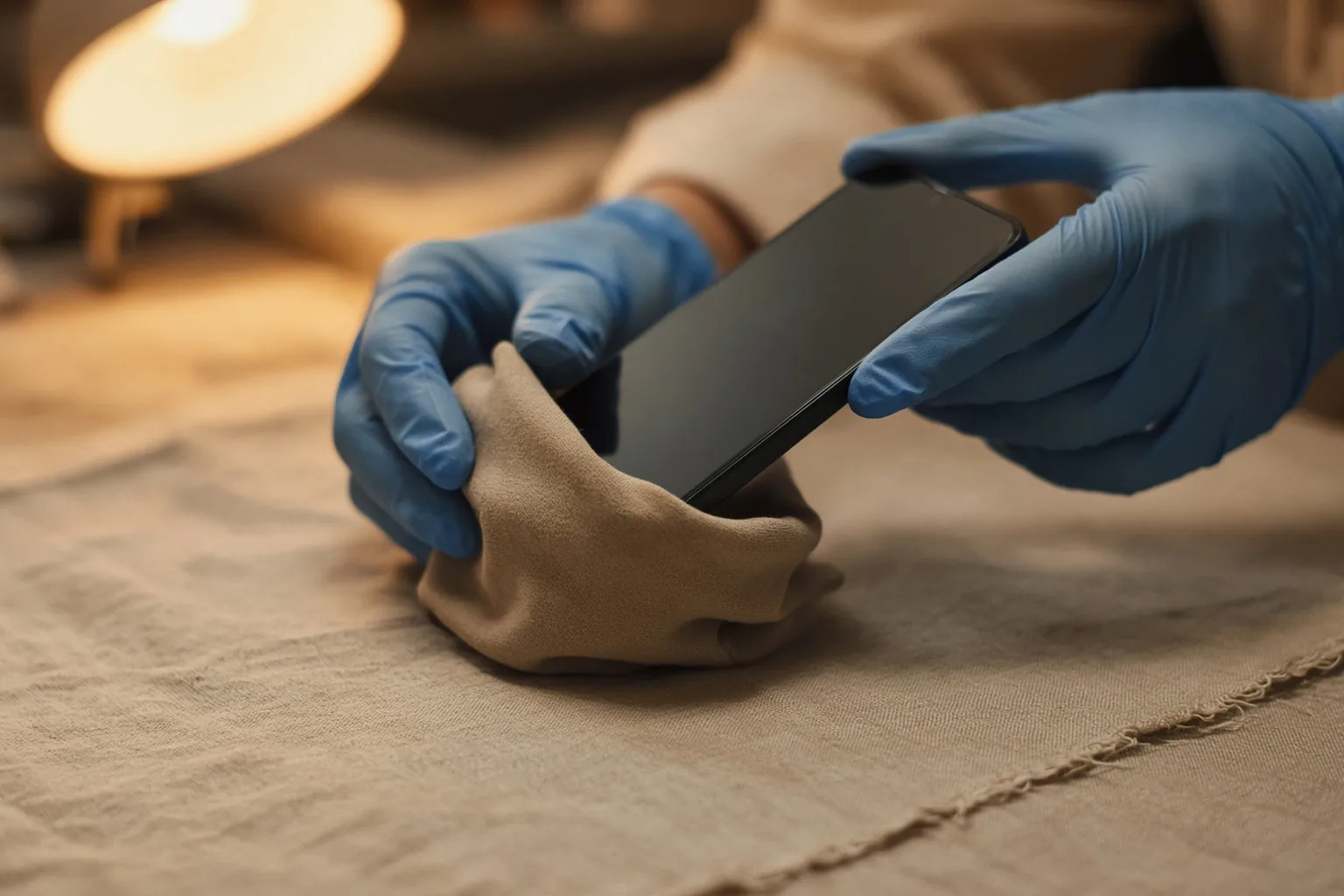
What does a forensic examination for spyware establish?
Whether a monitoring app is installed, when it appeared, which permissions and data it used, what it stored on the phone and which servers or accounts it reported to. The answer comes from device data, not from symptoms.
Suspicion is a reason to look, not a finding. The Safety Net Project of the National Network to End Domestic Violence, in its evidence collection guide on mobile spyware, advises first asking whether friends or relatives knew the information, or whether the abusive person is connected to a third party who can see that activity, and states that "direct evidence of spyware on a mobile device can only be obtained with the help of a forensic professional."
The examiner works from a copy of the device data. The questions are concrete: which app, under which name, installed on which date, with access to location, messages, microphone or accessibility functions, and with which servers it communicated. Each answer comes from the phone's own records, and the report states which tool and version read them.
The same examination can show the opposite. A report that finds no monitoring app after a full extraction gives the client a documented answer and a reason to look for the leak elsewhere.
What should a person do with the phone before the examination?
Keep the phone and its data intact and avoid a factory reset, which erases the data an examiner needs. The NNEDV guide suggests using the phone as though nothing is wrong and changing passwords only from a separate, safer device.
The NNEDV guide tells advocates to "protect all of the mobile device's data." It notes that some people feel safest getting rid of the phone or doing a factory reset, and that it is important to speak with survivors about the pros and cons of this strategy. A reset erases the data that a later examination would read.
The guide describes using "the phone as though nothing is wrong" as one of the safest options, because it avoids tipping off the abuser and leaves time to collect evidence. It also warns that "if spyware is on the device, it is not safe to change passwords on that device," and recommends changing them from a separate, safer device.
Safety comes first. The guide tells advocates to "help the survivor to make a safety plan" in case the abuser's behavior escalates during the investigation.
What traces does stalkerware leave on a phone?
Researchers presenting at DFRWS EU 2024 found that most stalkerware stores private information locally on the compromised device, and that 20 of 30 tested Android apps left account credentials, dashboard URLs or API tokens there.
Philippe Mangeard, Bhaskar Tejaswi, Mohammad Mannan and Amr Youssef presented WARNE, a stalkerware evidence collection tool, at DFRWS EU 2024. They identified 50 unique stalkerware apps whose download websites were reachable; 30 of them were free or offered a free trial and were tested.
Their abstract reports that most of these apps store private information locally on the compromised device, and that the tool found "account credentials, dashboard URLs, and API tokens in 20 apps out of 30 tested apps." Such data can point to the abuser's account or to the stalkerware company that runs the service.
For a case, those traces carry more weight than the app itself. An installed app proves that monitoring was possible; a dashboard address and an account identifier stored by the app show where the collected data went and which account received it.
Is putting spyware on another person's phone a federal crime?
Intercepting another person's communications without consent can be. 18 U.S.C. 2511(1)(a) punishes whoever intentionally intercepts any wire, oral or electronic communication, with up to five years in prison under 2511(4)(a).
Section 2510(4) defines intercept as "the aural or other acquisition of the contents of any wire, electronic, or oral communication" through a device. Section 2511(1)(a) applies to anyone who "intentionally intercepts, endeavors to intercept, or procures any other person to intercept" such a communication. Under section 2511(4)(a), a violator "shall be fined under this title or imprisoned not more than five years," or both.
Section 2511(2)(d) contains the consent exception: a person not acting under color of law may intercept a communication if he is a party to it or one party has given prior consent, "unless such communication is intercepted for the purpose of committing any criminal or tortious act." The exception covers a party to the communication; a person who installs an app on someone else's phone to read that person's conversations with others is not a party to them.
Section 2512(1)(b) reaches the tools. It applies to anyone who "manufactures, assembles, possesses, or sells" a device knowing or having reason to know that its design "renders it primarily useful for the purpose of the surreptitious interception" of communications. The examiner's report gives prosecutors and civil counsel the facts these sections turn on: what was intercepted, by what software and when.
Can the person who was monitored sue?
Yes. 18 U.S.C. 2520 lets any person whose communication was intercepted recover damages from the violator: the greater of actual damages and profits or statutory damages of $100 a day or $10,000, whichever is greater, within two years of discovery.
Section 2520(a) gives a civil action to "any person whose wire, oral, or electronic communication is intercepted" or disclosed or intentionally used in violation of the chapter, against the person or entity, other than the United States, that engaged in the violation.
Under section 2520(c)(2), the court may assess as damages whichever is greater: the plaintiff's actual damages plus the violator's profits, or statutory damages of whichever is greater of $100 a day for each day of violation or $10,000.
Timing matters. Section 2520(e) states that an action "may not be commenced later than two years after the date" on which the claimant first has a reasonable opportunity to discover the violation. The date the app was found, recorded in the forensic report, is part of that calculation, and so is the installation date, because statutory damages run by the day.
What has the FTC done about stalkerware makers?
On September 1, 2021, the FTC announced an order banning SpyFone's operator Support King and its CEO from the surveillance business and requiring deletion of the collected data and notice to owners of monitored devices.
The FTC alleged that the company "secretly harvested and shared data on people's physical movements," phone use and online activity through a hidden device hack. It also alleged security failures: personal information, including photos and text messages, was stored unencrypted; the company failed at ensuring that only authorized users could access it; and purchasers' passwords were sent in plain text. After a 2018 breach affecting about 2,200 consumers, the company did not follow through on its promise to investigate with an outside security firm and law enforcement.
The order bans Support King and its CEO from "offering, promoting, selling, or advertising any surveillance app, service, or business," requires deletion of the information collected through the apps, and requires notice to owners of devices with SpyFone apps that the devices "might have been monitored." The Commission voted 5-0 to issue the complaint and accept the consent order.
Samuel Levine, then Acting Director of the FTC's Bureau of Consumer Protection, said: "SpyFone is a brazen brand name for a surveillance business that helped stalkers steal private information." A notice from a vendor under such an order is itself a lead for an examination.
How is a spyware finding presented in court?
Through the examiner's report and testimony, authenticated under Rule 901 of the Federal Rules of Evidence. The examiner describes the extraction process, explains why it gives an accurate result and ties each artifact to the device.
Rule 901(a) requires "evidence sufficient to support a finding that the item is what the proponent claims it is." Rule 901(b)(9) accepts "evidence describing a process or system and showing that it produces an accurate result," and the advisory committee note lists the computer among the examples. A forensic report on spyware is that description: how the phone was copied, with which tool and version, how the copy was verified, and where each artifact was found.
Rule 901(b)(4) adds that the "appearance, contents, substance, internal patterns, or other distinctive characteristics" of an item, together with the circumstances, can authenticate it. An app's stored account identifier, its dashboard address and its installation date, read together with the timeline of the abuser's conduct, are distinctive characteristics of that kind.
The same findings serve in a protective order hearing, a divorce or custody case, a criminal prosecution and a civil suit under section 2520. Each forum asks for the same core: what was on the phone, since when, and where the data went.
Can the examiner say who installed the spyware?
Not from the phone alone, in most cases. The device holds the app, its dates, its settings and the account it reported to. Linking that account to a person needs records from the vendor, the payment or other devices.
The phone records the date of installation and changes in settings; it does not record whose hands held it. An examiner who writes that a named person installed the app, based only on the device, has gone beyond the data.
The traces the DFRWS researchers found narrow the gap. An account credential or dashboard URL stored by the app identifies the account that received the data. Subpoenaed records from the vendor, the app store or the payment processor can then link that account to a person.
The abuser's own phone or computer, if it is examined, may hold the dashboard session, the purchase receipt or the app installer. Together with the victim's phone, that gives both ends of the monitoring.
What should a spyware examination report contain?
How the device was copied, with tool, version and hash values, the apps and settings examined, each artifact with its location and timestamps in a stated time zone, what the artifacts prove and what they do not.
The report begins with the acquisition: the device, the extraction method, the tool and its version, the hash values of the copy and the date and time of acquisition. Without those, another examiner cannot repeat the work, and the opposing side will say so.
The findings follow: the app's name and package, its installation and last activity dates, its permissions, the data it stored, and the servers or accounts it reported to. Each timestamp is given with its time zone, because a phone, an app server and a court record may use different ones.
The conclusions come last and stay within the data. That the app was present and active between two dates is a finding; who installed it is a separate question, answered only if other records support it. For a retained expert in federal civil litigation, the report must also meet Rule 26(a)(2)(B) of the Federal Rules of Civil Procedure.
What does IAE do when a party suspects spyware on a phone?
IAE prepares a digital forensics expert report on the client's questions about software and devices: what a program does, what the phone stored and who logged in. The signed PDF follows in up to 5 business days.
The examiner answers what a program does and where its code came from, what a device stored and who logged in, from event logs, browser history and traces of connected USB drives, and compares a copy with the original by hash value. IAE frames the questions by the device, the application and the event the case needs to establish, and confirms the questions, the devices and how the data reach the examiner before work starts.
The secretariat confirms receipt the same day. IAE then confirms the format, the cost, the deadline and the specialist from its registry, and the client approves the candidate and the CV before work starts. The signed PDF is issued in up to 5 business days after the format and cost are confirmed, depending on the volume of data; cases with tight deadlines have a 48-hour rush.
Every specialist is a member of the public IAE registry and can be verified by Member ID or QR code, and confirms in the document that he or she has no interest in the outcome of the case. IAE is not a law firm and does not advise on case strategy; whether to report to the police or seek a protective order is a question for the client and the client's attorney. A report is evidence that the court weighs with the rest of the record, and neither IAE nor the examiner guarantees the outcome.
Sources
- 18 U.S.C. chapter 119, Wire and electronic communications interception, 2024 edition (govinfo.gov)
- Federal Trade Commission, FTC Bans SpyFone and CEO from Surveillance Business, press release, September 1, 2021
- Mangeard P., Tejaswi B., Mannan M., Youssef A. WARNE: A Stalkerware Evidence Collection Tool, DFRWS EU 2024 (abstract)
- NNEDV Safety Net Project, Evidence Collection Series: Mobile Spyware
- Federal Rules of Evidence, Rule 901, with notes (LII, Cornell Law School)
- Federal Rules of Civil Procedure, Rule 26 (LII, Cornell Law School)
Read also
All articles
Electronic signature disputed: how do you prove who signed, and what does a forensic examiner check?
An electronic signature has legal effect, but the party that relies on it must show that it was the act of the person named. In Fabian v. Renovate Sergei Voronin
How do you authenticate social media posts for court, and what does a forensic examiner add when the account is disputed?
A printout of a social media page proves that the page existed. It does not prove who wrote the post. In 2014 the Second Circuit vacated a convictionSergei Voronin
Forensic image authentication: how does an examiner show that a photo was edited?
A photograph offered in federal court must be shown to be what the party claims it is, under Rule 901(a) of the Federal Rules of Evidence. WhenSergei VoroninExpert examinations
Ready to discuss your case?
Send the materials: the secretariat will confirm the format, cost, deadline and the specialist within one business day.
