
Examinations
Garment damaged after following the care label: who is responsible, and what does a textile expert establish?
A coat comes back from the cleaner shrunk, a dress loses its color in the first wash, a lining separates from the shell. If the care label was followed, the dispute shifts away from the cleaner and toward the manufacturer. Under the FTC Care Labeling Rule, 16 CFR Part 423, the manufacturer or importer must have a reasonable basis for the instructions before the garment is sold. A textile expert tests whether it did.
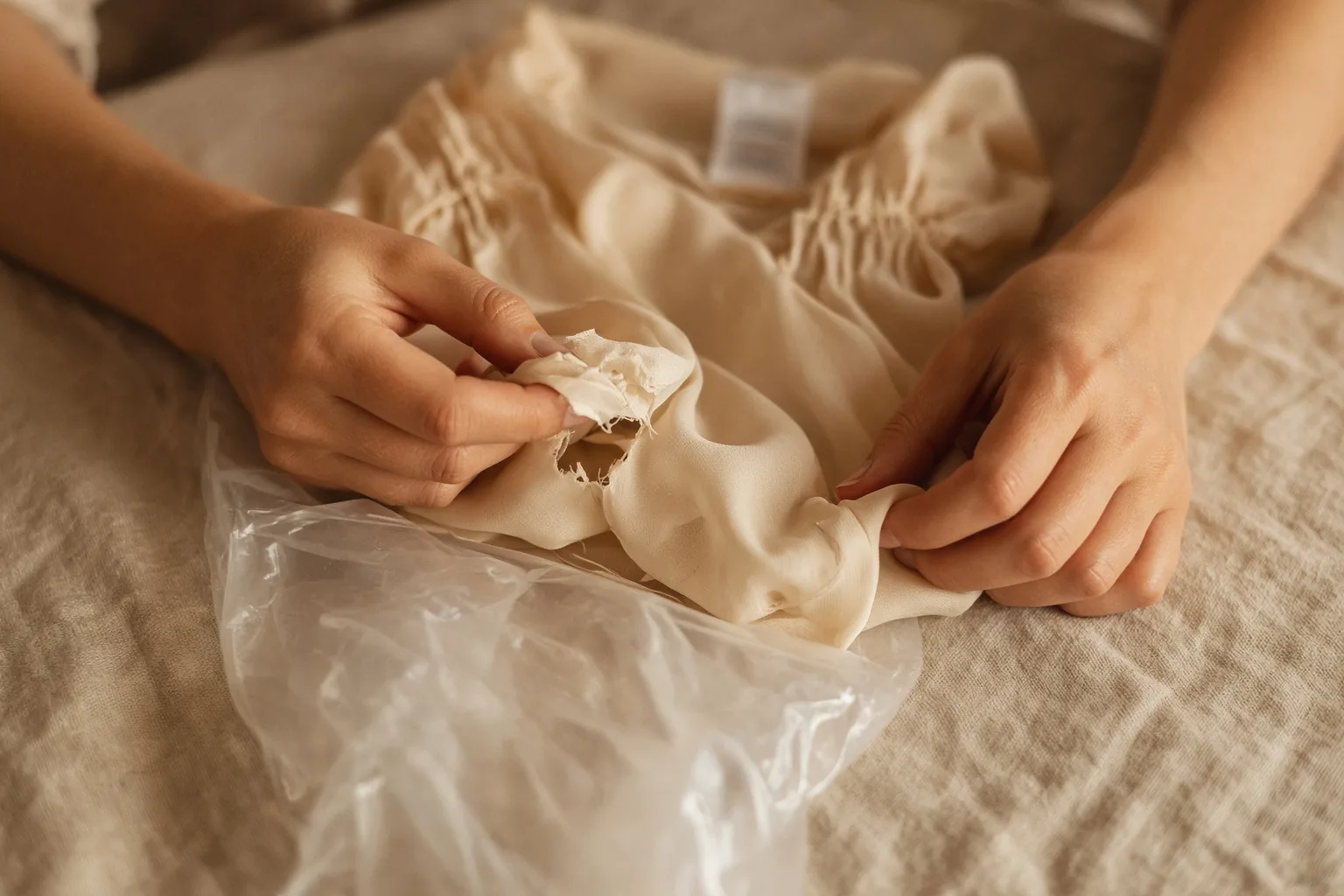
Who is responsible when a garment is damaged after the care label was followed?
Usually the manufacturer or importer, whose label must rest on a reasonable basis. The cleaner answers for damage caused by not following the label, and the owner for damage caused by use or storage.
The federal rule puts the label on the manufacturer and the importer. The Federal Trade Commission's Care Labeling Rule, 16 CFR Part 423, applies to anyone who directs or controls the manufacture or importation of covered products. Section 423.6(c) requires that person to have a reasonable basis for the care information before the product is sold. A label that tells the owner or the cleaner to use a method that destroys the garment is a label without that basis.
The cleaning trade draws the same line. DLI, which the Palm Beach County tip sheet names as the Dry Cleaning & Laundry Institute, issues a consumer guide titled "Who Is Responsible?" from its address in Laurel, Maryland. It says that a "dryclean" or "wash" label should mean that all components, including the shell, the lining, the buttons and the trim, will not be altered by that cleaning. Where a problem comes from following the label, the guide places it on the manufacturer: "responsibility lies with the manufacturer for not properly testing the garment before labeling."
The same guide assigns two other kinds of damage. Damage that occurs during the cleaning process can be the cleaner's responsibility. Damage from use or storage, such as stains that become visible only after cleaning or color loss from alcohol, perfume or household cleaners, "should be considered the consumer's responsibility." A consumer tip sheet on dry cleaning and care labels on the Palm Beach County website takes the cleaner's side of the same rule: "If the care label procedures were not followed, the damage claim can be resolved by the dry cleaner."
Which of the three explanations fits is a question of fact about the garment. Was the label followed? Would the labeled procedure damage this fabric, this lining or this trim? Did something the owner did weaken the fabric before cleaning? A textile expert answers those questions by examining the damaged item and, where possible, by running the labeled procedure on an identical garment or an undamaged part.
What does the Care Labeling Rule require the label to say?
The regular care the garment needs, a warning about any part of that procedure that would harm it or other items cleaned with it, and a statement if the garment cannot be cleaned without harm.
Section 423.1 defines a care label as a permanent label or tag containing regular care information and instructions, attached so that it will not separate from the product and will remain legible during the useful life of the product. Regular care means "customary and routine care, not spot care." Textile wearing apparel covers finished clothing made of a textile product that covers or protects the body, including hosiery, and excludes "footwear, gloves, hats or other articles used exclusively to cover or protect the head or hands."
Under section 423.6(a) the label must be placed where it can be seen or easily found when the product is offered for sale. If packaging, display or folding hides the label, the care information must also appear on the outside of the package or on a hang tag.
Section 423.6(b) governs the content. The label must state the regular care the product needs, and if the product cannot be cleaned by any method without harm, the label must say so. The label must warn about any part of the prescribed washing procedure that "would harm the product or others being washed with it in one or more washings." Dry cleaning instructions carry warnings on the same principle. A warning is not required for a procedure that is merely an alternative to the one on the label, so a label that says "Dry flat" does not also have to say "Do not tumble dry."
Section 423.8 lists exemptions. Totally reversible garments without pockets are exempt from the label requirement but must still provide care information by another means, such as a hang tag. A product that can withstand hot machine washing, high-heat drying, hot ironing, all bleaches and all dry-cleaning solvents is exempt if it displays "wash or dry clean, any normal method" on a hang tag, the package or another conspicuous place. Products sold to institutional buyers for commercial use need no care information, and a manufacturer may apply in writing for an exemption where a label would harm the appearance or usefulness of the product.
What counts as a reasonable basis for care instructions?
Reliable evidence held before sale: that the labeled care did not harm the product, that warned-against methods did, tests on each component and the whole garment, technical literature, past experience or industry expertise.
Section 423.6(c) lists the kinds of evidence that make a reasonable basis. The first is reliable evidence that the product was not harmed when cleaned reasonably often according to the label. The second is reliable evidence that the product, or a fair sample of it, was harmed by the method the label warns against. Evidence that other methods would harm the product is not needed where the label's silence about them does not constitute a warning.
The list continues. Evidence for each component part of the garment, combined with evidence for the garment as a whole, can make a reasonable basis. So can successful testing, which may simulate the suggested care or the care the label warns against. The rule also accepts "reliable evidence of current technical literature, past experience, or the industry expertise" and other reliable evidence.
Section 423.5 makes it an unfair or deceptive act or practice for a manufacturer or importer to sell a covered product without the required care instructions, without the required warnings, or without a reasonable basis for the care information. The FTC's Legal Library entry gives the source of the current text as 48 FR 22743 of May 20, 1983, shows the rule as amended effective September 1, 2000, and in section 423.8(f) refers to the Care Labeling Rule issued on December 9, 1971.
For a dispute, the reasonable basis is a set of documents and test results that existed, or did not exist, before the garment was sold. The expert compares that record with the garment. A wash test run on the fabric alone says nothing about a fusible interlining or a printed trim that failed, and evidence for the components without evidence for the assembled garment does not meet the combined test the rule describes.
Is the Care Labeling Rule still in force after the FTC proposed to repeal it?
Yes. The FTC proposed repeal in July 2020, but the electronic Code of Federal Regulations, current as of October 23, 2026, still shows Part 423 with the label, warning and reasonable basis requirements.
On July 23, 2020, the Commission published a supplemental notice of proposed rulemaking in the Federal Register, 85 Fed. Reg. 44485, proposing to repeal the Care Labeling Rule. It asked for comment on the costs and benefits of repeal and stated that Section 5 of the FTC Act "would continue to prohibit manufacturers from engaging in unfair or deceptive practices in labeling." The notice reasoned that consumers "need to clean their clothes and want to do so without ruining their investment."
The notice summarized survey evidence on how consumers read labels. A 2013 online survey by Harris Interactive, submitted by Peter Sinsheimer of UCLA, found that about 89% of respondents read "dryclean" as the only or the recommended method; the Commission noted limits in its method. A 1998 survey found that 73.2% read "dryclean" as requiring professional or special care.
Commenters described the technical side of the problem. The National Cleaners Association said that how aggressive a cleaning process is depends on more than the solvent, including heat and cycle length, so testing may be needed. Other commenters warned that wetcleaning can cause color loss, bleeding, shrinkage and surface changes. Manufacturers said that testing whole garments is often unnecessary and costly.
The rule was not repealed. The eCFR text of 16 CFR Part 423, marked as up to date as of October 23, 2026, contains the definitions in section 423.1, the label, warning and reasonable basis requirements in section 423.6 and the exemptions in section 423.8.
What does a textile expert examine in a damaged garment?
The type and pattern of the damage, the fiber content and construction of each component, the cleaning record, the label instructions, and the result of the labeled procedure on an identical item or an undamaged part.
The examination starts with the damage. Shrinkage is measured against the dimensions of an identical garment or the size specification. Color loss is mapped. Spots where the fabric touched perfume, alcohol or household cleaners, which the DLI guide lists as use damage, look different from loss spread evenly over the surface after a cleaning process. Bleeding between colors, puckering where a fusible interlining has separated, melted or dissolved trim, and surface abrasion each leave a pattern the expert photographs and measures.
Next comes the construction. The DLI guide treats the label as a promise about every component, so the expert identifies the shell fabric, the lining, the interlining, the thread, the buttons, the beads and the prints, and the fiber content of each. A label that permits dry cleaning on a garment with a trim that the common solvent dissolves is a label problem. A label that permits only professional wetcleaning, followed by a home wash at a high temperature, is not.
The cleaning record decides whether the label was followed. The expert reads the cleaner's ticket, the process used, the solvent, the temperature and the drying method, and compares them with the symbols and the words on the label. The owner's account of home washing is checked against the condition of the garment and against the symbols on the label.
Where an identical garment or spare fabric is available, the expert runs the labeled procedure and records the result. Section 423.6(c) itself accepts testing that simulates the suggested care as a basis for a label, and the same kind of test tells the court whether the label could have been right. Testing that destroys the item is done after the condition has been documented and after the other side has had a chance to attend.
The last task is value. The DLI guide says that cleaners often use the Fair Claims Guide for Consumer Textile Products to guide a settlement. The expert states the replacement cost of the item, its age and condition before the damage and whether it can be restored, so that the claim against the manufacturer, the seller or the cleaner has a supported figure.
What should the owner keep and record after the damage?
The garment with its label, the purchase receipt, the cleaner's ticket, photographs before any further cleaning, and the manufacturer's name or RN number, which the FTC database links to the manufacturer's address.
The label is the central exhibit. It should stay sewn in, and the garment should not be cleaned again or repaired before the expert has seen it. Photographs of the label, the damaged areas and the garment as a whole fix its condition at the time of the complaint.
The Palm Beach County tip sheet notes that a label may show a Registered Identification Number (RN) instead of the manufacturer's name, and that the FTC's RN database gives the manufacturer's name and address. It advises asking whether the cleaner has a loss or damage policy before cleaning, and contacting the cleaner promptly if a problem appears. If a garment has no care label, the tip sheet suggests a complaint to the FTC with the name and location of the retailer.
The DLI guide says that when there is a valid question about responsibility, the cleaner may ask the owner's permission to send the item to the International Textile Analysis Laboratory for an independent determination. A report from such a laboratory, or from an expert retained by the owner, is more useful when the owner can produce the same documents the expert will ask for: the receipt, the ticket and any earlier cleaning history.
If the cleaner warned that a garment was risky and the owner signed a release, the DLI guide says that the cleaner cannot be held responsible if damage occurs even though the cleaning was careful and professional. The expert then asks whether the cleaning was in fact careful and professional, which turns on the process record.
How is the textile expert's opinion used if the dispute reaches court?
As expert testimony under Rule 702 of the Federal Rules of Evidence in federal court, supported by the garment, the test results and the documents obtained through discovery under Rule 34.
Under Rule 702, a witness qualified as an expert by knowledge, skill, experience, training or education may testify in the form of an opinion if the proponent shows the court "that it is more likely than not that" the expert's knowledge will help the trier of fact, that the testimony "is based on sufficient facts or data" and "is the product of reliable principles and methods", and that the opinion applies those methods reliably to the facts of the case. State courts apply their own rules of evidence.
For a garment, sufficient facts or data means the damaged item, an identical item or matching fabric, the label and the cleaning record. Reliable methods means recognized measurement and test procedures for shrinkage, colorfastness and the behavior of each component in the solvent or wash used. A reliable application ties the test result to the damage actually found on the garment.
Rule 34 of the Federal Rules of Civil Procedure lets a party request documents and tangible things in the other party's possession, custody or control. A request to the manufacturer can cover its reasonable basis file, the test reports for the fabric and the garment, and retained samples. A request to the cleaner can cover the ticket and the process records. The request "must specify a reasonable time, place, and manner for the inspection", and the written response is due within 30 days after service.
What does IAE do in a dispute over a garment damaged in cleaning?
IAE prepares an expert report on the client's questions or a review of the opposing expert's report on the defect, its cause and the value of the goods, in up to 5 business days.
The product defect page of IAE lists the questions the expert answers: whether the goods were defective when delivered, whether the failure came from manufacturing or from misuse, and what the goods were worth as accepted. In a care label dispute the first question becomes whether the label had a reasonable basis, and the second becomes whether the cleaner or the owner departed from it. The expert reads damage marks, wear and repair traces to tell a manufacturing flaw from misuse.
A review of the opposing report looks for gaps between the data and the conclusions and lists the tests the expert did not run. A party may ask to inspect, test or sample goods held by the other side under Rule 34.
The client sends the garment description and photographs, the label, the receipt, the cleaner's ticket and any correspondence, the opposing report if there is one, and the questions. The secretariat confirms receipt the same day. Within one business day IAE confirms the format, the cost, the deadline and the specialist from its registry, and the client approves the candidate and the CV before work starts. Cases with tight deadlines have a 48-hour rush.
Registry members passed the collegial attestation of the council under the published Criteria Matrix, and the Member ID or QR code in the document opens the specialist's record. The specialist confirms in the document that he or she has no interest in the outcome of the case. The report is evidence that the court weighs with the other materials. Neither IAE nor the specialist guarantees the outcome, and IAE is not a law firm and does not advise on case strategy.
Sources
- 16 CFR Part 423, Care Labeling of Textile Wearing Apparel and Certain Piece Goods (eCFR, up to date as of October 23, 2026)
- FTC Legal Library, Care Labeling of Textile Wearing Apparel and Certain Piece Goods, 16 CFR Part 423
- FTC, Trade Regulation Rule on Care Labeling, supplemental notice of proposed rulemaking, 85 Fed. Reg. 44485 (July 23, 2020)
- DLI, Who Is Responsible? (consumer guide, Laurel, Maryland; copy on a member cleaner's website)
- Dry cleaning and care labels, consumer tip sheet (Palm Beach County website)
- Federal Rules of Evidence, Rule 702 (LII, Cornell Law School)
- Federal Rules of Civil Procedure, Rule 34 (LII, Cornell Law School)
Read also
All articles
Defective goods under the CISG: when must the buyer examine them and give notice, and what does the goods expert establish?
A buyer who receives defective goods under an international sale contract can lose every remedy for the defect by waiting. Article 39 of the CISG Sergei Voronin
Goods damaged in a warehouse: who is liable, and what does the goods expert establish?
Goods go into a warehouse sound and come out wet, crushed, spoiled or short. Under UCC 7-204 the warehouse answers for damage caused by its failureSergei Voronin
How do you prove goods are counterfeit, and what does the product expert compare?
Under the Lanham Act a counterfeit is a spurious mark that is identical with, or substantially indistinguishable from, a registered mark. WhetherSergei VoroninExpert examinations
Ready to discuss your case?
Send the materials: the secretariat will confirm the format, cost, deadline and the specialist within one business day.
