
Expert report review
Comparison charts in the opposing handwriting report: what does a reviewer check?
The part of a handwriting report that a judge or jury remembers is often the chart: questioned letters set beside matching letters from the known writing. The chart shows what the examiner selected. A reviewer checks it against ANSI/ASB Standard 070, the SWGDOC image capture standard and Federal Rule of Evidence 107, and against the full set of known writing the chart was cut from.
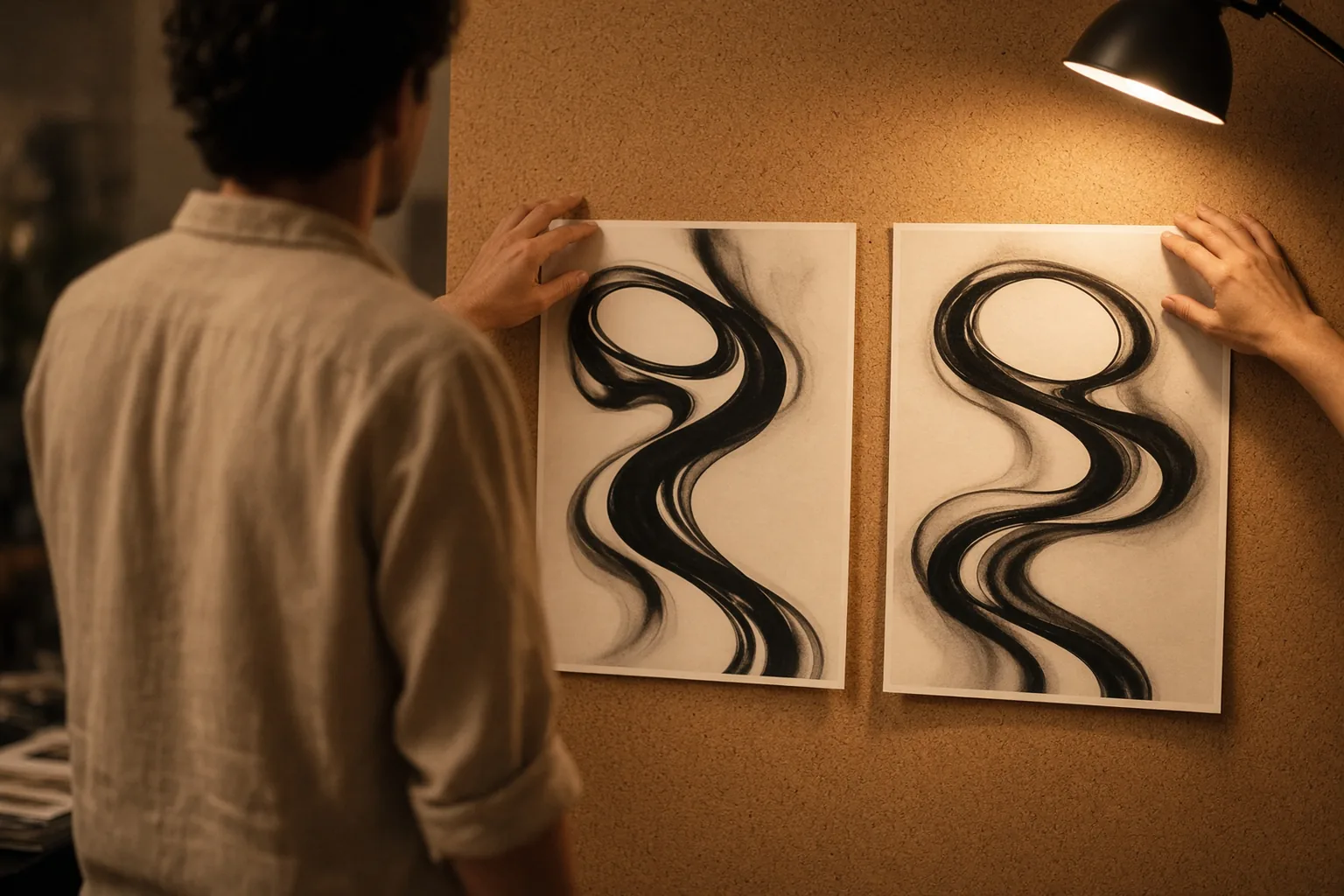
What is a comparison chart, and why does it need a review?
A chart places enlarged letters, words or signatures of the questioned item beside examples of the known writing. It is a selection, so the review checks what was selected, what was left out and how the images were made.
A typical chart has two columns: a questioned letter form on the left and two or three known letter forms on the right, with arrows marking the same feature in each. The format persuades because the viewer sees the match and does not see the other forty known examples of the same letter, some of which may look different.
Rule 26(a)(2)(B)(iii) requires a retained expert's report to contain "any exhibits that will be used to summarize or support" the opinions. The chart is therefore disclosed with the report or under a schedule set by the court, and counsel has time to have it reviewed before the deposition.
Standard 070 itself does not regulate charts. It regulates the examination behind them: what known writing was used, how dissimilarities were treated and how the combination of features was weighed. The review uses those rules to test whether the chart is a fair picture of the examination.
Is the chart evidence or an illustrative aid?
Usually an illustrative aid. Under Rule 107, added in 2024, the court may allow an aid that assists the jury in understanding evidence; the aid is not evidence and reaches the jury room only by consent or order.
Rule 107(a) lets the court allow "an illustrative aid to help the trier of fact understand the evidence or argument" if its utility is not substantially outweighed by the danger of unfair prejudice, confusing the issues, misleading the jury, undue delay or wasting time. Rule 107(b) states that "an illustrative aid is not evidence" and must not be provided to the jury during deliberations unless all parties consent or the court, for good cause, orders otherwise. Under Rule 107(c) an aid used at trial must be entered into the record when practicable.
Rule 107(d) separates aids from summaries: a summary, chart or calculation admitted to prove the content of voluminous evidence is governed by Rule 1006. A handwriting chart illustrates the examiner's testimony and does not summarize voluminous records, so the Rule 107 balance applies.
That balance is where the review is used. A chart that shows only matching forms and omits the dissimilarities the examiner found is open to the objection that it misleads the jury, and the review identifies the omitted forms by page and exhibit number.
Does the chart show the range of the known writing?
It should not suggest a uniformity the known writing lacks. Standard 070 ties the meaning of a dissimilarity to whether the known specimens are a comprehensive sample of the writer's full range of variation.
Section 6.5.5 of Standard 070 defines a dissimilarity as "a feature within the questioned writing that is not found in any of the submitted known specimens." The note to that section explains that the presence of a feature, even in one known specimen, is evidence that the feature is within the writer's capability, and that treating a dissimilarity as evidence of a different writer depends on whether the specimens are "a comprehensive sample of the writer's full range of variation." It calls that "a very high level of proof requiring extensive known specimens from multiple sources."
Sections 4.2.1 and 6.4.3(c) add a warning about the source of the known writing: specimens collected solely by a stakeholder may not cover the writer's full range of variation. A chart built from known signatures that one party gathered can show a narrow range, and a questioned signature outside that range can then look foreign when it is not.
The reviewer lists every known specimen the examiner received, counts the examples of each letter or signature feature shown in the chart, and compares the chart with the rest. If the examiner selected the three most similar forms out of twenty, the review says so and shows the other seventeen.
Are the differences shown along with the similarities?
They should be. Standard 070 requires the examiner to evaluate dissimilarities and similarities individually and in combination and to consider alternative interpretations, and a conclusion cannot rest on one characteristic.
Section 6.5.5 requires the examiner to "evaluate the significance of dissimilarities and similarities, individually and in combination." Section 6.8.1 states that "a conclusion is not based solely upon any one characteristic, but rather on the combination of characteristics." Section 6.7 requires a review of all observations and states: "The examiner shall consider alternative interpretations."
A chart for an identification usually shows only agreements, and a chart for an elimination only differences. The reviewer checks the bench notes for features the examiner recorded on the other side and asks why they are absent from the chart. Where the notes record a dissimilarity that the report later explains as natural variation, the review checks whether a known specimen with that variant exists.
The Department of Justice used a five-level scale in its proposed uniform language for handwriting testimony: identification, may have, no conclusion, may not have and elimination. A chart that looks like an identification while the conclusion says "may have" is a mismatch the reviewer points out, because the jury may remember the chart and forget the qualification.
Were the images captured and processed by the standard?
The SWGDOC image capture standard calls for a scale in each camera image, optical resolution of at least 300 pixels per inch at life size, originals kept unprocessed, processing only on working copies and a processing log.
Section 7.6.4.1 of the SWGDOC Standard for Use of Image Capture and Storage Technology in Forensic Document Examination says to "include a scale in each image" taken with a camera. Sections 7.6.1 and 7.6.2 call for an optical, not interpolated, resolution, with a minimum of 300 pixels per inch at life size and 8-bit grayscale. Section 7.6.9 requires a record of the capture details, including lighting.
Under section 7.7.2 originals are saved in their native format without processing, and "all processing shall be done only on working copies." Lossy formats such as JPEG are not recommended for archiving. Section 7.9.5 requires an image processing log that permits replication "by another person competent in the field."
Charts are often enlarged, cropped, converted to black and white or sharpened. Section 7.11.2 of the same standard notes that "differences in presentation methods can limit or enhance the perceived resolution." Line quality is where that matters most, because tremor, hesitation and pen lifts are read from the edges of the stroke. The reviewer compares the chart with the native images and the log and records any feature that appears only in the processed version.
Does the chart mix types of writing, sources or dates?
Standard 070 requires mixed writing to be split into groups of one type and lists the type of writing and noncontemporaneousness among features that limit comparability. A chart should keep those groups apart and label each specimen.
Sections 6.3.4(a) and 6.4.3(a) separate hand printing, cursive writing, numerals, symbols and signatures into single-type groups. Section 6.5.2.1 states that "features limiting comparability may include the type of writing, noncontemporaneousness, dissimilarities in text content."
On a chart the reviewer checks that each known example carries its exhibit number and date, that signatures are compared with signatures, and that a known form written ten years after the questioned document is not placed next to it without a note. A photocopy beside an original also needs a label, because line quality and pressure cannot be compared on a copy.
What does an overlay of two signatures prove?
An overlay tests for tracing or another form of simulation. Standard 070 uses it when indicia of simulation or tracing are noted, to assess unnatural pictorial similarity and to look for a common model.
Section 6.5.6 of Standard 070 mentions overlay comparisons as "an effective method of evaluation" when simulation or tracing is considered. Natural signatures of one writer vary in length, spacing and letter height between signings, so two signatures that superimpose almost exactly raise the question whether one was traced from the other or both from a common model.
A chart that presents a close overlay as proof that the same person signed reverses that logic. The reviewer checks whether the examiner considered tracing, whether the model signature was searched for among the known documents and whether the line quality of the questioned signature was examined on the original.
Which records let the reviewer test the charts?
The bench notes, the complete list of known specimens with their sources, the native image files, the image processing log and the record of the technical review, if one was performed.
Section 6.1 of Standard 070 requires the examiner to "contemporaneously document the examinations performed, relevant observations, and basis for results" in a way that permits an internal or external review of the examination process. Section 6.6 requires the bases and reasons for the conclusion to be included in the documentation. The DOJ supporting document for its handwriting language describes verification as "a technical review of the examination records and laboratory report."
Rule 26(a)(2)(B)(ii) requires the report to disclose "the facts or data considered by the witness," and counsel requests the native images and the processing log on that basis. Without them a reviewer can comment on what the chart omits only by comparing it with copies of the known documents, which is slower and less exact.
How does counsel use a review of the charts?
To build a rebuttal chart out of the same specimens, to frame deposition questions about selection and processing, and to support a Rule 107 objection or a Rule 702 motion if the chart departs from the examination.
A rebuttal chart uses the same exhibits and shows the forms the original chart left out, with the same scale and labels. Rule 26(a)(2)(D)(ii) gives 30 days after the other side's disclosure for evidence that solely contradicts or rebuts evidence on the same subject, unless the court sets another schedule.
At deposition the review supplies the questions: how many known examples of each letter were available, which were placed on the chart and why, what processing was applied, and whether the examiner recorded dissimilarities that the chart does not show. Under Rule 26(b)(4)(D) a consulting reviewer's opinions are ordinarily not discoverable, so counsel can read the review before deciding whether to disclose the reviewer.
What does IAE do when the opposing handwriting report relies on charts?
IAE prepares a review of the opposing handwriting examiner's report against Rule 26(a)(2)(B) and ANSI/ASB Standard 070, in up to 5 business days after the format and cost are confirmed.
The IAE review page for handwriting reports is written for attorneys whose opponent has disclosed a handwriting examiner's report. The reviewer reads the report and the examiner's file against Rule 26(a)(2)(B) and ANSI/ASB Standard 070 and sets out each point for a rebuttal report, the deposition or a Rule 702 motion, citing a page of the report and a section of a standard or rule. The page names the checks used here: the bench notes, images and list of known writing, limitations and verification.
Send the opposing report with its charts, the produced file and copies of all known writing through the form on the contact page; you approve the reviewer and the CV before work starts. Cases with tight deadlines have a 48-hour rush.
Registry members passed the collegial attestation of the council under the published Criteria Matrix, and the Member ID in the document can be checked by QR code. The reviewer confirms in the document that he or she has no interest in the outcome, and materials are not passed to third parties without your consent. Neither IAE nor the reviewer guarantees the outcome, and IAE is not a law firm and does not advise on case strategy.
Sources
- ANSI/ASB Standard 070, Standard for Examination of Handwritten Items, First Edition 2022 (AAFS Standards Board)
- SWGDOC Standard for Use of Image Capture and Storage Technology in Forensic Document Examination
- Federal Rules of Evidence, Rule 107, Illustrative Aids (LII, Cornell Law School)
- Federal Rules of Civil Procedure, Rule 26 (LII, Cornell Law School)
- U.S. Department of Justice, Supporting Documentation for Proposed Uniform Language for Testimony and Reports for the Forensic Handwriting Analysis Discipline
Read also
All articles
The handwriting examiner's opinion is inconclusive: what does that mean, and what does a reviewer check?
An inconclusive handwriting result is a defined conclusion. In the Department of Justice's uniform language it means that "no determination can be Sergei Voronin

The report says the signature was written under unusual conditions: what does that mean, and how is it reviewed?
A handwriting report may find that a questioned signature was written under unusual conditions: slowly, with tremor, poor line quality or an oddSergei Voronin
Auto-forgery: how is a finding that the signer disguised his own signature reviewed?
When a person denies a signature, the other side's examiner may answer that the person wrote it with deliberate changes, so that it could later beSergei VoroninExpert report review
Ready to discuss your case?
Send the materials: the secretariat will confirm the format, cost, deadline and the specialist within one business day.
