
Examinations
Medication error malpractice: what does the medical expert have to prove?
A wrong drug, a wrong dose or a missed interaction becomes malpractice only when a physician shows two things: the prescribing, dispensing or administration fell below the standard of care, and that departure caused the injury. Federal hospital rules require drugs to be given under the practitioner's orders and accepted standards of practice, and errors to be reported at once. Courts in New York and New Jersey have held that the package insert alone does not set the standard.
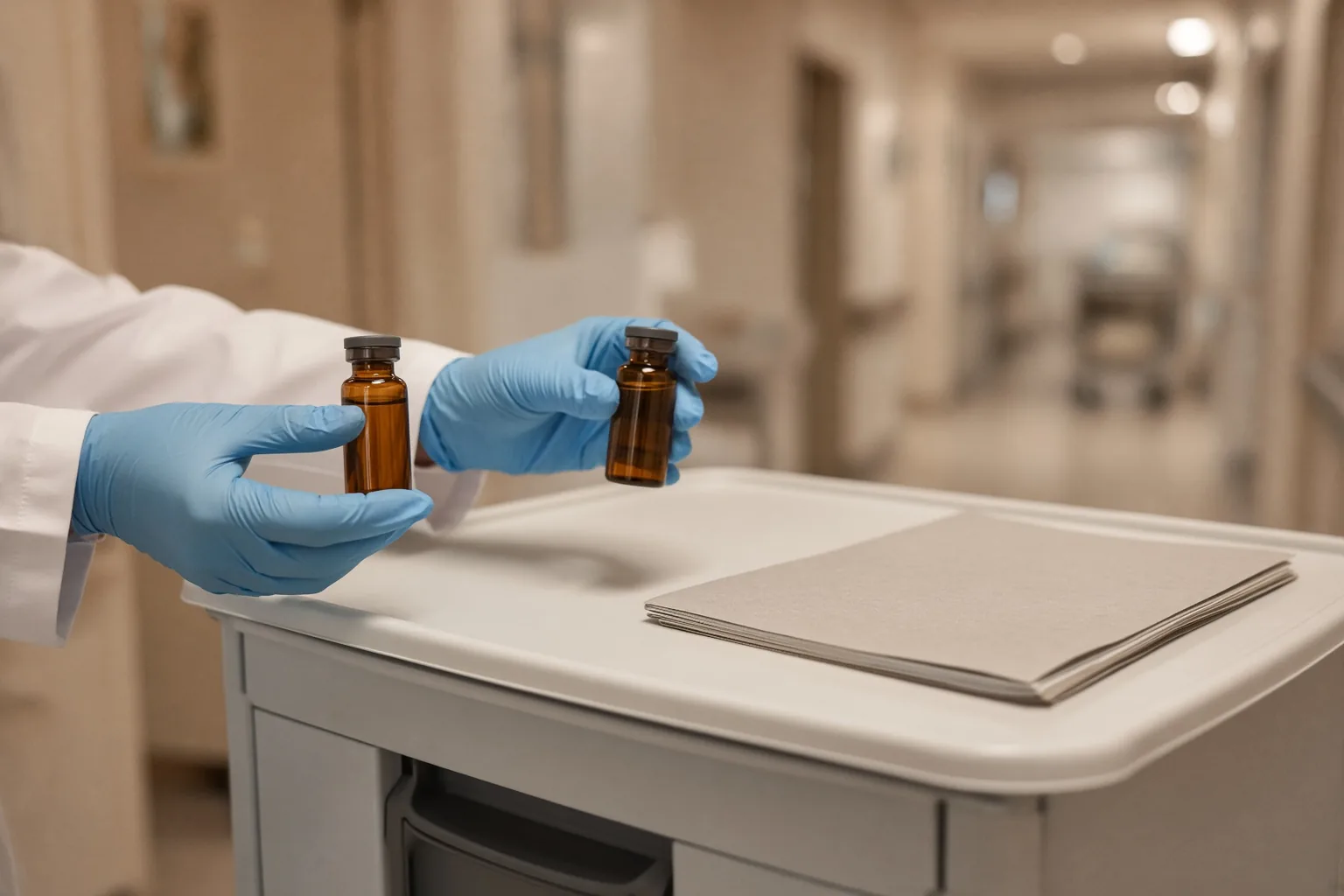
When is a medication error malpractice?
When the prescribing, dispensing, administration or monitoring of a drug departed from the standard of care and that departure caused harm. An error that injures nobody, or an injury the patient's illness explains, does not meet both elements.
A medication error can happen at each step: the order, the pharmacy, the bedside and the follow-up. The physician may order the wrong drug or dose, miss an allergy or an interaction, or fail to monitor drug levels. The pharmacy may dispense the wrong product or strength. The nurse may give the drug to the wrong patient, by the wrong route or at the wrong time.
The legal test is the same as in other malpractice claims. In Florida, for example, section 766.102(1) of the Florida Statutes requires the claimant to prove, by the greater weight of evidence, a breach of the prevailing professional standard of care, and section 766.102(3)(b) provides that the existence of a medical injury does not create any inference or presumption of negligence. The claimant keeps the burden of proving that the injury was proximately caused by the breach.
That is why the medical expert has two tasks. The first is to identify the standard for the step that went wrong and show the departure in the chart. The second is to show, with the patient's own data, that the drug, the dose or the omission caused the injury.
What do federal hospital rules require when drugs are given?
Under 42 CFR 482.23(c), drugs are prepared and administered under federal and state law, the practitioner's orders and accepted standards of practice. Orders are documented and signed, and verbal orders are to be used infrequently.
Hospitals that take part in Medicare must meet the conditions of participation in part 482 of title 42 of the Code of Federal Regulations. Section 482.23 covers nursing services. Under paragraph (c)(1), drugs and biologicals must be prepared and administered in accordance with federal and state laws, the orders of the practitioner responsible for the patient's care and accepted standards of practice.
Under paragraph (c)(2), nursing or other qualified personnel administer drugs in accordance with the approved medical staff policies and procedures. Paragraph (c)(3) requires orders for drugs to be documented and signed by a practitioner authorized to write them; if verbal orders are used, "they are to be used infrequently." Paragraph (c)(4) sets the same framework for blood transfusions and intravenous medications.
For the expert, these provisions frame the questions. Was there a written order, and did it name the drug, dose, route and frequency? Who transcribed a verbal order, and when was it signed? Did the medication administration record match the order? Each answer comes from a document the hospital must keep.
What do the pharmacy rules require?
Under 42 CFR 482.25, a registered pharmacist directs or supervises pharmacy services, the medical staff adopts policies to minimize drug errors, and drug information on interactions, side effects and dosage must be available to the staff.
Section 482.25 requires hospitals to provide pharmaceutical services that meet the needs of the patients, through a pharmacy directed by a registered pharmacist or a drug storage area under competent supervision. The medical staff is responsible for developing policies and procedures that minimize drug errors.
Paragraph (b)(1) places compounding, packaging and dispensing under the supervision of a pharmacist. Paragraph (b)(5) requires automatic stop orders for drugs not specifically prescribed as to time or number of doses. Paragraph (b)(8) requires information on drug interactions, therapy, side effects, toxicology, dosage, indications for use and routes of administration to be available to the professional staff. Paragraph (b)(9) requires a formulary.
A missed interaction is therefore a question about the system as well as the prescriber. The expert asks what drug information the hospital made available, whether the pharmacy reviewed the order, and whether an alert or a stop order should have caught the error.
What must the hospital do after a medication error?
Report it. Under 42 CFR 482.25(b)(6), drug administration errors, adverse drug reactions and incompatibilities must be immediately reported to the attending physician and, if appropriate, to the hospital's quality assessment and performance improvement program.
Section 482.25(b)(6) requires an immediate report to the attending physician of drug administration errors, adverse drug reactions and incompatibilities, and, where appropriate, to the hospital's quality assessment and performance improvement program. Section 482.23(c)(5) requires a hospital procedure for reporting transfusion reactions, adverse drug reactions and errors in administration of drugs.
The timing of the report matters for causation. The expert compares the time the error was recognized, the time the attending physician was told and what was done next: an antidote, monitoring, a transfer to intensive care. If the report came late, the delay itself may be part of the injury, and the expert separates the harm caused by the error from the harm caused by the late response.
The chart entries, the medication administration record and the physician's notes after the report are part of the medical record, and the expert asks for them first.
Does the package insert or the PDR set the standard of care?
Not by itself. In Spensieri v. Lasky (N.Y. 1999) and Morlino (N.J. 1998) the courts held that the PDR or package insert alone does not establish the standard of care; an expert interprets it.
In Spensieri v. Lasky, decided on December 2, 1999, Roberta Spensieri, then 29, had been prescribed the oral contraceptive Ortho-Novum 10/11 in May 1986 for irregular bleeding, and in September 1986 the estrogen Estinyl by telephone without an examination. Within a month she suffered a severe stroke that left her quadriplegic and unable to speak. The New York Court of Appeals held that the Physicians' Desk Reference, offered as it was, is hearsay and cannot by itself establish the standard of care. The court wrote: "The PDR may have some significance in identifying a doctor's standard of care", and "we reject the contention that the PDR constitutes prima facie evidence of a standard of care."
The court explained that manufacturers prepare PDR entries to meet labeling requirements, marketing goals and liability concerns, so the entries cover more than diagnosis and treatment. Expert testimony is needed to interpret them in light of the patient's condition.
The New Jersey Supreme Court reached the same result in Morlino v. Medical Center of Ocean County on February 26, 1998. A physician prescribed ciprofloxacin to a patient about eight and a half months pregnant, although the PDR warned against its use in pregnant women, and the fetus died. The court held that "package inserts and PDR references alone do not establish the standard of care" and that a departure from a PDR warning is not negligence by itself; such references may be considered together with expert testimony. It noted that "Drug manufacturers write explanations and warnings for doctors, not the general public." The jury had found for the defendants, and the judgment was affirmed as modified.
Is prescribing a drug off-label a medication error?
Not by definition. Once a drug is approved, the FDA says, providers generally may prescribe it for an unapproved use they judge medically appropriate. The expert asks whether that judgment met the standard of care.
The FDA page on unapproved use of approved drugs explains that approval means the agency found that the benefits of the drug for a specific use outweigh its risks. After approval, providers generally may prescribe the drug for an unapproved use when they judge that it is medically appropriate for the patient. The FDA gives examples: a drug approved for one type of cancer used for another, an oral solution used where a capsule is approved, and a dose of two tablets where the approved dose is one.
The same page warns that the FDA has not determined that the drug is safe and effective for the unapproved use. In a malpractice case the question is therefore whether a reasonably prudent physician in the same specialty would have made that choice for this patient, with the information available, and whether the patient was told about it.
Morlino is relevant here too. A departure from the label is evidence that the expert has to explain, not a finding of negligence on its own.
Who answers for a medication error: the physician, the nurse, the pharmacist or the hospital?
Each step has its own standard. The physician answers for the order, the pharmacist for dispensing and review, the nurse for administration under hospital policy, and the hospital for the systems the federal rules require.
Under 42 CFR 482.23(c)(2), nurses administer drugs under approved medical staff policies and procedures, and under 482.25(b)(1) compounding, packaging and dispensing are supervised by a pharmacist. For controlled substances, 21 CFR 1306.04(a) states that a prescription must be issued for a legitimate medical purpose by a practitioner acting in the usual course of professional practice, and that "a corresponding responsibility rests with the pharmacist who fills the prescription."
The expert's specialty follows the step. A claim about the dose ordered by an internist needs an internist or a specialist in the same field; a claim about bedside administration may need a nursing expert; a claim about dispensing needs a pharmacist. State statutes on expert qualifications decide who may testify against whom, and in Florida section 766.102(5) requires the expert to share the defendant's specialty or profession.
One case can involve several defendants. The medical expert's report then states, for each step, what the standard required and who departed from it.
Which records does the expert need in a medication error case?
The physician orders, the medication administration record, pharmacy dispensing records, nursing notes, allergy lists, laboratory results with drug levels, vital signs and the notes made after the error was found.
The core document is the medication administration record, which shows what was given, when and by whom. The expert compares it line by line with the physician orders and the pharmacy dispensing records. A discrepancy between the three documents shows the step at which the error occurred.
Laboratory results and vital signs show the effect: a drug level above the therapeutic range, a fall in blood pressure, a drop in oxygen saturation, a change in kidney function. Their timestamps let the expert build a timeline that links the dose to the change in the patient's condition.
The allergy list, the medication history at admission and the notes from consultations show what the prescriber knew. The notes after the report under 482.25(b)(6) show what was done to limit the harm.
How does the expert prove that the drug caused the injury?
With a timeline and a mechanism: when the drug was given, at what dose, when the effect appeared and why the illness does not explain it. Rule 702 requires sufficient facts and a reliable method.
Rule 702 of the Federal Rules of Evidence requires the proponent to show the court that it is more likely than not that the expert's testimony rests on sufficient facts or data, is the product of reliable principles and methods and applies them reliably to the facts of the case. A causation opinion in a medication case meets that test when it ties the known effect of the drug to the timing and the measured changes in this patient.
The expert also addresses alternative causes. A stroke, a bleed or kidney failure can follow the underlying disease as well as the drug, and the opinion has to explain why the drug is the more likely cause. In Morlino the autopsy showed no damage to joint cartilage, the harm the PDR warning addressed, and the plaintiff claimed that an allergic reaction to the drug caused the death.
Under Rule 26(a)(2)(B) of the Federal Rules of Civil Procedure, the report states each opinion with its basis and reasons and the facts or data considered, so every step of the timeline cites the record it comes from.
What does IAE do in a medication error case?
A physician in the relevant specialty from the IAE registry writes an expert report on the client's questions or a review of the opposing expert's report. Delivery takes up to 5 business days after the format and cost are confirmed.
The IAE medical expert report page covers standard of care, causation and the medical record in malpractice, wrongful death and personal injury cases. The physician builds a timeline from orders, vital signs, nursing notes and imaging, then compares each decision with the specialty's guidelines in force at the time of care. The expert separates general and specific causation and checks the record set for missing notes and gaps in orders.
The client sends the chart with the medication administration record, the pharmacy records and, where there is one, the opposing expert's report, and describes the task. The secretariat confirms receipt the same day. Within one business day IAE confirms the format, the cost, the deadline and the specialist from its registry, and the client approves the candidate and the CV before work starts. Delivery takes up to 5 business days after the format and cost are confirmed, with a 48-hour rush for tight deadlines.
Every specialist is a member of the public IAE registry, can be verified by Member ID or QR code and confirms in the document that he or she has no interest in the outcome. Materials are not passed to third parties without the client's consent. A report is evidence that the court weighs with the rest of the record. Neither IAE nor the physician guarantees the outcome, and IAE is not a law firm and does not advise on case strategy.
Sources
- 42 CFR 482.23, Condition of participation: Nursing services (LII, Cornell Law School)
- 42 CFR 482.25, Condition of participation: Pharmaceutical services (LII, Cornell Law School)
- Spensieri v. Lasky, 94 N.Y.2d 231 (N.Y. Dec. 2, 1999) (LII, Cornell Law School)
- Morlino v. Medical Center of Ocean County, A-36 September Term 1997 (N.J. Feb. 26, 1998) (Justia)
- U.S. Food and Drug Administration, Understanding Unapproved Use of Approved Drugs "Off Label"
- 21 CFR 1306.04, Purpose of issue of prescription (LII, Cornell Law School)
- Florida Statutes 2025, chapter 766: section 766.102 (The Florida Senate)
- Federal Rules of Evidence, Article VII, Opinions and Expert Testimony, Rules 701-706 (LII, Cornell Law School)
- Federal Rules of Civil Procedure, Rule 26 (LII, Cornell Law School)
Read also
All articles
Surgical item left inside a patient: when is negligence presumed, and what does the medical expert still have to prove?
A sponge, needle or clamp found inside a patient after surgery is one of the few malpractice events where the law begins on the patient's side Sergei Voronin

Lack of informed consent lawsuit: what does the medical expert have to prove?
A patient can sue when a doctor performed a procedure without disclosing a risk that later caused harm, even if the procedure itself was done wellSergei Voronin
Telemedicine malpractice: what standard of care applies to a virtual visit?
A video or app visit is judged by the same yardstick as an office visit. Florida's telehealth statute requires the remote provider to meetSergei VoroninExpert examinations
Ready to discuss your case?
Send the materials: the secretariat will confirm the format, cost, deadline and the specialist within one business day.
