
Expert report review
How is a utility's meter tampering report reviewed?
A utility that finds a cut seal, a missing seal or a meter with a damaged cover writes a tampering report and bills the customer for unrecorded use. In a lawsuit or a criminal case that report is evidence like any other. A review checks the record behind it: who saw what at the meter, what happened to the seal and the meter afterwards, what the shop test and the interval data contain, and how the estimate was built.
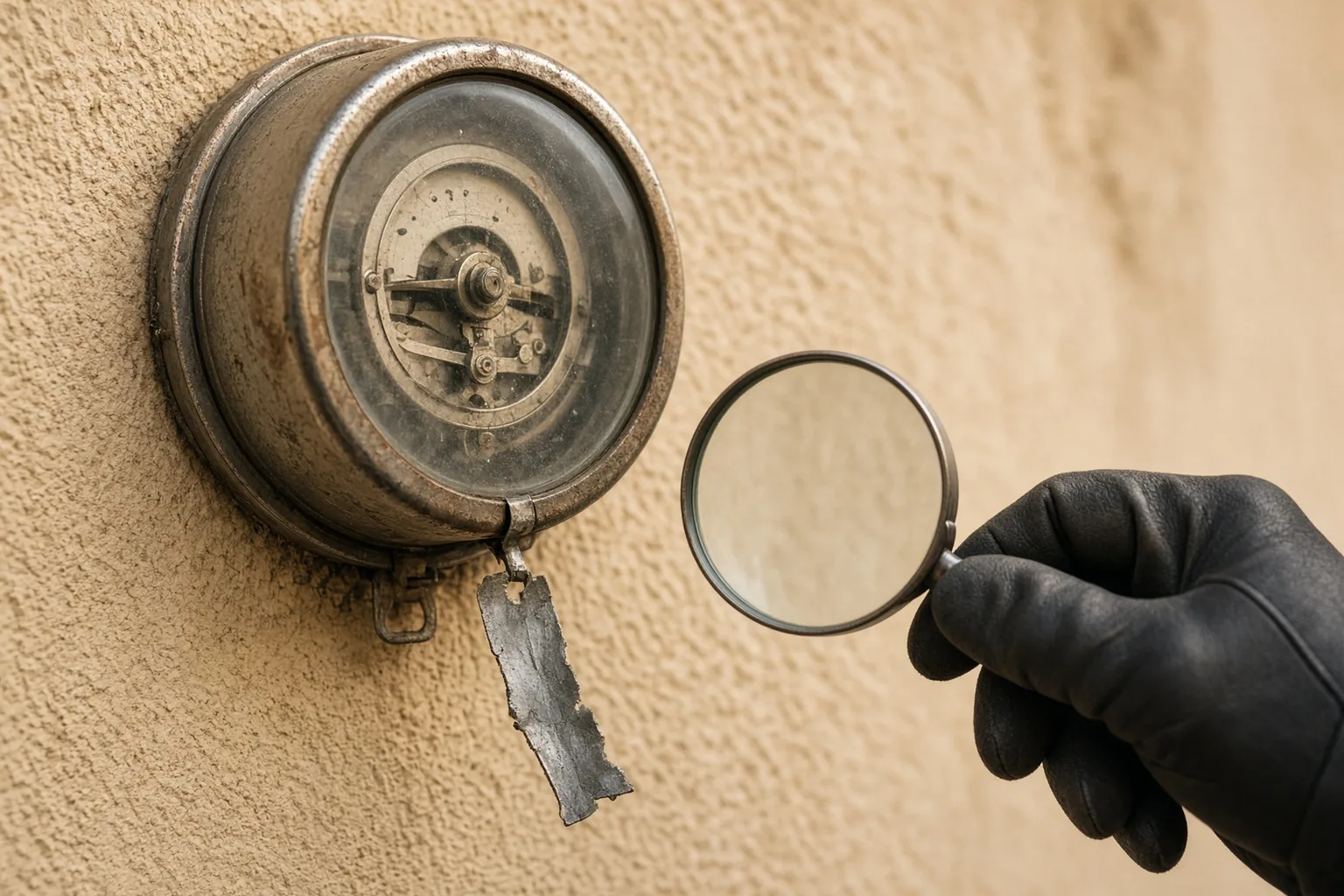
What does a review of a meter tampering report check?
Whether every step behind the bill is recorded: photographs of the meter and seal before removal, custody of the seal and meter, the shop test, the interval data and the method of the usage estimate.
A tampering case is built in stages. A field technician finds the condition at the meter, removes the seal and often the meter, the meter goes to a test shop, an analyst compares consumption before and after the visit, and the billing department issues an adjustment. Each stage leaves its own record, made by a different person. The reviewer reads each record against the conclusion it is supposed to support and marks the places where the chain breaks.
The EPRI report EL-3951, prepared by Honeywell's Technology Strategy Center in Roseville, Minnesota, opens with the line "Meter tampering cuts utility revenues" and describes a visible indicator "that is destroyed if the meter socket cover is removed." The report calls the device inexpensive and able to be retrofitted to existing installations. When a report rests on a broken indicator or seal, the review asks when it broke, how, and who could have broken it.
Texas regulates adjustments after tampering by a Public Utility Commission rule. The Technical Advisory Committee of the Electric Reliability Council of Texas (ERCOT) approved Retail Market Guide Revision Request 095, Meter Tampering Business Processes Clarifications, on March 3, 2011, effective April 1, 2011. The request was sponsored on behalf of the Meter Tampering Task Force and, in its own words, clarifies the process for market participants' compliance "with P.U.C. Subst. R. 25.126, Adjustments Due to Non-Compliant Meters and Meter Tampering in Areas Where Customer Choice Has Been Introduced." The review compares the utility's steps with the rule and market procedures of the state where the meter sits.
Which utility records should the review start with?
The field investigation report and photographs, the seal and meter custody records, the shop test report, the account's usage history and any interval data or event logs. Rule 34 reaches documents, stored data and tangible things such as the meter.
In federal court Rule 34(a)(1) lets a party ask another party "to produce and permit the requesting party or its representative to inspect, copy, test, or sample" items in its possession, custody or control. The rule covers "any designated documents or electronically stored information," including photographs, images "and other data or data compilations," and "any designated tangible things." The removed meter and the cut seal are tangible things. The interval readings, event logs and the field technician's photographs are documents or stored information.
A utility that offers its field report and test report as business records relies on hearsay exception 803(6). Under Rule 803(6) a record of an act, event or condition comes in if it was made at or near the time by someone with knowledge, or from information that person transmitted, if it was kept in the course of a regularly conducted activity and making it was a regular practice of that activity. The exception has a final condition: it applies only if "the opponent does not show that the source of information or the method or circumstances of preparation indicate a lack of trustworthiness."
That condition is where the review does its first work. The reviewer checks the date and time stamps of the field report against the photographs, the name of the person who wrote it against the person who visited, and the description of the seal against what the photographs show. A report typed days after the visit by an employee who never saw the meter, or a description that the photographs do not support, goes into the review with page and photo numbers.
How is a cut or replaced meter seal examined?
The examiner documents how the seal failed and compares its marks with test marks from the sealing tool on record. The review checks whether the seal was kept and whether its number matches the installation record.
Toolmarks on seals are compared with test marks made by the suspect tool. For a meter seal there are two tools to consider: the sealing pliers or press the utility's installer used, which leave a stamp or crimp, and whatever cut or opened the seal afterwards. A finding that a seal was removed and reapplied needs a comparison: differences between the crimp on the questioned seal and test crimps made with the installer's tool, or cut ends that do not match the removal the field technician recorded.
The review asks a fixed set of questions. Is the seal in evidence, or only a photograph of it? Was it photographed in place, with a scale, before the technician touched it? Does the seal number match the number recorded when the meter was last sealed, and is that record in the file? Did the examiner make test marks with the installer's tool, at the same magnification as the questioned marks? Does the report separate cuts made at removal by the utility from marks made before the visit?
Seal and toolmark comparison is technical work, and in Kumho Tire Co. v. Carmichael, 526 U.S. 137 (1999) the Supreme Court held that the trial judge's gatekeeping duty under Daubert covers testimony based on technical and other specialized knowledge. The 2023 committee note to Rule 702 adds that forensic experts "should avoid assertions of absolute or one hundred percent certainty" where the method "is subjective and thus potentially subject to error." A report that calls a seal "definitely" tampered with, on visual inspection alone, is open to that objection.
What does a meter shop test prove, and what does it leave open?
The shop test records the meter's accuracy and physical condition on the test date: broken parts, foreign objects, altered wiring. When and by whom the change was made are separate questions, answered by other records.
The test result is the output of a process: a test bench, a procedure and a technician. Rule 901(b)(9) names one way to authenticate such evidence: "Evidence describing a process or system and showing that it produces an accurate result." The review therefore asks for the test procedure, the calibration record of the test equipment for the test date, and the name of the technician who ran the test.
Custody comes next. Under Rule 901(a) the proponent "must produce evidence sufficient to support a finding that the item is what the proponent claims it is." The reviewer matches the meter serial number on the removal record, on the shipping or evidence tag and on the test report. A gap of weeks between removal and test, with no record of where the meter was kept, is noted, because any damage found at the test could have occurred in that period.
The shop test answers a narrow question. A meter that tests accurate on the bench says nothing about a bypass around it at the premises. A meter with a damaged register or a foreign object inside is evidence that something happened to the meter, but it carries no date. The review sets out what the test established and what the utility's report adds to it without support.
What can interval data add, and what if it was not kept?
Interval readings and event records can put a change in consumption on a date and compare it with the seal history. If the utility lost data it should have preserved for litigation, Rule 37(e) gives the court remedies.
Where the meter records consumption in intervals, the data can place a drop in usage on a specific day. The reviewer lines up that date with the seal installation record, the last recorded reading with an intact seal, any change of occupant on the account and the field visit. A drop that starts on the day a new tenant moved in reads differently from one that starts with no other event on the account.
The data is electronically stored information. Under Rule 37(e), if such information "that should have been preserved in the anticipation or conduct of litigation is lost because a party failed to take reasonable steps to preserve it, and it cannot be restored or replaced through additional discovery," the court may order measures no greater than necessary to cure the prejudice. Only on a finding that the party "acted with the intent to deprive another party of the information's use in the litigation" may it presume the lost information was unfavorable, instruct the jury to that effect, or dismiss the action or enter a default judgment.
For the review this means two separate checks. First, whether the data the utility produced covers the whole back-billing period or only selected months. Second, whether the utility kept the data after it decided to pursue the account, since the duty under Rule 37(e) attaches to information that should have been preserved in anticipation of litigation.
How is the estimate of unbilled energy checked?
The reviewer rebuilds it: the billed period, the baseline and why it was chosen, and whether the start date rests on a record. A court may reject an opinion separated from its data by too great an analytical gap.
A back-billing estimate has three inputs: a start date, an end date and a rate of consumption that the utility says the meter failed to record. The end date can be tied to a record such as the field visit. The start date and the rate are opinions. The reviewer asks what record fixes the start date: a reading with an intact seal, an earlier visit, a drop in interval data, or only the maximum period a tariff or rule permits.
For the rate, the review asks which baseline the analyst used: the same premises in an earlier year, similar premises, or the connected load. Each choice has assumptions about occupancy, equipment and weather, and the report should state them. Rule 702(b) requires that testimony be "based on sufficient facts or data"; a baseline taken from a different occupant's usage is a fact the opposing party can test.
In General Electric Co. v. Joiner, 522 U.S. 136 (1997) the Supreme Court wrote that "a court may conclude that there is simply too great an analytical gap between the data and the opinion proffered," and that nothing requires a court to admit opinion evidence "connected to existing data only by the ipse dixit of the expert." In a tampering case the gap can lie between a damaged seal found on one day and a claim of diverted energy over many months.
Does a tampering finding show who tampered?
Not by itself. A cut seal or damaged meter is a condition of equipment. The review lists who had access to the meter and when the seal was last recorded intact.
A meter on an exterior wall, in a shared meter room or on a pole can be reached by people other than the customer of record, and the customer may have moved in after the seal was last checked. The reviewer collects the account history: start dates of service in each name, earlier field visits, meter exchanges and service orders. Each is a record with a date, and each narrows or widens the period in which the condition could have arisen.
A report that treats "seal found cut" and "customer tampered" as one finding, without these records, mixes a finding about equipment with a finding about a person. The review separates the two and states which records support each. Who bears the adjustment is a legal question for counsel and the court; the review stays on the evidence.
When is a rebuttal report due, and who pays for deposing the utility's expert?
In federal court a report that only rebuts the other side's expert on the same subject is due within 30 days after that disclosure. The party that deposes an expert pays a reasonable fee for the time spent.
Under Rule 26(a)(2)(D)(ii), evidence "intended solely to contradict or rebut evidence on the same subject matter identified by another party" under Rule 26(a)(2)(B) or (C) is disclosed "within 30 days after the other party's disclosure," absent a stipulation or court order. If the utility's analyst is disclosed as a retained expert, the report must contain each opinion with its basis and reasons, the facts or data considered, the exhibits, the witness's qualifications with publications from the previous 10 years, prior testimony from the previous 4 years and the compensation.
Rule 26(b)(4)(E) provides that, unless manifest injustice would result, the court must require the party seeking discovery to pay the expert a reasonable fee for time spent responding to discovery under Rule 26(b)(4)(A) or (D). A defense that plans to depose the utility's analyst budgets for that fee. The review supplies the questions for the deposition, each tied to a page of the report or a photograph.
State courts and state utility commissions apply their own rules of procedure and evidence. The review cites the rules of the forum where the case is pending.
What does IAE do when a party needs a review of a meter tampering report?
IAE prepares a review of the opposing examiner's report or an expert report on the client's questions, in up to 5 business days or 48 hours on rush. Each point is tied to a page of the report.
The review covers seal and toolmark findings: toolmarks on lock cylinders and seals are compared with test marks made by the suspect tool, and the case file is checked for a record of the verification and of who performed it. IAE confirms the questions and the specialist with the client before work starts.
The secretariat confirms receipt the same day. Within one business day IAE confirms the format, the cost, the deadline and the specialist from its registry; the client approves the candidate and the CV. Every specialist is a member of the public IAE registry and can be verified by Member ID or QR code.
Materials go through the contact form or to info@iaexperts.com and are not passed to third parties without the client's consent. The court weighs a review with the other evidence, and neither IAE nor the examiner guarantees the outcome. IAE is not a law firm and does not advise on case strategy.
Sources
- ERCOT, RMGRR095, Meter Tampering Business Processes Clarifications (approved 03/03/2011, effective 04/01/2011)
- Detection of electric meter tampering. Final report, EPRI-EL-3951, Honeywell Inc. Technology Strategy Center (OSTI ID 5856656)
- Federal Rules of Civil Procedure, Rule 34 (LII, Cornell Law School)
- Federal Rules of Evidence, Rule 803 (LII, Cornell Law School)
- Federal Rules of Evidence, Rule 702 and 2023 committee note (LII, Cornell Law School)
- Kumho Tire Co. v. Carmichael, 526 U.S. 137 (1999) (LII, Cornell Law School)
- Federal Rules of Evidence, Rule 901 (LII, Cornell Law School)
- Federal Rules of Civil Procedure, Rule 37 (LII, Cornell Law School)
- General Electric Co. v. Joiner, 522 U.S. 136 (1997) (LII, Cornell Law School)
- Federal Rules of Civil Procedure, Rule 26 (LII, Cornell Law School)
Read also
All articles
Can the prosecution use a toolmark or footwear report without calling the examiner who did the comparison?
A toolmark or footwear report rests on a comparison that a particular examiner made, and the case file can show who else made test marks, verified Sergei Voronin
Footwear and toolmark conclusion scales: what do identification, probably made and inconclusive mean in the examiner's report?
A footwear report can end with one of seven conclusions under the SWGTREAD standard of 2013 or one of six under the Department of Justice languageSergei Voronin
Contextual bias in footwear and toolmark examinations: what was the examiner told, and what does a reviewer check?
A footwear or toolmark examiner who knows that the suspect confessed, has a record or was linked by other evidence has received informationSergei VoroninExpert report review
Ready to discuss your case?
Send the materials: the secretariat will confirm the format, cost, deadline and the specialist within one business day.
