
Expert report review
Rollover crash: what does a reviewer check in the opposing reconstruction of the loss of control, the seat belt and the ejection?
A rollover involves one vehicle, a loss of control, several impacts with the ground and sometimes an occupant thrown out. The experts then argue about why the driver lost control, whether the belt was worn and how the occupant left the car. In Cartwright v. American Honda a Texas federal court ruled on eight challenges to rollover experts in 2011 and excluded one item: a trooper's re-creation with his patrol car.
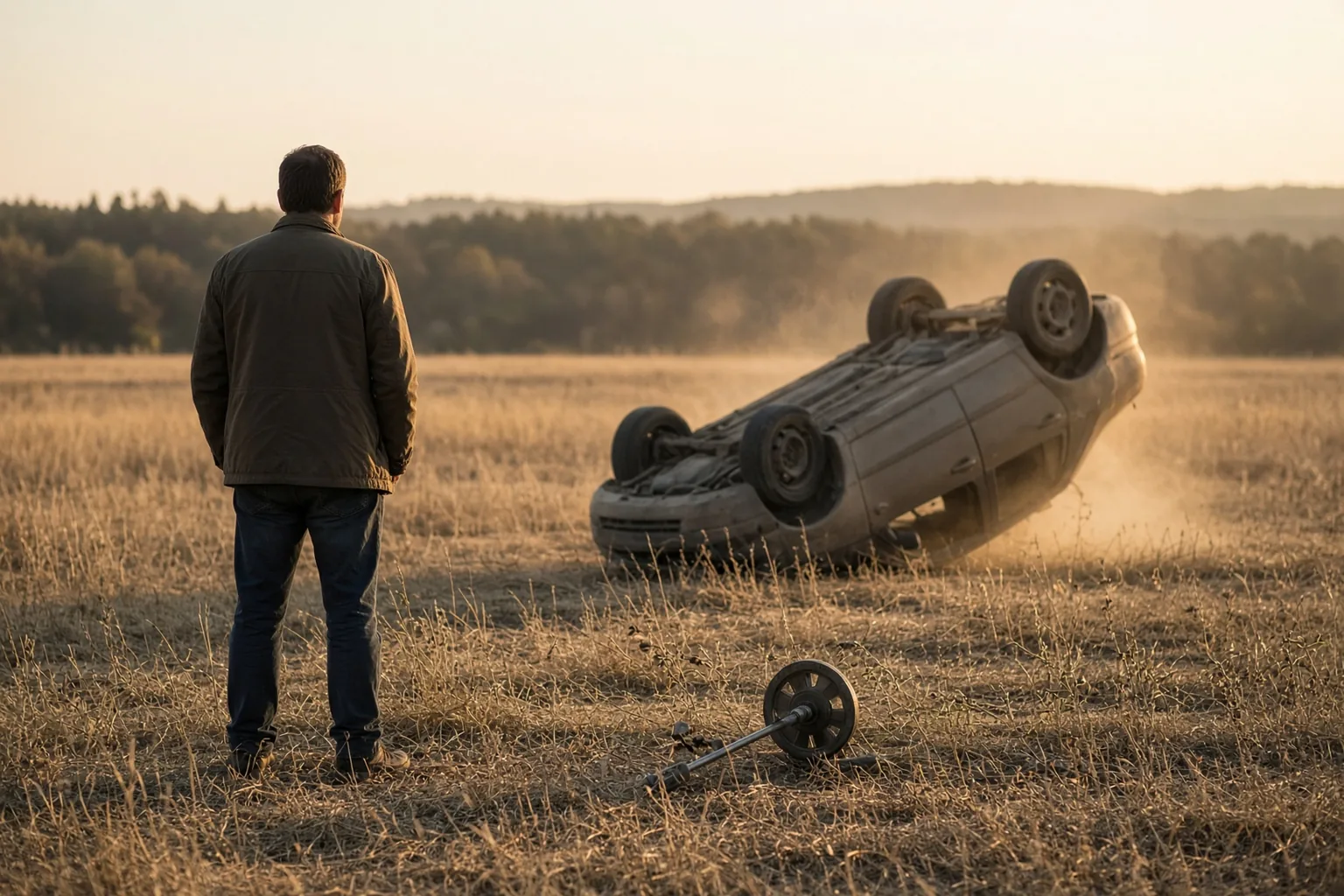
What is usually disputed in a rollover reconstruction?
Why the driver lost control, how fast the vehicle was moving, whether the occupants wore belts, how and where an occupant was ejected, and whether the roof and windows performed as they should have.
Cartwright v. American Honda Motor Co., Civil Action No. 9:09CV205, was decided by Magistrate Judge Judith K. Guthrie of the U.S. District Court for the Eastern District of Texas, Lufkin Division, on August 13, 2011, after a hearing on July 19, 2011. The case arose from "a one-vehicle roll over automobile accident that occurred on March 3, 2009 involving a 1997 Honda Accord" on Forest Service Road 107 in Shelby County.
The driver said she "swerved to avoid a pot-hole and lost control of her car." The car left the road and rolled, and she was ejected. The parties disputed "whether Plaintiff was wearing her seatbelt." She "suffered severe injuries rendering her a quadriplegic" and sued American Honda for defective design, alleging that the roof structure and the side windows, including their tempered glass, made the car uncrashworthy.
Each issue drew its own expert: a design engineer, a biomechanical engineer and an expert on NHTSA practice for the plaintiff, and for the defense the investigating trooper, a seat belt expert, a window glazing expert, an accident reconstructionist and a biomechanical expert. The court heard eight motions to exclude. It denied all of them except as to one item, the trooper's experiment.
Can the investigating officer re-create the crash with his own car?
Not without a showing that he is qualified and that the test is reliable. In Cartwright the court admitted the trooper's investigation opinions but excluded his patrol-car experiment that tried to re-create the driver's path around the pothole.
Corporal Jimmy Faulkner, the state trooper on the scene, "investigated the accident and prepared an accident report." The court held that "the testimony of Corporal Faulkner will assist the trier of fact" and that the plaintiff's challenges to his opinions "go to the weight of his opinions."
His experiment was different. Using "his patrol car," he had tried to re-create the plaintiff's path to test her account of the pothole. The court found that the experiment "lacks the reliability required by Daubert," noted that "there has been no showing that he is qualified to re-create an accident," and ruled: "Corporal Faulkner may not testify concerning his 'experiment.'"
A reviewer separates the two parts of an officer's file in the same way. Measurements at the scene, photographs and the positions of the vehicle and the occupant are observations. A drive-through with another vehicle is a test, and the report must show who ran it, with what vehicle, at what speed and under what conditions, and why those conditions match the crash. A different vehicle, speed or surface answers a different question from the one asked about the day of the crash.
How does a reviewer handle opinions built on crash statistics?
By checking whether the data set matches the crash. In Cartwright the plaintiff argued that NHTSA statistics did not concern similar accidents, and the court left that argument to cross-examination.
The defense reconstructionist, Lee Carr, gave opinions about the roof, the seat belt and the injuries that drew on NHTSA statistics. The plaintiff argued that "Carr is not qualified to offer an opinion concerning accident statistics" and that the statistics "do not concern similar accidents." The defense answered that "Carr's opinions concern injury risks, as opposed to causation."
The court found Carr qualified and his testimony reliable. It held that "Plaintiff's challenges to Carr's opinion go to the weight of his opinion" and "may be developed through cross-examination." A motion against the defense seat belt expert, Michael Klima, who also relied on accident statistics, was denied as well.
Because the court treated the objection as one of weight, the reviewer's work on the data set becomes the material for cross-examination. The review asks which database the figures come from, which crash types, vehicle classes and belt categories were included, and how many cases fit the facts at hand: a single-vehicle rollover after the car left the road. It also notes the defense's own description of the opinion as one about injury risk, as opposed to causation, which limits what it can be used for at trial.
What if the opposing expert relies on tests that differ from the crash?
In Cartwright the court treated that objection to the glazing expert as a matter of weight. The reviewer still lists every difference between the tests and the crash, because those differences become the cross-examination.
Dr. Michael Carhart, the defense window glazing expert, offered a centrifugal force analysis. The plaintiff argued that it "misrepresents the accident forces" and "relies upon tests that were not substantially similar to the subject accident." The defense described the method as "pure mathematical calculation based upon accepted principles of physics." The court found that the opinion "is the product of reliable principles and methods" and that the challenges "go to the weight of his opinion."
The two rulings in Cartwright draw a line a reviewer can use. A qualified expert's calculation from physical principles stayed in, with its test basis open to attack before the jury. An officer's re-creation, without a showing of qualification or reliability, was excluded. The review states on which side of that line each test in the opposing report falls.
For each test the review records the vehicle used, its mass and condition, the speed, the surface, the angle and the instruments, next to the same facts for the crash. Where the report gives no test conditions at all, the review says so, since nothing can then be compared.
How is seat belt use established in a rollover?
From the belt hardware, the occupant's injuries and, where it records belt status, the airbag control module. In one published rollover case study the module recorded that the driver's belt was not in use.
Jeffrey D. Armstrong, writing in the Journal of the National Academy of Forensic Engineers (Vol. XXVIII, No. 2, December 2011), says that seat belts should be inspected "to see if they were in use at the time of a crash, and to see if they were functioning properly." In his second case study an SUV rolled over after striking a culvert. The airbag control module recorded "the precrash speed approximately 10 mph above the posted speed limit" and an indication that the driver's seat belt was not in use.
In Cartwright belt use was disputed, and the defense biomechanical expert, Dr. Thomas McNish, offered opinions on injuries before ejection and on the effect of the belt. The court denied the motion to exclude them.
A reviewer checks the source of every statement about the belt in the opposing report: a physical inspection of the latch and webbing, a module record, the injuries, or a witness. If the report relies on one source only and the others were available, the review lists the ones not examined.
How does the reconstruction explain an ejection?
By identifying the opening the occupant left through and the point in the roll where it happened. Armstrong notes that ejections often occur at sudden changes in speed or direction, and scratches on the body may show the exit direction.
Armstrong writes that "Ejections often occur at points where there is a sudden change in the speed and/or direction of the vehicle" and that "Scratches on the bodies may indicate the direction that an ejected occupant exited the vehicle." In a 2005 presentation to the American Academy of Forensic Sciences on a high-speed rollover, Mark C. Pozzi and Todd K. Saczalski examined door latches, door structures, door window openings and exterior sheet metal for contact evidence, together with the occupants' injuries from photographs, autopsy and medical records.
In a case like Cartwright, where the plaintiff blamed the side windows and tempered glass, the ejection path bears directly on the defect claim. The reviewer checks whether the opposing report names the opening, ties it to marks on the door, the frame or the glass, and places it in the roll sequence, or simply assumes it.
Why do most challenges to rollover experts go to weight?
Because the court presumes expert testimony helpful and leaves disputes about its basis to cross-examination. In Cartwright seven of the eight motions were denied, and the one exclusion concerned an unqualified re-creation.
The court recited the trial judge's "gate-keeping role" over the relevance and reliability of expert testimony, and the rule that expert testimony is presumed helpful unless it concerns "matters within the everyday knowledge and experience of a lay juror." On the plaintiff's design engineer, whose alternative design the defense called untested, the court likewise held that the objections "go to the weight of his opinion."
One question was left for later. The plaintiff's NHTSA expert was challenged in part for offering legal conclusions, and the court said that issue "may be raised in a motion in limine."
For counsel this means that a review of a rollover reconstruction is written for two uses. A short part supports a motion against the opinions that lack any reliable basis or state legal conclusions. The longer part is a map for cross-examination: every assumption, every dissimilar test and every statistic that does not fit the crash, each tied to a page of the report.
What does the reviewer check in the opposing rollover reconstruction?
The cause assigned to the loss of control, any re-creation tests, the statistics and their data sets, the source of the belt findings, the ejection path and any opinion that states a legal conclusion.
Each point in the review is tied to a page of the opposing report and to a rule, a ruling or a published method.
- Does the report explain the loss of control with physical evidence, such as a pothole, tire marks or a mechanical defect, or with the driver's account alone?
- Who ran each re-creation or test, with what vehicle and under what conditions, and how do those conditions compare with the crash?
- Which statistics does the report use, from which database, and how many cases in it match this crash?
- What is the source of the finding on belt use: hardware, module data, injuries or a witness?
- Is the ejection opening identified from marks on the vehicle and placed in the roll sequence?
- Which opinions state that a party was negligent or a product defective, as opposed to engineering findings?
What does IAE do when a rollover reconstruction is disputed?
An engineer in the IAE registry reviews the opposing reconstruction: inputs, reaction times, calculations, tests and opinions that go past engineering. The review takes up to 5 business days, with a 48-hour rush.
The IAE accident reconstruction review is for counsel facing the other side's reconstructionist in an injury or property damage case in a US court. The engineer asks whether the opposing reconstructionist applied the intellectual rigor that practice in the field requires: inputs, reaction times, calculations, tests and the limits of engineering opinion. Each point is tied to a page of the report. Counsel also receives an inspection list.
The client sends the report with its exhibits, the police report, photographs, recorder downloads and deposition transcripts, and describes the task. The secretariat confirms receipt the same day. Within one business day IAE confirms the format, cost, deadline and the specialist in its registry, and the client approves the candidate and the CV before work starts.
Every specialist is a member of the public IAE registry and passed the council's attestation under the published Criteria Matrix. The Member ID or QR code on the document opens the specialist's category, specialization, attestation date and record status. The specialist confirms in the document that he or she has no interest in the outcome of the case. A review is evidence that the court weighs with the other materials; neither IAE nor the reviewer guarantees the outcome, and IAE is not a law firm.
Sources
- Cartwright v. American Honda Motor Co., Civil Action No. 9:09CV205 (E.D. Tex. Aug. 13, 2011), Memorandum Opinion and Order, ECF No. 82 (Justia)
- Jeffrey D. Armstrong, Forensic Engineering Determination of Who Was Driving, Journal of the National Academy of Forensic Engineers, Vol. XXVIII, No. 2 (December 2011)
- Mark C. Pozzi, Todd K. Saczalski, Determination of Driver Identity in a High-Speed Vehicle Rollover, American Academy of Forensic Sciences, Proceedings 2005, C15
Read also
All articles
Head-on or centerline collision: how does a reviewer check the opposing reconstruction of which vehicle crossed the line?
In a head-on or centerline crash each driver says the other came across the line, and the reconstruction decides in whose lane the collision Sergei Voronin
Left-turn collision: how does a reviewer check the opposing reconstruction of the oncoming vehicle's speed and the turning driver's gap?
In a left-turn crash each side blames the other: the turning driver failed to yield, or the oncoming driver was speeding. State statutes requireSergei Voronin
The police accident report is wrong: how is it checked, and what weight does it carry in court?
A police crash report is written by an officer who usually arrived after the vehicles stopped moving. It records what the officer saw, measuredSergei VoroninExpert report review
Ready to discuss your case?
Send the materials: the secretariat will confirm the format, cost, deadline and the specialist within one business day.
