
Expert witnesses
Slip and fall expert witness: what the floor tests show and when courts admit them
A slip and fall expert witness measures the surface where a person fell: how slippery it is wet and dry, whether a change in level or a stair meets the code, and what the owner's inspection records say. Federal courts admit or exclude these opinions under Rule 702. In Florida a business answers for a fall on a spill only if it knew or should have known about it, and the expert's work is read against that question.
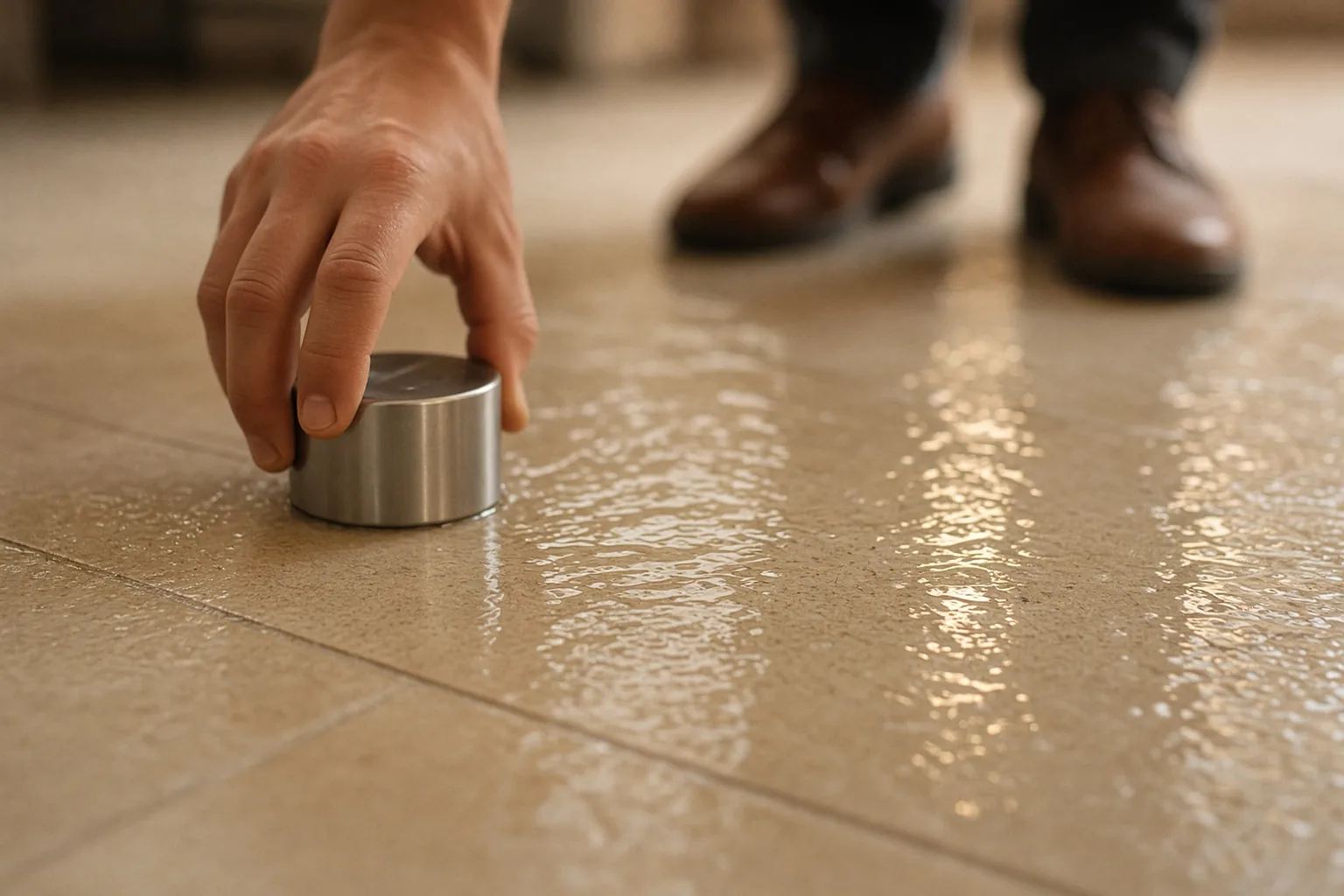
What does a slip and fall expert witness do?
The expert inspects and tests the surface where the person fell, compares it with codes and walkway standards, and reads the video, incident report and inspection logs to explain the fall and what the owner knew.
In slip and fall cases decided between 2015 and 2024, courts heard engineers and safety professionals. In Sorrels v. NCL (Bahamas) the plaintiff's expert was Dr. Ronald Zollo, a civil engineer. In Bunting v. District of Columbia CVS Pharmacy the store called Alexandra Maddox, a mechanical and biomedical engineer certified as an English XL tribometrist. In Nagy v. Outback Steakhouse the plaintiffs' liability expert was Scott D. Moore, PE, CSP.
The central measurement is the coefficient of friction (COF) between a test foot and the floor, taken with a portable instrument called a tribometer. A higher number means more resistance to slipping. In Alsip v. Wal-Mart the plaintiff's expert described a wet coefficient of 0.6 or greater as a high-traction surface. The expert also measures changes in level, stair risers and treads and handrail heights, and compares them with the code for that building.
The paper record is the other half of the work. Surveillance video fixes the time of the fall and what was on the floor before it. Incident reports, inspection logs and records of earlier falls go to the owner's knowledge, which Florida law makes the plaintiff's burden.
A retained expert's opinions go into a written report under Rule 26(a)(2)(B) of the Federal Rules of Civil Procedure: every opinion with its basis and reasons, the facts or data considered, the exhibits, the expert's qualifications with publications from the previous 10 years, the cases in which the expert testified during the previous 4 years, and the compensation for the study and testimony.
What does a Florida plaintiff have to prove about a spill on the floor?
Under section 768.0755, that the business had actual or constructive knowledge of the dangerous condition and should have fixed it. Constructive knowledge may be shown by how long the condition existed or by how often it occurred.
Section 768.0755 of the Florida Statutes, created by chapter 2010-8, applies when a person slips and falls on a transitory foreign substance in a business establishment. The injured person must prove that the business had actual or constructive knowledge of the dangerous condition and should have taken action to remedy it. Constructive knowledge may be proven by circumstantial evidence that the condition existed for such a length of time that, in the exercise of ordinary care, the business should have known of it, or that the condition occurred with regularity and was therefore foreseeable. Subsection (2) leaves in place any common-law duty of care owed by whoever possesses or controls the premises.
A friction test does not answer the knowledge question. In Francis v. MSC Cruises a passenger slipped on a piece of watermelon in a corridor outside a self-service buffet. Her expert, Dr. Reza Vaghar, measured a coefficient of friction of .35 for the deck material against an ASTM standard of .6. On June 29, 2021, Judge Federico A. Moreno of the Southern District of Florida granted MSC summary judgment on the negligent maintenance and negligent design theories. The order found that Francis "failed to present sufficient evidence showing that an industry standard put MSC Cruises on notice" of the dangerous condition. Francis had identified no industry standard requiring particular inspections of the deck material and had not explained how her expert's opinion showed that such inspections would have detected the slippery surface.
Francis was a cruise case under general maritime law, where the operator's liability turns on whether it knew or should have known of the condition. In a Florida store case section 768.0755 names two ways to prove that the business should have known: time and regularity. The materials that speak to them are the video before the fall, the inspection logs for that aisle and the records of earlier falls in the same place.
How does an expert measure how slippery the floor was?
With a tribometer that measures the coefficient of friction of the surface, wet and dry. The reading is compared with a walkway standard; the cases below use thresholds of 0.42, 0.5 and 0.6 from different standards.
In Nagy v. Outback Steakhouse (D.N.J., August 31, 2020) the expert used a BOT-3000E digital tribometer and the ANSI A326.3 wet dynamic coefficient of friction (DCOF) test method. He reported that the restaurant floor did not meet a 0.42 threshold wet or dry, and called 0.42 "the standard of care in the industry for slip resistance testing of hard surface flooring."
In Bunting v. District of Columbia CVS Pharmacy (D.D.C., February 7, 2024) the plaintiff slipped outside the store's automatic exit doors on salt and water on December 24, 2020. The store's expert tested the walkway on January 19, 2023 with an English XL tribometer. The manufacturer had calibrated the instrument three days earlier, and she field-calibrated it the day before the test. She used only water for the wet tests, as the instrument's manual provides, and applied ANSI A1264.2, which recommends a COF of 0.5 or greater for workplace walking surfaces. Her readings were 0.64 plus or minus .03 dry and 0.51 plus or minus .03 wet.
The plaintiffs moved to strike her. They argued that she had no P.E. license, that ASTM F2508 has limits, that ASTM F1679 had been withdrawn and that the calibration was flawed. Magistrate Judge Moxila A. Upadhyaya denied the motion. The opinion notes that the plaintiffs cited no federal decision finding this kind of testing unreliable, and holds that their arguments "go to the weight of the evidence, not its admissibility."
On a ship the expert in Sorrels relied on ASTM F1166-07, section 11.12.1.2, for a wet COF of 0.6 or higher on walkways. The district court ruled that the standard covered only crew areas. On August 4, 2015 the Eleventh Circuit held that this was an abuse of discretion, because crew members also walk on pool decks.
Does a test done months after the fall still count?
It can, if the surface is shown to be in the same condition. The Eleventh Circuit admitted wet tests taken 520 days after a fall; a New Jersey court excluded tests on a floor coated with unidentified grease.
Teresita Sorrels slipped on the exterior pool deck of the Norwegian Sky early on April 14, 2012, when the deck was wet from rain, and fractured her wrist. Dr. Zollo tested the deck about 520 days later, after a rainfall. His wet readings lay between 0.14 and 0.70, with an average of 0.45, and NCL's own expert used the same equipment and protocol. The district court struck the testing and granted NCL summary judgment.
The Eleventh Circuit reversed that ruling. Both experts testified that the wet condition during the test was similar to the condition at the time of the accident, and an NCL representative testified that the deck had not changed. The court wrote that "such testimony constituted sufficient evidence of 'substantial similarity' to allow admission," treated the 520-day gap and one "slimy" plank as matters of weight, and vacated the summary judgment and the cost award.
In Nagy the fall happened on October 18, 2018, and the expert inspected the restaurant on July 30, 2019, before it opened. He tested a floor covered in a greasy substance, and the plaintiffs did not show that it was the substance present on the day of the fall. Judge Anne E. Thompson granted the motion to preclude him: the testimony would not assist the jury in assessing the elements of the alleged negligence, so it failed the "fit" requirement.
The surface can also be gone before the defense expert sees it. In Maribona v. Wal-Mart (M.D. Fla., January 3, 2024) the plaintiff slipped on a painted stop bar in a parking lot wet from rain. The plaintiff's expert inspected the site about six months later. By the time the defense expert worked on the case the stripes had been repainted, and he did not inspect the site at all.
Can an expert give an opinion without testing the surface?
Courts have excluded such opinions when nothing measured the surface. In Alsip v. Wal-Mart the expert never visited the site, and the court found his opinion amounted to this: the plaintiff fell, so the surface was slippery.
Emma Alsip slipped in the rain on April 23, 2013, on the yellow painted crosswalk at the entrance of a Wal-Mart store in Foley, Alabama. Her expert, Russell Kendzior, was retained more than a year later. He worked from photographs, depositions and documents and concluded from the photographs that the striping was ordinary line paint without aggregate. He said a tribometer test would have been the best evidence, but that testing so late would not reproduce the conditions on the day.
He did not know the coefficient of friction of the crosswalk, and he conceded that aggregate is not the only way to make paint slip resistant. On November 12, 2015, Judge Callie V. S. Granade granted Wal-Mart's motion to exclude all of his testimony. He had performed no tests, the court found that his conclusions were not based on sufficient facts or data, and his opinion was "essentially that because Plaintiff fell, it must have been slippery."
An inspection without instruments can still be admitted. In Maribona the plaintiff's expert, Christopher Zimmerman, examined the stop bar by sight, touch and scratching and reported that "there was no evidence of an abrasive additive present within the painted marking." The court found him qualified and his method reliable, held that the asserted shortcomings went to weight and denied Wal-Mart's motion to strike.
The defense expert in the same case did no site examination. He relied on the store video, the photographs of the plaintiff's expert and six months of the company's slip and fall records. By his count the plaintiff was the only one of 336 people crossing the markings who slipped. He also ran a step analysis of 118 people and a gait analysis of the plaintiff. The court granted the plaintiff's motion to exclude him, finding that he had "essentially counted the number of people who did not slip over an arbitrary two-hour period," and then denied Wal-Mart's motion for summary judgment.
These rulings apply Rule 702 of the Federal Rules of Evidence. Under the rule as amended in 2023, the party offering the expert must convince the court that it is more likely than not that the testimony is based on sufficient facts or data, is the product of reliable principles and methods, and applies those methods reliably to the facts of the case.
Which codes and standards does the expert compare the premises with?
Accessibility standards for floors, changes in level and stairs, OSHA's walking-working surface rules where employees work, and the walkway friction standards that the expert names in the report.
The ADA Accessibility Standards published by the U.S. Access Board require floor and ground surfaces to be "stable, firm, and slip resistant" (section 302.1). The advisory note defines a slip-resistant surface as one that "provides sufficient frictional counterforce to the forces exerted in walking" to permit safe ambulation. Section 302.1 sets no friction number, so the expert takes the threshold from a walkway standard and names it.
Changes in level are measured in fractions of an inch. Under section 303 a change of up to 1/4 inch may be vertical, a change between 1/4 and 1/2 inch must be beveled with a slope not steeper than 1:2, and a change greater than 1/2 inch must be ramped under section 405 or 406. On stairs, section 504.2 requires uniform riser heights and uniform tread depths, risers at least 4 and at most 7 inches high and treads at least 11 inches deep. Section 504.3 prohibits open risers, and section 505.4 puts the top of a handrail's gripping surface 34 to 38 inches above the stair nosings.
Where employees work, 29 CFR 1910.22 requires the employer to keep workroom floors clean and, to the extent feasible, dry, and to keep walking-working surfaces free of hazards such as leaks, spills, snow and ice. Under paragraph (d) the surfaces are inspected regularly and as necessary, and a hazardous condition is corrected or repaired before an employee uses the surface again, or guarded until it is repaired. The regulation sets the employer's duties toward employees.
The court decides which standard the jury will hear about. In Sorrels the Eleventh Circuit found no abuse of discretion in the exclusion of the OSHA and Federal Register standards the expert cited, and reversed the exclusion of ASTM F1166-07.
What if the person who fell was not watching where they walked?
Florida divides damages by percentage of fault. Since the 2023 amendment, a plaintiff found more than 50 percent at fault for his or her own harm recovers nothing in a negligence action, except one for medical negligence.
Under section 768.81(2) the plaintiff's contributory fault reduces economic and noneconomic damages in proportion and, subject to subsection (6), does not bar recovery. Under subsection (3) the court enters judgment against each liable party on the basis of that party's percentage of fault, not on joint and several liability. Subsection (6), added by chapter 2023-15, provides that "any party found to be greater than 50 percent at fault for his or her own harm may not recover any damages." It does not apply to personal injury or wrongful death actions for medical negligence under chapter 766.
Defense experts address the plaintiff's own walking. In Maribona the defense expert ran a gait analysis of the plaintiff on the store video and a step analysis of 118 other people; both were excluded under Rule 702 together with the rest of his opinions.
Whether the hazard could be seen belongs to the same question. For stairs, the advisory to section 504.4 of the ADA standards suggests visual contrast on tread nosings, or on the leading edges of treads without nosings, for people with low vision.
Which evidence should be preserved for the expert?
The surveillance video, the incident report, inspection and cleaning logs, records of earlier falls, the shoes, photographs, and the surface itself before it is cleaned, repainted or replaced.
Store video is electronically stored information. Under Rule 37(e), if such information that should have been preserved in the anticipation or conduct of litigation is lost because a party failed to take reasonable steps to preserve it, and it cannot be restored or replaced through additional discovery, the court may order measures no greater than necessary to cure the prejudice. A presumption that the lost information was unfavorable, a jury instruction to that effect, dismissal or a default judgment require a finding that the party acted with intent to deprive the other side of the information.
Surfaces change after a fall. In Maribona the stop bar was repainted before the defense expert could see it. In Nagy the floor the expert tested nine months later carried a substance nobody tied to the day of the fall, and the tests were excluded.
Records of earlier falls go to the regularity route of section 768.0755(1)(b), and courts screen them. In Sorrels the Eleventh Circuit upheld the exclusion of 22 prior incidents that were not substantially similar to the plaintiff's fall. Testimony of NCL employees that signs were put out after rain was relevant to knowledge and, the court held, enough to withstand summary judgment on notice. In Maribona the defense expert relied on six months of slip and fall records.
How does IAE find a slip and fall expert?
In the IAE request, choose the case type Personal injury and name the field, for example walkway safety or slip resistance testing. Within 5 business days IAE sends 2-3 candidates with CVs, hourly rates and prior testimony lists.
The personal injury expert witness page lists falls among the case types and names floor safety and inspections under 29 CFR 1910.22 among the fields. The request also asks for the state and court, the side, the expert disclosure deadline, and the parties and their counsel for the conflict check. Within 1 business day IAE replies whether it can search in that field by that deadline. The form asks not to include privileged or sealed information.
Each candidate confirms in writing that he or she has no ties to the parties or their counsel. The candidate file includes testimony in the last 4 years and publications in the last 10 years, the lists that Rule 26(a)(2)(B) requires.
The search costs $2,000 per case, paid in advance, and candidate names and CVs come after payment. If no candidate fits, the second search is free; if IAE finds no candidates, it refunds the fee. The expert's hourly rate never depends on the outcome of the case or on the content of testimony. Under the agency option the expert bills through IAE, with $100 per hour added to the rate, on one invoice.
IAE is not a law firm. Case strategy and the decision to retain an expert stay with the attorney.
Sources
- Florida Statutes 768.0755, Premises liability for transitory foreign substances in a business establishment (2026)
- Florida Statutes 768.0755 (2023), with history note ch. 2010-8
- Florida Statutes 768.81, Comparative fault (2026)
- 29 CFR 1910.22, Walking-working surfaces, general requirements (LII)
- U.S. Access Board, ADA Accessibility Standards, chapter 3: Building blocks
- U.S. Access Board, ADA Accessibility Standards, chapter 5: General site and building elements
- Federal Rules of Evidence, Rule 702 (LII)
- Federal Rules of Civil Procedure, Rule 26 (LII)
- Federal Rules of Civil Procedure, Rule 37 (LII)
- Sorrels v. NCL (Bahamas) Ltd., No. 13-15858 (11th Cir. Aug. 4, 2015)
- Alsip v. Wal-Mart Stores East, LP, No. 14-476-CG-M (S.D. Ala. Nov. 12, 2015)
- Francis v. MSC Cruises, S.A., No. 18-61463-CIV-MORENO (S.D. Fla. June 29, 2021)
- Maribona v. Wal-Mart Stores East, LP, No. 2:22-cv-244 (M.D. Fla. Jan. 3, 2024)
- Nagy v. Outback Steakhouse, Civ. No. 19-18277 (D.N.J. Aug. 31, 2020)
- Bunting v. District of Columbia CVS Pharmacy, LLC, No. 22-cv-766 (D.D.C. Feb. 7, 2024)
Read also
All articles
Dram shop expert witness: what can a toxicologist prove about visible intoxication, and what do courts require of the opinion?
A dram shop claim asks a court to hold a bar or restaurant liable for what an intoxicated patron did after leaving. The crash is usually undisputed Sergei Voronin

Construction accident expert witness: which safety rules does the expert apply, and when do they decide the case?
A fall from a scaffold, a collapsed trench or a ladder that kicked out ends up in court as a question about safety rules. The construction safetySergei Voronin
Traumatic brain injury expert witness: what can a neuropsychologist and brain imaging prove in court?
A mild traumatic brain injury often leaves nothing a standard scan can show, so the case turns on experts: the treating physiciansSergei VoroninExpert witnesses
Need an expert witness for your case?
Describe the question, the case type and the court. Within 5 business days you receive 2-3 candidates with CVs, hourly rates and lists of prior testimony.
