
Expert report review
How is a tire impression report reviewed?
A tire impression report links a vehicle to a mark at a scene by comparing the questioned impression with test impressions of a known tire. Since August 15, 2020, Department of Justice examiners have reported one of six fixed conclusions and may not base a source conclusion on the uniqueness of the tire. The first black-box study of tire examiners, published in September 2025, counted 4 wrong definitive decisions in 238 comparisons.
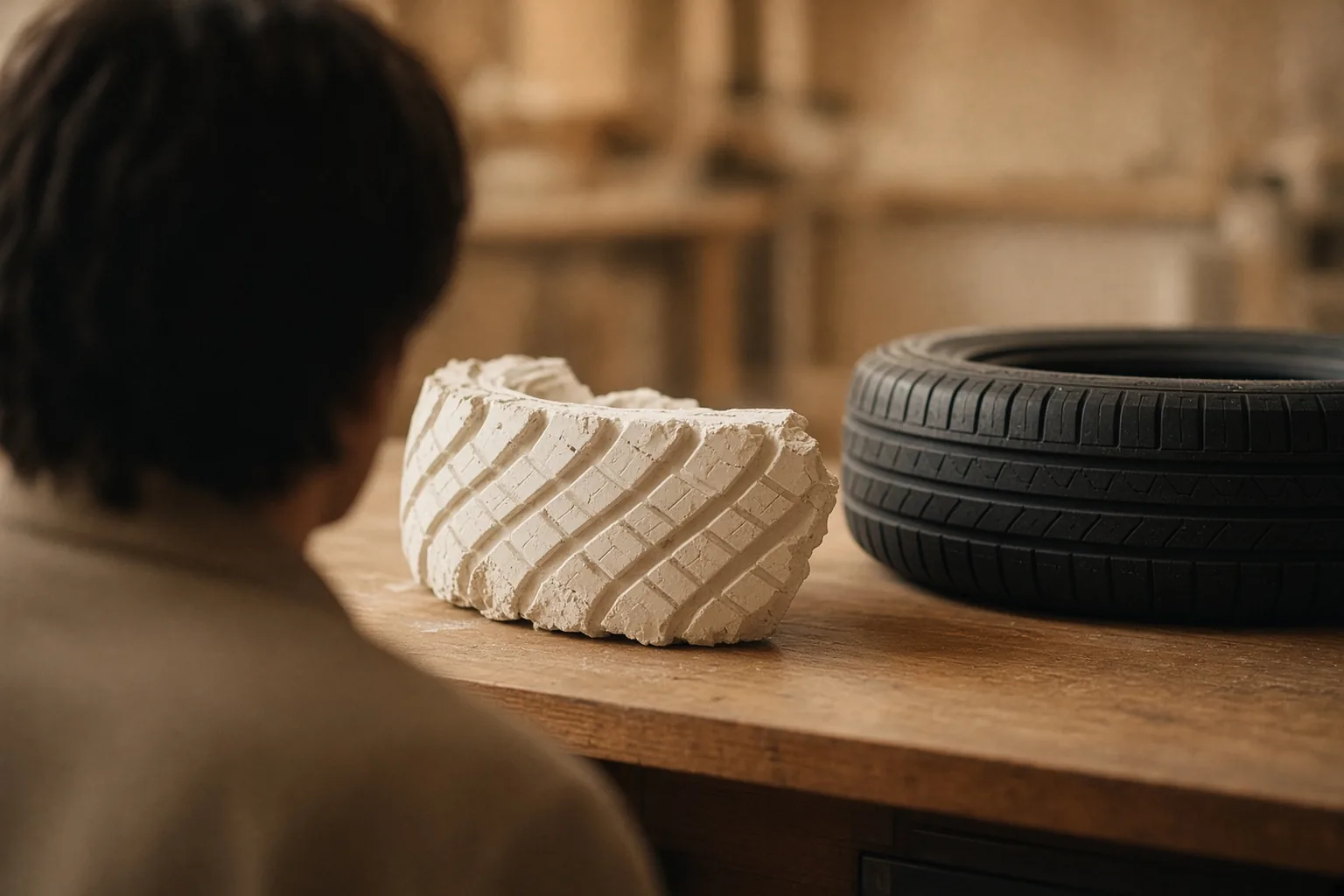
What does a review of a tire impression report check?
Whether the conclusion rests on documented features: what the examiner found in the questioned impression, how the known tire was printed, which characteristics were compared, who verified the result and how the conclusion is worded.
A tire comparison involves three objects: the questioned impression recovered at the scene, the known tire, and test impressions made with that tire. The Department of Justice defines a known tire as "a tire whose origin was documented" and a questioned impression as "an impression whose source is unknown." A reviewer reads the report and the bench notes in that order. First comes what was recovered and how it was photographed or cast. Then come the features the examiner recorded in the questioned impression, the way the test impressions were made, and the features that carry the conclusion.
The stated conclusion is then checked against the scale the laboratory uses. DOJ examiners follow the Uniform Language for Testimony and Reports for the Forensic Tire Discipline, and the FBI Laboratory follows its document IMPRS-901-03. A state laboratory may have its own procedure, so the review asks for that procedure and compares the report with it as well.
Each finding of the review is tied to a page of the report or of the notes, so the attorney can put that page to the examiner on cross-examination or cite it in a motion.
What conclusions may a tire examiner report?
Six under the DOJ tire rules in force since August 15, 2020: source identification, two levels of inclusion, inconclusive, support for exclusion and source exclusion. Each inclusion must state that other tires could have made the impression.
The Department of Justice approved the tire text on June 8, 2020, and it took effect on August 15, 2020. It applies to DOJ examiners who prepare reports or testify about forensic tire examination. Section III covers conclusions from the comparison of a known tire with a questioned impression; Section IV applies to all tire examinations.
"Source identification" is "an examiner's conclusion that the known tire made the questioned impression." An "inclusion based on class and randomly acquired characteristics" means the known tire "probably made" the impression. An "inclusion based on class characteristics" means it "could have made" the impression. "Inconclusive" means no determination can be reached either way. "Support for exclusion" means the tire "probably did not make" the impression, and "source exclusion" means it did not make it.
The FBI Laboratory document IMPRS-901-03, issued January 14, 2022, uses the same six conclusions for footwear and tires together, under the term "footwear item/tire." It lists design, physical size and wear as class characteristics. The policy is not retroactive to reports or testimony given before that date.
The two inclusions differ in what the examiner found. The first rests on class characteristics plus randomly acquired ones, the second on class characteristics alone. A report that uses words such as "matched" or "consistent with" and names none of the six conclusions leaves the reader to guess the level, and the review records that gap.
Which statements are off limits for a tire examiner?
Under the DOJ and FBI texts: uniqueness, individualization, exclusion of all other tires, infallibility or a zero error rate, statistics without relevant data, a career case count as proof of accuracy, and 100 percent certainty.
Section IV of the DOJ tire text says an examiner shall not assert that a source identification or source exclusion is based on the "uniqueness" of the evidence, and shall not use the terms "individualize" or "individualization" for a source conclusion. The examiner shall not assert that the known tire made the questioned impression "to the exclusion of all other tires," or that tire examinations are "infallible or have a zero error rate."
A statistic or numerical degree of probability is barred "except when based on relevant and appropriate data." The number of tire examinations in the examiner's career may not be cited as a direct measure of accuracy. Absolute or 100% certainty and phrases such as "reasonable degree of scientific certainty" are barred unless a judge or applicable law requires them. Neither inclusion may be given without the explanation that other tires with indistinguishable characteristics could have made the impression.
FBI document IMPRS-901-03 repeats these limits in sections 5.1 through 5.6. It lets an examiner cite the career number of examinations to describe qualifications, and it notes that examiners may have to depart from the approved statements in circumstances outside their control, such as in courts of law.
The 2023 committee note to Federal Rule of Evidence 702 says that "Forensic experts should avoid assertions of absolute or one hundred percent certainty" or to a reasonable degree of scientific certainty "if the methodology is subjective and thus potentially subject to error." The reviewer marks every sentence of the report and of any prior testimony that crosses these lines, and the list becomes material for cross-examination.
Which tire features can support the conclusion?
Class characteristics shared by two or more tires, such as tread design, size and wear, and randomly acquired characteristics such as a cut, a scratch, a tear, a hole or a stone hold.
The DOJ text defines a class characteristic as "a feature that is shared by two or more tires." The definition of a randomly acquired characteristic begins with the words "a feature (e.g., a cut, a scratch, a tear, a hole, or a stone hold) on a tire". The names of the two inclusion levels state which of these the examiner relied on.
Tread design alone does not fix the size of the tire. Machelle A. Reid of the FBI Laboratory presented "Tire Impressions: Does Size Really Matter?" at the 2008 meeting of the American Academy of Forensic Sciences (abstract B138). The work used several sizes of the Michelin LTX M/S tire. Discrepancies in tread element size or in the width of the whole impression were "readily differentiating a majority of the tires from the others," while in comparisons of the noise treatment, or pitch sequence, "short areas, at best, aligned."
The abstract describes two levels of association an examiner may reach on design: an impression that "corresponds in tread design" and one that corresponds "in tread design and tread dimension." According to the abstract, many examiners lack the experience or confidence for the stronger association and give only the weaker one. The presentation set out to find the minimum length of impression needed to tell two sizes of one design apart.
The reviewer then asks whether the examiner measured tread elements and impression width and in what units, how long the questioned impression is, and whether randomly acquired characteristics are marked on photographs of the questioned impression and of the test impression at the same scale.
How should the known tire's test impressions be made and documented?
The report should state how the known tire was printed, on what medium and over what length. Reid's 2008 FBI presentation treated full rotation test impressions of the known tires as part of a complete examination.
A tire comparison is made against test impressions of the known tire. The Reid abstract stresses "making full rotation test impressions of the known tires." If the report or notes show only a partial printing, the review asks how the examiner found the section of tread that corresponds to the questioned impression.
The 2025 black-box study discussed below measured how the questioned impression affected the answers. Two-dimensional questioned impressions, prints on a surface, were more likely to result in definitive decisions, and lower quality questioned impressions were more likely to end in class associations.
The review also checks the order of work and its record. The notes should show what the examiner observed in the questioned impression before the known tire was examined, the date and method of each test impression, the scale of each photograph, and who verified the conclusion. When the verifier is named, the review asks whether the verifier knew the first examiner's result.
How often do tire examiners reach wrong conclusions?
In the first published black-box study, 17 examiners and trainees made 238 comparisons. Among definitive decisions, 96 percent of identifications and 89 percent of exclusions were correct; four definitive decisions were wrong.
The study is A Black Box Study of the Accuracy and Reproducibility of Tire Evidence Examiners' Conclusions, NCJ 310751, published in September 2025 under National Institute of Justice award 2020-DQ-BX-0026. Its abstract states that until then "there have not been any studies published that empirically evaluate the accuracy and reproducibility" of tire evidence examiners.
Seventeen tire impression examiners and trainees conducted 238 comparisons on 77 distinct sets, each pairing a questioned impression with a known tire. The study was conducted digitally, and decisions were based solely on images of the impressions. Sixty-eight percent of responses were class associations, 21 percent definitive decisions (identification or exclusion), 8 percent probable decisions and 3 percent neutral responses (not suitable or inconclusive).
Definitive decisions were often correct: 96 percent of identifications and 89 percent of exclusions matched ground truth. The participants made 4 erroneous definitive decisions: 3 exclusions on mated sets and 1 identification on a nonmated set. They also made 1 incorrect probable decision, an indication of non-association on a mated set. The authors state that the size of the study limits the precision of the measured rates.
Before September 2025 no published black-box data on tire examiners existed, and the DOJ text bars statistics without relevant and appropriate data. An examiner who cites the study after that date is citing results from 17 participants who worked from images, not from the physical tire.
What must the prosecution disclose about its tire examiner?
In federal court, on the defendant's request: reports of scientific tests under Criminal Rule 16(a)(1)(F), and a signed disclosure under Rule 16(a)(1)(G) with every opinion, its bases and reasons, qualifications and prior testimony.
Under Federal Rule of Criminal Procedure 16(a)(1)(F), the government must let the defendant inspect and copy the results or reports of scientific tests in its possession, custody or control if the item is material to preparing the defense or the government intends to use it in its case-in-chief.
Rule 16(a)(1)(G) requires a written disclosure of expert testimony under Federal Rules of Evidence 702, 703 or 705 that the government intends to use in its case-in-chief, or in rebuttal to defense expert testimony disclosed under Rule 16(b)(1)(C). It must contain a complete statement of all opinions, the bases and reasons for them, the witness's qualifications including publications from the previous 10 years, and a list of cases from the previous 4 years in which the witness testified as an expert at trial or by deposition. With narrow exceptions, the witness must approve and sign it, and the court sets a deadline early enough to give the defense a fair opportunity to respond. Corrections and supplements go through Rule 16(c).
The duty runs both ways. Under Rule 16(b)(1)(C), if the defense requested the government's expert disclosures and the government complied, the defense must disclose its own expert testimony on the government's request, with the same contents and signature. A reviewer who will testify is covered by that rule.
In a federal civil case, Civil Rule 26(a)(2)(B) requires a retained expert's written report with the opinions, the facts or data considered, exhibits, qualifications, prior testimony and compensation. Absent a stipulation or order it is due at least 90 days before trial, and a report intended solely to rebut it is due within 30 days after the other party's disclosure.
How have courts treated tire impression testimony?
In State v. Addie (2022) the Missouri Court of Appeals upheld the admission of testimony that tire marks matched a tire on the defendant's car, although the defense pointed to the lack of tire studies.
In State v. Addie, No. WD84656, decided November 29, 2022, the Missouri Court of Appeals, Western District, reviewed the admission of tire impression testimony. Police noticed that the tread on Addie's car was consistent with tire tracks where the victim's body was found. Impressions and tread photographs went to the Missouri State Highway Patrol Laboratory, and criminalist James Crafton gave the opinion that the tire marks "matched the rear passenger tire on Addie's car." The opinion notes that the laboratory's results were peer reviewed by another qualified expert.
The defense argued that the tire impression evidence was not a proper subject for expert testimony, that the State cited no specific case on tire impressions under Daubert or Missouri's Section 490.065, and that Crafton relied on a footwear study because no similar studies existed for tire tracks. The court held that "The record supports the circuit court's determination that Crafton's testimony satisfied the requirements of reliability" and found no abuse of discretion.
The word "matched" is not among the six DOJ conclusions, which bind DOJ examiners only. In a state case the review sets the testimony against the laboratory's own procedure and against the federal texts, and records each difference for cross-examination or a motion.
In federal court, Rule 702 admits expert testimony only if the proponent shows the court that it is more likely than not that the testimony will help the trier of fact, rests on sufficient facts or data, and is the product of reliable principles and methods applied to the case. A review that finds no record of the test impressions or of the verification goes to the second and third of these points.
What does IAE do when a party needs a review of a tire impression report?
IAE reviews the opposing examiner's report in up to 5 business days, or 48 hours on rush, and ties each point to a page of the report or notes and to a standard, a DOJ rule or a ruling.
The review is for US criminal defense and cargo loss cases in which the other side's examiner links a shoe, a tire or a tool to a mark. It checks the case file against the standard for that kind of mark, including whether the verification is recorded and who performed it. IAE confirms the questions and the specialist with the client before work starts.
The secretariat confirms receipt the same day. Within one business day IAE confirms the format, the cost, the deadline and the specialist from its registry, and the client approves the candidate and the CV before work starts. The specialist confirms in the document that he or she has no interest in the outcome of the case, and materials are not passed to third parties without the client's consent.
IAE is not a law firm and does not advise on case strategy. The court weighs a review with the other evidence, and neither IAE nor the reviewer guarantees the outcome or influences the decision.
Sources
- U.S. Department of Justice, Uniform Language for Testimony and Reports for the Forensic Tire Discipline (approved June 8, 2020, effective August 15, 2020)
- FBI Laboratory, IMPRS-901-03, FBI Approved Standards for Scientific Testimony and Report Language for Forensic Examination of Footwear and Tire Impression Evidence (issued January 14, 2022)
- A Black Box Study of the Accuracy and Reproducibility of Tire Evidence Examiners' Conclusions, NCJ 310751, National Institute of Justice award 2020-DQ-BX-0026 (September 2025)
- Machelle A. Reid, Tire Impressions: Does Size Really Matter?, American Academy of Forensic Sciences, 2008, abstract B138
- State v. Addie, No. WD84656 (Mo. Ct. App. W.D. Nov. 29, 2022)
- Federal Rules of Criminal Procedure, Rule 16 (LII, Cornell Law School)
- Federal Rules of Evidence, Rule 702 and 2023 committee note (LII, Cornell Law School)
- Federal Rules of Civil Procedure, Rule 26 (LII, Cornell Law School)
Read also
All articles
Can the prosecution use a toolmark or footwear report without calling the examiner who did the comparison?
A toolmark or footwear report rests on a comparison that a particular examiner made, and the case file can show who else made test marks, verified Sergei Voronin
Footwear and toolmark conclusion scales: what do identification, probably made and inconclusive mean in the examiner's report?
A footwear report can end with one of seven conclusions under the SWGTREAD standard of 2013 or one of six under the Department of Justice languageSergei Voronin
Contextual bias in footwear and toolmark examinations: what was the examiner told, and what does a reviewer check?
A footwear or toolmark examiner who knows that the suspect confessed, has a record or was linked by other evidence has received informationSergei VoroninExpert report review
Ready to discuss your case?
Send the materials: the secretariat will confirm the format, cost, deadline and the specialist within one business day.
