
Expert report review
How is a toolmark examiner's report reviewed?
A toolmark examiner compares a mark on a lock, a door frame, a wire or a seal with test marks made by a suspect tool and reports whether the tool made it. A review of that report checks the record behind each step: documentation, class and subclass marks, test marks, verification and the wording of the conclusion. The OSAC draft standard and the Department of Justice testimony rules give the checklist.
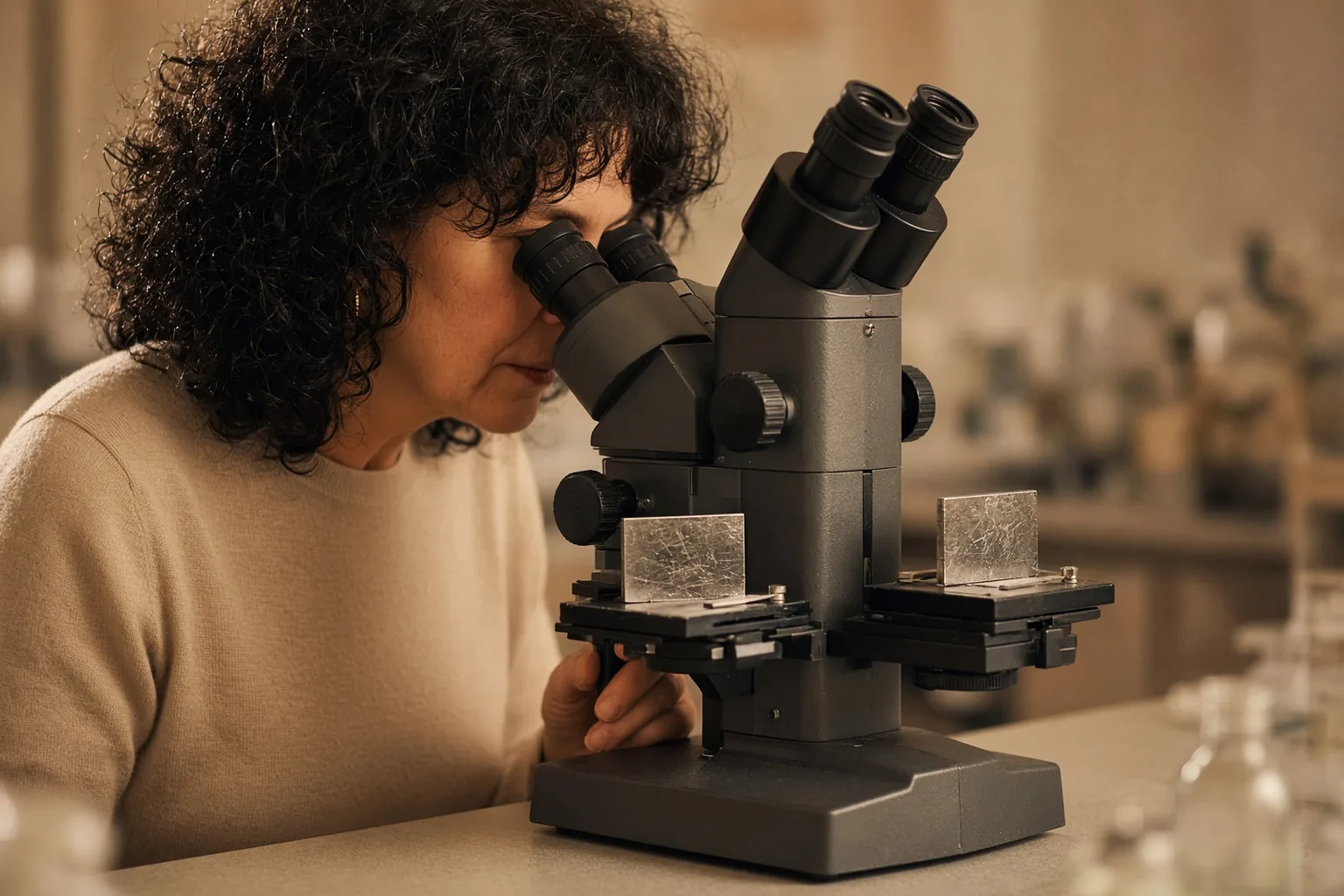
What does a review of a toolmark examination report check?
Whether the examiner documented each step, separated class and subclass marks from individual marks, made proper test marks, had the conclusion verified, and worded it within the limits the Department of Justice sets for its own examiners.
The method is written down in OSAC Proposed Standard 2024-S-0002, Standard Test Method for the Examination and Comparison of Toolmarks for Source Attribution, version 2.0 of January 2025, prepared by the OSAC Firearms and Toolmarks Subcommittee. It is a proposed standard that will be submitted to a standards development organization and may change. It describes casework in five steps: Evaluation, Classification, Comparison, Conclusion and Verification.
The wording of the result is set for Department of Justice laboratories by the Uniform Language for Testimony and Reports for the Forensic Firearms/Toolmarks Discipline, Pattern Examination, approved on May 18, 2023 and effective August 16, 2023. It applies to "firearms/toolmarks evidence" and permits three conclusions: source identification, source exclusion and inconclusive.
The same comparison applies whether the mark is on a lock cylinder, a door frame, a cut wire or a container seal. A questioned toolmark is compared with test marks made by the suspect tool. A review follows the five steps of the method and ties every point to a page of the report or of the bench notes.
What should the reviewer get from the case file?
The report, the bench notes, the photographs and the record of each comparison. The OSAC draft standard requires documentation that would let another examiner understand the analysis and the basis for the conclusion without the specimens.
Under the OSAC draft standard, documentation must allow another examiner, without the specimens, to understand the analysis and the basis for conclusions. "Written notes are sufficient and may be supplemented with photographs." A conclusion stated without supporting documentation is insufficient. The examiner documents each pair-wise comparison and confirms the identity of each specimen by its unique identifier.
A report that states only the conclusion gives the reviewer nothing to test. The request to the other side therefore lists the bench notes, worksheets, photographs and micrographs of the questioned mark and of the test marks, the record of who verified the conclusion and when, and access to the tool and the marked object for inspection.
Documentation arguments do not always lead to exclusion. In State v. Caneiro, Indictment No. 19-02-283 (N.J. Super. Ct. Law Div., Monmouth County, August 7, 2025), Judge Marc C. Lemieux denied a motion to preclude the State's firearm toolmark testimony. He held that the State had met its discovery obligations and that concerns about cognitive bias and documentation went to weight and were for cross-examination. In such a court the review becomes the outline of the cross-examination.
Did the examiner separate class, subclass and individual characteristics?
Agreement in class characteristics only places a tool in a group. The OSAC draft says that agreement of subclass characteristics cannot support a same-source conclusion, and a New York court limited testimony to class characteristics.
In the Classification step of the OSAC draft the examiner documents class characteristics of the tools and toolmarks. If class characteristics disagree, "a conclusion of exclusion shall be reached." Surfaces used for a source conclusion must be evaluated for subclass potential, because agreement of subclass characteristics, which tools from the same production run can share, cannot support a same-source conclusion. A specimen with no discernible class, subclass or individual characteristics has no value for comparison.
In People v. Ross, 68 Misc 3d 899 (Sup Ct, Bronx County, June 30, 2020), Justice April A. Newbauer heard a Frye challenge to testimony that shell casings matched a firearm. The court found that subclass characteristics can mimic individual characteristics and that examiners usually cannot detect them. It found the "sufficient agreement" standard vague and circular.
The court allowed the examiner to testify about class characteristics and to say that, if the class characteristics match, the firearm "cannot be ruled out as the source of the shell casings." It barred opinions on the significance of other marks and barred subjective terms such as "sufficient agreement" and "consistent with."
For a pry mark or a cut, the reviewer asks the same questions. Which features of the mark come from the design of the tool, such as blade width or jaw shape? Which could come from manufacturing and be shared by other tools of the same batch? Which come from wear and damage of this tool? The report should say which features the conclusion rests on and why they are not subclass features.
How were the test marks made and compared?
With the suspect tool, on suitable material, by methods that can reproduce the questioned mark. The OSAC draft requires test marks to be compared with each other before the questioned mark, and preserved when they are used for a conclusion.
Under the OSAC draft, exemplars are prepared using appropriate materials and methods. They must be intercompared before comparison with the questioned toolmark, and exemplars used for conclusions must be preserved. Both specimens are compared at the same magnification, oblique lighting is usually preferred, and the examiner considers the entire toolmark or the combination of marks.
The intercomparison step answers whether the tool leaves repeatable marks at all. If two test marks from the same tool do not agree with each other, agreement between a test mark and the questioned mark means little. The reviewer looks for the record of this step.
The reviewer then compares the conditions. A test mark cut in soft lead or made at a different angle may not reproduce a mark left on a brass cylinder or a steel seal shackle. The report should name the test material, the angle and the direction of the stroke, and the reviewer checks each against the questioned mark and the object it was found on.
Was the conclusion verified, and did the verifier know the answer?
Verification is the last step of the method in the OSAC draft. A 2024 independent review of the Rhode Island State Crime Laboratory, as reported by the Rhode Island Current, faulted a verification that was not blind.
The OSAC draft lists Verification as the fifth step of casework and refers its details to a separate verification document. The reviewer checks who verified the conclusion, when, whether the verifier worked independently and what record the verification left.
The Rhode Island Current reported on an independent report by Ronald Nichols, a California consultant and former ATF employee, presented to the State Crime Laboratory Commission on October 23, 2024. In a 2021 Pawtucket murder case, the laboratory had attributed 13 fired cartridge casings to a Glock that could not have fired them. Nichols found a lack of diligence and confirmation bias among all three examiners. According to the report, Examiner 1 said the verification was not truly blind, because Examiner 2 "had innocently shared during a conversation that this case was an identification."
Nichols re-examined 15 gun cases handled by the same examiners, found no other misidentifications, and disagreed with two inconclusive findings. The case concerns firearm toolmarks on cartridge cases, the same discipline that the DOJ language and the OSAC draft cover. A reviewer of any toolmark report asks for the verification record for that reason.
Is the conclusion worded within the limits the Department of Justice sets?
DOJ examiners may report source identification, source exclusion or inconclusive. They may not claim uniqueness, exclusion of all other sources, a zero error rate or absolute certainty, or cite their caseload as proof of accuracy.
Under the firearms/toolmarks ULTR, a source identification means the examiner concludes that two toolmarks came from the same source and judges as negligible the possibility that they have different sources. A source exclusion means they did not come from the same source. Inconclusive means class characteristics agree but individual characteristics are insufficient for either identification or exclusion.
The same document lists statements the examiner shall not make. He shall not base a source conclusion on the "uniqueness" of the evidence, use the terms "individualize" or "individualization," say that the toolmarks came from the same source "to the exclusion of all other sources," or call the discipline "infallible" or claim a "zero error rate." He shall not give a statistic without relevant and appropriate data, cite the number of his career examinations as a measure of accuracy, or assert absolute or 100 percent certainty or a "reasonable degree of scientific certainty" unless a judge or applicable law requires it.
The 2023 committee note to Rule 702 says the same for courts: forensic experts should avoid assertions of absolute or 100 percent certainty, or of a reasonable degree of scientific certainty, if the methodology is subjective and potentially subject to error. A state laboratory may follow its own policy, so the reviewer compares the wording in the report with the policy of that laboratory as well.
How have courts limited toolmark conclusions?
Some courts allow only class-level or "consistent with" testimony, others admit full identifications and leave weaknesses to cross-examination. The outcome depends on the jurisdiction and the record built at the hearing.
In Abruquah v. State, No. 10, September Term 2022 (Md., June 20, 2023), the Supreme Court of Maryland held 4-3, in an opinion by Chief Justice Fader, that the trial court abused its discretion by letting the firearms examiner give an unqualified opinion that the bullets were fired from the defendant's revolver. The methodology, the court wrote, "can support reliable conclusions that patterns and markings on bullets are consistent or inconsistent" with those of a known firearm. The court found that the AFTE "sufficient agreement" standard "lacks any guiding standard other than the examiner's own subjective judgment," and reversed for a new trial.
The ABA Journal reported on July 24, 2023 that Colorado Judge Gurley in Grand Junction ruled on July 7, 2023 on a motion for a new trial filed by a man serving a life sentence for 1993 pipe bombings that killed two people. At his trial an ATF agent had testified that the defendant's pliers and wire cutters matched marks on the bomb fragments and were "the only tools in the world" that could have made them. The judge found that an opinion of a match "to the exclusion of every tool in the world" would be rejected by the relevant scientific community today and that "there are no scientific principles underlying or supporting" the certainty of the match.
Other courts have gone the other way. In Caneiro the New Jersey court held firearm toolmark analysis reliable as a matter of law under existing state precedent and rejected the request to limit the expert to class characteristics or "cannot be excluded" language. In Ross the New York court allowed only class-level testimony. The review gives counsel the record for whichever argument the jurisdiction permits.
When is a rebuttal report on a seal or toolmark examination due in a civil case?
In federal civil cases, such as cargo loss suits, absent a stipulation or court order a rebuttal is due within 30 days after the other side's disclosure and must answer evidence on the same subject matter.
Rule 26(a)(2)(D)(ii) sets the default: evidence "intended solely to contradict or rebut evidence on the same subject matter identified by another party" is due within 30 days after the other party's disclosure. A retained examiner writes a full report under Rule 26(a)(2)(B), with all opinions and their basis, the facts or data considered, exhibits, qualifications, prior testimony and compensation.
The scope rule from crash cases applies here too. In Withrow v. Spears (D. Del. 2013) the court held that a rebuttal report "may cite new evidence and data so long as the new evidence and data is offered to directly contradict or rebut" the opposing expert. In Hampton v. Bob Evans Transportation Co. (E.D. Ky. 2019) the court struck a rebuttal witness whose report agreed with the opposing expert on several points and stated that the physical evidence was not enough for an estimate, because that rebutted nothing.
Under Rule 26(b)(4)(C), the facts, data and assumptions that counsel gave the opposing examiner are discoverable even though other attorney-expert communications are protected. In a seal case these are often the shipping documents and the seal numbers recorded at loading and at delivery, and the reviewer checks them against the physical seal.
What does IAE do when a party needs a review of a toolmark or impression report?
IAE prepares a review of the opposing examiner's report or an expert report on the client's questions for criminal defense and cargo loss cases in US courts. Delivery takes up to 5 business days, or 48 hours on rush.
The questions cover whether a shoe, tire or tool could have left the mark, how strong the association is, and whether a lock or seal was defeated. Toolmarks on lock cylinders and seals are compared with test marks made by the suspect tool, and each question is tied to the ANSI/ASB or ISO standard for that kind of mark. For a footwear report the review checks whether the examiner analyzed the questioned print before the known shoe, documented class characteristics and characteristics of use, and recorded the conclusion. For a toolmark report it checks whether the case file records the verification and who performed it.
IAE confirms the questions with the client before work starts. The secretariat confirms receipt the same day, and within one business day IAE confirms the format, the cost, the deadline and the specialist from its registry. The client approves the candidate and the CV.
Every specialist is a member of the public IAE registry, verified by Member ID or QR code, and confirms in the document that he or she has no interest in the outcome. Materials go through the contact form or to info@iaexperts.com and are not passed to third parties without the client's consent. The court weighs a review with the other evidence, and neither IAE nor the examiner guarantees the outcome. IAE is not a law firm and does not advise on case strategy.
Sources
- OSAC Proposed Standard 2024-S-0002, Standard Test Method for the Examination and Comparison of Toolmarks for Source Attribution, version 2.0, January 2025 (NIST)
- U.S. Department of Justice, Uniform Language for Testimony and Reports for the Forensic Firearms/Toolmarks Discipline, Pattern Examination (approved 5.18.23, effective 8.16.23)
- Federal Rules of Evidence, Rule 702, Testimony by Expert Witnesses, with Committee Notes (LII)
- Federal Rules of Civil Procedure, Rule 26, Duty to Disclose; General Provisions Governing Discovery (LII)
- Abruquah v. State, No. 10, Sept. Term 2022 (Md. June 20, 2023)
- People v. Ross, 68 Misc 3d 899, 2020 NY Slip Op 20153 (Sup Ct, Bronx County June 30, 2020)
- State v. Caneiro, Indictment No. 19-02-283 (N.J. Super. Ct. Law Div., Monmouth County Aug. 7, 2025), order and opinion
- ABA Journal, Expert's assertions about toolmark evidence lead judge to order new trial in pipe bombings, July 24, 2023
- Rhode Island Current, report on the independent review of toolmark testing at the Rhode Island State Crime Laboratory (2024)
- Withrow v. Spears, Civil Action No. 12-06-LPS-CJB (D. Del. Aug. 22, 2013), Memorandum Order
- Hampton v. Bob Evans Transportation Co., Civil Action No. 6:18-143-DCR (E.D. Ky. Apr. 8, 2019), Doc. 43 (Justia)
Read also
All articles
Can the prosecution use a toolmark or footwear report without calling the examiner who did the comparison?
A toolmark or footwear report rests on a comparison that a particular examiner made, and the case file can show who else made test marks, verified Sergei Voronin
Footwear and toolmark conclusion scales: what do identification, probably made and inconclusive mean in the examiner's report?
A footwear report can end with one of seven conclusions under the SWGTREAD standard of 2013 or one of six under the Department of Justice languageSergei Voronin
Contextual bias in footwear and toolmark examinations: what was the examiner told, and what does a reviewer check?
A footwear or toolmark examiner who knows that the suspect confessed, has a record or was linked by other evidence has received informationSergei VoroninExpert report review
Ready to discuss your case?
Send the materials: the secretariat will confirm the format, cost, deadline and the specialist within one business day.
