
Expert report review
Warranty denied for liquid damage: how does a reviewer check the finding that water caused the failure?
A red liquid indicator records one fact: water touched the indicator. A warranty denial needs a second fact, that the liquid caused the failure the owner complains of. For a full warranty 15 U.S.C. 2304(c) puts that showing on the warrantor. A reviewer of the service report or of the opposing expert's report checks where the traces are, which component failed, and what in the report connects the two.
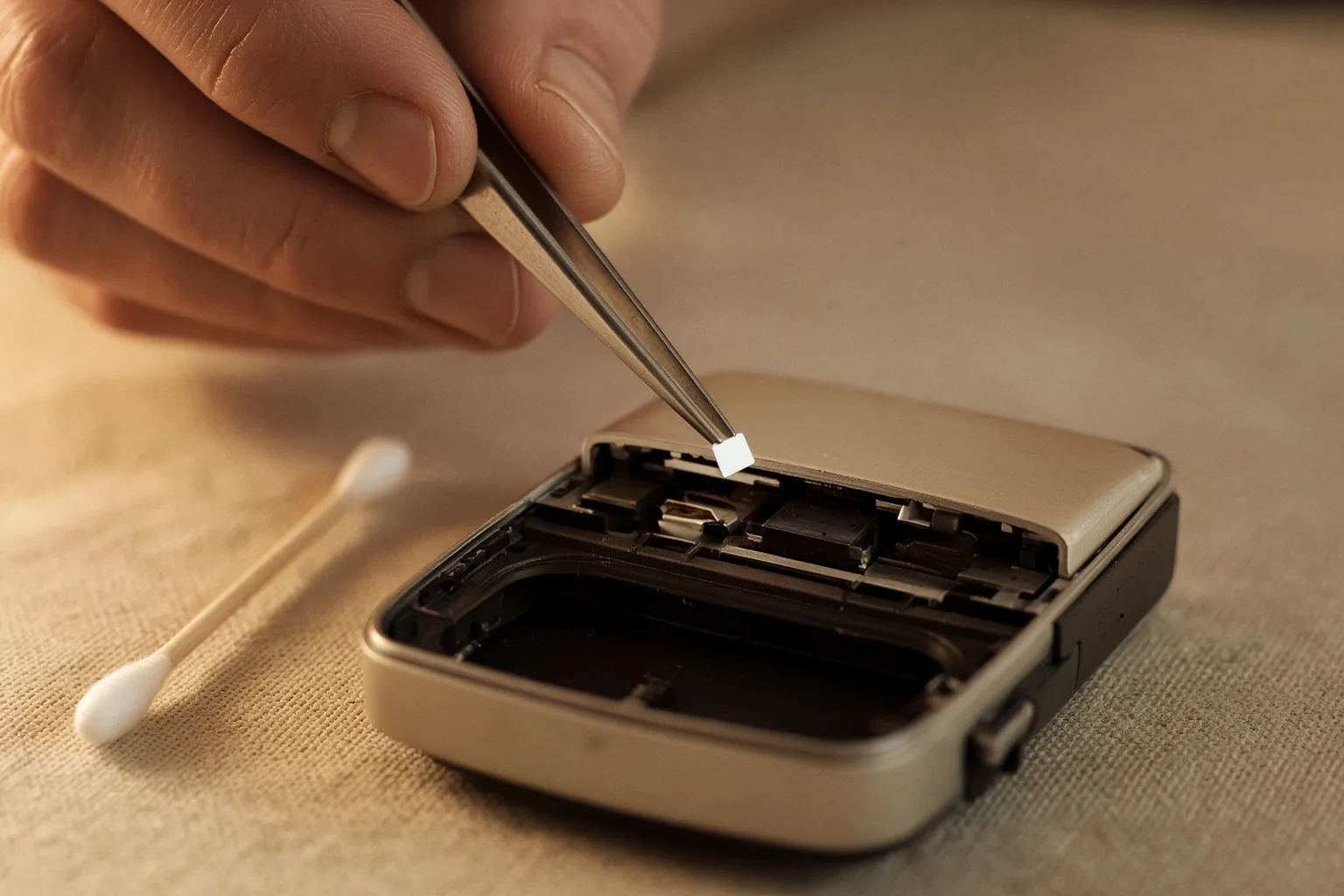
Does a tripped liquid indicator prove that liquid caused the failure?
No. The indicator records contact with water at the place where it sits. Whether that contact caused the fault in dispute is a separate question of causation, and the report has to answer it with findings about the failed part.
Apple's support page Water and other liquid damage to iPhone or iPod isn't covered by warranty describes the device in one sentence: "An LCI will activate when it contacts water or a liquid containing water." The indicator "is normally white or silver," and after contact "it will turn fully red." The page describes what the indicator detects. It does not say which component of a given device failed or why.
A warranty dispute turns on that second step. The federal warranty statute speaks of a failure that "was caused by damage (not resulting from defect or malfunction) while in the possession of the consumer." A reviewer reads the service report for the link between the trace and the failure: where the corrosion is, which part stopped working, and which test ties one to the other.
What is a liquid contact indicator, and what does the manufacturer say about it?
A small indicator inside the device that changes colour on contact with water. Apple states that iPhone and most iPod devices built after 2006 have them and that liquid damage is outside its one-year limited warranty.
The same Apple page, published on May 26, 2026, states: "Service for liquid damage to an iPhone or iPod isn't covered by the Apple One-Year Limited Warranty." It adds that the owner "may have rights under consumer law." On the indicators it says: "iPhone and most iPod devices that were built after 2006 have built-in Liquid Contact Indicators (LCIs)."
Apple also describes what the indicator should not respond to: "An LCI won't activate because of humidity and temperature changes" that are within the product's environmental requirements. The sentence carries a condition. A reviewer asks what the environmental requirements of the model are and whether the report says anything about the conditions the device was kept in.
The reviewer starts with the documents that the denial itself cites: the warranty text and the maker's published description of its indicators, in the version current on the date of the claim.
The phone is rated IP68: can a warranty claim still be refused for liquid?
Yes, under the manufacturer's terms. Apple states that the rating was obtained under controlled laboratory conditions, that water resistance is not permanent, and that liquid damage is not covered under warranty, subject to rights under consumer law.
Apple's page About splash, water, and dust resistance of iPhone 7 and later lists the ratings by model. For one group: "These models have a rating of IP68 under IEC standard 60529 (maximum depth of 6 meters up to 30 minutes)." For another: "These models have a rating of IP67 under IEC standard 60529 (maximum depth of 1 meter up to 30 minutes)." The models were "tested under controlled laboratory conditions."
The page then limits the promise. "Splash, water, and dust resistance are not permanent conditions," and "resistance might decrease as a result of normal wear." It lists what to avoid, starting with "Swimming or bathing with your iPhone," "Exposing your iPhone to pressurized water or high velocity water" and "Using your iPhone in a sauna or steam room." It ends: "Liquid damage is not covered under warranty, but you might have rights under consumer law."
For a rated device the reviewer adds one question to the list: does the report say how liquid got past the seals? The candidates are an enclosure opened in an earlier repair, a cracked housing, worn seals, or exposure beyond the rated depth and time. A report that records a red indicator in a rated phone and stops there has not addressed whether the enclosure performed as rated.
Who has to prove what caused the failure?
Under a full warranty the warrantor must show that the failure was caused by damage in the consumer's possession or by unreasonable use. In a suit over accepted goods the UCC places the burden of proving breach on the buyer.
Section 2304 of Title 15 sets federal minimum standards. The warrantor "must as a minimum remedy such consumer product within a reasonable time and without charge, in the case of a defect, malfunction, or failure to conform with such written warranty." Subsection (c) states the exception: "The performance of the duties under subsection (a) shall not be required of the warrantor if he can show that the defect, malfunction, or failure of any warranted consumer product to conform with a written warranty, was caused by damage (not resulting from defect or malfunction) while in the possession of the consumer, or unreasonable use (including failure to provide reasonable and necessary maintenance)."
Two words in subsection (c) set the task for the service report: "can show" and "caused." Subsection (e) ties these standards to a warranty that the supplier designates as full. Apple's page names its warranty the "Apple One-Year Limited Warranty," so the owner of such a device reads the warranty text itself for the exclusion and its wording.
In court the sales article applies as well. Under UCC 2-607(4), "The burden is on the buyer to establish any breach with respect to the goods accepted." An owner who sues over a device that stopped working brings evidence that the failure came from a defect, and the seller answers with its inspection. Each report is then tested on the same question of cause.
Has the reliability of liquid indicators been litigated?
Yes. In re Apple iPhone/iPod Warranty Litigation in the Northern District of California ended with a $53 million settlement fund. The plaintiffs alleged that warranty repairs were refused on indicators prone to false readings.
The case is In re Apple iPhone/iPod Warranty Litigation, No. C 10-1610 RS (N.D. Cal.), docketed as Gallion v. Apple, Inc. Judge Seeborg's order of April 14, 2014 on attorney fees records the claim: that Apple wrongfully denied warranty repairs by relying on "immersion indicators" that were prone to false readings implying the devices had been submerged in liquid. Apple's liability was fixed at a fund of $53 million in cash. About 132,000 class members were to receive payments automatically and about 43,000 more after verifying their claims.
An order of April 17, 2014 set the fee and cost award at "$13.25 million (25% of $53 million)."
The case ended by settlement, and the two orders deal with fees. They contain no finding on whether the indicators were reliable. For an individual claim the settlement establishes nothing about a particular device: each denial stands or falls on its own inspection record.
What does a reviewer check in the service report or the opposing expert's report?
Where the traces of liquid are, which part failed, whether the report ties the two together with measurements, and whether the photographs and the handling of the device let another specialist verify each finding.
The review goes through the report with questions that can be answered from its text, photographs and attachments:
- Does the report state where each trace was found, such as the indicator, a connector or an area of the board, and include a photograph of each?
- Does it identify the component that failed and the test that established the failure?
- Is the failed component at the place of the corrosion, or is the distance between them left unexplained?
- Does it address other causes of the same fault: a defective part, a charging accessory, an earlier repair?
- Does it say whether the enclosure, seals and screws had been opened before this inspection, and by whom?
- For a device with a stated water-resistance rating, does it say how liquid entered?
- Does it record when the device was received, who held it, and whether the board was cleaned or parts were replaced before the photographs were taken?
- Does the author state training in failure analysis of electronics, or only in intake inspection?
Is a visual inspection enough for an opinion on cause?
That depends on whether the method is reliable for the question asked. In Kumho Tire the Supreme Court upheld the exclusion of a tire analyst whose visual and tactile inspection could not be shown to support his conclusion.
Kumho Tire Co. v. Carmichael, No. 97-1709, was decided on March 23, 1999. The Court held that the trial judge's gatekeeping duty applies to "technical" and "other specialized" knowledge as well as scientific knowledge. The tire analyst, Dennis Carlson, inspected the tire by sight and touch and concluded that a defect caused the tread separation unless the tire had "at least two of four signs of abuse."
The Court wrote that "the specific issue before the court was not the reasonableness in general" of such inspection. The question was whether this analyst's method was reliable for this tire. It added: "We have found no indication in the record that other experts in the industry use Carlson's two-factor test." The Court concluded that the exclusion was within the trial court's discretion: "the trial judge must have considerable leeway in deciding in a particular case how to go about" determining reliability.
A liquid damage report has the same structure: an inspection by sight, then a conclusion about cause. The conclusion that this trace caused this failure needs a method the author can name. Rule 702 requires testimony that is "the product of reliable principles and methods," and the 2000 committee note says of a witness relying on experience: "the witness must explain how that experience leads to the conclusion reached."
Can the owner have the device examined, and what should be preserved?
Yes. UCC 2-515 gives either party, on reasonable notification, the right to inspect, test and sample the goods, including goods held by the other side. In a lawsuit Rule 34 covers inspection and testing of tangible things.
UCC 2-515(a): "either party on reasonable notification to the other and for the purpose of ascertaining the facts and preserving evidence has the right to inspect, test and sample the goods including such of them as may be in the possession or control of the other." Under subsection (b) the parties "may agree to a third party inspection or survey to determine the conformity or condition of the goods and may agree that the findings shall be binding upon them in any subsequent litigation or adjustment." Without such an agreement the service center's report is one side's evidence.
After suit is filed, Rule 34 of the Federal Rules of Civil Procedure lets a party request "to produce and permit the requesting party or its representative to inspect, copy, test, or sample" any designated tangible things. The request "must specify a reasonable time, place, and manner for the inspection and for performing the related acts," and the other side "must respond in writing within 30 days after being served."
A written request under these provisions can ask for three things: that the device be kept as it is, without repair or cleaning of the board; that replaced parts be returned with it; and that the photographs taken at intake and after opening be delivered with the report. A reviewer who receives only a one-line denial lists what is missing.
What does IAE prepare for a dispute over a liquid damage finding?
A review of the opposing report or an expert report on the client's questions for warranty and supply disputes, in up to 5 business days. The format, cost, deadline and specialist are confirmed within one business day.
The review page for product defect reports describes the work: the review reads the other side's defect report against Rule 26(a)(2)(B) and Rule 702 and lists the tests the expert did not run and the conclusions the data do not support.
The client sends the opposing report with its exhibits and describes what to check. For a liquid damage dispute the useful materials are the denial letter, the service report with its photographs, the warranty text, the purchase record and photographs of the device. The secretariat confirms receipt the same day. Within one business day IAE confirms the format, the cost, the deadline and the specialist from its registry, and the client approves the candidate and the CV before work starts. A 48-hour rush is available for cases with tight deadlines.
Every specialist is a member of the public IAE registry and can be verified by Member ID or QR code. The specialist confirms in the document that he or she has no interest in the outcome of the case. IAE is not a law firm and does not advise on case strategy. A review is evidence that the court or authority weighs together with the other materials, and neither IAE nor the reviewer guarantees the outcome.
Sources
- Apple Support, Water and other liquid damage to iPhone or iPod isn't covered by warranty (published May 26, 2026)
- Apple Support, About splash, water, and dust resistance of iPhone 7 and later (published October 28, 2026)
- 15 U.S.C. 2304, Federal minimum standards for warranties (LII, Cornell Law School)
- Uniform Commercial Code 2-607 (LII, Cornell Law School)
- Uniform Commercial Code 2-515 (LII, Cornell Law School)
- In re Apple iPhone/iPod Warranty Litigation (Gallion v. Apple, Inc.), No. C 10-1610 RS, Document 146 (N.D. Cal. Apr. 14, 2014) (Justia)
- In re Apple iPhone/iPod Warranty Litigation, No. C 10-1610 RS, Document 148, Order of Clarification re Fee and Cost Award (N.D. Cal. Apr. 17, 2014) (Justia)
- Kumho Tire Co. v. Carmichael, No. 97-1709 (U.S. Mar. 23, 1999) (LII, Cornell Law School)
- Federal Rules of Evidence, Rule 702 with committee notes (LII, Cornell Law School)
- Federal Rules of Civil Procedure, Rule 34 (LII, Cornell Law School)
Read also
All articles

The shipment was rejected on a sample: how does a reviewer check whether the opposing expert's sample speaks for the whole lot?
Nobody tests 10,000 sweatshirts or 1,709 microprocessors one by one. A buyer who rejects a shipment, and a seller who sues for the price, both rely Sergei Voronin

Defect after the warranty expired: is there still a claim, and what must the expert prove about when it arose?
A defect that first shows up after the warranty period has ended is usually outside the express warranty, even if the cause was there from the startSergei Voronin
USDA inspection certificate in a produce dispute: what does it prove, and how is it checked?
A certificate issued by a USDA inspector is prima facie evidence of the facts it states in every federal court proceeding under the PerishableSergei VoroninExpert report review
Ready to discuss your case?
Send the materials: the secretariat will confirm the format, cost, deadline and the specialist within one business day.
