
Examinations
What goes into an accident reconstruction expert's work, and who pays for each stage?
An accident reconstruction moves in stages: the case file, an inspection of the vehicles and the scene, a download of the event data recorder where one exists, the calculations and the report. Each stage depends on access the expert does not control. In Florida a crash report with personal information is confidential for 60 days except to the parties and their lawyers, and in federal court a request to inspect the other side's vehicle is answered within 30 days.

What does an accident reconstruction expert's work consist of?
Collecting the case file, inspecting the vehicles and the scene, downloading recorded data, measuring and calculating, and writing a report that meets the court's rules. How much of each stage a case needs depends on the crash.
The engineer works from physical and recorded evidence: crush on each vehicle, tire marks and gouges, the police diagram, photographs, video and, where a vehicle has one, the event data recorder. From these the engineer sets the point of impact, the impact angle and the speeds before the crash. Each source has to be obtained, checked against the others and documented, because in federal court the written report lists "the facts or data considered by the witness" together with "a complete statement of all opinions the witness will express and the basis and reasons for them" (Rule 26(a)(2)(B)).
The volume changes with the crash. A rear-end collision on a dry road, with clear video and a recorder download from the striking car, needs fewer inputs than a night crash with a pedestrian, no recorder and a scene that was cleared before anyone measured it. A dispute over whether the damage fits the claimed crash adds a second vehicle inspection and a comparison of the damage on both cars.
The time a reconstruction takes is mostly the time it takes to get access: to the police file, to the vehicles, often held by the other side, an insurer or a tow yard, and to the scene before it changes. The sections below take those stages in order.
When can the expert get the police crash report in Florida?
The officer files a long-form report within 10 days after completing the investigation of an injury crash. A report with personal information is confidential for 60 days, but the parties, their lawyers and insurers can get it at once.
Section 316.066(1)(a) of the Florida Statutes requires a long-form report for a crash that "Resulted in death of, personal injury to, or any indication of complaints of pain or discomfort," a crash involving leaving the scene or driving under the influence, a crash in which a vehicle was disabled so that a wrecker had to remove it, and a crash involving a commercial motor vehicle. The report is due "within 10 days after an investigation is completed by the law enforcement officer." For other crashes on public roads, "the law enforcement officer shall complete a short-form crash report or provide a driver exchange-of-information form" (316.066(1)(c)).
Under 316.066(2)(a), reports that reveal personal information are "confidential and exempt" for "a period of 60 days after the date the report is filed." Under 316.066(2)(b) they may be "made immediately available to the parties involved in the crash," their legal representatives, licensed insurance agents, insurers and the other listed recipients. A reconstructionist retained by a party's lawyer therefore works from the copy the lawyer obtains, and the 60-day period does not hold up the work.
The report is a starting point, not evidence of the reconstruction. Under 316.066(4) crash reports and the statements made for them "may not be used as evidence in any trial, civil or criminal," with a narrow exception for an officer's testimony about a person's statements in a criminal trial. The expert uses the diagram and the measurements as data and checks them on site, so that each figure in the report can be supported by evidence the court will admit.
What does the event data recorder add, and what does reading it take?
Pre-crash speed, accelerator and brake data and the change in velocity, if the vehicle has a recorder covered by 49 CFR Part 563. Reading it takes the vehicle and a commercially available retrieval tool.
Under 49 CFR 563.3, Part 563 covers passenger cars, multipurpose passenger vehicles, trucks and buses "with a GVWR of 3,855 kg (8,500 pounds) or less" and an unloaded weight of 2,495 kg (5,500 pounds) or less, built on or after September 1, 2012 and equipped with an event data recorder. Table I of 563.7 requires, among other elements, longitudinal delta-V, vehicle indicated speed, accelerator pedal position, service brake on or off, driver safety belt status, the number of events recorded and the time between the first and the second event.
Those last two elements matter for the work. A crash can produce more than one recorded event, for example a first impact and a second impact with a pole, and the engineer has to match each record to the physical evidence before using its speeds. A record marked as incomplete under the "complete file recorded" element needs the same caution.
The download itself depends on a tool. Under 563.12 each manufacturer must arrange, by licensing agreement or other means, for a retrieval tool to be on the market, and the tool "shall be commercially available not later than 90 days after the first sale" of the vehicle. The engineer still needs the vehicle, or the recorder module, in hand, which brings the next stage: access to a vehicle that the client does not own.
How long can it take to inspect the other side's vehicle?
In federal court a Rule 34 request is answered in writing within 30 days after service and must set a reasonable time, place and manner for the inspection. A nonparty, such as a tow yard, is reached under Rule 45.
Rule 34(a)(1)(B) of the Federal Rules of Civil Procedure lets a party request "any designated tangible things," which covers a vehicle and its recorder. Rule 34(a)(2) reaches land as well, "so that the requesting party may inspect, measure, survey, photograph, test, or sample the property," which covers a private parking lot or driveway where a crash happened.
The request must specify "a reasonable time, place, and manner for the inspection" (34(b)(1)(B)), and the party served must "respond in writing within 30 days after being served" (34(b)(2)(A)). If the vehicle is at a body shop, a tow yard or with an insurer that is not a party, Rule 34(c) points to Rule 45: "As provided in Rule 45, a nonparty may be compelled to produce documents and tangible things."
These steps set the earliest date on which the engineer can see the vehicle. A repaired, salvaged or crushed vehicle cannot be inspected at all, and the reconstruction then rests on photographs and on the recorder data if it was downloaded before the vehicle was released. The deposition of the expert comes later: under Rule 26(b)(4)(A) it "may be conducted only after the report is provided."
Why does the report deadline matter for the fee in Florida?
Because a Florida court taxes expert fees as costs only if the retaining party served a signed expert report at least 5 days before the expert's deposition or 20 days before the discovery cutoff, whichever is sooner.
Section 57.071(2) of the Florida Statutes provides that "Expert witness fees may not be awarded as taxable costs unless the party retaining the expert witness" furnishes each opposing party with a written report signed by the expert. The report summarizes the expert's opinions and their factual basis, including the documentary evidence and the authorities relied on.
The timing is in the same subsection: "Such report shall be filed at least 5 days prior to the deposition of the expert or at least 20 days prior to discovery cutoff, whichever is sooner, or as otherwise determined by the court." The subsection does not apply to actions under the Florida Family Law Rules of Procedure.
For a reconstruction this deadline sits at the end of the access stages above. An inspection that is scheduled late or a download that waits for a tool pushes the report toward the cutoff, and a report served after the statutory date can cost the retaining party the right to tax the fee, whatever the verdict.
Who pays for each stage in a civil crash case?
The party that retains the reconstructionist pays for every stage, file review and trial included. The other side pays for the time it takes at a deposition, and in federal court the winner recovers little of the rest.
In a civil crash case the general rules come down to one picture. The retaining party carries the inspection, the download, the calculations and the report under its engagement agreement. When the other side deposes the expert, Rule 26(b)(4)(E) makes it pay a reasonable fee for that time. At the end of a federal case the prevailing party can tax only the statutory witness fee for its expert, because the Supreme Court held in Crawford Fitting Co. v. J. T. Gibbons, Inc., 482 U.S. 437 (1987), that the limit applies "absent contract or explicit statutory authority to the contrary." In Florida state court the route to taxing the fee is the report rule of section 57.071(2).
Each stage therefore has its own payer and its own timing. The file review and the first site visit happen before suit or early in discovery and are paid by the client alone. Inspections of the other side's vehicle wait for a Rule 34 response. The deposition comes after the report and is paid by the party that asks the questions.
Who pays for a reconstruction in a criminal case?
The prosecution pays for its own reconstruction. A financially eligible federal defendant can obtain expert services under 18 U.S.C. 3006A(e), with court authorization above set amounts and an ex parte application heard in camera.
Chapter 3 of Volume 7A of the Guide to Judiciary Policy, published by the U.S. Courts, covers "Investigative, expert, or other services necessary to adequate representation, as authorized by subsection (e)" of the Criminal Justice Act. They are available to eligible persons, including those with retained counsel who are found financially unable to obtain the services.
An application for such services "must be heard in camera and must not be revealed without the consent of the defendant" (section 310.30(a)), and it stays under seal until final disposition in the trial court unless the court orders otherwise. A defense lawyer can therefore ask for a reconstructionist without disclosing the defense theory to the prosecution.
The Guide sets dollar thresholds for these services. Under section 310.20.30(a), counsel may obtain services without prior authorization, subject to later review, up to $1,000 for services performed from January 1, 2024. Under section 310.20.10(a) the case maximum with authorization is $3,000 for the same period. Under section 310.20.20(a), payment above it requires certification by the court or a U.S. magistrate judge and approval by the chief judge of the circuit or a delegated circuit judge, as necessary for "fair compensation for services of an unusual character or duration." These thresholds govern authorization of public funds; they are not the price of any expert.
What does IAE do when a crash case needs a reconstruction?
IAE prepares an expert report on the crash or a review of the opposing reconstruction. Format, cost, deadline and engineer are confirmed within one business day; the signed report follows in up to 5 business days.
The IAE accident reconstruction service covers how the vehicles moved before impact, what the event data recorder shows about speed and braking, and whether the damage on each vehicle fits the claimed crash. The engineer sets the point of impact, the impact angle and pre-crash speeds from crush, tire marks, gouges, the police diagram and video, and checks an event data recorder download against the scene evidence. Questions are confirmed with the client before work starts.
The client sends the report or the case materials and describes the task. The secretariat confirms receipt the same day, and within one business day IAE confirms the format, the cost, the deadline and the specialist from its registry. The client approves the candidate and the CV before work starts, the draft is checked for facts, and the signed PDF is issued in up to 5 business days. Cases with tight deadlines can use a 48-hour rush.
Every specialist is a member of the public IAE registry, and the Member ID in the document can be checked by QR code. The specialist confirms in the document that he or she has no interest in the outcome. Neither IAE nor the engineer guarantees the outcome, and IAE is not a law firm.
Sources
- Federal Rules of Civil Procedure, Rule 26 (LII, Cornell Law School)
- Federal Rules of Civil Procedure, Rule 34 (LII, Cornell Law School)
- 49 CFR Part 563, Event data recorders: 563.3, 563.7, 563.12 (Code of Federal Regulations, 2023 edition, govinfo.gov)
- Florida Statutes 2026, section 316.066, Written reports of crashes
- Florida Statutes 2026, section 57.071, Costs; what taxable
- Crawford Fitting Co. v. J. T. Gibbons, Inc., 482 U.S. 437 (1987) (U.S. Reports, govinfo.gov)
- Guide to Judiciary Policy, Vol. 7A, Chapter 3: Authorization and Payment for Investigative, Expert, or Other Services (U.S. Courts, last revised October 8, 2026)
Read also
All articles
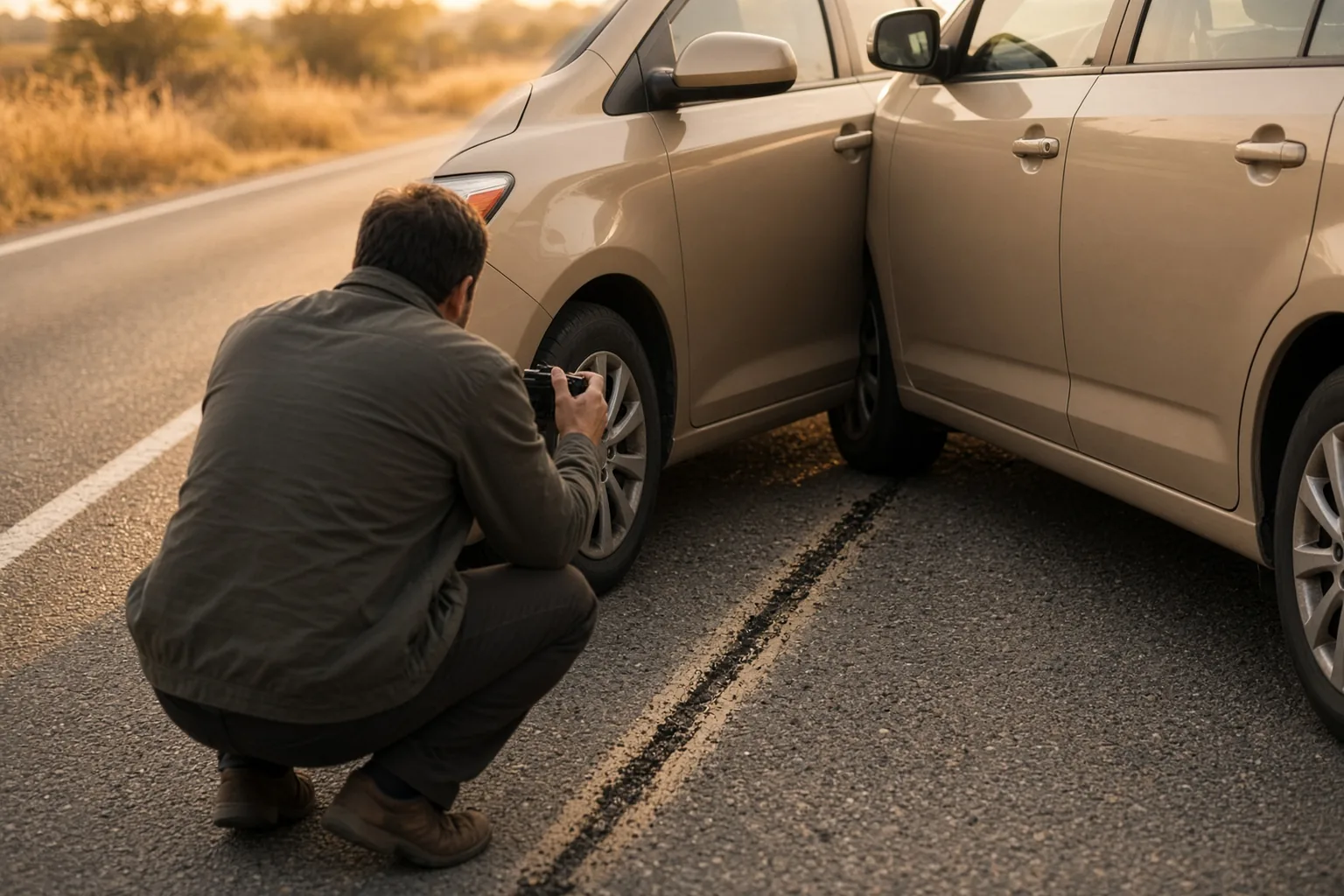
Sideswipe or lane-change crash: how does an expert establish which vehicle left its lane?
Two cars travelling in the same direction touch sides, and each driver says the other drifted over. Traffic codes put the duty on the driver who Sergei Voronin

Motorcycle accident reconstruction: how does the expert find speed, position and visibility without a car's data recorder?
In 2024, 6,228 motorcyclists were killed on US roads, 16 percent of all traffic deaths, according to NHTSA. Many of these crashes turn on threeSergei Voronin
Who ran the red light? How does an accident reconstructionist analyze signal timing?
When two drivers each say the light was green, the answer comes from timing: when each signal phase changed, where each vehicle was at that momentSergei VoroninExpert examinations
Ready to discuss your case?
Send the materials: the secretariat will confirm the format, cost, deadline and the specialist within one business day.
