
Examinations
Sideswipe or lane-change crash: how does an expert establish which vehicle left its lane?
Two cars travelling in the same direction touch sides, and each driver says the other drifted over. Traffic codes put the duty on the driver who leaves the lane, so the case turns on one fact: which vehicle crossed the line. An accident reconstruction engineer answers it with the damage on both vehicles, the marks and debris on the road, video and, where it was stored, the recorder's steering data.
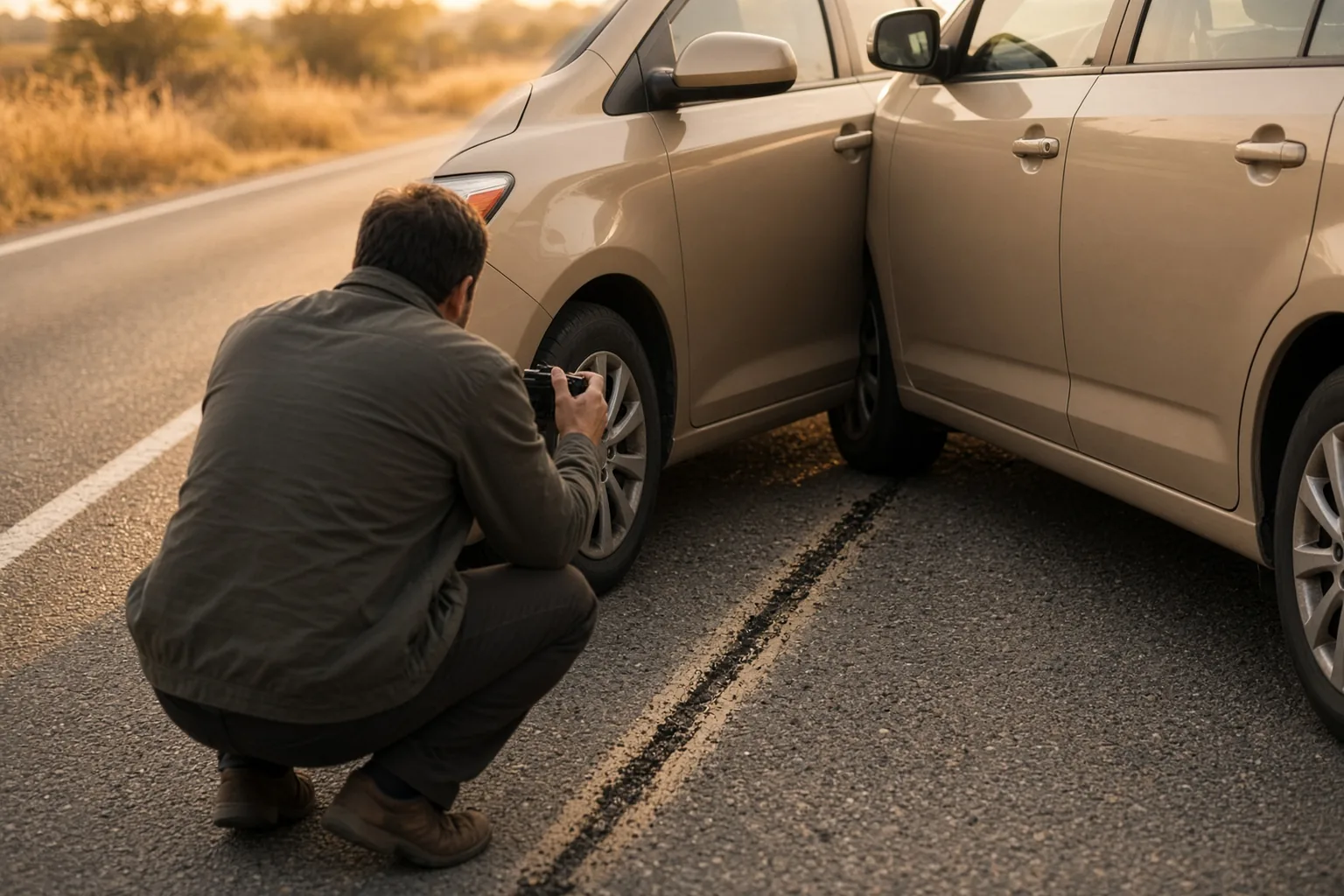
Which driver has the legal duty in a lane-change crash?
The driver who leaves the lane. Florida forbids driving a vehicle off a direct course in any lane until the driver has determined that no other vehicle is approaching or passing and that the move can be made with safety.
The Florida rule is section 316.085(2) of the Florida Statutes: "No vehicle shall be driven from a direct course in any lane on any highway until the driver has determined that the vehicle is not being approached or passed by any other vehicle" and that "the move can be completely made with safety." A violation is a noncriminal traffic infraction, punishable as a moving violation.
Section 316.089(1) says the same thing about the lane itself. A vehicle is driven "as nearly as practicable entirely within a single lane" and is not moved out of that lane until the driver has first ascertained that the movement can be made with safety.
California uses nearly the same words. Vehicle Code section 21658(a) requires a vehicle to be driven as nearly as practical entirely within a single lane and not moved out of it until the movement can be made with reasonable safety. Section 22107 adds the signal: no person shall move right or left upon a roadway until the movement can be made with reasonable safety, and then only after giving an appropriate signal if any other vehicle may be affected.
None of these statutes tells the court which vehicle moved. That is a question of fact, and in a sideswipe it is the fact the two drivers dispute.
Why is it hard to prove who changed lanes?
Because the two vehicles end up side by side with scrapes on both, each driver says the other came over, and the cars may be moved before anyone photographs where they stood.
In a rear-end or right-angle collision the damage itself points to the striking vehicle: the front of one car is in the rear or the door of the other. A sideswipe leaves contact along the flanks of both vehicles, and the same scrape is consistent, at first sight, with either car drifting toward the other.
The statements cancel out. The police report records two versions, and a citation, where one is issued, records the officer's judgment on those versions. What remains is physical evidence and recordings, and both have to be collected before the vehicles are repaired.
What physical evidence shows which vehicle moved sideways?
The damage on both vehicles, tire marks, gouges and debris on the road, the police diagram and video. From these the engineer sets the point of impact and the impact angle, the two findings a lane-change dispute turns on.
The IAE accident reconstruction page describes this part of the work in one sentence: the engineer matches crush on both vehicles with tire marks, gouges, the police diagram and video, and sets the point of impact, the impact angle and pre-crash speeds. The paragraphs below apply that description to a sideswipe. They are questions put to the engineer. They are not a published standard for reading sideswipe damage, and under Rule 702 a report has to name the method and the data behind each conclusion.
The point of impact comes first. Debris, tire marks and gouges are measured against the lane line, and the contact is placed in one lane or the other. A point of impact inside one driver's lane means that the other vehicle was in that lane when the two touched.
The impact angle is the second finding. Two vehicles travelling parallel along the road meet side by side with no angle between them. An angle at first contact means that one of them was heading across the lane line, and the engineer says which one and on what evidence.
The damage on the two vehicles is read together. The engineer records where the contact begins and ends on each car and at what height, so that the marks on one vehicle can be fitted to the marks on the other in a single relative position. If the two sets of marks cannot be fitted to the position a driver describes, the report says so.
What can the event data recorder add?
Speed, accelerator position and brake status before the crash in every vehicle with a recorder, and steering input where the recorder stores it. Federal rules do not require every recorder to keep steering data.
The required elements are listed in Table I of 49 CFR 563.7: indicated vehicle speed, engine throttle or accelerator pedal position and service brake on or off. Table II lists elements that are governed by the rule only "if recorded." Steering input is in that second table, together with lateral acceleration, stability control status and ABS activity.
The recording window is changing. For recorders manufactured before September 1, 2031 the default interval for these pre-crash elements is the 5 seconds before time zero at 2 samples per second. The amended rule sets 20 seconds at 10 samples per second and phases it in: 25 percent of each manufacturer's production built between September 1, 2028 and August 31, 2029, then 50 percent, then 75 percent in the two following years.
Two cautions apply to a sideswipe. Whether the recorder stored this event at all is the first thing the download answers. And a steering trace records that a driver turned the wheel, which can be a lane change or a reaction to the other car's lane change. The trace is read together with the damage and the roadway evidence.
How is dashcam or surveillance video used?
As a record of position against the lane lines. A camera that shows the markings and one of the vehicles lets the engineer place that vehicle in its lane frame by frame up to the contact.
A forward-facing dashcam shows its own car's position between the lines, even when the other car is outside the frame until the last moment. A fixed camera on a building or a pole can show both vehicles. In either case the engineer asks for the original file with its date and time data, not a copy re-recorded off a screen.
Video also checks the other evidence. If the recording shows a turn signal, a brake light or a third vehicle that forced a swerve, the reconstruction has to account for it.
What if both drivers were changing lanes?
Then both had the statutory duty, and fault is divided. In Florida each party's percentage of fault reduces that party's recovery, and a party found more than 50 percent at fault for his or her own harm recovers nothing.
One version of this crash is two vehicles moving into the same middle lane at once. Each driver was leaving a direct course, and sections 316.085(2) and 316.089(1) applied to each.
Florida's comparative fault statute then governs the money. Under section 768.81(2) contributory fault chargeable to the claimant "diminishes proportionately the amount awarded." Under subsection (3) the court enters judgment against each party liable on the basis of that party's percentage of fault. Subsection (6) bars any recovery by a party found to be greater than 50 percent at fault for his or her own harm, with an exception for medical negligence claims.
The engineer's contribution to that allocation is timing and position: which vehicle crossed its line first, how far each had moved when they touched and what each driver could see. The percentages are for the jury.
Can the expert say who was at fault?
The expert can say which vehicle crossed the lane line, where the contact occurred and what each driver did with speed, brakes and steering. Whether that conduct was negligent is decided by the judge or jury.
In federal court the opinion must meet Rule 702. The proponent has to show that it is more likely than not that the testimony is based on sufficient facts or data and is the product of reliable principles and methods reliably applied to the facts of the case. A reconstruction built on two photographs and a driver's statement will be tested on the first of those conditions.
A useful report states its limits. If the evidence fixes the lane of the contact but not which car arrived there first, the report says so and does not fill the gap with one driver's version.
What should be preserved after a sideswipe?
Photographs of the full side of each vehicle before repair, the position of the vehicles and debris relative to the lane lines, the original video files and the recorder data from both vehicles.
The photographs should cover each damaged side end to end and include close views with a scale, so that the engineer can see where the contact begins and ends and at what height. If the cars have been moved, photographs of the debris and the marks on the pavement still record where they lay relative to the lane line.
The other driver's car is evidence too. In a federal civil case a party may request under Rule 34(a)(1)(B) to inspect, test or sample designated tangible things in the other party's possession, and the written response is due within 30 days after service (Rule 34(b)(2)(A)). A request sent after the car has been repaired or sold for salvage finds the damage gone, and possibly the car with its recorder.
What does IAE do in a sideswipe or lane-change case?
IAE prepares an expert report on the client's questions about the crash or a review of the opposing expert's report, in up to 5 business days, with a 48-hour rush for cases with tight deadlines.
The IAE accident reconstruction service answers how the vehicles moved before impact, what the event data recorder shows about speed and braking and whether the damage on each car fits the claimed crash, for injury and property damage cases in US courts. The engineer matches crush on both vehicles with tire marks, gouges, the police diagram and video, and sets the point of impact, the impact angle and pre-crash speeds. IAE confirms the questions with the client before work starts.
The client sends the report or the case materials and describes the task. The secretariat confirms receipt the same day. Within one business day IAE confirms the format, cost, deadline and the specialist from its registry, and the client approves the candidate and the CV before work starts. The draft is checked for facts, and the signed PDF is issued in up to 5 business days.
Every specialist is a member of the public IAE registry and can be verified by Member ID or QR code. The specialist confirms in the document that he or she has no interest in the outcome of the case. Neither IAE nor the specialist guarantees the outcome, and IAE is not a law firm.
Sources
- Florida Statutes 2026, section 316.085, Limitations on overtaking, passing, changing lanes and changing course (The Florida Senate)
- Florida Statutes 2026, section 316.089, Driving on roadways laned for traffic (The Florida Senate)
- California Vehicle Code section 21658 (California Public Law)
- California Vehicle Code section 22107 (California Public Law)
- Florida Statutes 2026, section 768.81, Comparative fault (The Florida Senate)
- 49 CFR 563.7, Data elements (LII, Cornell Law School)
- Federal Rule of Evidence 702 and committee notes (LII, Cornell Law School)
- Federal Rules of Civil Procedure, Rule 34, Producing Documents and Tangible Things (LII, Cornell Law School)
Read also
All articles
Motorcycle accident reconstruction: how does the expert find speed, position and visibility without a car's data recorder?
In 2024, 6,228 motorcyclists were killed on US roads, 16 percent of all traffic deaths, according to NHTSA. Many of these crashes turn on three Sergei Voronin
Who ran the red light? How does an accident reconstructionist analyze signal timing?
When two drivers each say the light was green, the answer comes from timing: when each signal phase changed, where each vehicle was at that momentSergei Voronin
Dangerous road condition or driver error: what does an accident expert examine when the road is blamed?
When a crash is blamed on the road, the expert has two tasks: measure the condition and show whether it, rather than speed or inattention, causedSergei VoroninExpert examinations
Ready to discuss your case?
Send the materials: the secretariat will confirm the format, cost, deadline and the specialist within one business day.
