
Examinations
Motorcycle accident reconstruction: how does the expert find speed, position and visibility without a car's data recorder?
In 2024, 6,228 motorcyclists were killed on US roads, 16 percent of all traffic deaths, according to NHTSA. Many of these crashes turn on three facts: how fast the motorcycle was going, where it was when the other driver began to turn, and whether that driver could have seen it. The federal event data recorder rule does not cover motorcycles, so the engineer rebuilds those facts from the scene, the vehicles and the rider's path.
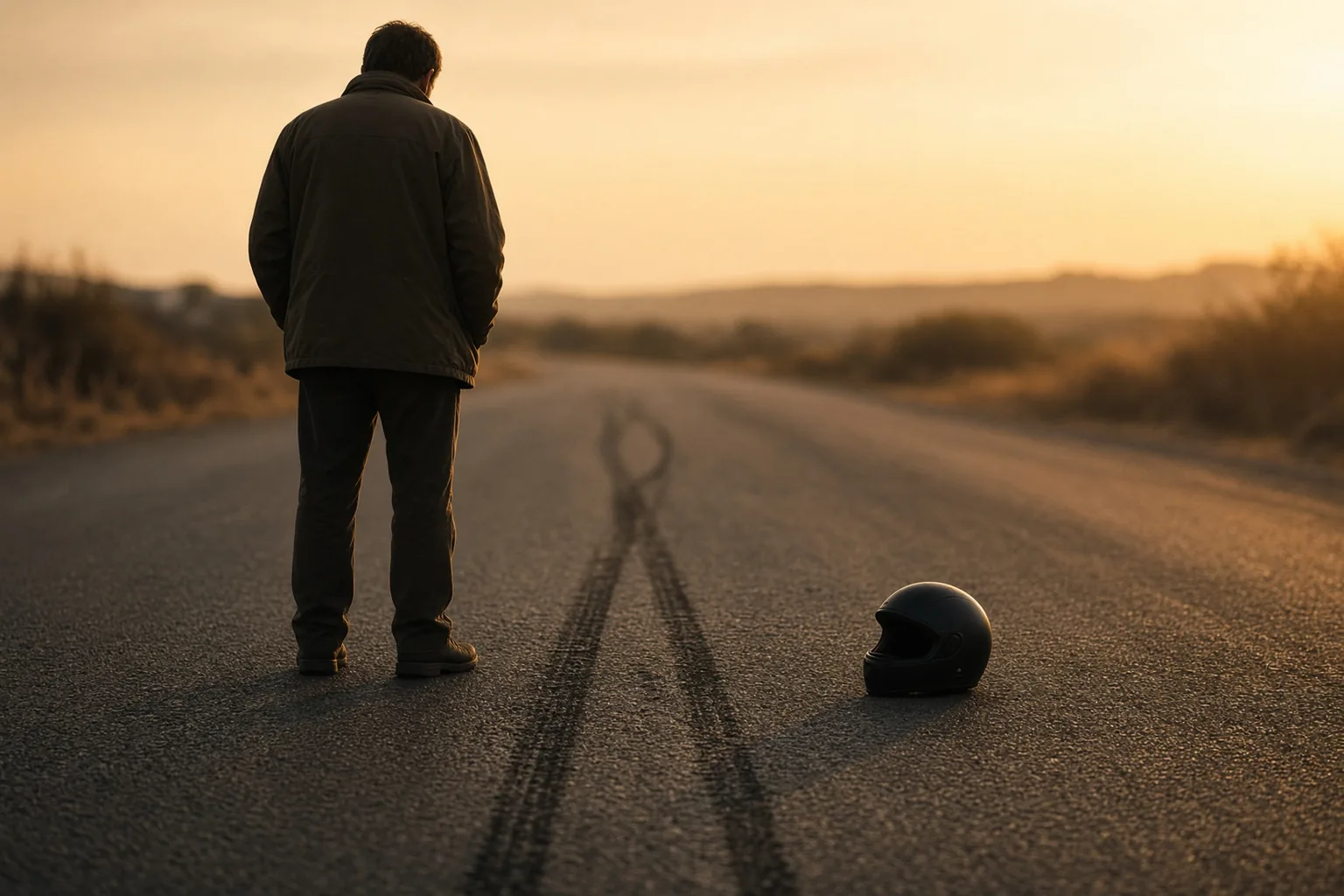
How is a motorcycle crash reconstruction different from a car crash reconstruction?
The motorcycle and the rider separate and travel on two paths, the motorcycle leaves less crush and fewer tire marks, and federal recorder rules do not cover motorcycles, so speed and position come mainly from physical evidence.
In a crash between two cars, each vehicle stays in one piece with its occupants, and either car may carry an event data recorder. Under 49 CFR 563.3, the federal recorder rule applies to passenger cars, multipurpose passenger vehicles, trucks and buses with a gross vehicle weight rating of 8,500 pounds or less and an unloaded weight of 5,500 pounds or less, manufactured on or after September 1, 2012 and equipped with a recorder. Motorcycles are not on that list. A reconstructionist cannot assume that any module on the motorcycle stored pre-crash speed, and checks the specific model before relying on one.
The second difference is the rider. At impact the rider usually leaves the motorcycle. The engineer then has two bodies moving after the collision, each with its own path, its own contact marks on the road and its own rest position. Scrapes from footpegs, handlebars and the frame mark where the motorcycle fell and slid. Marks from the helmet and the rider's clothing, and the rider's rest position, mark the second path.
The third difference is the other vehicle. A car struck by a motorcycle often shows a concentrated dent or a broken panel instead of wide crush. The shape and height of that damage tell the engineer which part of the motorcycle hit first and at what angle. The crush on the motorcycle's front wheel, fork and frame belongs to the same analysis.
NHTSA reports that motorcyclists were almost 27 times more likely than passenger car occupants to die in a motor vehicle crash. Fatal crashes often leave no rider statement, so the case rests on the scene, the vehicles, video and the other driver's account.
Who has the right of way when a car turns left in front of a motorcycle?
Under Florida Statutes 316.122, a driver turning left must yield to a vehicle approaching from the opposite direction that is within the intersection or so close to it as to be an immediate hazard. The reconstruction tests that distance.
Florida Statutes 316.122 provides that the driver of a vehicle intending to turn left within an intersection or into an alley, private road or driveway shall yield the right-of-way to any vehicle approaching from the opposite direction, or vehicles lawfully passing on the left of the turning vehicle, which is within the intersection or so close to it as to constitute an immediate hazard. A violation is a noncriminal traffic infraction, punishable as a moving violation under chapter 318.
The statute turns on a fact the engineer can measure: whether the motorcycle was "so close" when the turn began. The reconstruction works backward from the point of impact. It sets the motorcycle's speed, the distance it covered in the seconds before impact and the time the turning vehicle needed to cover the distance between its waiting position and the collision point. That gives the motorcycle's distance from the intersection at the moment the turn started.
If the motorcycle was far away when the car began to turn and arrived only because it was going much faster than the limit, the defense argues that it was not an immediate hazard when the turn began. If it was close at a lawful speed, the plaintiff argues that the turning driver failed to yield. The engineer gives the distance, the time and the speed. The legal label belongs to the jury.
How does the expert estimate the motorcycle's speed?
From pre-impact tire marks where they exist, from the distance the motorcycle and rider traveled after impact and the energy that travel used up, by the damage on both vehicles and by video. Each method needs measured inputs.
A braking motorcycle can leave a front or rear tire mark, or both, before impact. The engineer measures the length of each mark and its end point relative to the point of impact, and tests the road surface where the marks lie. A mark from one wheel means that only part of the braking force was in use, which the calculation has to take into account.
After impact, the motorcycle slides on its side and the rider slides or tumbles to a stop. The distance each traveled and the surface they crossed tell the engineer how much energy they lost after the collision. Adding the energy lost in the impact gives a minimum speed at impact. In Smith v. Latos, decided by the Appellate Court of Illinois, Second District, in 2015, the defense expert concluded that the motorcycle was traveling at least 57 to 60 miles per hour when it struck a truck. The court wrote that he reached that figure by considering the distance the motorcycle traveled after impact and the energy it dissipated.
Damage to the other vehicle gives a second check. The depth and extent of crush, measured against test data for similar vehicles, gives the energy absorbed in the impact. Video from a dashcam, a traffic camera or a nearby business gives a third check if it captures the motorcycle in two or more frames against fixed objects.
A careful report states whether its speed is a minimum or a best estimate. A post-impact calculation that ignores the energy lost in the collision yields a speed below the true one. A report that presents such a figure as exact speed overstates what the method can give.
Could the other driver have seen the motorcycle?
The engineer checks sight lines from the driver's eye position, obstructions such as parked vehicles or hedges, the light and the motorcycle's headlamp, and the time the motorcycle was visible before the turn began.
NHTSA states that in most multi-vehicle crashes involving a motorcycle, other drivers simply did not see the motorcyclist. Whether a particular driver could have seen a particular motorcycle is an engineering question about geometry and time, which the engineer answers with measurements.
The engineer places the turning driver's eyes at the waiting position and draws the line to each point the motorcycle occupied in the seconds before the turn. Each line is checked for objects that blocked it: a vehicle waiting to turn in the opposite lane, a bus at a stop, a hedge, a sign, the curve of the road or the crest of a hill. A site visit at the same hour and in similar light tests what the calculation predicts. Photographs and video taken from the driver's eye height put the result before the jury.
If the motorcycle was visible for several seconds before the turn began, the question shifts to perception and response: whether a driver who looked would have recognized an approaching motorcycle and its speed in time. The engineer does not testify about what this driver saw. He or she testifies about what was visible from that position and for how long.
Does lane splitting change the reconstruction?
It adds two questions: where the motorcycle was across the lane and how fast it moved relative to the traffic around it, and whether the other vehicle changed lanes into its path. California defines lane splitting in Vehicle Code 21658.1.
California Vehicle Code section 21658.1(a) defines lane splitting as driving a two-wheeled motorcycle between rows of stopped or moving vehicles in the same lane, including on divided and undivided streets, roads and highways. Section 21658.1(b) lets the California Highway Patrol develop educational guidelines on lane splitting, and section 21658.1(c) names the agencies and organizations it consults, among them the Department of Motor Vehicles, the Department of Transportation and the Office of Traffic Safety.
When a crash happens between lanes, the engineer reconstructs the motorcycle's lateral position and the other vehicle's movement in the seconds before contact. Scrape marks on the side of the car, broken mirrors and the angle of the contact show whether the car moved sideways into the motorcycle or the motorcycle closed on a car that held its line. Traffic speed comes from video, witness vehicles and the flow on that road at that hour.
Speed relative to surrounding traffic matters as much as speed over the ground. A motorcycle moving slowly past stopped cars and one moving much faster than cars that are still moving leave different time margins for the drivers around them. The report states both figures.
What evidence should be preserved after a motorcycle crash?
The motorcycle, the other vehicle, the rider's helmet and gear, any electronic module data, scene measurements, photographs, video from nearby cameras and phone records. Federal Rule 34 lets a party inspect, test and sample the other side's items.
Items to preserve and, where needed, request from the other side:
Video goes first, because businesses and agencies overwrite their recordings. Scene marks fade with traffic and rain within days. The motorcycle is often sold for salvage soon after a total loss, and with it go the tire marks on its rubber and the fork damage.
Federal Rule of Civil Procedure 34(a)(1) lets a party request that the other side produce and permit it to inspect, copy, test or sample documents, electronically stored information and tangible things in the other side's possession, custody or control. Rule 34(a)(2) covers entry onto land to inspect, measure, survey, photograph, test or sample the property. Under Rule 34(b)(2)(A) the responding party must answer in writing within 30 days after service. Any test that alters a part, such as removing a lamp or downloading a module, is agreed with the other side before it happens.
- The motorcycle as it came to rest: tires, wheels, fork, frame, lamps and any electronic modules.
- The other vehicle, including the damaged area, its own event data recorder and the driver's seat position.
- The rider's helmet, jacket, gloves and boots, which carry contact and abrasion marks.
- Police diagrams, photographs and measurements, and the rest positions of both vehicles and the rider.
- Video from dashcams, traffic cameras, buses and nearby businesses.
- Phone records of both drivers for the minutes around the crash.
How does a court test a motorcycle reconstruction?
In federal court under Rule 702: the opinion must rest on sufficient facts or data and reliable methods reliably applied. A reconstruction built on physical evidence can be admitted even where eyewitnesses disagree.
Federal Rule of Evidence 702 lets a qualified expert testify if the proponent shows the court that it is more likely than not that the expert's specialized knowledge will help the trier of fact, that the testimony is based on sufficient facts or data, that it is the product of reliable principles and methods, and that the opinion applies those methods reliably to the facts of the case. State courts apply their own evidence rules.
Smith v. Latos is a nonprecedential order of the Appellate Court of Illinois, Second District, issued under Illinois Supreme Court Rule 23 on October 21, 2015. The plaintiff motorcyclist struck the defendant's truck, which was turning. The defense reconstructionist relied mainly on photographs, tire marks, measurements and the truck's final position, and concluded that the truck was turning into a driveway and that the motorcycle was traveling at least 57 to 60 miles per hour. Before trial the plaintiff moved to bar him, arguing that expert testimony was not needed because eyewitnesses would testify and the subject was within the knowledge of an average juror. The trial court said the opinion would be admitted if it rested more on physical evidence than on deposition testimony. After defense counsel said the expert relied on physical evidence from the scene, the court denied the motion and stated that what the expert relied on went to the weight, not the admissibility, of his testimony. The jury found for the defendant.
The appellate court held that the trial court did not abuse its discretion. It found the eyewitness testimony, to the extent it existed at all, inconclusive as to the plaintiff's speed, the defendant's location and how the accident occurred. It wrote that how energy affects objects in motion is beyond the knowledge of the average juror, and that the expert's testimony helped resolve the conflicts in the witnesses' testimony. The court affirmed the judgment of the Circuit Court of McHenry County.
A speed estimate of this kind depends on the friction values used for the sliding motorcycle and rider, on the measured distances and on the point of impact. A report that does not say where each input came from, or that uses a value from a different surface, gives opposing counsel material for cross-examination and a Rule 702 motion.
What does IAE do in a motorcycle crash case?
IAE prepares an expert report on the client's questions about the crash or a review of the opposing expert's report, in up to 5 business days, with a 48-hour rush for cases with tight deadlines.
The IAE accident reconstruction service answers how the vehicles moved before impact, what the event data recorder shows about speed and braking where one exists, and whether the damage on each vehicle fits the claimed crash, for injury and property damage cases in US courts. The engineer matches crush on both vehicles with tire marks, gouges, the police diagram and video, and sets the point of impact, the impact angle and pre-crash speeds. IAE confirms the questions with the client before work starts.
The client sends the report or the case materials and describes the task. The secretariat confirms receipt the same day. Within one business day IAE confirms the format, cost, deadline and the specialist from its registry, and the client approves the candidate and the CV before work starts. The draft is checked for facts, and the signed PDF is issued in up to 5 business days.
Every specialist is a member of the public IAE registry and passed the council's attestation under the published Criteria Matrix; the specialist can be verified by Member ID or QR code. The specialist confirms in the document that he or she has no interest in the outcome of the case. Neither IAE nor the specialist guarantees the outcome, and IAE is not a law firm.
Sources
- NHTSA, Motorcycle Safety
- 49 CFR 563.3, Application (LII, Cornell Law School)
- Florida Statutes 316.122, Vehicle turning left (2024), Florida Senate
- California Vehicle Code section 21658.1, lane splitting
- Federal Rules of Civil Procedure, Rule 34 (LII, Cornell Law School)
- Federal Rules of Evidence, Rule 702 (LII, Cornell Law School)
- Smith v. Latos, 2015 IL App (2d) 141237-U, Appellate Court of Illinois, Second District
Read also
All articles
Sideswipe or lane-change crash: how does an expert establish which vehicle left its lane?
Two cars travelling in the same direction touch sides, and each driver says the other drifted over. Traffic codes put the duty on the driver who Sergei Voronin
Who ran the red light? How does an accident reconstructionist analyze signal timing?
When two drivers each say the light was green, the answer comes from timing: when each signal phase changed, where each vehicle was at that momentSergei Voronin
Dangerous road condition or driver error: what does an accident expert examine when the road is blamed?
When a crash is blamed on the road, the expert has two tasks: measure the condition and show whether it, rather than speed or inattention, causedSergei VoroninExpert examinations
Ready to discuss your case?
Send the materials: the secretariat will confirm the format, cost, deadline and the specialist within one business day.
