
Examinations
How to tell if a check has been altered, and what can a forensic document examiner prove?
A check is altered when someone changes the payee, the amount or the date after the drawer signed it, or fills in a blank on a signed check without authority. Article 3 of the Uniform Commercial Code defines the alteration and decides who bears the loss. The SWGDOC Standard for Examination of Altered Documents lists the signs an examiner looks for on the paper and the tests that bring out an erased entry.
What counts as an altered check?
Under UCC 3-407(a), an unauthorized change that purports to modify a party's obligation, or an unauthorized addition of words or numbers to an incomplete instrument. A new payee, a raised amount and a changed date all fall within it.
Section 3-407(a) of the Uniform Commercial Code has two branches. An alteration is "an unauthorized change in an instrument that purports to modify in any respect the obligation of a party", or "an unauthorized addition of words or numbers or other change to an incomplete instrument relating to the obligation of a party." On a check the obligation is written in four places: the payee line, the amount in figures, the amount in words and the date.
The second branch covers checks signed before they were filled in. Section 3-115(a) defines an incomplete instrument as a signed writing whose contents "show at the time of signing that it is incomplete but that the signer intended it to be completed by the addition of words or numbers." Under section 3-115(c), if words or numbers are added without the signer's authority, "there is an alteration of the incomplete instrument under Section 3-407."
The burden in that situation is fixed by section 3-115(d). The person who says the words or numbers were added without authority has to establish it. A drawer who signed a check with the amount line empty and now disputes the figure written in it carries that burden.
What signs of alteration can be seen on the check itself?
Overwritten figures, entries made with a second writing instrument, crowded or awkward placement, disturbed paper fibers, discolored areas, smearing and irregular spacing. The SWGDOC standard lists these indicators and warns that normal handling can produce some of them.
The SWGDOC Standard for Examination of Altered Documents, version 2013-1, defines an alteration in section 3.2.1 as "a modification made to a document by physical, chemical or mechanical means", including obliterations, additions, overwritings and erasures. Section 3.2.5 defines an erasure as "the area where material has been removed from a document by chemical, abrasive, or other means." The SWGDOC list of published standards marks this text, E03-13, as superseded by an ASB standard. ANSI/ASB Standard 035, Standard for the Examination of Documents for Alterations, first edition 2020, covers the same examination and has been on the OSAC Registry since March 4, 2025; OSAC lists a second edition as in development.
Section 7.3 tells the examiner to look for indicators of alteration and lists fifteen. Those that fit a check are overwriting, characteristics of multiple writing instruments, crowded or awkward placement of writing or printed text, paper fiber disturbance, different fonts, sizes or styles, areas of discoloration, an obscuring substance, smearing, irregular spacing and alignment, inconsistent handwriting features and an unusual sequence of line intersections contrary to what may be claimed.
The amount box and the line for the amount in words are short. A digit added before the original figure, or a word squeezed in before "hundred", has to fit into the space left by the drawer, and the standard names crowded or awkward placement as one of the indicators.
The same section adds that normal preparation, handling and storage can also produce some of these features. A smear on a check carried in a wallet, or a payee written with one pen and the amount with another, is a feature to explain, and the examiner records which explanation the evidence supports.
Can an examiner tell that ink was chemically removed from a check?
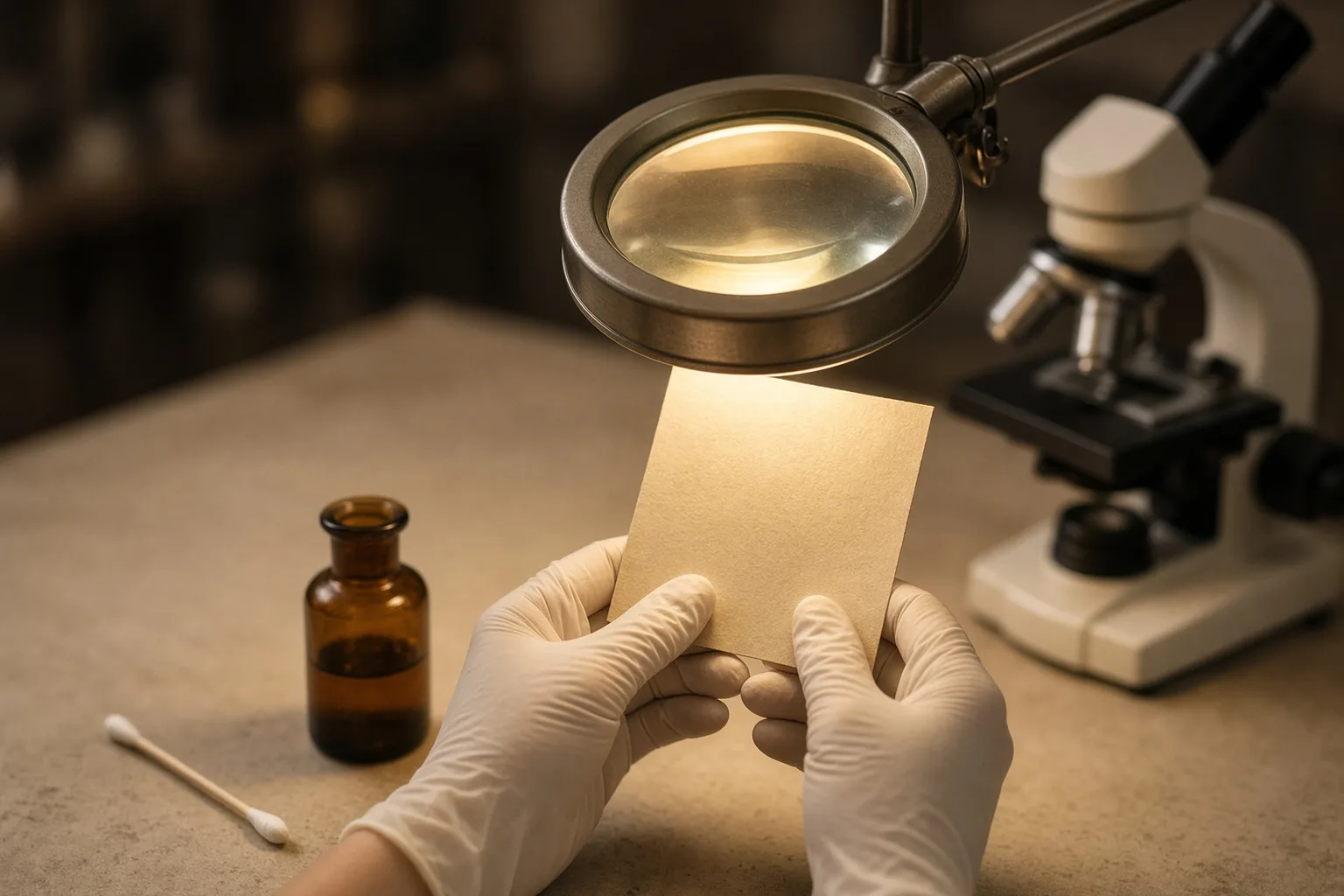
Chemical removal is an erasure in the standard's terms. The examiner looks for discoloration and disturbed fibers and examines the area under magnification, side lighting, ultraviolet light and infrared techniques before any destructive step.
A washed check is one whose original writing was dissolved and replaced with new entries written over the cleaned area. The SWGDOC standard does not use the word. Its definition of erasure covers material removed by chemical means, and two of its indicators, areas of discoloration and paper fiber disturbance, describe what such treatment can leave on the paper.
The non-destructive steps are listed in sections 7.4 to 7.10, and section 7.4 says they "shall be performed when applicable and need not be performed in the order given." The examiner looks at the document macroscopically or microscopically (7.5), under various lighting techniques such as side lighting, and under transmitted light (7.6). Section 7.7 requires visualizing techniques "such as UV, RIR, and IRL": ultraviolet light, infrared examination and infrared luminescence. Measurements (7.8), processing with an electrostatic detection device (7.9) and photography or digital image processing (7.10) complete the list.
Indentations are handled under a separate document. Section 7.6 of the alteration standard refers to the SWGDOC Standard for Indentation Examinations, and section 7.9 tells the examiner to process the document with an EDD. Both steps come before anything that wets or scrapes the paper.
Can the examiner read what the check said before it was changed?
Sometimes. The SWGDOC standard lets the report state whether any altered entries were decipherable, give the text or a description of them and include images of the alterations and of the original entries.
Section 8.3 lists what an alteration report may contain: whether alterations were observed (8.3.1), "whether any of the altered entries were decipherable" (8.3.2), the text or description of altered entries (8.3.3) with the method or sequence of alterations (8.3.3.1), and images of the alterations and original entries (8.3.4). A report can therefore say that the payee line first read one name and now reads another, if the original strokes survived.
When the original entry is covered, for example by correction fluid or an ink blot, the standard moves to destructive techniques. Under section 7.14 the examiner may apply a solvent such as petroleum ether or liquid fluorocarbons to make the paper translucent; prolonged exposure may affect the obscuring substance. Under section 7.15 methanol or ethanol may be used to remove the substance, and some solvents may dissolve ink or toner. Under section 7.16 the substance may be abraded, scraped or peeled off.
Those steps change the check. Section 7.13 places them after the non-destructive methods are exhausted, section 7.13.1 notes that they may interfere with chemical ink or latent print examinations, section 7.13.2 advises consultation with the submitter, and section 7.13.3 requires the item to be documented before they start.
Does a different pen on the amount line prove that the check was altered?
No. Characteristics of multiple writing instruments are an indicator in the SWGDOC list, and the same section says normal preparation can produce such features. A drawer may fill in the payee and the amount at different times.
A second ink tells the examiner that two writing instruments were used. It does not say who used the second one or when. The question whether the added entries were written by the drawer, by the payee or by a third person is a handwriting comparison, and inconsistent handwriting features are a separate indicator in section 7.3.
Where the ink itself is in question, section 7.17 of the alteration standard refers the examiner to the SWGDOC Standard for Test Methods for Forensic Writing Ink Comparison and notes that other forensic specialists may perform chemical ink work. A chemical ink test takes ink from the strokes, so it falls under the same rules on destructive examination.
The sequence of strokes is a separate indicator. Where an added digit crosses the printed border of the amount box or a line of the drawer's writing, section 7.3.14 lists an unusual sequence of line intersections contrary to what may be claimed as an indicator. The examiner compares the order in which the strokes were laid down with the account given by each party.
Who bears the loss when an altered check is paid?
Under UCC 3-407(b) a fraudulent alteration discharges the party whose obligation it affects. Under 3-407(c) a bank that paid in good faith and without notice may enforce the check according to its original terms.
Section 3-407(b) reads: "an alteration fraudulently made discharges a party whose obligation is affected by the alteration unless that party assents or is precluded from asserting the alteration." No other alteration discharges a party, and the instrument may be enforced according to its original terms.
Section 3-407(c) protects the bank and later holders. A payor bank or drawee paying a fraudulently altered instrument, or a person taking it for value, in good faith and without notice of the alteration, may enforce rights "according to its original terms", or, for an incomplete instrument altered by unauthorized completion, according to its terms as completed. A bank that paid a raised check in good faith and without notice keeps its rights on the check up to the original amount.
Section 3-406 shifts the loss when the drawer's own carelessness made the alteration possible. Under 3-406(a), a person whose failure to exercise ordinary care "substantially contributes to an alteration of an instrument" is precluded from asserting the alteration against a person who in good faith pays the instrument or takes it for value or for collection. Under 3-406(b), if that person also failed to exercise ordinary care, the loss is allocated between the two according to the extent each failure contributed to it.
Section 3-406(c) puts the burden of proving the lack of ordinary care on the person asserting the preclusion under subsection (a), and on the person precluded under subsection (b). The examiner's description of where the added characters sit, and how much room the drawer left for them, is evidence on that question.
How should the check be kept until it is examined?
Keep the paper item unmarked and unfolded in its own envelope, away from extreme heat and humidity, and send it to the document examiner before any fingerprint or chemical processing.
OSAC 2022-N-0035, Standard for On-Scene Collection and Preservation of Document Evidence, version 2.1 of September 18, 2024, an OSAC Proposed Standard, sets the rules for documents whose physical characteristics are of interest. Under section 4.1(a), document evidence "shall be handled, collected, and preserved in a manner that prevents contamination, tampering, alteration or loss."
Section 4.2(f) says that document evidence "shall not be unnecessarily folded, torn, marked, soiled, stamped, or written on", and that investigators "shall not mark the document itself, or mark the package while it contains the document." Under section 4.2(e), items that may need fingerprint, DNA or trace analysis go into breathable packaging such as paper envelopes; plastic is generally not acceptable. Section 4.2(h) asks for storage away from extreme temperature and humidity.
The order of work comes from section 5.3 of the SWGDOC alteration standard: the results of prior storage, handling, testing or chemical processing, for example for latent prints, may interfere with the document examination, so it should ideally come first.
Can an alteration be found on a check image from the bank?
Only within limits. The SWGDOC standard names submission of non-original documents as a limitation that the examiner notes and records, and several indicators of alteration belong to the paper and the ink rather than to the picture.
Section 5.1 of the standard says that submitted items may have inherent limitations that interfere with the procedures, and that such limitations should be noted and recorded. Section 5.2 names the submission of non-original documents first, together with limited comparability and the condition of the items.
Paper fiber disturbance, discoloration and the response of the ink to ultraviolet and infrared light are properties of the paper item. An image carries only what the scanner recorded at its resolution and in its color range. Overwriting, crowding and irregular alignment can still be visible on a good image, and the report says which observations were made on what material.
If the paper check still exists, the request for it goes first. Section 7.2 of the standard lets the examiner stop a procedure when a feature cannot be found or the item lacks the needed quality, and requires the reason to be documented. A report written from an image should therefore say what could not be examined.
What should the examiner's report on a check say?
Whether alterations were observed, whether the altered entries were decipherable, their text or description, the method or sequence of alteration, and images. The bases and reasons for each conclusion go into the examiner's documentation.
Section 7.1 of the SWGDOC standard reads: "Examinations performed, relevant observations, and results shall be documented." Section 8.2 adds that the bases and reasons for the conclusions should be included in the examiner's documentation and may also appear in the report. The items of section 8.3 described above give the structure of the findings.
The AAFS Standards Board published ANSI/ASB Standard 035, Standard for the Examination of Documents for Alterations, as a first edition in 2020. Its page describes it as establishing "the minimum required procedure(s) used by Forensic Document Examiners (FDE)" for this examination. A report prepared for a court names the standard it followed and the version.
On a disputed check the findings follow the fields: was the amount raised, was the payee replaced, was the date changed, and what did each field say before. Under section 5.1 the limitations of the submitted item are recorded as well, so the report also states what the examiner could not establish.
What does IAE do when a check or another document may have been altered?
An examiner from the IAE registry prepares a report on the client's questions about the document, or a review of the opposing examiner's report, in up to 5 business days after the format and cost are confirmed.
The IAE forensic document examination page lists the questions the examiner answers: whether a page was inserted or replaced, an entry erased or overwritten, a stamp impression made by the stamp in question, and how the document was printed. Erasures, additions, overwriting and inserted or substituted pages are examined under ANSI/ASB Standard 035 (2020) with side lighting, UV light and infrared techniques.
IAE frames the questions around the document and the part of it in dispute, here the payee line, the amount or the date, and confirms the questions and the handling of the original with the client before work starts. Send the case materials and describe the task through the form on the contact page. IAE confirms the format, cost, deadline and the specialist from the registry within one business day, and you approve the examiner and the CV before work starts. Cases with tight deadlines have a 48-hour rush.
Registry members passed the collegial attestation of the council under the published Criteria Matrix, and the Member ID in the report can be checked by QR code. The examiner confirms in the document that he or she has no interest in the outcome, and materials are not passed to third parties without your consent. The court weighs the report with the other evidence; neither IAE nor the examiner guarantees the outcome, and IAE is not a law firm.
Sources
- Uniform Commercial Code, section 3-407, Alteration (LII, Cornell Law School)
- Uniform Commercial Code, section 3-406, Negligence contributing to forged signature or alteration of instrument (LII, Cornell Law School)
- Uniform Commercial Code, section 3-115, Incomplete instrument (LII, Cornell Law School)
- SWGDOC Standard for Examination of Altered Documents, ver. 2013-1
- ANSI/ASB Standard 035, Standard for the Examination of Documents for Alterations, 1st Ed., 2020 (AAFS Standards Board)
- OSAC 2022-N-0035, Standard for On-Scene Collection and Preservation of Document Evidence, version 2.1, 2024 (NIST)
- SWGDOC, published standards list
- OSAC Forensic Document Examination Subcommittee, standards list (NIST)
Read also
All articles
How to prove that medical records were altered: what does a forensic document examiner check in the chart?
A chart that changed after a bad outcome can decide a malpractice case. Federal hospital rules require every entry to be dated, timed Sergei Voronin
What can you ask a forensic document examiner, and what should you send with the document?
A forensic document examiner answers questions about how a document was made and what was done to it afterwards: whether an entry was added, a pageSergei Voronin
Burned, soaked or torn: what can a document examiner recover from a damaged document?
A document that went through a fire, a flood or a shredder is often still readable in part. Forensic document examiners work with charredSergei VoroninExpert examinations
Ready to discuss your case?
Send the materials: the secretariat will confirm the format, cost, deadline and the specialist within one business day.
