
Examinations
Burned, soaked or torn: what can a document examiner recover from a damaged document?
A document that went through a fire, a flood or a shredder is often still readable in part. Forensic document examiners work with charred and liquid-soaked documents under ANSI/ASB Standards 127 and 128, published in 2022, and with torn paper under a SWGDOC physical match standard. How much they recover depends on the ink, the paper and what happened to the document between the damage and the laboratory.
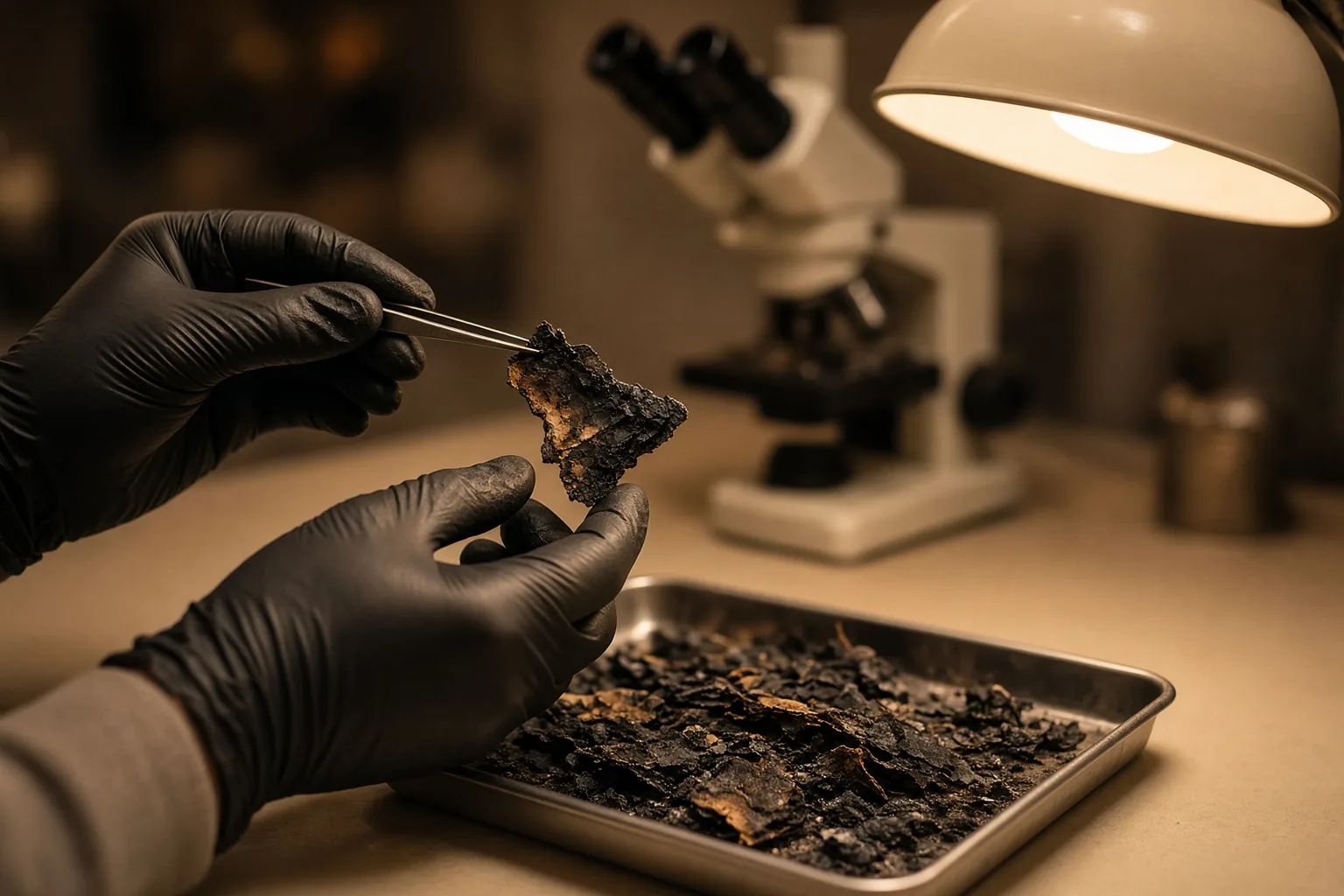
Can a document examiner read a burned or water-damaged document?
Often in part. Dense inks, typewriting and printing inks stay visible after burning, and in one case an examiner deciphered over 85 percent of the contents of a burned strong box. Badly broken fragments may yield nothing.
Donald Doud and Ordway Hilton described the work in "The Document Examiner Aids the Arson Investigation," published in the Journal of Criminal Law and Criminology in 1955. They reported that iron-gall inks, typewriting and printing inks "remain most visible after burning," and that in a Wisconsin case John F. Tyrrell was able to "decipher over 85 % of the contents of a burnt strong box." Most of the remaining documents in that box were too badly broken to be read.
The same authors wrote that "charred documents are often more easily deciphered than badly watersoaked documents," especially where the writing was in synthetic dye inks, and that "no rule of thumb is applicable to all charred document problems." The examiner can tell what is recoverable only after the initial assessment of the actual items.
The questions put to the examiner are usually three: what the document said, what it was made of, and where it came from. ANSI/ASB Standard 127 covers exactly those three areas, content, material and source, for charred documents, and Standard 128 covers them for documents soaked in a liquid.
Which standards govern charred and liquid-soaked documents?
ANSI/ASB Standard 127 for charred documents and ANSI/ASB Standard 128 for liquid-soaked documents, both first editions of 2022. Both set the minimum procedures for examiners. SWGDOC had earlier published its own Standard for Preservation of Liquid Soaked Documents, version 2013-1.
Both ASB standards state that they establish "the minimum required procedures used by Forensic Document Examiners (FDEs)" for preservation, examination and reporting. Standard 127 does not cover chemical testing: "This does not include chemical examination of documents for accelerants or source of combustion." Standard 128 does not cover identification of the liquid that soaked the document.
A report on a damaged document should therefore name the standard it followed and should not offer opinions on the accelerant or on the liquid unless another discipline produced them. Questions about ignitable liquids go to a separate examination, and the document examiner's report stays with the content, the material and the source of the document.
For torn and cut paper SWGDOC published a separate Standard for Physical Match of Paper Cuts, Tears, and Perforations in Forensic Document Examinations. For collection at the scene the Organization of Scientific Area Committees has a proposed Standard for On-Scene Collection and Preservation of Document Evidence, OSAC 2022-N-0035, version 2.0.
What should be done with a burned document before it reaches the examiner?
Photograph it in place, immobilize it in a rigid flat box padded with sheet cotton, collect every fragment, and do not separate or flatten pages at the scene. Charred paper breaks from handling and from moving air.
Section 8 of the OSAC proposed standard states that "charred documents are particularly fragile and should be protected or immobilized as soon as possible to minimize damage." Section 8.1 lists the steps: a rigid, flat box padded with sheet cotton or similar material, collection of all fragments, and no attempt to separate or flatten the documents on scene. If the debris may be tested for volatile substances, the note to 8.1 calls for a non-breathable container.
Doud and Hilton gave the same rule in 1955, "Observe Carefully-Preserve Carefully," and preferred to "transport intact the charred documents and container in which they are enclosed," for example a safe drawer or a strong box. They explained why: burned documents are "almost completely dehydrated" and "take very little motion of air to break apart."
Standard 127 continues the same logic in the laboratory. The examiner makes an initial assessment to choose the examinations and their order, immobilizes the document, prevents air circulation from disturbing it, and records staples and other attached material before removing them.
What should be done with documents that got wet?
Move them on a flat rigid support, dry them in a secure place on clean paper, or keep them wet or frozen on the examiner's advice. Standard 128 calls for drying, freezing or other immobilization as soon as possible.
Section 9 of the OSAC proposed standard says that "wet documents are fragile and shall be handled delicately." A flat, clean, rigid surface is slid under the item and the item travels on it to the drying location. For documents found under water the investigator "should contact the FDE to get advice whether the document should be maintained in water, frozen" or treated otherwise, and a folded or multi-page wet document should not be dried before the examiner is consulted. A document that may be analyzed for volatile substances should not be dried at all.
Once dry, the document is packed in clean, dry, rigid and breathable material such as cardboard. Section 4.2(e) of the same proposal states that "generally, plastic is not an acceptable packaging material" for evidence that needs further analysis.
In the laboratory Standard 128 lets the examiner choose "air drying, freeze drying, or pressing" for pages that cannot be separated. Frozen documents are freeze dried, and if time does not permit they are thawed and treated as wet documents. Section 4.3.6 warns against "disturbance of the paper fibers due to prolonged submersion."
How does the examiner bring out writing on charred or stained paper?
With optical methods first: oblique and transmitted light, ultraviolet and the two infrared methods known as IRR and IRL, recorded by photography or digital imaging with a scale. Destructive methods come only after the non-destructive ones are exhausted.
Section 4.5.4 of Standard 127 lists examination with "oblique lighting, transmitted lighting, UV, IRR, and IRL," and section 4.2.5 requires infrared conversion equipment for the IRR and IRL examinations. Section 4.5.5 requires the examiner to record the document by photography or digital image processing, and section 4.5.6 requires a measurement scale in the image. Under section 4.5.9 the examiner "may attempt to decipher and transcribe any visualized entries."
Infrared methods work because inks and the charred paper respond differently to infrared light. Giancarlo Santacroche reported in the International Journal of Forensic Document Examiners in 1999 that infrared luminescence revealed an obliterated signature on a Swiss passport, and that a lacquer treatment followed by optical examination gave good results on a burned French passport. He added that the result "largely depends on the state of the document, the type of ink used" and the soaking time.
For liquid-soaked documents section 4.5.4 of Standard 128 uses the same set of light sources. Under section 4.6.5 obscured entries can be visualized by destructive methods, section 4.6.8 says that entries obscured by substances such as blood or grease may be recovered by removing the substance after freezing, and section 4.6.6 warns that solvents can have "a deleterious effect on inks, toner, or the substrate."
Can torn or shredded documents be put back together?
Yes, if the fragments carry enough individual features. Under the SWGDOC physical match standard the examiner reports that fragments were once one sheet, that only class similarities were found, or that they came from different sheets.
Section 10 of the OSAC proposed standard requires collection of all relevant material, including the pad a sheet was torn from, and states that "no attempt shall be made to reassemble questioned evidence items prior to formal examination." Shredded paper is collected "with a minimum of disturbance to avoid further mixing," material from separate locations is kept apart, and the shredder is collected intact where possible, with the fragments in its blades.
The SWGDOC standard describes visual inspection, manual alignment, edge-to-edge realignment, surface markings and measurements. Its section 8.3 gives three conclusions: the fragments "were at one time joined to form a single piece of paper"; there were class similarities but insufficient individual features to determine a join; or the samples did not come from one piece of paper.
Section 5.2 of that standard names the limits: water-soaked, stained, charred or finely shredded paper may be unsuitable for some examinations. Section 5.3 adds that latent print processing and other chemical treatment can interfere and that document examinations should be conducted before any chemical processing whenever possible.
When does the examiner need permission, and what can be lost?
Before any physical change or destructive test. Standard 128 requires the examiner to obtain and record permission from the party requesting the work and to explain the benefits and limits of the test.
Section 4.3.4 of Standard 128 states that before making physical changes the examiner "shall obtain and record permission from the responsible party requesting the examination," and section 4.6.2 requires consultation with that party about the potential benefits and limitations of destructive testing. Standard 127 has matching provisions in sections 4.3.3 and 4.6.2 and requires images before and after destructive changes in section 4.3.8.
Order matters because one test can foreclose another. Section 4.6.3 of Standard 127 notes that destructive examinations can interfere with other analyses, such as ink chemistry or latent prints. A party that wants fingerprints, DNA or ink dating from the same document settles the sequence of laboratories before the first one starts work.
What can and cannot the report say?
It can report deciphered text, the material of the document and features pointing to its source, with the methods, limitations and images. It cannot infer the document's earlier condition from the absence of features.
Section 4.7.1 of Standard 127 requires a report that is complete and thorough and states the purpose of the examination, the examinations conducted, observations, conclusions or opinions, the methods, and "limitations and sources of uncertainty (as applicable)." As applicable it addresses the charring, the decipherable writing and its text, other materials found, images and the preservation or packaging used. Standard 128 has the same structure in section 4.7.1 and requires notes detailed enough for independent review by another examiner in section 4.4.3.
Both standards set the same limit on reasoning. Under section 4.3.7 of Standard 127 the absence of charring characteristics "does not support a determination of the condition" of the document before exposure, and section 4.3.6 warns that features resembling charring may come from normal preparation, handling or storage. A report that says a document was intact before the fire because certain features are missing from it goes past the standard.
Can a damaged document still be used in court if the original is destroyed?
Yes. Federal Rule of Evidence 1004 admits other evidence of a writing's content if all originals are lost or destroyed and the proponent did not act in bad faith. The examiner's transcription and images can be that evidence.
Rule 1004 lists four situations in which an original is not required: all originals are lost or destroyed, "and not by the proponent acting in bad faith"; an original cannot be obtained by any available judicial process; the opposing party controlled the original, was on notice that it would be a subject of proof and fails to produce it; or the writing is not closely related to a controlling issue.
A charred contract that can no longer be handled is an original in poor condition, and the court can see the remains together with the examiner's images and transcription. Where the remains were discarded after the fire, the examiner's records become the main evidence of what was readable, which is why Standards 127 and 128 require images of the initial condition and of every destructive step.
What does IAE do when a damaged document is in dispute?
An examiner from the IAE registry prepares a report on your questions about the document, or a review of the opposing examiner's report, in up to 5 business days after the format and cost are confirmed.
The IAE forensic document examination page lists the questions the examiner answers: whether a page was inserted or replaced, an entry erased or overwritten, a stamp impression made by the stamp in question, and how the document was printed. Erasures, additions, overwriting and inserted or substituted pages are examined under ANSI/ASB Standard 035 (2020) with side lighting, UV light and infrared methods. IAE frames the questions around the document and the part of it in dispute, and the handling of the original, including any destructive step, is agreed with you before work starts.
Send a description of the damage, photographs of the document as it is now and the case materials through the form on the contact page; do not try to separate, flatten or dry the pages before the examiner has seen the photographs. You approve the examiner and the CV before work starts. Cases with tight deadlines have a 48-hour rush.
Registry members passed the collegial attestation of the council under the published Criteria Matrix, and the Member ID in the report can be checked by QR code. The examiner confirms in the document that he or she has no interest in the outcome, and materials are not passed to third parties without your consent. The court weighs the report with the other evidence; neither IAE nor the examiner guarantees the outcome, and IAE is not a law firm.
Sources
- ANSI/ASB Standard 127, Standard for the Preservation and Examination of Charred Documents, First Edition 2022 (AAFS Standards Board)
- ANSI/ASB Standard 128, Standard for the Preservation and Examination of Liquid Soaked Documents, First Edition 2022 (AAFS Standards Board)
- OSAC 2022-N-0035, Standard for On-Scene Collection and Preservation of Document Evidence, proposed standard, version 2.0 (NIST)
- SWGDOC Standard for Physical Match of Paper Cuts, Tears, and Perforations in Forensic Document Examinations
- SWGDOC Standard for Preservation of Liquid Soaked Documents, ver. 2013-1
- Doud D., Hilton O. The Document Examiner Aids the Arson Investigation. Journal of Criminal Law and Criminology 46(3):404 (1955)
- NCJRS abstract: Santacroche G. Forensic Examination of Fire and Water-Damaged Documents. International Journal of Forensic Document Examiners 5:76-82 (1999)
- Federal Rules of Evidence, Rule 1004, Admissibility of Other Evidence of Content (LII, Cornell Law School)
Read also
All articles
What can you ask a forensic document examiner, and what should you send with the document?
A forensic document examiner answers questions about how a document was made and what was done to it afterwards: whether an entry was added, a page Sergei Voronin
Same pen or a different pen: what can a document examiner tell from the ink?
A document examiner can often show that two entries were written with different inks, and that settles that two pens were used. The reverse isSergei Voronin
Indented writing: can an examiner read what was written on the sheet above?
Writing presses into the sheets underneath, and a document examiner can often make those invisible indentations readable with low-angle lightSergei VoroninExpert examinations
Ready to discuss your case?
Send the materials: the secretariat will confirm the format, cost, deadline and the specialist within one business day.
