
Examinations
Are 911 calls admissible in court, and what can a forensic audio examiner do with the recording?
A 911 call can be the only recording made while an incident was still going on. In Davis v. Washington the Supreme Court held in 2006 that a caller's statements made to get help during an ongoing emergency are not testimonial, so the Confrontation Clause does not bar them. The recording still has to clear the hearsay rules and Rule 901, and the words a party relies on have to be audible on the file the court plays.
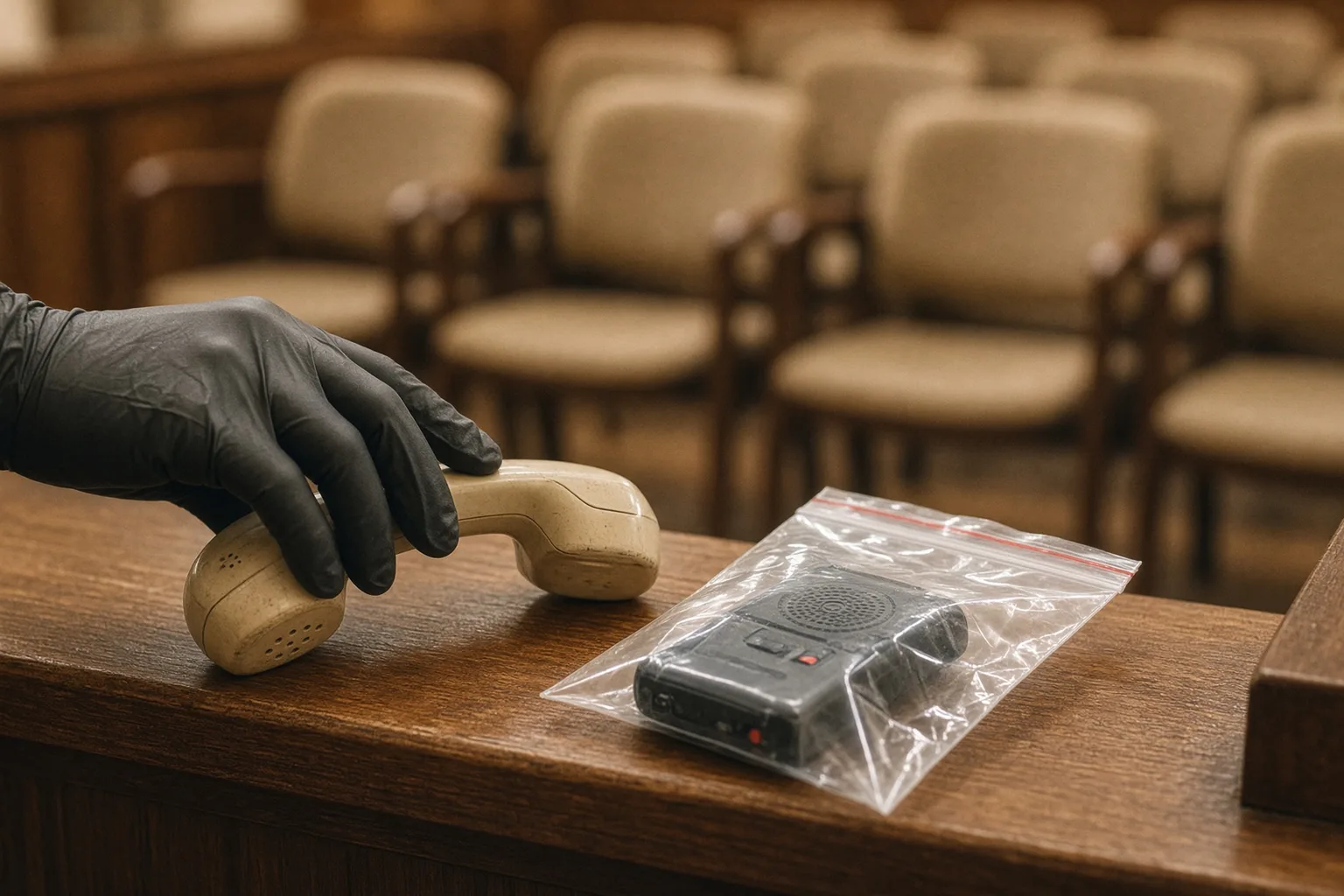
Can a 911 call be played to the jury?
Yes, when it clears three separate tests: the Confrontation Clause in a criminal case, a hearsay exception for the caller's words, and authentication of the recording itself under Rule 901.
The questions come from different sources of law. The Sixth Amendment gives the accused in a criminal prosecution the right to be confronted with the witnesses against him, and the Supreme Court decides which out-of-court statements trigger that right. The Federal Rules of Evidence decide whether a statement made outside the courtroom may be offered for its truth. Rule 901 decides whether the file is what the party says it is.
A caller who does not come to trial raises all three questions at once. In Davis v. Washington the caller, Michelle McCottry, did not appear, and the Court wrote that she "presumably could have testified as to whether Davis was her assailant". Her voice reached the jury only through the recording.
The answers can differ for parts of one call. The opening seconds, when the caller describes what is happening, may come in while later answers about past events are kept out. For that reason the transcript, the timing and the audio quality of each passage matter as much as the call as a whole.
What did the Supreme Court decide about 911 calls in Davis v. Washington?
That statements made in response to police questioning are nontestimonial when the primary purpose, judged objectively, is to enable police assistance to meet an ongoing emergency. McCottry's call fell on that side of the line.
The call was made on February 1, 2001. After the greetings the operator asked "What's going on?" and the caller answered "He's here jumpin' on me again." Asked about weapons, she said "He's usin' his fists." The operator then asked for the man's last name and middle initial. The State charged Adrian Davis with felony violation of a domestic no-contact order, and "Over Davis's objection, based on the Confrontation Clause of the Sixth Amendment, the trial court admitted the recording of her exchange with the 911 operator, and the jury convicted him."
Justice Scalia wrote for the Court, which decided the case on June 19, 2006. The rule reads: "Statements are nontestimonial when made in the course of police interrogation under circumstances objectively indicating that the primary purpose of the interrogation is to enable police assistance to meet an ongoing emergency. They are testimonial when the circumstances objectively indicate that there is no such ongoing emergency, and that the primary purpose of the interrogation is to establish or prove past events potentially relevant to later criminal prosecution."
Applying it, the Court noted that "McCottry was speaking about events as they were actually happening" and that her "frantic answers were provided over the phone, in an environment that was not tranquil". Its conclusion: "She simply was not acting as a witness; she was not testifying." The judgment of the Supreme Court of Washington was affirmed.
Footnote 2 treats the operator as part of the police for this purpose: "For purposes of this opinion (and without deciding the point), we consider their acts to be acts of the police." In the companion case, Hammon v. Indiana, statements made to responding officers in a separate domestic incident were held testimonial because no emergency was in progress, and the Indiana judgment was reversed.
Can one 911 call contain both admissible and inadmissible parts?
Yes. Davis says a call that begins as a request for help can become testimonial once its emergency purpose is achieved, and trial courts redact or exclude the later portions before trial.
In the McCottry call the operator learned that Davis had "just r[un] out the door". The Court wrote that the emergency "appears to have ended (when Davis drove away from the premises)" and that "It could readily be maintained that, from that point on, McCottry's statements were testimonial". It did not have to decide the point, because only the early part of the call was at issue.
The instruction to trial judges is short: "Through in limine procedure, they should redact or exclude the portions of any statement that have become testimonial." In practice that means a ruling tied to time codes: from which second the emergency was over, and which questions afterward asked about past events.
That ruling depends on what the recording actually says. When the caller is crying, the line is noisy or two people talk at once, the parties may disagree about the words at the very moment the emergency ends. A transcript with time codes, prepared from the original file and marking the passages that cannot be made out, gives the judge a fixed text to rule on.
Does the emergency test reach statements made outside a 911 call?
Yes. In Michigan v. Bryant (2011) a mortally wounded man's statements to police were held nontestimonial, and in Ohio v. Clark (2015) a 3-year-old boy's statements to his preschool teachers were admissible.
In Bryant, 562 U.S. 344, decided on February 28, 2011, police found Anthony Covington mortally wounded at a gas station, and he told them that "Rick" had shot him. Justice Sotomayor wrote for the Court that the primary purpose of the questioning was "to enable police assistance to meet an ongoing emergency." The Court noted that this was the first of its post-Crawford Confrontation Clause cases to involve a gun, that the armed shooter's location was unknown and that the threat extended to the police and the public. It described the situation during the questioning as "fluid and somewhat confused". The judgment of the Michigan Supreme Court was vacated and the case remanded.
In Clark, 576 U.S. 237, decided on June 18, 2015, a 3-year-old boy, L. P., told his preschool teachers that "Dee", his mother's boyfriend Darius Clark, had hurt him. Justice Alito wrote that "neither the child nor his teachers had the primary purpose of assisting in Clark's prosecution," so the statements did not implicate the Confrontation Clause and were admissible at trial. The judgment of the Supreme Court of Ohio was reversed.
Both cases apply Crawford v. Washington, 541 U.S. 36, decided on March 8, 2004. Justice Scalia wrote there that testimonial statements of witnesses absent from trial have been admitted "only where the declarant is unavailable, and only where the defendant has had a prior opportunity to cross-examine." When the declarant appears for cross-examination at trial, "the Confrontation Clause places no constraints at all on the use of his prior testimonial statements." A 911 caller who does not come to trial and was never cross-examined raises the Crawford question, and Davis decides whether the caller's words were testimonial at all.
Which hearsay exceptions do courts use for 911 calls?
Most often the present sense impression of Rule 803(1) and the excited utterance of Rule 803(2). Both apply regardless of whether the caller is available to testify.
Rule 803(1) covers "A statement describing or explaining an event or condition, made while or immediately after the declarant perceived it." The advisory committee note to the proposed rule explains the theory: a statement made at nearly the same moment as the event leaves little time for deliberate misrepresentation.
Rule 803(2) covers "A statement relating to a startling event or condition, made while the declarant was under the stress of excitement that it caused." The committee note explains that a startling event can produce excitement that temporarily stops deliberate thought, and it treats spontaneity as the decisive factor.
Both exceptions turn on timing and state of mind, and a recording carries evidence of both. The time stamp shows how long after the event the call was placed. The voice shows breathing, crying and shouting, and background sounds may show that the event was still under way. A court hears these things on the recording itself, and a degraded copy loses part of them.
The note to Rule 803 also addresses anonymous callers. When the declarant is an unidentified bystander, it says, "the cases indicate hesitancy" in upholding the statement alone. Who is speaking, and whether one voice or two can be heard, then becomes a question about the recording.
How is a 911 recording authenticated?
The proponent must produce evidence sufficient to support a finding that the item is what it is claimed to be. A dispatcher, a records custodian or a certification under Rule 902 usually supplies that evidence.
Rule 901(a) sets the standard, and Rule 901(b) gives examples. Under example (1) a witness with knowledge testifies "that an item is what it is claimed to be": the dispatcher who took the call, or the custodian who exported it. Under example (9) the proponent offers "Evidence describing a process or system and showing that it produces an accurate result", which fits a logging recorder that captures every line automatically.
Rule 902 lets some records authenticate themselves. Paragraph (11) covers certified domestic records of a regularly conducted activity that meet Rule 803(6)(A) to (C). Paragraph (13) covers "A record generated by an electronic process or system that produces an accurate result", and paragraph (14) covers data copied from an electronic device, storage medium or file and authenticated by a process of digital identification. Each requires a qualified person's certification and reasonable written notice to the adverse party before trial.
The 2017 committee note on paragraph (14) names the usual tool: "Today, data copied from electronic devices, storage media, and electronic files are ordinarily authenticated by 'hash value'." A hash value recorded at export lets both sides confirm later that the file played in court is the file that left the center.
The caller's identity is a separate matter. Rule 901(b)(5) admits an "opinion identifying a person's voice" from anyone who has heard the voice under circumstances that connect it with the speaker, and the committee note states that aural voice identification is not a subject of expert testimony. A comparison of the recorded voice with known samples by an examiner is expert testimony under Rule 702.
What should be requested from the 911 center?
The recording in its native format with its time stamps and metadata, the hash values, and the call record that shows when the call started and ended. A transcoded export loses information an examiner may need.
A party serves a request under Rule 34 or, when the call center is not a party, a subpoena under Rule 45 of the Federal Rules of Civil Procedure. Rule 34(a)(1)(A) names "sound recordings" among the items that may be requested, and both rules allow the requesting party to specify the form in which electronically stored information is produced.
SWGDE Best Practices for Forensic Audio, version 2.5 of June 9, 2022, explains what the form should be. Section 4.1 says a laboratory "should request the original recording or the earliest generation available", and that a bit stream duplicate of a recorded file is equivalent to the original because each copy can be confirmed with a hash function. Section 4.2.2 adds that the original recording system holds "the audio data in its native format, original modified/access/creation (MAC) time stamps of files, metadata, internal time clock, and the settings of the recorder."
When a system cannot export in its native encoding, section 4.2.6.1 tells the lab to export to uncompressed PCM "while preserving the sampling rate and bit depth of the original recording, whenever possible", and warns that re-encoding and resampling can add audible artifacts or remove frequency content. A file sent by email after being converted to a compressed format is already one step further from the original.
The same document lists what an examination request should contain: the type of examination, the acoustic events recorded, "subjects of interest, and portions of interest", each evidence item with hash values if available, and the chain of custody with shipping dates.
What can a forensic audio examiner do with a 911 recording?
Clarify speech buried in noise, check whether the file is consistent with an original export, analyze the acoustic events in the background, compare the caller's voice with known samples, and prepare a transcript marked against the original file.
For enhancement, SWGDE defines the goal as increasing "the intelligibility of voice information" or improving the signal to noise ratio of a target signal. Its separate enhancement document, 20-A-001 version 2.0 of July 25, 2023, published as a draft for comment, tells examiners to work on a working copy, to document "the processes, settings, and applications used, with their versions, the time segments processed", and to compare the result with the unprocessed original. It also says that the goal "may not be achievable" and that "The quality of the enhanced audio depends on the quality of the submitted recording."
An authentication examination "seeks to determine if a recording is consistent with the manner in which it is alleged to have been produced." Under SWGDE 15-a-001, version 1.3 of September 20, 2018, the examiner starts with critical listening, in which "attention must be paid to voices, acoustic events, background noise changes, uncharacteristic noises", and then runs file structure, spectral and waveform analyses. No single analysis may be relied upon alone, and the report concludes that the recording is consistent with an original, inconclusive or inconsistent with an original.
Background sounds in an emergency call can matter as much as the words: a door, a second voice, a shot, a car leaving. SWGDE calls this acoustical signal analysis, the application of scientific and engineering principles to acoustic events, which "requires an understanding of the mechanisms which produced the acoustic events in question." For speaker comparison the same document says a subject matter expert should be consulted, because it goes beyond the technical aspects of the recording.
The examiner's work reaches the court through a report. In a civil case Rule 26(a)(2)(B) requires a retained expert's report to contain all opinions with their basis and reasons, the facts or data considered, exhibits, qualifications with publications from the previous 10 years, prior testimony from the previous 4 years and the compensation. Rule 702(c) and (d) then require the proponent to show that the testimony is the product of reliable principles and methods, reliably applied to this recording.
Does it matter how the 911 call is played in the courtroom?
Yes. SWGDE notes that playback equipment and the listening environment affect how audio is perceived, and it cautions against laptop, phone or television loudspeakers.
Section 9.2 of the 2022 best practices recommends "the highest quality playback system available, which may include external loudspeakers or headphones." The same section cautions against "low-quality internal laptop, computer, tablet, phone, or television loudspeakers."
A party that relies on a short phrase in the call should test the courtroom system before trial and keep both versions ready: the original export and the documented enhanced copy. If the two sides hear different words, the transcript and the examiner's notes on each disputed passage show the judge where the disagreement lies.
What does IAE do when a 911 recording is disputed?
An IAE examiner prepares a report on the client's questions about the recording, such as the words spoken, the speaker and the integrity of the file, or reviews the opposing examiner's report, in up to 5 business days.
The audio and voice page of IAE lists three kinds of work. In a voice comparison the examiner compares the questioned voice with known recordings by pitch, formants, speech rate and pronunciation and states the limits of the comparison in the report. In an authenticity check the examiner looks for breaks in background noise, metadata that does not match the device, signs of re-recording and gaps in the chain of copies. Noise reduction is done on a working copy with every filter and setting logged, and the transcript marks speakers, time codes and unintelligible passages against the original file.
The client sends the recording or the case materials and describes the task. The secretariat confirms receipt the same day. Within one business day IAE confirms the format, the cost, the deadline and the specialist from its registry, and the client approves the candidate and the CV before work starts. The signed PDF is issued in up to 5 business days after the format and cost are confirmed, and a 48-hour rush is available for tight deadlines.
Every specialist is a member of the public IAE registry and can be verified by Member ID or QR code. The specialist confirms in the document that he or she has no interest in the outcome of the case. IAE is not a law firm: whether a statement is testimonial or fits a hearsay exception is for the client's attorney and the court. A report is evidence that the court weighs with the rest of the record, and neither IAE nor the examiner guarantees the outcome.
Sources
- Davis v. Washington, 547 U.S. 813 (2006), United States Reports (GovInfo)
- Michigan v. Bryant, 562 U.S. 344 (2011), United States Reports (GovInfo)
- Ohio v. Clark, 576 U.S. 237 (2015), United States Reports (GovInfo)
- Crawford v. Washington, 541 U.S. 36 (2004), United States Reports (GovInfo)
- Federal Rules of Evidence, Rule 803, with committee notes (LII, Cornell Law School)
- Federal Rules of Evidence, Rule 901, Authenticating or Identifying Evidence (LII, Cornell Law School)
- Federal Rules of Evidence, Rule 902, Evidence That Is Self-Authenticating, with 2017 committee note (LII, Cornell Law School)
- Federal Rules of Evidence, Rule 702, Testimony by Expert Witnesses (LII, Cornell Law School)
- Federal Rules of Civil Procedure, Rule 26 (LII, Cornell Law School)
- Federal Rules of Civil Procedure, Rule 34 (LII, Cornell Law School)
- Federal Rules of Civil Procedure, Rule 45 (LII, Cornell Law School)
- SWGDE Best Practices for Forensic Audio, version 2.5, June 9, 2022
- SWGDE Best Practices for Digital Audio Authentication, 15-a-001, version 1.3, September 20, 2018
- SWGDE document 15-a-001, Best Practices for Digital Audio Authentication, document page with version history
- SWGDE Best Practices for the Enhancement of Digital Audio, 20-A-001, version 2.0 (draft for comment), July 25, 2023
Read also
All articles
Can a voice changer be reversed, and can a forensic examiner identify a disguised voice?
A simple pitch shift can often be estimated and undone. In a 2020 study, restoring pitch-shifted speech brought a speaker verification system's error Sergei Voronin

Can a voice recording prove a verbal agreement in court, and what does the recording have to show?
In California all contracts may be oral, except those that a statute requires to be in writing: that is Civil Code section 1622. A recording isSergei Voronin
Is voice stress analysis admissible in court, and can an audio expert tell from a recording whether someone lied?
Voice stress analysis results are kept from juries as proof that a person lied. In a study funded by the National Institute of Justice, twoSergei VoroninExpert examinations
Ready to discuss your case?
Send the materials: the secretariat will confirm the format, cost, deadline and the specialist within one business day.
