
Examinations
Is voice stress analysis admissible in court, and can an audio expert tell from a recording whether someone lied?
Voice stress analysis results are kept from juries as proof that a person lied. In a study funded by the National Institute of Justice, two commercial systems caught on average about 15% of deceptive answers about recent drug use. Courts have applied the polygraph rule to them, and Rule 702 governs any expert opinion. A forensic audio examiner answers different questions: whose voice, whether the file is intact, what was said.
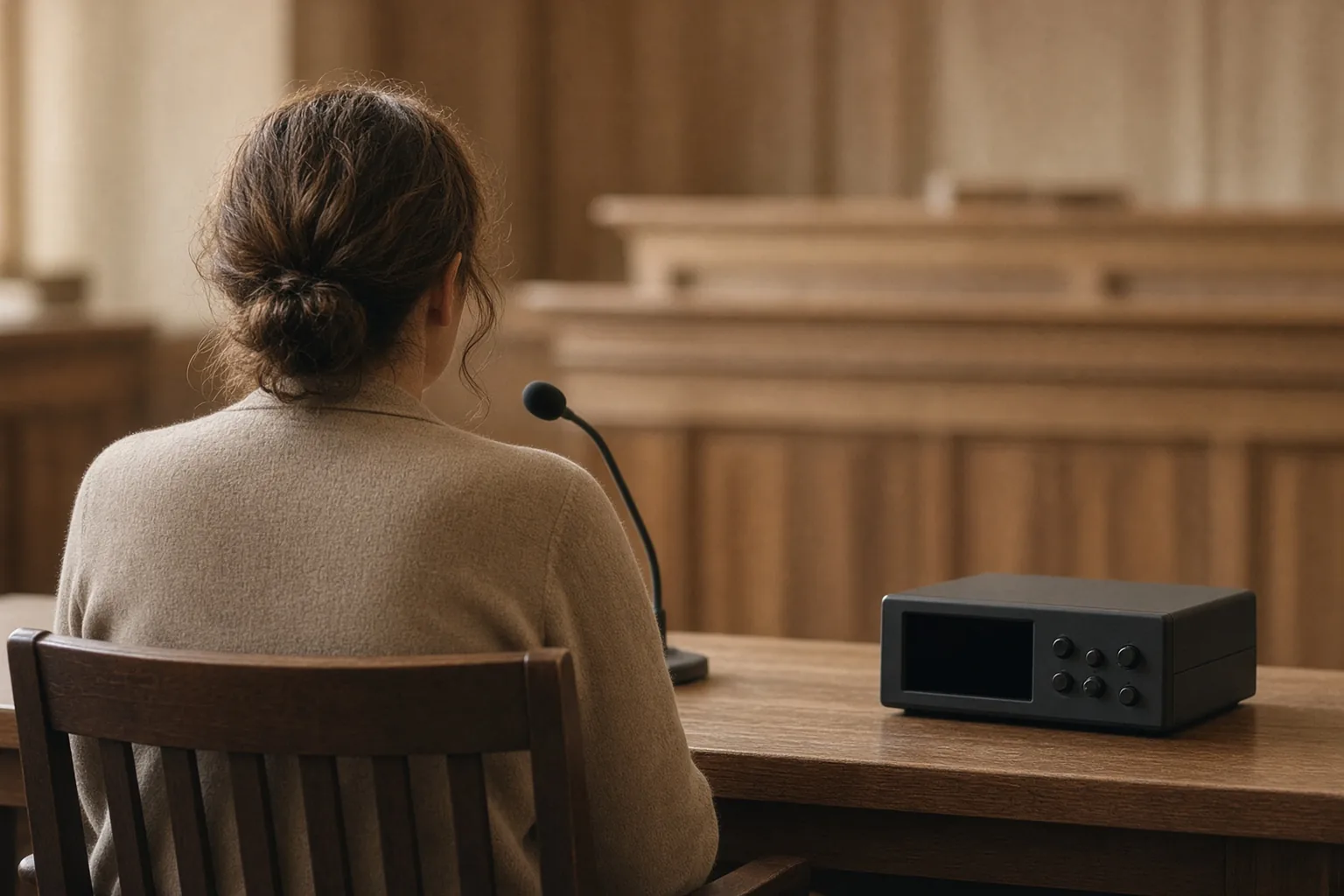
What is voice stress analysis?
Software that claims to detect deception from changes in a person's voice while he or she answers questions. The Computer Voice Stress Analyzer (CVSA) and Layered Voice Analysis (LVA) are two systems sold to law enforcement agencies.
The operator asks a set of questions, records the answers and the program marks each answer as stressed or not. The vendors describe stress as a sign of deception.
The NIJ Journal article on the Oklahoma County jail study gives the cost of the equipment: LVA can cost up to $20,000, and CVSA training and equipment average $11,500. The authors estimated the nationwide investment in CVSA at more than $16 million, not counting staff time.
Voice stress analysis is a different task from forensic voice comparison. A voice comparison asks whether two recordings contain the same speaker. A voice stress reading asks whether one speaker told the truth in one answer. The first question can be tested against known samples; the second rests on the claim that stress and lying go together.
Is voice stress analysis admissible in court?
Not as proof that a person told the truth or lied. A New York appellate court applied the polygraph rule to a voice stress test, and a federal court in Ohio kept such results out of trial.
In People v. Tarsia the Appellate Division of the New York Supreme Court treated a voice stress evaluation the same way as a polygraph. The court wrote that "Evidence obtained through the use of a polygraph test is generally inadmissible in a criminal case" and recorded that "the People concede its lack of reliability." The trial court had held the results inadmissible.
In United States v. Traficant the federal district court in Ohio granted the government's motion in limine to keep out evidence of psychological stress evaluation tests in 1983. The test results, the order says, "are the product of a voice stress analysis done by defendant Traficant's chosen examiner."
The Tarsia majority applied the polygraph rule to the voice stress test in so many words: "the same rule must be applied to the stress test herein." The leading Supreme Court decision on lie detection, Scheffer, concerns the polygraph itself.
What did the NIJ study find about accuracy?
In a study of 319 arrestees at the Oklahoma County jail, CVSA and LVA flagged about 15% of deceptive answers about recent drug use. Urinalysis was the check. Accuracy across all answers was about 50%.
The National Institute of Justice funded the study. Researchers from the Oklahoma Department of Mental Health and Substance Abuse Services interviewed randomly selected male arrestees held for less than 24 hours. They asked about marijuana use in the prior 30 days and about cocaine, heroin, methamphetamine and PCP use in the prior 72 hours.
Each arrestee then gave a urine sample. The laboratory result showed whether the answer about drug use was truthful or deceptive, and that finding was compared with what each program reported. The study design gave the researchers a ground truth that most interview settings lack.
Sensitivity, the share of deceptive answers the systems caught, averaged about 15%: 21% for LVA and 8% for CVSA. Specificity, the share of truthful answers correctly cleared, averaged about 91.5%. Accuracy across all answers was about 50%, which the article compared to flipping a coin.
The study found one effect of the devices. Only 14% of arrestees in the VSA study gave deceptive answers, compared with 40% in an earlier study at the same jail with the same protocol and no VSA. The article links the drop to the "bogus pipeline" effect: people answer more honestly if they believe their responses can be tested for accuracy. It adds that any deterrence may dissipate as word spreads about the real accuracy rates.
Why do courts treat voice stress results like polygraph results?
Both claim to detect lying from physiological signals, and the Supreme Court in United States v. Scheffer accepted a rule excluding polygraph evidence because "there is simply no consensus that polygraph evidence is reliable."
United States v. Scheffer, decided on March 31, 1998, concerned Military Rule of Evidence 707. The rule barred polygraph results, the examiner's opinion and any reference to taking or refusing a polygraph in a court-martial. The accused argued that the rule violated his right to present a defense.
The Court held that Rule 707 "does not unconstitutionally abridge the right to present a defense" and reversed the Court of Appeals for the Armed Forces. Justice Thomas wrote the principal opinion; Justice Stevens dissented.
Scheffer gives two reasons that apply equally to voice stress systems. The first is the lack of scientific consensus on reliability. The second is the role of the jury: the principal opinion repeated that "the jury is the lie detector" and said that polygraph evidence "may diminish the jury's role in making credibility determinations." Justice Kennedy, concurring, wrote that the opinion overreaches on this point.
Which rule decides whether a voice stress opinion reaches the jury?
Federal Rule of Evidence 702. Since the amendment effective December 1, 2023, the proponent must show the court that it is more likely than not that the opinion rests on sufficient facts or data and on reliable principles and methods.
Rule 702 lists four conditions: the knowledge will help the trier of fact, the testimony is based on sufficient facts or data, it is the product of reliable principles and methods, and the expert applied those methods reliably to the facts of the case.
The 2023 committee note says that expert testimony may not be admitted unless the proponent shows the court "that it is more likely than not" that the proffered testimony meets these requirements. It calls this the preponderance of the evidence standard that applies to most admissibility questions under the evidence rules.
For a voice stress opinion the contested condition is (c), a reliable method. A test of the system against a known ground truth gives the court an error rate to weigh. The NIJ study is such a test, and it reported 8% and 21% sensitivity for the two systems it examined.
The same note warns that forensic experts "should avoid assertions of absolute or one hundred percent certainty" when the method is subjective and potentially subject to error. A report that states a person "was deceptive" on a question, without an error rate, runs into that sentence.
Can any expert tell the jury that a witness was telling the truth?
Rule 608(a) permits testimony about a witness's character for truthfulness, in the form of reputation or opinion. A machine reading about one answer is a statement about that answer, and courts leave that judgment to the jury.
Rule 608(a) says a witness's credibility "may be attacked or supported by testimony about the witness's reputation for having a character for truthfulness or untruthfulness, or by testimony in the form of an opinion about that character." Evidence of truthful character is admissible only after the witness's character for truthfulness has been attacked.
A voice stress chart does not describe character. It claims to show that a specific answer, given on a specific day, was a lie. That is the question Scheffer described as belonging to the jury.
Psychologists, phoneticians and audio examiners can still testify about matters a jury cannot judge by ear: the conditions of the recording, the state of the file, the identity of the speaker. Each of those opinions is tested under Rule 702 on its own method.
Can evidence of a voice stress test come in for another purpose?
Sometimes. In Tarsia the defendant himself elicited testimony about the test to argue that his confession was involuntary, and the court let the jury hear a tape of the test questions and answers.
In Tarsia the detective who ran the test testified about the questions and the defendant's answers without objection. Defense counsel objected only when the prosecution offered the tape. The Appellate Division saw no prejudice, because the same questions and answers were already in evidence through the detective.
The court also found that the defendant "chose to allow, and, in fact, elicited detailed testimony" about the test, to show that the interrogation was coercive. Having done so, he could not complain later. The results of the test stayed out; the jury heard how the interrogation went.
In Tarsia the trial court held the test results inadmissible but allowed the tape to be played. Two justices, Sweeney and Mikoll, dissented and would have reversed; the dissent wrote that "In effect, defendant was administered a lie detector test."
What can a forensic audio examiner say about a recorded interview?
Whether the file is an original and unedited recording, whose voice is on it and what was said. These questions are tested against the file and known samples. Whether the speaker lied is not among them.
The SWGDE Best Practices for Digital Audio Authentication describe the tests an examiner runs on a disputed file: analysis of the file format and metadata, the structure of the file, the signal, and traces such as electric network frequency. The document states that "Not all tests will be applicable in each case, nor shall any single analysis be relied upon solely."
For common open formats such as WMA, MP3, WAV and AAC, SWGDE says it "should be mandatory to supply the purportedly original file," because such a file can be altered in an editor before submission. Transcoded or re-encoded versions "are not original recordings," and after decoding, file format analysis regarding the original format becomes impossible.
An interview recording can matter for other reasons. A gap in the file can hide part of the questioning. A transcript can attribute words to the wrong speaker. Those are questions an examiner can answer from the recording, and they bear on voluntariness and on what the person actually said.
What if the other side offers a report that the voice shows stress or deception?
Ask for the method, its validation against a known ground truth, the error rate, the original file and the full session. The NIJ figures give a published benchmark for CVSA and LVA.
A report claiming deception from voice features should name the system, its version, the settings and the questions asked. It should say how the system was validated and what its sensitivity and specificity are. Without those facts, the court has nothing to weigh under Rule 702(c).
The recording itself should be checked as for any audio evidence: whether the file analyzed was the original, whether it was compressed or transcoded before the analysis, whether parts of the session are missing. SWGDE warns that language implying 100% certainty should be avoided unless the examiner speaks about known alterations or deletions.
A review of such a report compares each conclusion with the data on which it rests. Where the report rests on a reading of stress alone, the review cites the published accuracy figures and the courts that excluded the same kind of evidence.
What should be sent to an examiner when an interview was recorded?
The original file from the recording device or system, the device make and model, any VSA charts, the list of questions, the time of the session and a description of how the file was copied.
SWGDE says the first removable instance of the original data should be protected from modification. A copy made through a messaging app or an email client may be re-encoded, and a re-encoded file cannot answer questions about the original format.
If the original recorder is unavailable, SWGDE describes test recordings made on the same make and model of device. The examiner compares the structure of the evidence file with those exemplars.
The client also describes the task in writing: whether the file is complete, whether a voice belongs to a named person, or what was said in a passage. The questions decide which tests the examiner runs and what the report can conclude.
What does IAE do when a recorded interview or a voice stress result is disputed?
IAE prepares an expert report on the client's questions about the recording: the speaker, the integrity of the file and the words spoken, or a review of the opposing report, in up to 5 business days.
IAE frames the questions around the recording: whose voice is on it, whether the file is intact and what was said. The examiner works from the original file, and noise reduction, if needed, is done on a working copy with every filter and setting logged. The audio and voice page of IAE lists three kinds of work: voice comparison with known recordings, checking the file for edits, and enhancement with transcripts.
The client sends the recording, the opposing report if there is one, and describes the task. The secretariat confirms receipt the same day. Within one business day IAE confirms the format, the cost, the deadline and the specialist from its registry, and the client approves the candidate and the CV before work starts. The signed PDF is issued in up to 5 business days after the format and cost are confirmed, and a 48-hour rush is available for tight deadlines.
Every specialist is a member of the public IAE registry and can be verified by Member ID or QR code. The specialist confirms in the document that he or she has no interest in the outcome of the case. IAE is not a law firm and does not advise on case strategy. A report is evidence that the court weighs with the rest of the record, and neither IAE nor the examiner guarantees the outcome.
Sources
- National Institute of Justice, NIJ Journal No. 260 (July 2008), Does VSA work? Study of CVSA and LVA at the Oklahoma County jail
- United States v. Scheffer, 523 U.S. 303 (1998) (LII, Cornell Law School)
- People v. Tarsia, 67 A.D.2d 210, 415 N.Y.S.2d 120 (N.Y. App. Div. 1979), opinion text
- United States v. Traficant, 566 F. Supp. 1046 (N.D. Ohio 1983) (Leagle)
- Federal Rules of Evidence, Rule 702, Testimony by Expert Witnesses, with Committee Notes (LII)
- Federal Rules of Evidence, Rule 608, A Witness's Character for Truthfulness or Untruthfulness (LII)
- SWGDE Best Practices for Digital Audio Authentication, Version 1.3 (September 20, 2018)
- Rule 702 as amended, effective in the Federal Rules of Evidence on December 1, 2023 (U.S. Court of Appeals for the Armed Forces, conference handout, PDF)
Read also
All articles

Can a voice recording prove a verbal agreement in court, and what does the recording have to show?
In California all contracts may be oral, except those that a statute requires to be in writing: that is Civil Code section 1622. A recording is Sergei Voronin
The court transcript does not match the audio recording: how is the record corrected, and what can a forensic transcript add?
When the official transcript of a federal hearing differs from what the audio recording shows, the transcript is presumed correct until the courtSergei Voronin
Is a partial recording of a conversation admissible, and can an examiner tell whether parts are missing?
A recording that captures only part of a conversation can still be admitted in a federal court. Rule 106 of the Federal Rules of Evidence letsSergei VoroninExpert examinations
Ready to discuss your case?
Send the materials: the secretariat will confirm the format, cost, deadline and the specialist within one business day.
