
Examinations
Bicycle accident reconstruction: how does the expert establish where the cyclist was, how fast both were moving and whether the bicycle could be seen?
A car and a bicycle collide, and the dispute is about the last few seconds: where the cyclist was riding, how fast each was moving and whether the driver could see the bicycle. The bicycle rarely keeps an electronic record of its own speed, so the engineer works with the marks on the road, the damage to both, the lamps and any video. Florida's bicycle statute supplies the rules those findings are measured against.
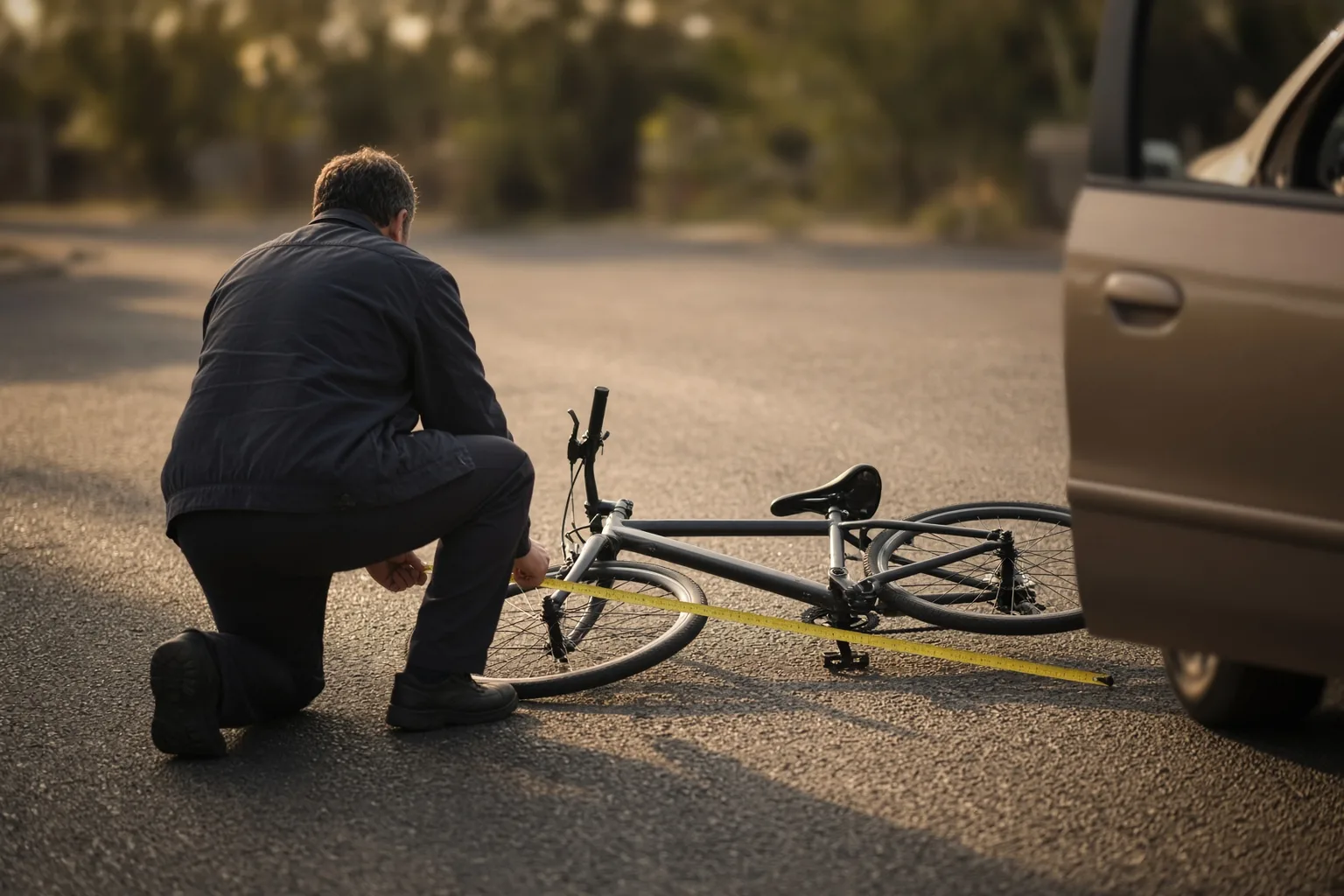
What does a bicycle accident reconstruction establish?
Where the bicycle and the car were at impact, how fast each was moving, which way each was heading and whether the driver could have seen the cyclist in time. The legal consequences of those findings are for the court.
The IAE accident reconstruction page describes the core of the work in one sentence: the engineer matches crush on the vehicles with tire marks, gouges, the police diagram and video, and sets the point of impact, the impact angle and pre-crash speeds. A bicycle case needs the same three findings. The evidence on the bicycle's side is thinner, because a bicycle is far lighter than a car, deforms differently and usually stores nothing about its own speed.
Most disputes come down to a short list of facts. Was the cyclist in the travel lane, in a bicycle lane, on the shoulder or coming off a sidewalk? Was the car overtaking, turning across the cyclist's path or pulling out of a driveway? Were the bicycle's lamps on? Each answer is a position, a speed or a time, and each has to be tied to physical evidence or a recording.
The reconstruction does not decide who was negligent. It gives the judge or jury the positions, speeds and times, and the traffic statute supplies the duties against which those facts are measured.
What duties does the law put on a cyclist?
Florida gives a person riding a bicycle the rights and duties of the driver of any other vehicle, with special rules on lane position, riding abreast, lamps, brakes and helmets in section 316.2065.
Section 316.2065(1) of the Florida Statutes begins: "Every person propelling a vehicle by human power has all of the rights and all of the duties" applicable to the driver of any other vehicle under chapter 316. The exceptions are the chapter's special rules for bicycles and the provisions that by their nature cannot apply to a bicycle.
Lane position is governed by subsection (5)(a). A person operating a bicycle upon a roadway at less than the normal speed of traffic at the time and place "must ride in the bicycle lane or, if there is no bicycle lane on the roadway, as close as practicable to the right-hand curb or edge of the roadway." The statute then lists three situations in which the cyclist may move away from the right edge: overtaking and passing a bicycle or vehicle going in the same direction, preparing for a left turn at an intersection or into a private road or driveway, and avoiding a hazard or conflict that makes the right edge unsafe, such as a parked or moving vehicle, a pedestrian, an animal, a surface hazard, a turn lane or a lane too narrow to share side by side.
Subsection (6)(a) adds that persons riding bicycles upon a roadway or in a bicycle lane "may not ride more than two abreast except on a bicycle path."
These rules turn the cyclist's lateral position into a legal question. A cyclist found well out from the edge may have been passing, preparing to turn or avoiding something in the road. The engineer fixes the position from the evidence and records what was on the road at that point, such as a parked car, debris, a drain grate or a turn lane. The court then decides which part of subsection (5)(a) applies.
What changes if the cyclist was on the sidewalk or in a crosswalk?
In Florida a person riding a bicycle on a sidewalk or across a roadway in a crosswalk has the rights and duties of a pedestrian, must yield to pedestrians and must give an audible signal before passing one.
Subsection (9) of section 316.2065 covers "A person propelling a vehicle by human power upon and along a sidewalk, or across a roadway upon and along a crosswalk." That person "has all the rights and duties applicable to a pedestrian under the same circumstances." Subsection (10) adds that the rider "shall yield the right-of-way to any pedestrian and shall give an audible signal before overtaking and passing such pedestrian."
Where a sidewalk crosses a driveway or a side street, a driver pulling out may look for cars in the roadway and not for a cyclist on the sidewalk. The reconstruction then turns on sight lines and timing. The engineer measures what the driver could see from the stopping position, places the cyclist along the sidewalk at the moments before impact and estimates the cyclist's speed.
Speed matters here more than in a pedestrian case. A person on foot and a person on a bicycle can start the same distance from the driveway and arrive at very different moments, and the driver's look to the side may have come before the cyclist was in view. The engineer works out where the cyclist was when the driver looked, if the driver's statement or a video fixes that moment.
Did the bicycle need lamps, and how does the engineer check them?
Between sunset and sunrise a bicycle in Florida must have a front lamp with white light visible from at least 500 feet and a rear lamp and reflector, each showing red light visible from 600 feet.
Subsection (7) reads: "Every bicycle in use between sunset and sunrise shall be equipped with a lamp on the front exhibiting a white light visible from a distance of at least 500 feet" to the front "and a lamp and reflector on the rear each exhibiting a red light visible from a distance of 600 feet to the rear." The rear lamp is required in addition to the rear reflector. Under the same subsection a bicycle or its rider may carry more lights than the law requires.
Whether the lamps were on is a question of fact the engineer can work on. The bicycle is examined with everything still mounted on it: which lamps were fitted, whether they work after the crash, the state of the batteries and whether a lamp found in the debris belonged to this bicycle. A lamp worn by the rider, such as a helmet light, is recorded as well.
Visibility is then tested at the scene. The engineer records the street lighting, the position of the sun where dusk or dawn is in issue, the driver's line of sight and the distance at which a bicycle with the lamps actually found could first be seen. That distance, set against the car's speed, gives the time the driver had to perceive the bicycle and react.
How does the engineer estimate speeds when the bicycle has no data recorder?
From the physical evidence and any recordings: marks on the road, the rest positions of the bicycle and rider, the damage to both, video and any GPS or phone record of the ride, checked against each other.
The car's speed often comes from the car. If the car has an event data recorder and the crash triggered a record, the download gives speed and braking in the seconds before impact. Braking marks from the car's tires, where there are any, give a second figure to compare with it.
The bicycle's speed is harder to fix. A rider may carry a cycling computer, a sports watch or a phone app that logs position and speed by GPS, and that file can be the only record of the last seconds of the ride. Video from a dashcam, a doorbell camera or a shop on the street gives speed by measuring how far the bicycle travels between frames, once the frame rate and the distances in the picture are known.
Without a recording, the engineer works from positions: where the bicycle was before the crash, where the contact occurred on the car, where the bicycle and the rider came to rest. The report names the method and the data behind each number and gives a range where the evidence does not fix a single value. A speed stated to the mile per hour with no calculation shown is the figure an opposing reviewer will ask about first.
The bicycle's brakes belong to the same question. Subsection (13) requires every bicycle to be "equipped with a brake or brakes which will enable its rider to stop the bicycle within 25 feet from a speed of 10 miles per hour on dry, level, clean pavement." Where the cyclist's ability to stop is disputed, the engineer can test the brakes of the bicycle involved against that figure.
Does a missing helmet count against the cyclist?
Not as evidence of negligence in Florida. Riders and passengers under 16 must wear a helmet, but the statute says failure to wear one may not be considered evidence of negligence or contributory negligence.
Subsection (3)(d) states: "A bicycle rider or passenger who is under 16 years of age must wear a bicycle helmet that is properly fitted and is fastened securely upon the passenger's head by a strap and that meets the federal safety standard for bicycle helmets, final rule, 16 C.F.R. part 1203." The term passenger includes a child riding in a trailer or semitrailer attached to a bicycle.
Subsection (18) limits the use of that rule in a lawsuit: "The failure of a person to wear a bicycle helmet or the failure of a parent or guardian to prevent a child from riding a bicycle without a bicycle helmet may not be considered evidence of negligence or contributory negligence."
For the reconstruction the helmet is a physical exhibit. A damaged helmet records where the head struck the car or the road, and it is kept with the bicycle. Under subsection (18) its absence is not evidence of negligence, so the engineer's findings about the crash do not depend on it.
Can the expert say who was at fault?
No. The engineer states positions, speeds, sight distances and times. Whether the driver or the cyclist breached a duty under section 316.2065 or another traffic rule is for the judge or jury.
Under subsection (19), a person who violates section 316.2065 commits a noncriminal traffic infraction, punishable as a pedestrian violation under chapter 318. A citation written at the scene records an officer's view of the crash. The reconstruction tests that view against the marks, the damage and the recordings.
A report that says the cyclist "should have" stayed farther right, or that the driver "failed to yield", has left engineering and states a legal conclusion. The useful report says where the bicycle was relative to the edge, what was on the road there, how fast both were moving and when the driver could first see the bicycle. It leaves the label to the court.
What should be preserved after a car-bicycle crash?
The bicycle unrepaired with its lamps and computer, the helmet, the rider's clothing, photographs of the car's damage, the GPS or app file, nearby video and the car's event data recorder before the car is repaired.
The bicycle and the car are the two main exhibits, and both change quickly. A bicycle is often straightened or thrown away within days, and a car goes to a body shop. The list below is what the engineer will ask for.
- Keep the bicycle exactly as it was after the crash, with its lamps and any cycling computer still mounted.
- Keep the helmet and the rider's clothing, since scuffs and tears mark the points of contact.
- Save the GPS or phone app file of the ride before the device overwrites it, and keep the original file.
- Photograph the car's front, hood, windshield and side before repair, with a scale in the frame.
- Ask nearby homes and businesses for camera footage before their systems record over it.
- Ask the other side in writing to preserve the car and its event data recorder until both can be inspected.
What does IAE do in a bicycle accident case?
IAE prepares an expert report on the client's questions about the crash or a review of the opposing expert's report, in up to 5 business days, with a 48-hour rush for cases with tight deadlines.
The IAE accident reconstruction service answers how the vehicles moved before impact, what the event data recorder shows about speed and braking and whether the damage on each vehicle fits the claimed crash, for injury and property damage cases in US courts. The engineer matches crush with tire marks, gouges, the police diagram and video, and sets the point of impact, the impact angle and pre-crash speeds. IAE confirms the questions with the client before work starts.
The client sends the report or the case materials and describes the task. The secretariat confirms receipt the same day. Within one business day IAE confirms the format, cost, deadline and the specialist from its registry, and the client approves the candidate and the CV before work starts. The draft is checked for facts, and the signed PDF is issued in up to 5 business days.
Every specialist is a member of the public IAE registry and can be verified by Member ID or QR code. The specialist confirms in the document that he or she has no interest in the outcome of the case. Neither IAE nor the specialist guarantees the outcome, and IAE is not a law firm.
Sources
Read also
All articles
Who was driving? How does an accident reconstruction expert identify the driver after a crash?
After a crash with two people in the front seats, each may say the other was driving, and in a fatal drunk-driving case that answer decides who is Sergei Voronin
Sideswipe or lane-change crash: how does an expert establish which vehicle left its lane?
Two cars travelling in the same direction touch sides, and each driver says the other drifted over. Traffic codes put the duty on the driver whoSergei Voronin
Motorcycle accident reconstruction: how does the expert find speed, position and visibility without a car's data recorder?
In 2024, 6,228 motorcyclists were killed on US roads, 16 percent of all traffic deaths, according to NHTSA. Many of these crashes turn on threeSergei VoroninExpert examinations
Ready to discuss your case?
Send the materials: the secretariat will confirm the format, cost, deadline and the specialist within one business day.
