
Examinations
Who was driving? How does an accident reconstruction expert identify the driver after a crash?
After a crash with two people in the front seats, each may say the other was driving, and in a fatal drunk-driving case that answer decides who is prosecuted. Statements by the occupants and witnesses often conflict. A reconstructionist identifies the driver from the crash itself: the direction of the impact force, contact marks inside the car, injuries, blood and fabric traces, seat belts and the airbag module.
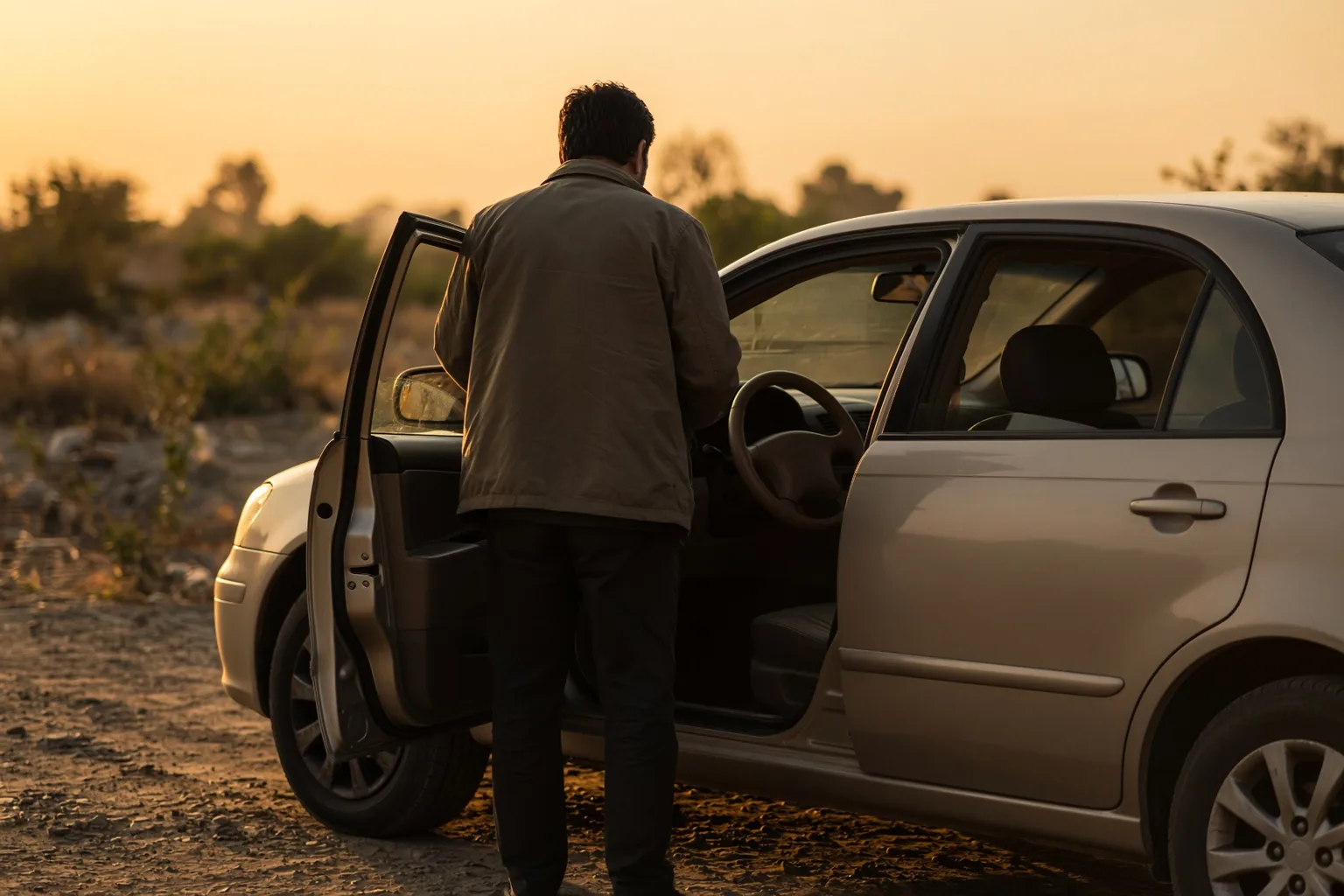
Why does it matter who was driving?
Because criminal charges, civil liability and insurance coverage attach to the person behind the wheel. In People v. Hillis, an Illinois aggravated DUI death case, the man charged testified that the woman who died had been driving.
People v. Hillis, 2016 IL App (4th) 150703, was decided by the Appellate Court of Illinois, Fourth District, on September 28, 2016. The State charged Garry L. Hillis with aggravated driving under the influence of alcohol under 625 ILCS 5/11-501(d)(1)(F), alleging that on May 2, 2013 he drove a Ford F-150 pickup on Illinois Highway 108 in Greene County and was in a crash that caused the death of Brandy Gilbert.
Hillis testified that Gilbert had driven all evening, that he was the passenger and that he fell asleep before the crash. Apart from Hillis himself, no eyewitness testified to seeing who was in the driver's seat. The jury convicted him, he was sentenced to five years, and the appellate court affirmed.
The same question comes up in civil cases. An injured passenger who sues the driver, an owner who says a friend took the car and an insurer that covers only listed drivers all need to know who was in the driver's seat at the moment of impact, and the occupants are the people least likely to agree.
What evidence does a reconstructionist use to identify the driver?
The direction of the impact force and the occupants' expected movement, contact marks inside the car, injuries matched to those marks, seat belts, airbags, blood, hair and fabric traces, and the vehicle's crash data.
Jeffrey D. Armstrong, P.E., set out the categories in "Forensic Engineering Determination of Who Was Driving," published in the Journal of the National Academy of Forensic Engineers, Vol. XXVIII, No. 2, in December 2011. He wrote that "the engineer or investigator should look for and identify evidence of occupant contact" inside the vehicle, and that "It may be possible to match trauma such as head, chest, or knee injuries with damage inside the vehicle."
The paper lists the parts to examine. "The steering wheel should be inspected for contact damage," and so should the knee bolsters. Seat belts are inspected "to see if they were in use at the time of a crash, and to see if they were functioning properly." "Deployed airbags should be inspected for traces of bodily fluids, lipstick and makeup stains," and the search inside the car "should include a search for hair fibers or traces of bodily fluids such as blood." Fabric imprints matching the occupants' clothing can sometimes be found as well.
For an occupant thrown from the car, Armstrong wrote that "Scratches on the bodies may indicate the direction that an ejected occupant exited the vehicle," and that "Ejections often occur at points where there is a sudden change in the speed and/or direction of the vehicle."
A 2005 presentation to the American Academy of Forensic Sciences by Mark C. Pozzi and Todd K. Saczalski on driver identity in a high-speed rollover used similar evidence: occupant trauma determined from photographs and a review of autopsy and medical records, "Mud deposits on the vehicle interior and the lack thereof on one occupant's shoes," and evidence, or its absence, on door latches, door structures, door window openings and exterior sheet metal.
How does the direction of the impact point to each occupant's seat?
Occupants move toward the point of impact, opposite to the force on the vehicle. Knowing the direction of force and where each body struck the interior, the engineer can place each person in a seat.
Armstrong defined the term: "The PDOF defines the direction of force at the point of maximum engagement of the two vehicles." PDOF stands for principal direction of force. He wrote that "The movement of the occupants will typically be directly opposite of and parallel to the PDOF." A car struck on the passenger side throws its occupants toward that side, and the person in the passenger seat is the one closest to the intrusion.
In Hillis the State's reconstructionist, Nathan S. Shigemura, testified that the truck "failed to negotiate the curve fully and left the roadway to its right," struck a power pole "with the passenger side of the vehicle," then rotated and came to rest several feet past the pole. Gilbert had severe right-sided injuries, skull fractures and lacerations from broken safety glass. Hillis had minor injuries, including a mark on the left chest that the expert tied to the steering wheel, whose bottom was bent.
From these facts Shigemura testified: "I believe the female was the passenger at the time of the crash and the male was the driver at the time of the crash." He also inferred that the passenger had been unrestrained, because the webbing of the passenger seat belt had no blood on it and there were glass cubes inside the buckle.
Do blood and DNA on the driver's seat settle the question?
Not by themselves. People can move or be moved after a crash. In Hillis the blood on the driver's seat matched the woman who died, and the jury still convicted the man.
The State's crime scene investigator testified in Hillis that the driver's seat, the console, the dash and the passenger seat were stained with a blood-like substance, and DNA analysis matched it to Gilbert. Gilbert herself was found outside the truck, on the ground 10 to 15 feet from the driver's side. The defense reconstructionist, James Hall, conceded that "if defendant had dragged Gilbert from the passenger seat, he could have gotten her blood on his hands." Shigemura's opinion did not rest on the DNA.
Armstrong's first case study ran the other way. An unrestrained young woman was found in the driver's seat of a 2006 Ford Taurus after an intersection crash with a 1996 Chevrolet Lumina and was charged with vehicular homicide. The part of the driver's airbag with traces of bodily fluids was cut out and sent to a laboratory, and the DNA matched her boyfriend. The evidence showed that he had been in the front seat and in contact with the driver's airbag, and it supported the theory that he had moved her after the crash. The State dropped the charges against her and charged him.
The lesson for the engineer is about time. Positions found by the first responders are positions after the crash. The airbag, the steering wheel and the belt record contact during the crash, and that is the moment the case is about.
Can a reconstructionist rely on injuries without being a physician?
In Hillis, yes. The Illinois court held that the reconstructionist stayed within physics, because physicians made the diagnoses and he matched those injuries with the movement of the occupants in the crash.
Hillis argued that Shigemura had no medical training and should not have relied on injury patterns. The appellate court disagreed: "Shigemura's testimony fell within the realm of physics, not medicine." It quoted a treatise saying that "the reconstructionist may want to discuss occupant injuries with the pathologist, attending physician, or coroner," and explained that "the traffic-accident reconstructionist is not the one who diagnoses the injuries": he or she "obtains that diagnosis from physicians and other qualified medical personnel."
The court applied the same line to the defense. The trial court had barred Charles Earnshaw, Jr., a retired internist with no listed reconstruction training, from testifying as an expert on accident reconstruction. The appellate court found no abuse of discretion: "A doctor in internal medicine is not, ipso facto, a traffic-accident reconstructionist." It read the order narrowly, as not barring him from testifying about injuries, and rejected the argument that the ruling violated the right to present a defense.
The practical division follows from that. A physician says what the injuries are and what kind of force caused them. The reconstructionist says where in the car that force could have come from and which seat it points to. A report that does both should say which part rests on whose work.
What happens when the two sides' experts disagree?
The jury decides which expert to believe. In Hillis the defense expert said the driver could not be identified with reasonable certainty, and the court held that a rational jury could still find the defendant was driving.
Hall's position in Hillis was that "it was impossible for any accident reconstructionist to opine, to a reasonable degree of accident-reconstruction certainty, who the driver was in this case," although he thought Gilbert had been driving. He testified that an unrestrained driver "would have flown to the right, striking the middle console," and would have struck the left side of the passenger.
On appeal Hillis argued that the evidence was insufficient. The court held that identity may be proved by circumstantial evidence, that the jury could credit Shigemura over Hall and reject Hillis's own account, and noted that Hillis, not Gilbert, was the registered owner of the truck. Its conclusion: "A rational jury could have found, beyond a reasonable doubt, that defendant was the driver."
Rulings on expert testimony are reviewed deferentially. The court wrote that it would "defer to the ruling on a motion in limine unless we find the ruling to be an abuse of discretion," which occurs only if the trial court "acted arbitrarily, exceeded the bounds of reason, or ignored or misapprehended the law." For that reason the objection to a driver identification opinion is made in the trial court, by motion in limine or at trial. On appeal the ruling stands unless it was arbitrary or misread the law.
What can the airbag control module add?
Speed before the crash and whether the driver's belt was buckled, where the module recorded them. In Armstrong's rollover case the module recorded a speed about 10 mph over the limit and an unbuckled driver's belt.
Armstrong's second case study was an SUV that rolled over after striking a culvert. The airbag control module recorded "the precrash speed approximately 10 mph above the posted speed limit" and an indication that the driver's seat belt was not in use. The paper reports the conclusion about the male occupant: "it was determined that he was driving at the time of the crash."
The module's record did not name the person in the seat. It gave two facts, speed and belt use. Both occupants were ejected, and the engineer matched the record to a person by where the bodies were found: the man on the north side of the road, after an ejection through the driver's side window that the calculations supported, and the woman where the passenger-side window would have rolled. Armstrong wrote that "Information from the vehicles must be matched with information from the roadway."
What should be preserved when the driver is disputed?
The vehicle with its interior untouched, the airbags and seat belts, the occupants' clothing and shoes, photographs of injuries, medical and autopsy records, the airbag module data and a record of where each person was found.
Armstrong noted that "driver, passenger, and witness statements are often in conflict with one another." The physical evidence is what remains when the statements cancel out, and most of it is inside the car. Cleaning, repairing or scrapping the vehicle removes it.
- Keep the vehicle closed and uncleaned, with the airbags, steering wheel, knee bolsters and seat belts in place.
- Record where each occupant was found and who moved whom, with the names of first responders.
- Keep the occupants' clothing and shoes, since fabric imprints and mud or debris on the soles can be compared with the interior.
- Collect photographs of injuries, the medical records and any autopsy report.
- Have the airbag control module downloaded before the vehicle is sold or repaired.
- Ask for swabs of the airbags and the steering wheel to be taken for DNA before anyone else touches them.
What does IAE do when the driver's identity is disputed?
IAE prepares an expert report on the client's questions about the crash or a review of the opposing expert's report, in up to 5 business days, with a 48-hour rush for cases with tight deadlines.
The IAE accident reconstruction service answers how the vehicles moved before impact, what the event data recorder shows about speed and braking and whether the damage on each car fits the claimed crash, for injury and property damage cases in US courts. The engineer matches crush on the vehicles with tire marks, gouges, the police diagram and video, and sets the point of impact, the impact angle and pre-crash speeds. IAE confirms the questions with the client before work starts.
The client sends the report or the case materials and describes the task. The secretariat confirms receipt the same day. Within one business day IAE confirms the format, cost, deadline and the specialist from its registry, and the client approves the candidate and the CV before work starts. The draft is checked for facts, and the signed PDF is issued in up to 5 business days.
Every specialist is a member of the public IAE registry and can be verified by Member ID or QR code. The specialist confirms in the document that he or she has no interest in the outcome of the case. Neither IAE nor the specialist guarantees the outcome, and IAE is not a law firm.
Sources
- People v. Hillis, 2016 IL App (4th) 150703 (Ill. App. Ct. Sept. 28, 2016) (Illinois Courts)
- Jeffrey D. Armstrong, Forensic Engineering Determination of Who Was Driving, Journal of the National Academy of Forensic Engineers, Vol. XXVIII, No. 2 (December 2011)
- Mark C. Pozzi, Todd K. Saczalski, Determination of Driver Identity in a High-Speed Vehicle Rollover, American Academy of Forensic Sciences, Proceedings 2005, C15
Read also
All articles
Bicycle accident reconstruction: how does the expert establish where the cyclist was, how fast both were moving and whether the bicycle could be seen?
A car and a bicycle collide, and the dispute is about the last few seconds: where the cyclist was riding, how fast each was moving and whether Sergei Voronin
Sideswipe or lane-change crash: how does an expert establish which vehicle left its lane?
Two cars travelling in the same direction touch sides, and each driver says the other drifted over. Traffic codes put the duty on the driver whoSergei Voronin
Motorcycle accident reconstruction: how does the expert find speed, position and visibility without a car's data recorder?
In 2024, 6,228 motorcyclists were killed on US roads, 16 percent of all traffic deaths, according to NHTSA. Many of these crashes turn on threeSergei VoroninExpert examinations
Ready to discuss your case?
Send the materials: the secretariat will confirm the format, cost, deadline and the specialist within one business day.
