
Examinations
Cut padlock or chain: can an examiner match the cut to a pair of bolt cutters?
A cut padlock or chain is often the only physical trace of a theft from a shed, a storage unit or a bike rack. When bolt cutters later turn up in a suspect's car, the question is whether those cutters made that cut. A toolmark examiner can sometimes answer it. The answer depends on what the cut surface kept, what the tool cut afterwards and how the items were collected.
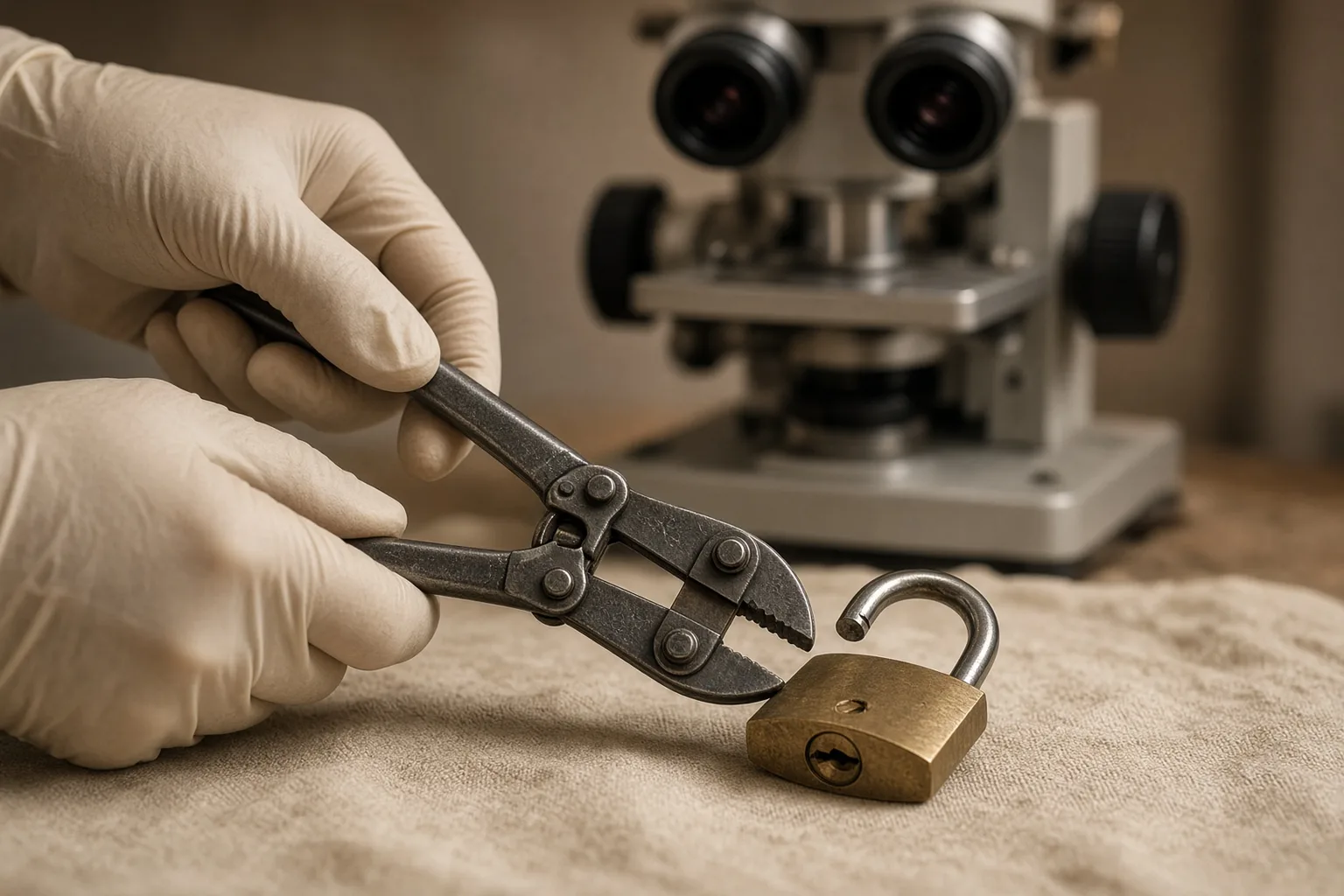
Can a cut padlock shackle or chain link be matched to the bolt cutters that cut it?
Sometimes. The blades of bolt cutters leave fine striations on the cut surface. An examiner makes test cuts with the seized tool and compares both sets of marks under a comparison microscope.
The crime laboratory of the Missouri State Highway Patrol describes its toolmark casework in these terms. The tools it lists include bolt cutters, screwdrivers, scissors, knives, pliers, crowbars and saws. The marked objects include chains, padlocks, doorknobs, bolts and safety-deposit boxes. The page uses the bolt cutter as its example: "the cutting edge on the blades of a pair of bolt cutters leaves striations on the cut padlock shackle."
A toolmark, in the laboratory's words, consists of "scratches and/or impressions that are left on an object that is softer" than the tool. Imperfections of the cutting edge transfer to the metal. In the laboratory the examiner makes test marks with the suspect tool and compares the minute scratches on them with those on the evidence under a comparison microscope. Marks pressed into a surface without cutting it, such as those of a screwdriver tip, a chisel or a hammer, are compared the same way to identify or eliminate the tool.
The comparison needs a cut surface that kept those scratches. Not every one does. In the sample laboratory report described below, a padlock shackle "bears no microscopic marks of value for comparison purposes," and nothing on it could be compared with any tool.
Can the examiner tell bolt cutters from tin snips, a knife or a pry bar?
Often, by the kind of action the tool used. A sample laboratory report separates cuts made by a pinching action, as with bolt cutters, from shearing cuts like those of tin snips, single-blade cuts and prying marks.
The sample is a laboratory report used in the Firearm Examiner Training course (2008) and credited to the National Forensic Science Technology Center. It reports results on 37 items, among them lineman's pliers, a screwdriver, bolt cutters, two knives, a hammer, alarm wire, a cashbox, two safe doors, five chain links, copper power line, railroad spikes, a lock mechanism, a padlock shackle and a lead bank seal.
The five chain links bear toolmarks "indicative of having been cut by a tool or tools employing a pinching action," and the submitted bolt cutters are a tool of that kind. The questioned ends of the copper power line sections were also cut by a pinching-action tool. Two sheet metal sections bear marks "made by a tool employing a shearing action, such as tin snips." The end of a telephone cord was consistent with a single-bladed tool, and the railroad spikes carried marks consistent with removal by a tool employing a prying action.
A finding of this kind names a type of tool and points to no single tool. Measurements go further and can exclude a tool. Under the heading "Elimination Based on Class Characteristics" the same report states that the screwdriver tip "is one half inch wide and could not have made the impressions" in a wooden door casing, where the impressions had a well-defined tip width of a quarter inch. A hammer was excluded as the source of a round impression about two inches in diameter in a vehicle door.
What results can a laboratory report give on a cut lock or chain?
Four kinds appear in the sample report: identification of the tool, exclusion, no conclusion because the microscopic marks do not correspond sufficiently, and no marks of value on the item at all.
In two comparisons the laboratory identified the tool. "The Item #7 alarm wire was identified as having been cut by the Item #1 lineman's pliers," and the screwdriver was identified as having made the toolmark next to the lock on the lid of the cashbox.
The bolt cutters were not identified. According to the report, none of the chain links "were identifiable as having been cut by the Item #3 bolt cutters" because of "a lack of corresponding microscopic marks," and "no conclusion could be reached as to whether or not these items were cut by the Item #3 tool." They were not excluded either. The chain links carried the pinching cuts that such a tool makes, and the microscopic detail did not settle the question in either direction.
The padlock shackle produced no comparison. The lead bank seal "bears no marks of value for comparison purposes." For those two items the laboratory had nothing to compare with any tool, whatever tool the police later found.
A report on a cut lock states which of these results it reached and on what observations: the kind of action, the measured dimensions and, for an identification, the agreement seen under the microscope between the evidence cut and the test cuts.
What can the examiner say before any tool has been found?
The type of tool, its measurable features and whether several cuts or marks were made by one tool. Marks of value can also be recorded and kept for a comparison if a tool turns up later.
Several results in the sample report involve no submitted tool. Impressions in a safe door "were made with a flat bladed tool with a tip width of approximately three quarters of an inch," and they were identified as made by the same tool as the impressions in a second safe door. Two sheet metal sections were cut by one shearing tool. The copper power line sections were compared with each other, and no conclusion was reached for lack of sufficient corresponding microscopic characteristics.
For other items the laboratory recorded what could be done later. The knob of a lock mechanism bears toolmarks "like those produced by a serrated jawed gripping tool," with microscopic marks of value "should a suspect tool be recovered." A bank depository drawer carried marks consistent with a large flat-bladed tool such as a pry bar, again with microscopic value if a tool is found.
In a series of thefts, locks cut at different sites can be compared with each other before any tool is seized. A link between two cuts says that one tool made them. It says nothing about who held the tool or when.
Do bolt cutters keep making the same marks after they cut other locks?
Not reliably. In a study described by the Association of Firearm and Tool Mark Examiners, one bolt cutter cut series of 25 similar shackles, and in only one case was the first shackle identified to the last cut.
The study, "Consecutive Cuts By Bolt Cutters and Their Effect on Identifications," is sold as an article in the store of the Association of Firearm and Tool Mark Examiners (AFTE). Its description says that bolt cutter jaws were studied "to try to determine whether or not a bolt cutter could cut 25 similar shackles" and still be identified as the tool that cut the first one. The store page names neither the authors nor the journal issue.
According to the description, cuts in lead kept enough detail for the first and the last cut of each series to be identified with each other. The shackles behaved differently: "in only one case could the first cut shackle of a series be identified to the last cut." Comparisons of three consecutively assembled bolt cutters confirmed microscopic differences between the tools. Cuts made close together in a series were easier to identify than cuts made far apart.
The description draws its conclusion for proficiency tests. The same fact bears on casework. If the seized cutters went through more hardened shackles between the theft and the seizure, the jaws may no longer make the marks they left on the evidence. The examiner needs the date and place the tool was found and whatever is known about its use in between, and a defense examiner reading an identification asks for the same information.
How may a Department of Justice examiner word the conclusion?
With one of three conclusions: source identification, source exclusion or inconclusive. The Department's 2023 language rules for firearms and toolmarks bar claims of uniqueness, a zero error rate and absolute certainty.
The Uniform Language for Testimony and Reports for the Forensic Firearms/Toolmarks Discipline, Pattern Examination, was approved by the U.S. Department of Justice on May 18, 2023 and took effect on August 16, 2023. It applies to the Department's examiners. Source identification is "an examiner's conclusion that two toolmarks originated from the same source." Source exclusion is "an examiner's conclusion that two toolmarks did not originate from the same source." An inconclusive result means that the observed class characteristics agree but the quality or quantity of corresponding individual characteristics is insufficient to identify or exclude.
A Department examiner may not base an identification or exclusion on the "uniqueness" of an item, may not use the words "individualize" or "individualization," and may not assert that two toolmarks came from the same source "to the exclusion of all other sources." Examinations may not be called infallible or said to have a zero error rate. The number of examinations in a career may describe the examiner's experience but may not be cited as a direct measure of the accuracy of a conclusion. A conclusion may not be stated "with absolute or 100% certainty." The phrase "reasonable degree of scientific certainty" is barred unless a judge or applicable law requires it, and a statistic or numerical probability needs relevant and appropriate data behind it.
The Missouri page uses other wording. It speaks of each tool's "unique and individual imperfections" and of a "positive identification." When the report in a case comes from a state or local laboratory, a reviewing examiner compares its wording with that laboratory's procedures and with the federal document and records where they differ.
What must the party offering a toolmark opinion show in federal court?
Under Rule 702, that it is more likely than not that the testimony rests on sufficient facts or data and that the expert applied reliable principles and methods reliably to the facts of the case.
Federal Rule of Evidence 702 lets a qualified expert give an opinion only if the proponent convinces the court that it is more likely than not that four conditions are met. The expert's knowledge will help the trier of fact. The testimony is based on sufficient facts or data. It is the product of reliable principles and methods. The expert applied those principles and methods reliably to the facts of the case.
The 2023 committee note addresses courts that had treated these points as matters for the jury. It states that "many courts have held that the critical questions of the sufficiency of an expert's basis, and the application of the expert's methodology, are questions of weight and not admissibility," and that "These rulings are an incorrect application of Rules 702 and 104(a)." For a cut lock, the sufficiency of the basis includes the condition of the cut surface and the history of the tool.
The same note says forensic experts should avoid assertions of absolute or one hundred percent certainty if the methodology is subjective and potentially subject to error, and that the judge should, where possible, receive an estimate of the known or potential rate of error of the method.
In a federal criminal case the defense learns the basis before trial. Under Rule 16(a)(1)(E) the government, on request, lets the defendant inspect and copy or photograph items such as the lock and the cutters if they are material to preparing the defense, intended for use in its case-in-chief or obtained from the defendant. Rule 16(a)(1)(F) covers reports of scientific tests, and Rule 16(a)(1)(G) requires a signed written disclosure with a complete statement of the expert's opinions, their bases and reasons, the witness's qualifications with publications of the previous 10 years and a list of cases with testimony in the previous 4 years. Under Rule 16(b)(1)(C) a defendant who requested that disclosure and received it gives the same information about the defense examiner at the government's request.
How should a cut lock, a chain and suspected bolt cutters be collected?
Photographed with a scale before anyone handles them, submitted whole and packaged in separate boxes, with any cut made by an officer marked so that nobody confuses it with the cut under examination.
Evidence guidance titled "Tools and Tool Marks," posted on the Maine State Police website, defines a tool mark as an area of damage on an object caused by a tool and gives bolt cutters as one of its example tools. It asks that the mark be photographed with a scale before handling, that its location and orientation in the scene be recorded, and that collectors keep DNA and latent print evidence in mind.
"If a lock was cut, submit the entire lock." An object too large to remove is cast, or the marked area is cut out with a wide margin. Cuts made by the officer are kept apart from the marks of the suspected tool, for example by coloring them with black marker and drawing arrows to the marks to be compared. Rope or wire that can fray is taped just below the cut edge.
Sharp items go into boxes, not paper bags, secured with cable ties whose knot stays inside the box. The package is taped and sealed, and the seal is initialed and dated. The guidance repeats one rule for both marks and tools: "Do NOT package unknown tool marks in the same box as the tool."
The tool itself is photographed before handling, its location and condition are recorded, and it is submitted whole.
Which questions can be put to a toolmark examiner about a cut lock?
Whether the item was cut and by what kind of action, whether it bears marks of value, whether several cuts were made by one tool, and whether the submitted bolt cutters made the cut or are excluded.
These questions follow the results the sample report gives, and each can be answered separately. A finding that a shackle was cut by a pinching-action tool does not depend on any seized tool. A finding about one pair of cutters does, and it also depends on test cuts made with that pair.
Other questions belong to the court. Who cut the lock, whether that person had a right to open it and whether anything was taken are facts of the case proved by other evidence. The examiner reports what the metal recorded.
The request to the examiner lists every item with its packaging and seal, the date and place each item was found, and what is known about the use of the tool after the event.
What does IAE do when a cut lock or chain is part of a case?
IAE prepares an expert report on the client's questions, or a review of the opposing examiner's report, on whether a tool could have left a mark and whether a lock or seal was defeated, in up to 5 business days.
The IAE trace evidence page describes work for criminal defense and cargo loss cases in US courts on three questions: whether a shoe, a tire or a tool could have left the mark, how strong the association is, and whether a lock or seal was defeated. Toolmarks on lock cylinders and seals are compared with test marks made by the suspect tool, and each question is tied to the ANSI/ASB or ISO standard for that kind of mark. IAE confirms the questions with the client before work starts.
The client sends the report or the case materials and describes the task. The secretariat confirms receipt the same day, and within one business day IAE confirms the format, the cost, the deadline and the specialist from its registry. The client approves the candidate and the CV before work starts. The signed PDF is issued in up to 5 business days, and cases with tight deadlines have a 48-hour rush.
Every specialist is a member of the public IAE registry, can be verified by Member ID or QR code and confirms in the document that he or she has no interest in the outcome of the case. Materials are not passed to third parties without the client's consent. IAE is not a law firm and does not advise on case strategy. A report is evidence that the court weighs with the other materials, and neither IAE nor the specialist guarantees the outcome.
Sources
- Missouri State Highway Patrol, Crime Laboratory Division, Firearms and Toolmarks section: Toolmarks
- Sample toolmark laboratory report, Firearm Examiner Training (2008), courtesy of the National Forensic Science Technology Center
- AFTE Store: Consecutive Cuts By Bolt Cutters and Their Effect on Identifications (description)
- Maine State Police, Tools and Tool Marks (evidence collection and packaging guidance)
- U.S. Department of Justice, Uniform Language for Testimony and Reports for the Forensic Firearms/Toolmarks Discipline, Pattern Examination (approved May 18, 2023, effective August 16, 2023)
- Federal Rule of Evidence 702 and committee notes (LII, Cornell Law School)
- Federal Rules of Criminal Procedure, Rule 16, Discovery and Inspection (LII, Cornell Law School)
Read also
All articles
Can a shoe print show the brand, model and size of the shoe that made it?
A shoe print at a scene is often found long before any suspect or any shoe. Investigators then want two answers. Which shoe should they look for? Sergei Voronin
Was the window broken from inside or outside? How does a glass fracture examination answer, and how far can the answer be trusted?
After a reported burglary, a shooting or a fire, one broken pane can decide which account is true: forced entry or a staged scene, a shot fired intoSergei Voronin
No signs of forced entry: how is a door, lock or window examined after a reported burglary?
Some commercial burglary policies pay only for entry by force that leaves visible marks, and police reports often carry the line "no signs of forcedSergei VoroninExpert examinations
Ready to discuss your case?
Send the materials: the secretariat will confirm the format, cost, deadline and the specialist within one business day.
