
Examinations
No signs of forced entry: how is a door, lock or window examined after a reported burglary?
Some commercial burglary policies pay only for entry by force that leaves visible marks, and police reports often carry the line "no signs of forced entry." Courts in Massachusetts and Kansas reached opposite results on such clauses. A toolmark examiner answers the physical questions: whether the door, lock or window was forced, from which side, with what kind of tool, and whether the marks fit the reported entry.
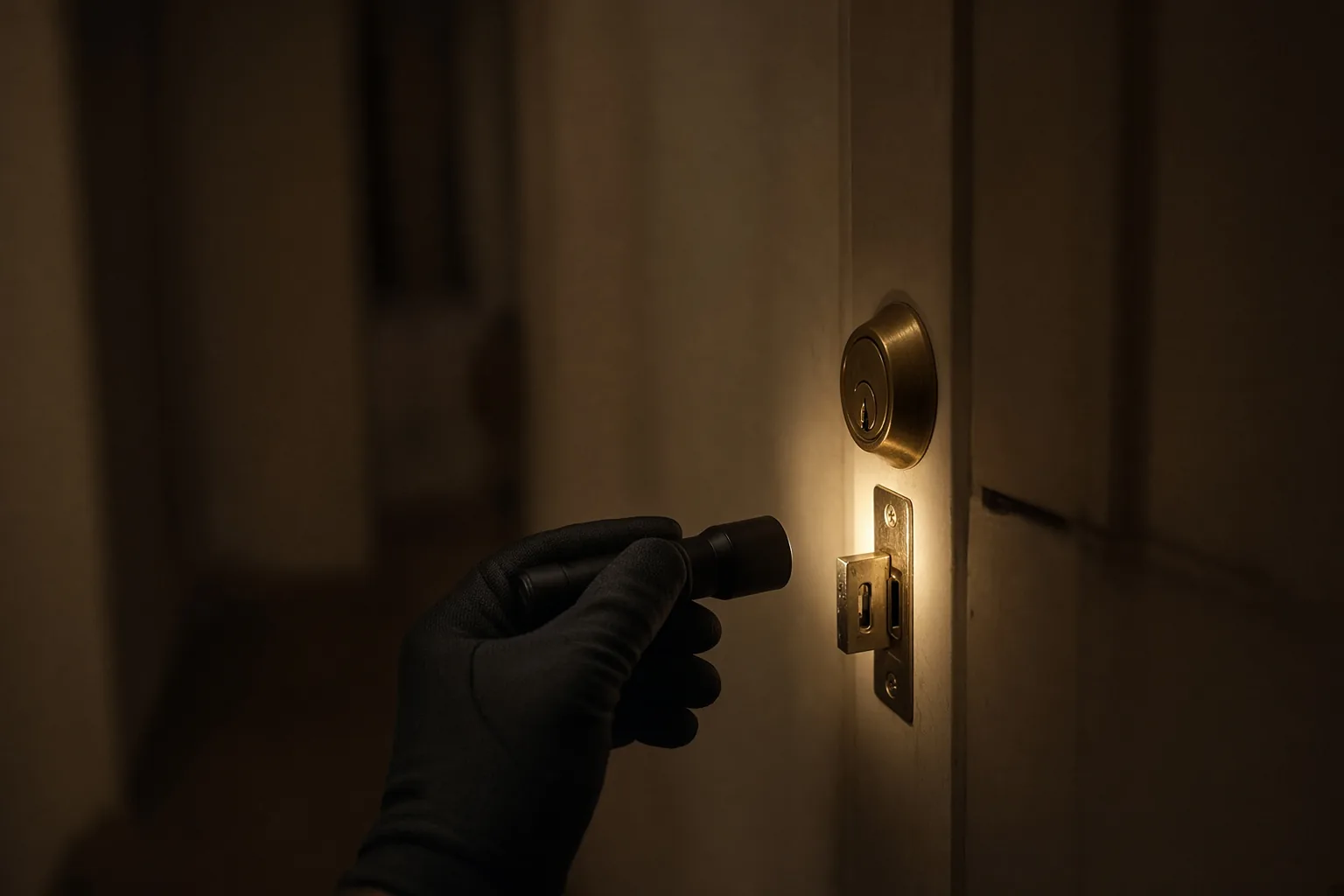
Why does "no signs of forced entry" decide a burglary claim?
Because some burglary policies define the covered loss by visible marks of force at the place of entry. Without the marks the loss falls outside burglary coverage even if a theft occurred, unless the policy also covers theft.
The policy in Markline Co. v. Travelers Insurance Co., decided by the Supreme Judicial Court of Massachusetts in 1981, defined burglary as taking property "from within the premises by a person making felonious entry therein by actual force and violence, of which force and violence there are visible marks made by tools, explosives, electricity or chemicals upon, or physical damage to, the exterior of the premises at the place of such entry." A parallel clause covered felonious exit, with marks on the interior.
The court stated the reason for such clauses: "The reason for the visible marks restriction is to protect insurers from 'inside jobs.'" It placed the burden on the insured: "It is the plaintiff's burden to prove that its loss was within the description of the risks covered." It also noted that "the plaintiff did not buy 'theft' coverage."
Policy forms differ, and the wording of each policy decides what the examiner's findings have to show. The examiner supplies the facts about the door, the lock and the window; the insurer, the court or the jury applies the policy to them.
What happened when there were no visible marks at all?
The insured lost. In Markline the burglar alarm went off, an inventory showed a $19,380 loss, but the judge found no visible marks of entry or exit, and the Supreme Judicial Court entered judgment for the insurer.
The store was closed and locked at 1 p.m. on June 15, 1974. The burglar alarm activated at 2:03 p.m., and the police and the alarm company arrived about 2:42 p.m. An inventory in early July found a loss of $19,380.
The trial judge found that "there were no visible marks of entry or exit by tools, explosives, electricity or chemicals" and no physical damage at the place of entry or exit, and still entered judgment for the store. The Supreme Judicial Court reversed: "Therefore, there could be no recovery under burglary coverage."
An alarm that sounds proves that something happened, and the absence of marks still decided the case. Where an insured expects to rely on burglary coverage, the condition of the doors and windows on the day of the loss has to be recorded before anything is repaired.
Do all courts enforce the visible marks clause the same way?
No. In Ferguson v. Phoenix Assurance (Kan. 1962) the Kansas Supreme Court treated a visible marks clause as a rule of evidence and refused to apply it where its use went beyond what was needed to prevent fraud.
The front door of a drug store in Council Grove, Kansas, was forced on the night of March 8, 1960. The safe had an outer door with a combination lock and an inner door with a key lock. The outer door was opened by manipulating the combination and showed no marks; the inner door was opened by punching out its lock and showed visible marks of force. The policy required marks on "all of said doors" if entry was made through them.
The court held that the clause "imposes a rule of evidence upon the assured to establish that entry was made" by actual force and violence. Applied to the outer door, it went "beyond the reasonable requirements necessary to prevent fraudulent claims" and was "obviously designed to defeat recovery on a just claim under the policy." The insured recovered.
Ferguson concerned a safe, Markline a building, and the two courts read their clauses differently. In both, the facts that mattered were physical: which door showed marks, what kind and where. Those are the questions a toolmark examination answers.
What does an examiner look for on a door, frame, lock and window?
Tool impressions and scrapes on the door, frame, strike plate and lock, the condition of the bolt and the cylinder, broken glass and its position, and whether each mark is consistent with the entry described in the claim.
On a door the examiner records where each mark sits: the exterior face, the edge, the frame, the strike plate. Width, depth and shape of a pry impression record the working end of the tool. The examiner compares damage to the strike and the frame with the position of the bolt, because a bolt forced out of the strike and a bolt withdrawn by a key leave different evidence.
The lock is examined separately. A forensic locksmith takes the cylinder apart and looks for marks of picking, bumping or a foreign key on the pins and the keyway. A lock opened without force leaves its evidence inside the cylinder, not on the door, so an examination limited to the exterior surfaces can miss it.
On a window the examiner records the glass that fell, where the fragments lie relative to the frame, marks on the sash and the latch, and whether the opening is large enough for the entry described. Each finding is photographed with a scale before the item is removed.
Can a burglar get in without leaving visible marks?
Yes. Ferguson involved a safe door opened by manipulating the combination with no marks, and locks can be picked or opened with a copied key. The absence of exterior marks does not show that no one entered.
The Ferguson safe is the clearest example in the case law: one door opened without any mark, the next door forced with a tool. A visible marks clause applied to the first door alone would have reported no forced entry for a burglary that undoubtedly occurred.
For buildings the same split applies to locks. An examination that ends with "no signs of forced entry" on the exterior should say whether the lock cylinder was examined internally, whether keys were accounted for and whether windows and other openings were checked. Without those steps the phrase records the limits of the examination, not the absence of an intruder.
What may the examiner conclude about a pry mark and a tool?
Under the Department of Justice uniform language, one of three conclusions: source identification, source exclusion or inconclusive. The examiner may not claim absolute certainty, a zero error rate or identification to the exclusion of all other sources.
The DOJ Uniform Language for Testimony and Reports for the Firearms/Toolmarks Discipline, Pattern Examination, effective August 16, 2023, covers toolmarks as well as firearms. "Source identification" is "an examiner's conclusion that two toolmarks originated from the same source"; "source exclusion" is the conclusion that they did not; "inconclusive" means that the observed class characteristics agree but the individual characteristics are insufficient to identify or exclude.
Section IV of the document bars the examiner from asserting that two toolmarks came from the same source "to the exclusion of all other sources," from claiming that the discipline is "infallible or have a zero error rate," and from stating a conclusion "with absolute or 100% certainty." It also bars "reasonable degree of scientific certainty" unless a judge or the applicable law requires it.
In a burglary claim the tool is often missing. Without a suspect tool the examiner can still describe the class of tool, the side from which it was applied and the sequence of damage, and the report should say which of these were determined and on what observations.
Who decides whether a break-in was staged?
The insurer, the court or the jury decides whether a claim is honest. The examiner reports physical findings: whether the marks fit the lock's condition, the reported side of entry and the time sequence of the damage.
Questions that point toward or away from staging are physical. Were the marks made from the side the claim describes? Does damage to the frame match the position of the bolt? Was the door forced while it was open or while it was locked? Were the marks made with a tool found on the premises? Each answer is a finding about the door, not about the claimant.
Under Rule 702 as amended in 2023, the party offering the examiner must show that it is more likely than not that the opinion rests on sufficient facts or data and reliable methods applied reliably to the case. An examiner who infers the claimant's honesty out of the condition of a door leaves the method behind, and the review of such a report marks that step.
What should be preserved after a reported break-in?
Photographs of every door and window before repair, the lock cylinder and keys, the strike plate and damaged pieces of the frame, broken glass in place, any tool found, the police report and the alarm records.
Repairs start quickly after a burglary, and the evidence is the damage that gets repaired. The usual list of items to keep is short.
- Photograph each door, frame, lock and window from both sides with a scale before anything is touched.
- Keep the lock cylinder and all keys; do not let a locksmith rekey the original cylinder.
- Keep the strike plate and the damaged sections of the frame or sash when they are replaced.
- Leave broken glass in place until it is photographed, then bag it by location.
- Keep any tool found at the scene without cleaning it.
- Obtain the police report, the alarm event log and the key-holder list.
What does IAE do when forced entry is disputed?
IAE prepares expert reports on the client's questions and reviews of the opposing examiner's report on whether a lock or seal was defeated, for US criminal defense and cargo loss cases, in up to 5 business days.
The questions cover whether a shoe, a tire or a tool could have left the mark, how strong the association is and whether a lock or seal was defeated. Toolmarks on lock cylinders and seals are compared with test marks made by the suspect tool, and each question is tied to the ANSI/ASB or ISO standard for that kind of mark. IAE confirms the questions with the client before work starts.
The secretariat confirms receipt the same day. IAE then confirms the format, the cost, the deadline and the specialist from its registry, and the client approves the candidate and the CV before work starts. Cases with tight deadlines have a 48-hour rush.
Every specialist is a member of the public IAE registry and can be verified by Member ID or QR code, and confirms in the document that he or she has no interest in the outcome of the case. IAE is not a law firm and does not advise on case strategy. A report is evidence that the court weighs with the rest of the record, and neither IAE nor the examiner guarantees the outcome.
Sources
- Markline Co. v. Travelers Insurance Co., 384 Mass. 139 (1981) (Justia)
- Ferguson v. Phoenix Assurance Co. of New York, 189 Kan. 459, 370 P.2d 379 (1962) (Justia)
- U.S. Department of Justice, Uniform Language for Testimony and Reports for the Firearms/Toolmarks Discipline, Pattern Examination, effective August 16, 2023
- Federal Rules of Evidence, Rule 702 (LII, Cornell Law School)
Read also
All articles
Was the window broken from inside or outside? How does a glass fracture examination answer, and how far can the answer be trusted?
After a reported burglary, a shooting or a fire, one broken pane can decide which account is true: forced entry or a staged scene, a shot fired into Sergei Voronin
Safe burglary: how does an examiner tell whether a safe was forced, drilled or opened with the combination?
An examination of a safe after a theft answers how it was opened: by force on the door or body, by drilling, or with the combination or keySergei Voronin
Physical fit examination: can a broken or torn piece be shown to come from one object?
A physical fit examination answers whether broken, torn or separated pieces were once joined together as one object. ASTM E3392-24, publishedSergei VoroninExpert examinations
Ready to discuss your case?
Send the materials: the secretariat will confirm the format, cost, deadline and the specialist within one business day.
