
Examinations
Can a shoe print show the brand, model and size of the shoe that made it?
A shoe print at a scene is often found long before any suspect or any shoe. Investigators then want two answers. Which shoe should they look for? And could the shoes they later seize have made it? The first answer is about outsole design, brand, model and size. Reference collections and manufacturers supply much of it, though not always, and a matching design does not identify one shoe.
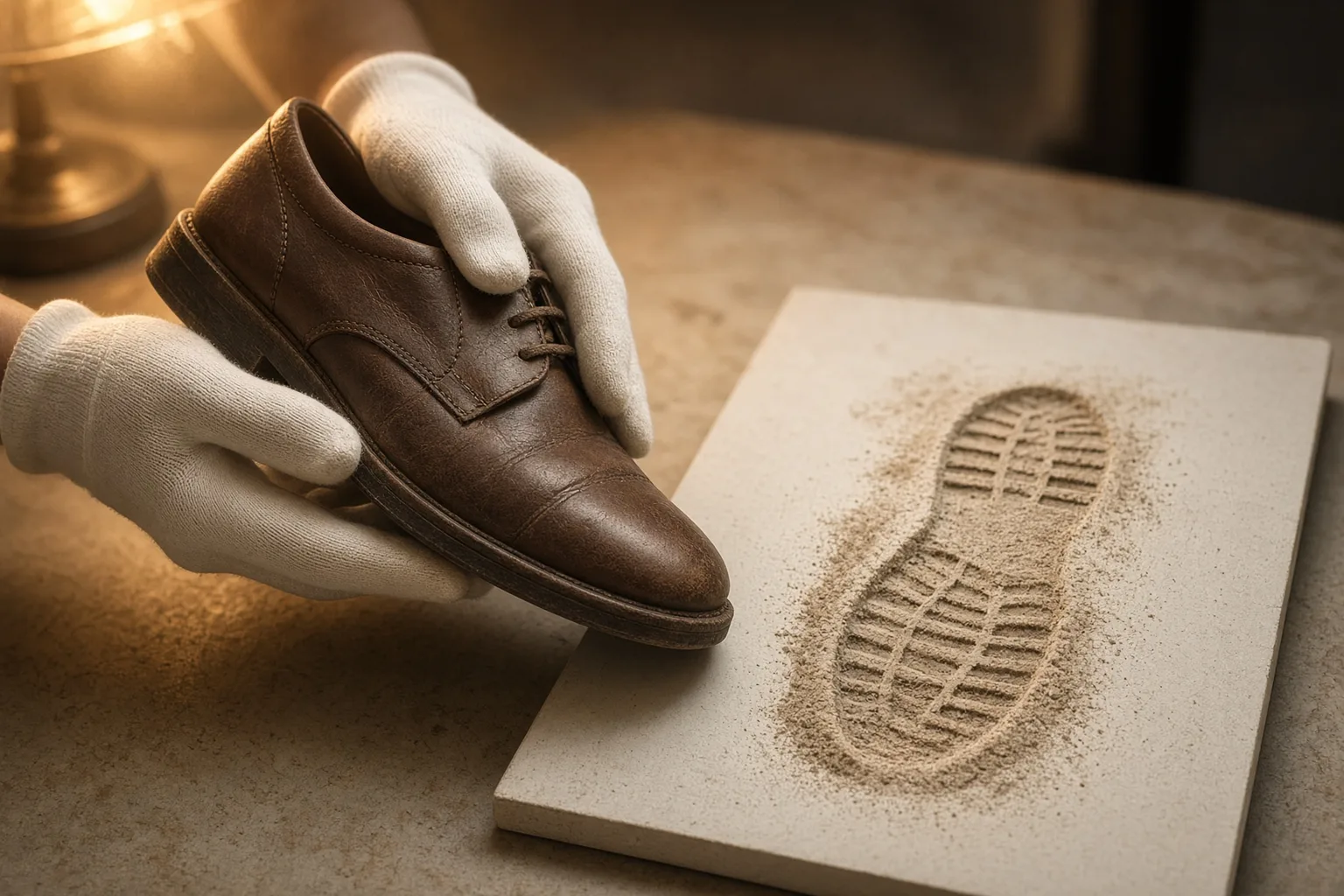
What can a shoe print show before any shoe is found?
The outsole design and its dimensions, often the make and model through reference collections, the general wear, and damage features for a later comparison. A print alone does not name the person who wore the shoe.
The guide to footwear and tire track examination published by the National Forensic Science Technology Center (NFSTC) divides what a print can carry into two groups. "Class characteristics result from the manufacturing process and are divided into general and limited." General class characteristics are standard for every item of a make and model. Limited ones vary by mold.
The second group comes from use. The guide describes individual characteristics as aspects of a particular shoe "that result from use, not the manufacturing process," and gives cuts, gouges, cracks and a stone stuck in the tread as examples.
The Guide for the Examination of Footwear and Tire Impression Evidence issued in March 2006 by SWGTREAD, the scientific working group for this field, adds the investigative step. Under section 6.8 the possible make, model or manufacturing source of the shoe "may be determined using reference materials/sources," and manufacturing, production, distribution and sizing information may be obtained "with assistance from the specific manufacturers." The guide says this information "may be useful for investigative purposes."
Which databases are used to find the brand and model of a shoe?
The FBI keeps the Footwear and Tire Tread Files, and laboratories use commercial collections such as SoleMate. In 2007 the National Institute of Justice described SoleMate as covering more than 12,000 sports, work and casual shoes.
According to the NFSTC guide, "The FBI compiles and maintains the Footwear and Tire Tread Files database," which holds manufacturers' information and earlier evidence and is used to identify the brand and model of impressions found at crime scenes.
An article by Robin Bowen and Jessica Schneider in the NIJ Journal of October 1, 2007 described two commercial products. SoleMate covered "more than 12,000 sports, work, and casual shoes" and was sold on DVD with updates every three months. TreadMark used four parameters, pattern, size, damage and wear, to identify individual outsole impressions by comparing crime-scene impressions with prints from people in custody and from other scenes.
The FBI Laboratory's later study of a national footwear database lists the products in its own use. Before the project the laboratory used SoleMate FPX and Everspry EverOS. During the project it acquired Bluestar NFD and Everspry EverASM, and Forensity and Hobbit Imaging Solutions presented their systems to the laboratory.
Can a database name the exact make and model?
Not always. Different manufacturers often use the same sole unit, and the model name is rarely molded into the outsole, so a search may return several candidate shoes for one print.
The 2007 NIJ article names the limitation in plain terms: "One limitation is that different manufacturers often use the same sole unit." As a result, the authors wrote, "it may be difficult to determine the exact make and model of a shoe." The software links related records so that "all footwear that might match a crime-scene print can be considered."
The FBI study, dated December 21, 2021 and funded by the National Institute of Justice under award 2016-DNR-5470, adds that "the model name is rarely printed on or molded into footwear." It notes that "The U.K. uses the brand name followed by a serial number" and describes naming reference records by outsole pattern as one option, with make and model, when known, included as metadata for each record.
A report that names one brand and model can therefore be checked on one point: how the examiner ruled out other shoes with the same sole unit.
Can the shoe size be read from the print?
The print gives the physical size of the outsole design, which the examiner compares with test impressions. The SWGTREAD guide sends the examiner to the manufacturer for sizing information and gives no conversion of print length into a size.
Size enters the SWGTREAD procedure as a comparison. Section 6.7.2.1 treats a print as different from the known shoe if the "specific design and/or physical size and shape of design" differ, and its note says: "If physical size is different, consider scaling, perspective and other issues."
The guide contains no table or formula for turning the length of a print into a shoe size. Section 6.8 places sizing information among the facts that may be learned from the specific manufacturers.
The FBI study lists "the make, model, and size of the footwear" among the fields researchers want in reference data. Its suggested naming of reference records rests on outsole pattern.
Does wear on the sole matter, and can it change before the shoes are seized?
Yes. The examiner compares the position and degree of general wear, and the SWGTREAD guide requires an evaluation of possible wear changes between the date of the crime and the date the shoes were recovered.
Under section 6.7.3.1, "If the position and degree of general wear are different, document, and evaluate possible wear changes" between the date of the crime and the date the shoes or tires were recovered. A pair seized months later may have worn past the state recorded in the print.
Individual characteristics come next. Under section 6.7.4.1 they "should be evaluated according to their position, size, shape, orientation and clarity," and when sufficient individual characteristics in the questioned impression correspond with features of the known shoe, "an identification can be effected."
The guide also warns that "not all individual characteristics will reproduce in every impression," so "the absence of an individual characteristic is not a basis for elimination and does not preclude identification." A cut that appears on the seized sole but not in the print does not by itself exclude the shoe.
How does the examiner compare a print with the shoes that are later seized?
Step by step under the 2006 SWGTREAD guide: suitability of the print, design, physical size and shape, general wear, then individual characteristics, with test impressions of the known shoes and documentation at each step.
The examiner first assesses the questioned print for "Quality, clarity, and comparative potential." Under section 6.5.3.1, "If no class characteristics are present discontinue these procedures and report accordingly."
The design is compared next. "If design is different, document, discontinue these procedures and report accordingly." "If design is similar, prepare test impressions and continue with these procedures." Physical size and shape of the design are then compared with the test impressions, followed by wear and individual characteristics as described above.
Section 7.1 ends the procedure with documentation: "Examinations conducted, procedures utilized, evidence photographed, and conclusions reached should be documented" and may appear in a report. A defense examiner reading the report looks for that record of each step.
What does a matching outsole design prove?
That the seized shoe belongs to the group that could have made the print. The 2009 National Academy of Sciences report, as quoted by the Justice Department, knew of no data on the variability of class or individual characteristics.
The Justice Department's supporting documentation for its proposed uniform language for footwear and tire examiners quotes the 2009 report of the National Academy of Sciences: "the committee is not aware of any data about the variability of class or individual characteristics." The same report, as quoted there, found that "there is no consensus regarding the number of individual characteristics needed to make a positive identification."
The supporting documentation states that the Department's examination process "adheres to published recommendations of" SWGTREAD and cites later studies of class correspondence, outsole wear and randomly acquired characteristics.
Research on measuring those features continues. A NIST project page dated June 24, 2025 describes work on "an end-to-end comparison workflow to support examiners in all phases of evidence evaluation," including "quantifying correspondence of wear regions or randomly acquired characteristics (RACs)," to be evaluated on footwear comparisons used by the FBI.
Can prints from different scenes be linked before a suspect is known?
Yes, by comparing outsole designs across scenes. The FBI's 2021 feasibility study found footwear intelligence underused in the United States and recommended regional programs before any national system.
The study states: "Footwear information is a valuable source of intelligence that is underutilized in the U.S." Its authors concluded that "the U.S. is not ready for a national footwear system" and that "it would be neither feasible nor fiscally responsible to implement a U.S. NFD system now." They cite the lack of local and regional programs, standard practices and a business case, and call for a privacy impact assessment and further legal analysis.
The recommendations are a national expert board, federal grants for regional footwear intelligence programs and regional pilots. The report cites a Swiss study in which regional data raised the share of footwear-generated links to 49 percent, up from 19 percent.
A link of this kind connects scenes by shoe design. It names neither the shoe nor its owner until shoes are seized and compared.
What must be shown before a footwear opinion reaches a federal jury?
Under Rule 702, the proponent must show that it is more likely than not that the opinion rests on sufficient facts or data and that reliable methods were reliably applied to the case.
The 2023 committee note to Federal Rule of Evidence 702 says that rulings treating "the critical questions of the sufficiency of an expert's basis, and the application of the expert's methodology" as questions of weight "are an incorrect application of Rules 702 and 104(a)." It adds that forensic experts should avoid assertions of absolute or one hundred percent certainty if the method is subjective and potentially subject to error, and that the judge should, where possible, receive an estimate of the method's known or potential rate of error.
For a print linked to a brand and model, the basis includes the reference collection searched, the date of its data and the candidates found. For a print linked to a seized shoe, it includes the test impressions and the record of wear between the crime and the seizure.
In federal criminal cases Rule 16(a)(1)(E) lets the defense inspect items such as seized shoes and lifts if they are material to preparing the defense or intended for use at trial. Rule 16(a)(1)(F) covers reports of scientific tests, and Rule 16(a)(1)(G) requires a signed disclosure of each government expert's opinions, bases and reasons, with qualifications and a list of cases with testimony in the previous 4 years.
Which questions can be put to a footwear examiner when no shoe has been seized yet?
What outsole design the print shows, which makes and models carry it, what size range the dimensions fit, what wear and damage are visible, and whether prints from different places share a design.
Each question has its source in the guides above. Design and dimensions come from the print. Candidate makes and models come from reference collections, with a note on shoes that share the sole unit. Sizing comes from the manufacturer. Wear and damage are recorded for a later comparison.
When shoes are seized, the questions change. Could these shoes have made the print? Which features agree and which differ? How much time passed between the event and the seizure, and what wear could that time explain?
The request lists every print with its photographs and scale, every lift or cast, and the date and place each was made.
What does IAE do when a shoe print is part of a case?
IAE prepares an expert report on the client's questions, or a review of the opposing examiner's report, on whether a shoe could have left the mark and how strong the association is, in up to 5 business days.
The IAE trace evidence page describes work for criminal defense and cargo loss cases in US courts on whether a shoe, a tire or a tool could have left the mark, how strong the association is, and whether a lock or seal was defeated. For footwear the page cites ANSI/ASB Standard 137 (2023): the examiner documents the class characteristics and characteristics of use of the questioned print before examining the known shoe. IAE confirms the questions with the client before work starts.
The client sends the report or the case materials and describes the task. The secretariat confirms receipt the same day, and within one business day IAE confirms the format, the cost, the deadline and the specialist from its registry. The client approves the candidate and the CV before work starts. The signed PDF is issued in up to 5 business days, and cases with tight deadlines have a 48-hour rush.
Every specialist is a member of the public IAE registry, can be verified by Member ID or QR code and confirms in the document that he or she has no interest in the outcome. Materials are not passed to third parties without the client's consent. IAE is not a law firm and does not advise on case strategy. A report is evidence that the court weighs with the other materials, and neither IAE nor the specialist guarantees the outcome.
Sources
- NFSTC, A Simplified Guide to Footwear and Tire Track Examination: Principles (2013)
- Bowen R., Schneider J. Forensic Databases: Paint, Shoe Prints, and Beyond. NIJ Journal, October 1, 2007 (National Institute of Justice)
- McVicker B. C., McGurk J. F., Shaw S. D. U.S. National Footwear Database System Feasibility Study, FBI Laboratory Division, December 21, 2021, NIJ award 2016-DNR-5470, NCJ 304048
- SWGTREAD, Guide for the Examination of Footwear and Tire Impression Evidence (03/2006)
- U.S. Department of Justice, Supporting Documentation for Department of Justice Proposed Uniform Language for Testimony and Reports for the Forensic Footwear and Tire Impression Discipline
- NIST, Building Trust in Forensic Science: Footwear Analysis (project page, June 24, 2025)
- Federal Rule of Evidence 702 and committee notes (LII, Cornell Law School)
- Federal Rules of Criminal Procedure, Rule 16, Discovery and Inspection (LII, Cornell Law School)
Read also
All articles
Cut padlock or chain: can an examiner match the cut to a pair of bolt cutters?
A cut padlock or chain is often the only physical trace of a theft from a shed, a storage unit or a bike rack. When bolt cutters later turn up Sergei Voronin
Was the window broken from inside or outside? How does a glass fracture examination answer, and how far can the answer be trusted?
After a reported burglary, a shooting or a fire, one broken pane can decide which account is true: forced entry or a staged scene, a shot fired intoSergei Voronin
No signs of forced entry: how is a door, lock or window examined after a reported burglary?
Some commercial burglary policies pay only for entry by force that leaves visible marks, and police reports often carry the line "no signs of forcedSergei VoroninExpert examinations
Ready to discuss your case?
Send the materials: the secretariat will confirm the format, cost, deadline and the specialist within one business day.
