
Examinations
Was the window broken from inside or outside? How does a glass fracture examination answer, and how far can the answer be trusted?
After a reported burglary, a shooting or a fire, one broken pane can decide which account is true: forced entry or a staged scene, a shot fired into the house or out of it. The edges of the fragments record the side the force came from. The method dates to the 1890s and is simple to state. A 2006 literature search found no published study of its reliability. A report on a broken window has to deal with both facts.
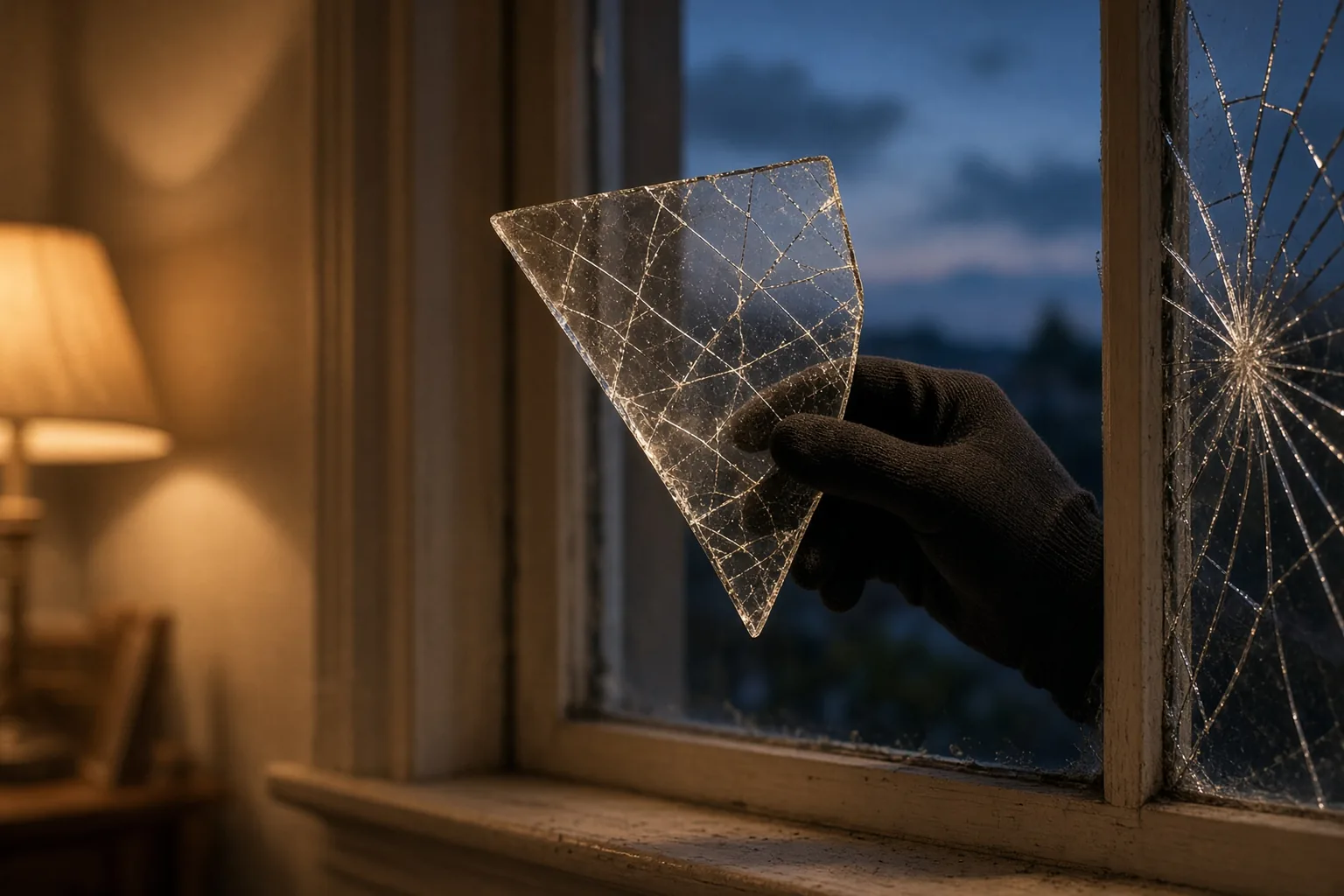
Can an examiner tell which side a window was broken from?
Often yes, if the fragments can be oriented. The examiner reads the curved marks on the broken edges of the cracks around the point of impact and applies a rule first described by Hans Gross in the 1890s.
A study by Joseph A. Keierleber presented at the 2006 annual meeting of the American Academy of Forensic Sciences (abstract D20) summarizes the history. In the 1890s Gross described how to tell which side of a pane a penetrating bullet had struck, and in 1930 the Ukrainian researcher S. N. Matwejeff expanded on his work. A blow to a pane produces two families of cracks. Radial cracks run outward from the point of impact. Concentric cracks connect them in a rough circle around it.
The information is on the edges. The edge surfaces of the fractures often show curved lines, or arcs. At one end each arc meets a face of the glass at close to a right angle, and at the other end it meets the opposite face at a very oblique angle. The examiner records which face the right angles meet and on which kind of crack.
A 2013 presentation to the same academy by Craig L. Heummer, Nicholas Petraco, Mary Eng and Nicholas D. Petraco lists where the question arises. In a burglary the issue is whether a window was broken or cut from inside or outside the premises. In an arson case it matters whether the windows were broken by thermal radiation, a projectile or another physical force. In a shooting the questions are which bullet hole was made first and whether a hole was made from outside in or inside out. The fourth setting is a leaving-the-scene investigation with a fractured windshield.
How does the 3R rule work?
On a radial crack the arcs form right angles on the rear face, the side opposite the impact. On a concentric crack the right angles are on the side that was struck. The three words are right, rear and radial.
The examiner first decides whether a fracture is radial or concentric and then finds the arcs on its edge. The face they meet squarely is the rear. The force came through the other face.
A concentric edge of the same fragment gives a second reading that should point the opposite way: right angles on the struck side. Two readings that disagree are a reason to stop and check which crack is which.
The two abstracts name the rule differently. The 2006 abstract calls it the 3-R Rule and states it as "Radial cracks have Right angles on the Reverse side of the force." The 2013 abstract refers to the "right, rear, radial rule" and devotes part of the presentation to common pitfalls in applying it. Its authors write that "the nomenclature used for fracture marks is often confusing" and offer terms from the fractography of brittle materials such as glasses and ceramics: rib marks, hackle marks, radial lines and concentric lines.
What must be known about each fragment before the rule is applied?
Which face was inside and which was outside. Without that the rule gives a direction relative to the fragment and says nothing about the building. Orientation comes from reassembly or from dirt and paint on the faces.
The 2006 abstract states the condition plainly: the examiner must know which way each fragment faced before the glass broke. That can be determined by reassembling the pieces or by comparing dirt or paint on the fragments with the glass left in the frame.
An article by Kathy Steck-Flynn in Law Enforcement Technology (March 2005), abstracted in the Justice Department's NCJRS library, describes the same sequence for a shattered pane. Investigators first identify the inside and the outside of the frame. They then match loose fragments to the pieces still in the frame, find the point of impact and determine the side the glass was broken from.
The pieces held by the frame are therefore the reference for everything else. Once they are pulled out unmarked, or the window is cleaned or reglazed, loose fragments can be read for direction but can no longer be tied to the inside or the outside of the room.
How reliable is the method?
Less tested than its age suggests. The 2006 study found no published reliability studies and reported that briefly trained volunteers judged the struck side correctly in 80.9 percent of evaluations on ten test windows.
Keierleber searched the literature and found no published study of the technique's reliability. Matwejeff's paper, he wrote, reveals little about the test conditions and does not state whether the windows were examined blind. A 1936 FBI bulletin reported confirming Matwejeff's findings on more than 200 panes and said nothing about the conditions of the examination.
His own experiment used ten identical wood-framed windows. Each was struck on side A or side B, chosen at random, by a pendulum at a measured force. Twenty-two volunteers received a brief tutorial and examined the broken windows without knowing the answer. They averaged 8.1 correct out of 10, with a standard deviation of 2.18 and a median of 9.0, a result the abstract reports as significantly above chance. Nine of the 22 identified all ten windows correctly. In total 178 of 220 evaluations were correct. Confidence correlated with accuracy (r=0.69).
The author called the study preliminary and recommended a control group with no familiarity with the technique, to rule out other sources of information about the direction of impact.
Three limits follow directly. The examiners were volunteers, so the figure is not an error rate for trained examiners. The panes were framed windows struck by a pendulum, so the figure says nothing about bullets, thrown objects or heat. And roughly one evaluation in five was wrong under clean laboratory conditions with every fragment available.
What else can a fracture pattern show?
The point of impact, the order of several impacts, the angle of a projectile and whether a pane broke by heat or by a blow. The 2005 article and the 2013 abstract name these uses; each needs its own support.
The NCJRS abstract of the 2005 article says that when a projectile penetrates glass, the fracture pattern can show the direction it came from, the order of fractures and the angle of impact. The 2013 abstract adds thermal versus projectile breakage in arson cases and windshield fractures in vehicle accidents.
Neither source gives accuracy figures for those uses. A report that states the order of two shots or the angle of a thrown object should say on what testing the statement rests.
A different examination answers a different question. Whether a fragment found on clothing could have come from this window is a source comparison of the glass itself. The Department of Justice document discussed in the next section covers such comparisons: macroscopic and microscopic characteristics, refractive index and elemental composition.
How may the examiner state the conclusion in court?
Without claims of certainty. The 2023 committee note to Rule 702 says forensic experts should avoid assertions of absolute or one hundred percent certainty where the method is subjective and potentially subject to error.
Under Federal Rule of Evidence 702 the proponent must show that it is more likely than not that the testimony is based on sufficient facts or data and is the product of reliable principles and methods reliably applied to the facts of the case. The committee note adds that the judge should, where possible, receive an estimate of the known or potential rate of error of the method. The 2006 experiment supplies one such figure for direction of force, with the limits already described.
The Justice Department's Uniform Language for Testimony and Reports for the Forensic Glass Discipline, effective May 8, 2024, defines four conclusions for comparing fragments: physical fit, inclusion, exclusion and inconclusive. Its examiners may not call glass examinations infallible or claim a zero error rate, may not cite the number of examinations performed in a career as a measure of accuracy, and may not use "absolute certainty," "100% certainty" or "reasonable scientific certainty" unless a judge or applicable law requires it.
That document does not mention fracture patterns, direction of force or sequence of impacts. For an opinion on the side of the break it supplies no wording. The report has to define its own terms, show the fragments and edges it relied on and state how they were oriented.
In a federal criminal case the defense can obtain the basis of such an opinion before trial. Under Rule 16(a)(1)(G) the government, at the defendant's request, must disclose in writing a complete statement of all opinions it will elicit in its case-in-chief, the bases and reasons for them, the witness's qualifications with publications of the previous 10 years and a list of cases in which the witness testified as an expert in the previous 4 years. Rule 16(a)(1)(F) covers the results or reports of any scientific test or experiment.
In which cases does the side of the break decide something?
Reported burglaries where a staged break-in is suspected, shootings through windows, fires and leaving-the-scene investigations. In each, the side the force came from separates two accounts of the same broken pane.
The burglary case is the plainest. A pane broken by an intruder standing outside and a pane broken by someone inside the room to imitate an entry carry opposite readings on their radial cracks. The same reading matters to the defense when the charge depends on entry through a particular window.
In a shooting the question is whether the shot was fired into the room or out of it, and, with several holes, in what order. In a fire the question is whether the glass failed in the heat or was broken first. The 2013 abstract lists all of these as casework applications.
What should be preserved when a broken window may become evidence?
Photographs of the pane in its frame taken on both sides, every piece still in the frame marked inside and outside before removal, the loose fragments on both sides of the wall, and the frame, all before cleaning or repair.
Each item on that list serves orientation. Reassembly needs as many fragments as can be collected. Dirt and paint on the faces are compared with the glass left in the frame, so the faces must not be washed. The place where each group of fragments lay should be recorded with the photographs.
Any object that may have broken the glass belongs with the fragments. Once the window is reglazed, the examiner has only the photographs and the fragments that were kept.
What does IAE do when a broken window is part of a forced-entry dispute?
IAE prepares expert reports on the client's questions and reviews of the opposing examiner's report on marks left by shoes, tires and tools and on whether a lock or seal was defeated, in up to 5 business days.
The trace evidence page describes the questions: whether a shoe, a tire or a tool could have left the mark, how strong the association is and whether a lock or seal was defeated, for criminal defense and cargo loss cases in US courts. Each question is tied to the ANSI/ASB or ISO standard for that kind of mark. IAE confirms the questions with the client before work starts.
The client sends the report or the case materials and describes the task. The secretariat confirms receipt the same day. IAE then confirms the format, the cost, the deadline and the specialist from its registry, and the client approves the candidate and the CV before work starts. Cases with tight deadlines have a 48-hour rush.
Every specialist is a member of the public IAE registry and can be verified by Member ID or QR code, and confirms in the document that he or she has no interest in the outcome of the case. IAE is not a law firm and does not advise on case strategy. A report is evidence that the court weighs with the other materials, and neither IAE nor the examiner guarantees the outcome.
Sources
- Keierleber J. A. Broken Windows: Evaluating the Reliability of a Crime Scene Reconstruction Technique. AAFS 2006 Annual Meeting, abstract D20
- Heummer C. L., Petraco N., Eng M., Petraco N. D. Revisiting Glass Fracture Examination and Interpretation in Forensic Casework. AAFS 2013 Annual Meeting, abstract A142
- Steck-Flynn K. Through the Looking Glass: Interpretation, Collection and Preservation of Glass Fragments. Law Enforcement Technology, March 2005, abstract NCJ 209508 (Office of Justice Programs)
- U.S. Department of Justice, Uniform Language for Testimony and Reports for the Forensic Glass Discipline, effective May 8, 2024
- Federal Rule of Evidence 702 and committee notes (LII, Cornell Law School)
- Federal Rules of Criminal Procedure, Rule 16, Discovery and Inspection (LII, Cornell Law School)
Read also
All articles
No signs of forced entry: how is a door, lock or window examined after a reported burglary?
Some commercial burglary policies pay only for entry by force that leaves visible marks, and police reports often carry the line "no signs of forced Sergei Voronin
Safe burglary: how does an examiner tell whether a safe was forced, drilled or opened with the combination?
An examination of a safe after a theft answers how it was opened: by force on the door or body, by drilling, or with the combination or keySergei Voronin
Physical fit examination: can a broken or torn piece be shown to come from one object?
A physical fit examination answers whether broken, torn or separated pieces were once joined together as one object. ASTM E3392-24, publishedSergei VoroninExpert examinations
Ready to discuss your case?
Send the materials: the secretariat will confirm the format, cost, deadline and the specialist within one business day.
