
Examinations
Brake failure or driver error? How an expert examines a vehicle's mechanical condition after a crash
When a driver blames a crash on brake failure, the vehicle decides the question. In New York, a driver who rear-ends another car and blames the brakes must show that the failure was unanticipated and that reasonable care was exercised to keep the brakes in good working order, the Appellate Division, Second Department, held in April 2026. An engineer tests both points: what failed, when it failed, and what the maintenance records show.
What must a driver prove when blaming a crash on brake failure?
In New York, that the brake failure was unanticipated and that reasonable care was exercised to keep the brakes in good working order. Without evidence on both points, the brake failure explanation does not raise a triable issue.
The Appellate Division, Second Department, restated the rule in Wesa v Consolidated Bus Tr., Inc., 2026 NY Slip Op 02690, decided April 29, 2026. The plaintiff, Adel Wesa, sued for injuries after the defendants' vehicle struck his vehicle from behind. He moved for summary judgment on liability before discovery, with an affidavit that his vehicle had been stopped for about 10 seconds at a red light when it was struck. The Supreme Court, Kings County, denied the motion without prejudice to renew in an order dated June 26, 2024.
The Second Department reversed. A rear-end collision with a stopped or stopping vehicle establishes a prima facie case of negligence against the operator of the rear vehicle, who must then provide a nonnegligent explanation; the court cited Maurice v Donovan, 235 AD3d 633 (2025). Where the defendants lay the blame on brake failure, the court wrote, it is incumbent on them to show that the failure was unanticipated and that reasonable care was exercised to keep the brakes in good working order, citing Ballatore v HUB Truck Rental Corp., 83 AD3d 978 (2011), and Reid v Rayamajhi, 17 AD3d 557 (2005).
The defendants did not raise a triable issue of fact on either point. The court granted summary judgment on liability, dismissed the comparative negligence defenses, and held that the motion was not premature under CPLR 3212(f). For the defense, the lesson in Wesa is about evidence: a statement that the brakes failed, without an inspection and without maintenance records, did not create a fact question.
Why does the vehicle have to be kept unrepaired?
Because the answer is in the brake parts. Once the vehicle is repaired, scrapped or sold at salvage, the engineer cannot test the components, and the other side cannot check the result.
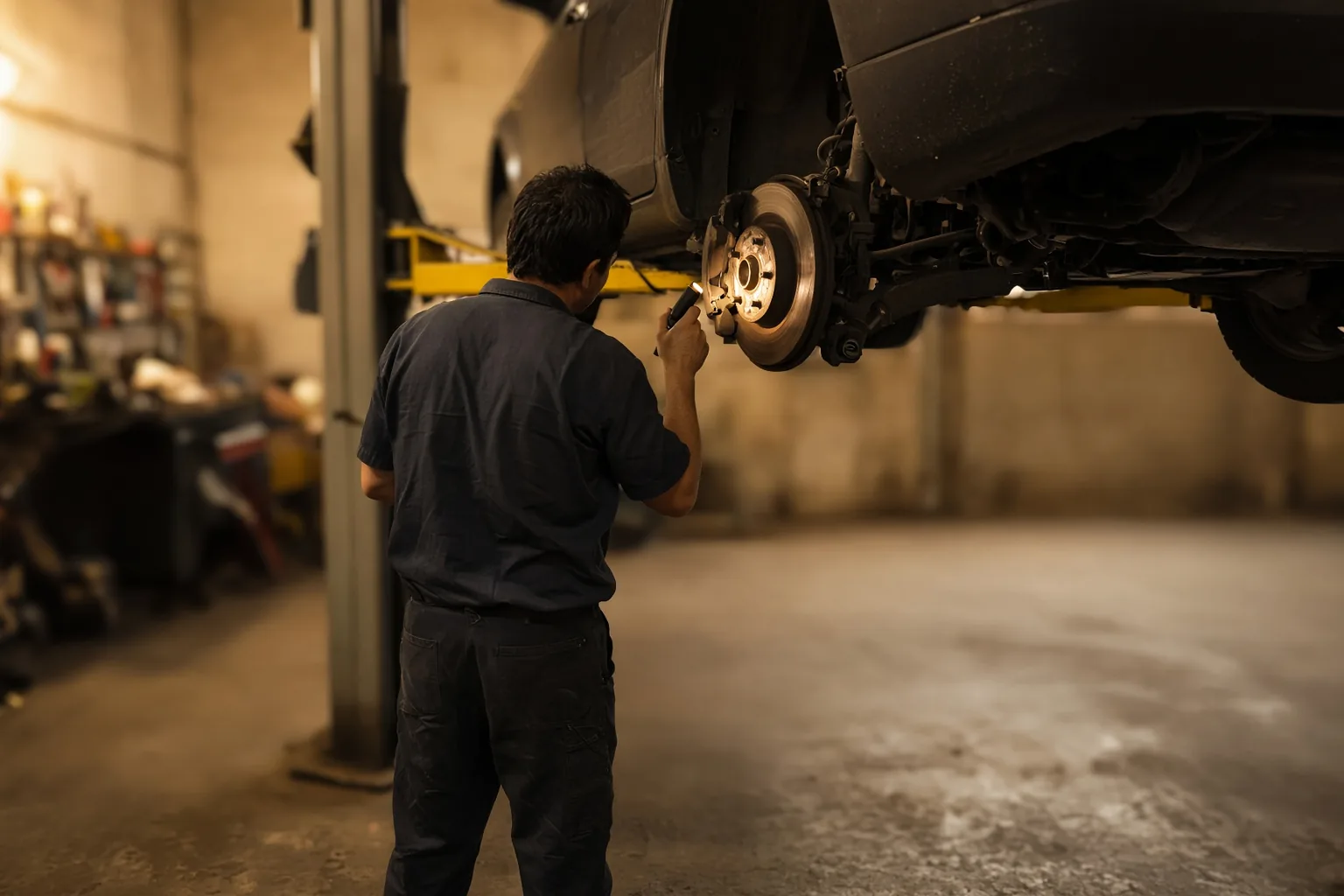
A brake failure opinion rests on physical findings: the condition of the hoses and lines, fluid level and leaks, pad and shoe thickness, drums and rotors, and the state of any warning lamps and stored fault codes. Each of these can change when the vehicle is towed, stored outside, repaired or crushed. The first step for counsel on either side is a written request to hold the vehicle as it is.
In federal court the other side's vehicle can be inspected under Rule 34 of the Federal Rules of Civil Procedure. A party may serve a request to produce and permit the requesting party or its representative to inspect, copy, test or sample designated tangible things in the responding party's possession, custody or control. The request must specify a reasonable time, place and manner for the inspection and the related acts, and the responding party must answer in writing within 30 days after being served.
Vehicles often end up with a towing company, a storage yard or an insurer's salvage vendor. Rule 34(c) provides that, under Rule 45, a nonparty may be compelled to produce documents and tangible things or to permit an inspection. A protocol agreed in advance lists who attends, what may be removed, whether fluids are sampled, and how the inspection is photographed, so that both sides' engineers work from the same record.
Which brake components does the engineer inspect?
The whole brake system: service and parking brakes, drums or rotors, hoses and tubing, the hydraulic, air or vacuum system, warning devices, the antilock brake system and adjusters. Federal inspection standards for commercial vehicles list these items.
Appendix A to Part 396 of the Federal Motor Carrier Safety Regulations sets the minimum periodic inspection standards for commercial motor vehicles. Its first item, the brake system, lists thirteen components: service brakes; the parking brake system; brake drums or rotors; brake hose; brake tubing; the low pressure warning device; the tractor protection valve; the air compressor; electric brakes; hydraulic brakes, including power assist and engine drive hydraulic boosters; vacuum systems; the antilock brake system; and automatic brake adjusters.
A passenger car has fewer of these parts, but the sequence of the examination is the same. The engineer records the vehicle as found, checks the fluid and looks for leaks along the lines, inspects each hose and line for cracks, chafing and kinks, measures friction material, examines the drums or rotors, and checks the parking brake. Where the car has an antilock system, the engineer reads the stored codes before anything is disconnected.
Testing follows inspection. Depending on the condition of the vehicle after the crash, the engineer may test the pedal and the hydraulic circuit, or remove and examine individual parts. Each step is photographed so that the other side's engineer can review it.
How does the engineer tell a failure before the crash from damage caused by the crash?
By the kind of damage and its age. Corrosion, wear and old fluid traces point to a condition that existed before impact. Fresh breaks at points of crush, with clean fracture surfaces, point to damage caused by the collision.
A collision can cut a brake line, crush a caliper or rupture a hose. A defense engineer who finds a broken line has to establish whether it broke before the driver pressed the pedal or when the front of the car folded. The location of the break relative to the crush zone, the condition of the fracture surfaces and any fluid trail on the road surface before the point of impact are the evidence for that.
Wear tells a slower story. Friction material worn to the backing plate, scored rotors, corroded lines and seized adjusters develop over months. Such findings support a failure that existed before the crash, but they also cut against the second element in Wesa: a condition that developed over time is the kind that reasonable maintenance would have found.
The engineer also checks whether the claimed failure fits the crash. A driver who reports no brakes at all leaves no tire marks from braking; a driver whose brakes were weak but working may leave marks that are shorter or uneven. Scene photographs, the police diagram and witness accounts are compared with the mechanical findings.
Which maintenance records show reasonable care?
Inspection, repair and maintenance records, daily driver inspection reports and periodic inspection reports. Federal rules require motor carriers to keep each of these, for 1 year, 3 months and 14 months respectively.
For commercial vehicles the Federal Motor Carrier Safety Regulations set out the records. Under 49 CFR 396.3(a), every motor carrier must systematically inspect, repair and maintain all motor vehicles subject to its control, and parts and accessories must be in safe and proper operating condition at all times. Under 396.3(b) the carrier keeps, for each vehicle controlled for 30 consecutive days, the vehicle's identification, a means to indicate the nature and due date of the various inspection and maintenance operations, and a record of inspection, repairs and maintenance indicating their date and nature. Under 396.3(c) these records are retained where the vehicle is housed or maintained for 1 year and for 6 months after the vehicle leaves the carrier's control.
Under 49 CFR 396.11 the driver prepares a written inspection report at the completion of each day's work on each vehicle, covering at least the service brakes including trailer brake connections, the parking brake, steering, lights, tires, horn, wipers, mirrors, coupling devices, wheels and rims, and emergency equipment. Under 396.11(a)(2)(i) a driver who discovers no defect or deficiency, and to whom none is reported, is not required to prepare the report. The carrier keeps each report for three months from the date it was prepared. Under 396.13 the driver must be satisfied that the vehicle is in safe operating condition before driving, must review the last report where one was required, and must sign it.
Under 49 CFR 396.17 a commercial motor vehicle may not be operated unless each component in Appendix A passed an inspection at least once during the preceding 12 months. Under 396.21 the periodic inspection report identifies the inspector, the date, the vehicle and the components inspected, and is kept for 14 months. For a private passenger car there is no such set; the engineer works from service invoices, dealer records and the owner's account.
When should the maintenance records be requested?
Before the retention periods run. A daily driver inspection report may be kept only three months, so a preservation letter sent in the first weeks after the crash protects the records the engineer needs.
The retention periods in Part 396 are minimums. A carrier that follows them strictly may discard a daily inspection report three months after it was prepared and an annual inspection report after 14 months. A crash claim filed close to the statute of limitations can find the daily reports gone, and a day on which the driver found no defect may have no report at all.
A preservation letter names the vehicle, the date of the crash and the categories of records: inspection, repair and maintenance records under 396.3, driver vehicle inspection reports under 396.11, periodic inspection reports under 396.21, repair orders and parts invoices for the brake system, and any fault code or telematics data. The same letter asks that the vehicle be held unrepaired.
For a private car, the records sit with the owner and the repair shops. Shop invoices list the work done and the parts installed; the engineer compares them with the parts found on the car. A brake job billed a month before the crash and pads found worn to the metal is a discrepancy that both sides will want explained.
Can the other side challenge the expert's opinion on brake failure?
Yes. Under Rule 702 the proponent must show that the opinion rests on sufficient facts or data and on reliable methods reliably applied. An opinion without an inspection or without records is open to that challenge.
Federal Rule of Evidence 702 admits expert testimony if the proponent shows the court that it is more likely than not that the expert's knowledge will help the trier of fact, that the testimony is based on sufficient facts or data, that it is the product of reliable principles and methods, and that the opinion applies the principles and methods reliably to the facts of the case.
The committee note to the 2023 amendment states that some challenges raise matters of weight rather than admissibility, and that once the court finds the requirements met, any attack by the opponent goes only to the weight of the evidence. A brake opinion based on a documented inspection, photographs and records can still be attacked for its conclusions. A brake opinion based on the driver's description alone faces the first question: what facts or data support it.
State courts apply their own evidence rules. Wesa shows the practical effect in New York: on a summary judgment motion, the court asks whether the defense has evidence of an unanticipated failure and of reasonable care, and an affidavit from an engineer who examined the brakes is the kind of evidence the defendants in Wesa did not have.
What does IAE do when brake failure is disputed?
IAE prepares an expert report on the client's questions about the crash and the vehicle, or a review of the opposing expert's report, in up to 5 business days, with a 48-hour rush for tight deadlines.
The IAE accident reconstruction service answers how the vehicles moved before impact, what the event data recorder shows about speed and braking, and whether the damage on each car fits the claimed crash, for injury and property damage cases in US courts. Where a vehicle has a recorder, the engineer checks the download against the scene evidence. For the other side's vehicle the engineer lists for counsel what needs to be measured and downloaded at an inspection under Rule 34. IAE confirms the questions with the client before work starts.
The client sends the report or the case materials and describes the task. The secretariat confirms receipt the same day. Within one business day IAE confirms the format, the cost, the deadline and the specialist from its registry, and the client approves the candidate and the CV before work starts. The draft is checked for facts, and the signed PDF is issued in up to 5 business days.
Every specialist is a member of the public IAE registry and passed the council's attestation under the published Criteria Matrix; the Member ID in the document can be checked by QR code. The specialist confirms in the document that he or she has no interest in the outcome. Neither IAE nor the engineer guarantees the outcome, and IAE is not a law firm.
Sources
- Wesa v Consolidated Bus Tr., Inc., 2026 NY Slip Op 02690 (App. Div. 2d Dept., April 29, 2026)
- 49 CFR 396.3, Inspection, repair, and maintenance (eCFR)
- 49 CFR Part 396, sections 396.11, 396.13, 396.17, 396.21 and Appendix A (eCFR)
- Federal Rules of Civil Procedure, Rule 34 (LII, Cornell Law School)
- Federal Rules of Evidence, Rule 702, with committee notes (LII, Cornell Law School)
Read also
All articles

Sideswipe or lane-change crash: how does an expert establish which vehicle left its lane?
Two cars travelling in the same direction touch sides, and each driver says the other drifted over. Traffic codes put the duty on the driver who Sergei Voronin

Motorcycle accident reconstruction: how does the expert find speed, position and visibility without a car's data recorder?
In 2024, 6,228 motorcyclists were killed on US roads, 16 percent of all traffic deaths, according to NHTSA. Many of these crashes turn on threeSergei Voronin
Who ran the red light? How does an accident reconstructionist analyze signal timing?
When two drivers each say the light was green, the answer comes from timing: when each signal phase changed, where each vehicle was at that momentSergei VoroninExpert examinations
Ready to discuss your case?
Send the materials: the secretariat will confirm the format, cost, deadline and the specialist within one business day.
