
Examinations
Can an expert witness testify remotely?
Federal courts take trial testimony in open court and let an expert testify from another place only for good cause in compelling circumstances and with appropriate safeguards (Rule 43(a)). Judges have refused remote testimony when the expert's problem was inconvenience known more than a month before trial and allowed it when COVID-19 reached a law firm in the middle of a trial. The Civil Rules Advisory Committee is studying whether to drop the compelling circumstances requirement.
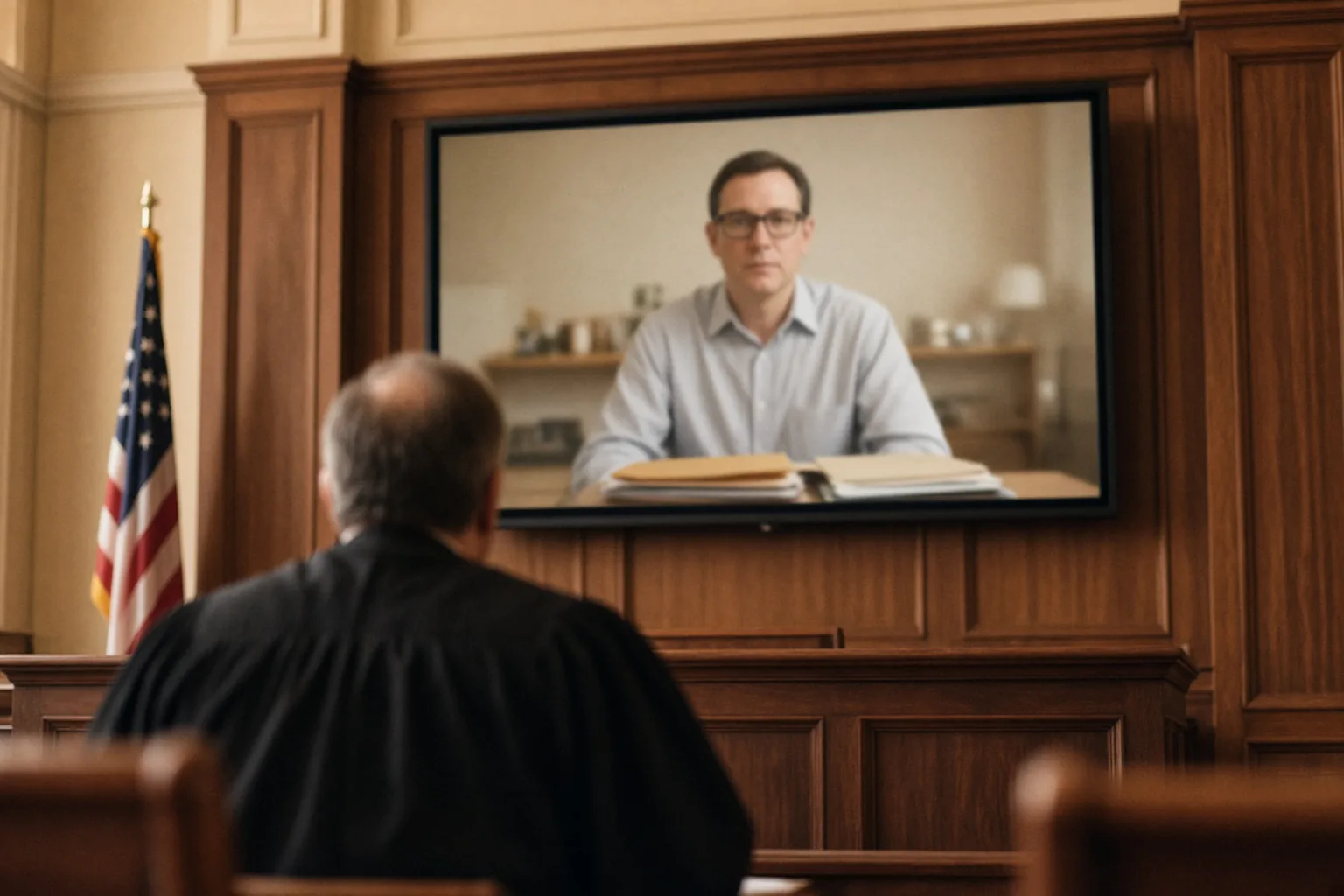
Can an expert witness testify remotely at a federal civil trial?
Yes, with the court's permission. Rule 43(a) requires testimony in open court and lets the judge permit contemporaneous transmission from another location for good cause in compelling circumstances and with appropriate safeguards.
Rule 43(a) of the Federal Rules of Civil Procedure starts with the default: "At trial, the witnesses' testimony must be taken in open court unless a federal statute, the Federal Rules of Evidence, these rules, or other rules adopted by the Supreme Court provide otherwise." The second sentence is the exception: "For good cause in compelling circumstances and with appropriate safeguards, the court may permit testimony in open court by contemporaneous transmission from a different location."
The rule draws no line between fact witnesses and experts. A retained expert who lives across the country meets the same test as an eyewitness. The transmission sentence was added in 1996, and the Advisory Committee wrote in its note: "The importance of presenting live testimony in court cannot be forgotten." The 2007 amendment restyled the rule, and its note says the changes were "intended to be stylistic only."
Motion hearings follow a different paragraph. Under Rule 43(c), when a motion relies on facts outside the record, "the court may hear the matter on affidavits or may hear it wholly or partly on oral testimony or on depositions." The open court requirement in Rule 43(a) is written for testimony "at trial".
A party that wants its expert to appear by video asks the court by motion, and the other side may oppose it. In Graham v. Dhar, described below, the defendants filed the motion and the plaintiff opposed.
What counts as good cause in compelling circumstances?
An unexpected event that keeps the expert from traveling, such as an accident or illness, while the expert can still testify from elsewhere. Inconvenience is not enough, and a problem the party could foresee is hard to call compelling.
The 1996 Advisory Committee Note sets the test. Contemporaneous transmission "is permitted only on showing good cause in compelling circumstances," and "Transmission cannot be justified merely by showing that it is inconvenient for the witness to attend the trial."
According to the Note, the strongest showings of good cause and compelling circumstances "are likely to arise when a witness is unable to attend trial for unexpected reasons, such as accident or illness, but remains able to testify from a different place." It also names the weakest: "A party who could reasonably foresee the circumstances offered to justify transmission of testimony will have special difficulty in showing good cause and the compelling nature of the circumstances."
Timing counts. Notice of a wish to transmit testimony "should be given as soon as the reasons are known." Good cause and compelling circumstances "may be established with relative ease if all parties agree that testimony should be presented by transmission." The same paragraph adds: "The court is not bound by a stipulation, however, and can insist on live testimony."
Why have courts refused to let an expert testify remotely?
Because the travel problem was known in advance, the opinion was technical and needed full cross-examination, or the cost argument came without numbers. Courts in West Virginia, New Jersey and Louisiana required in-person testimony.
In Graham v. Dhar, No. 1:18-cv-00274 (S.D. W. Va. June 25, 2020), the defendants asked to present their expert, Jeffrey A. Kalish, M.D., a vascular surgeon at Boston Medical Center, by contemporaneous transmission. He had a COVID-19 backlog of surgical cases, and the defendants wrote that travel to the trial in late July would put his patients at risk by further postponing their surgery. Senior Judge David A. Faber denied the motion. The trial was more than a month away, which left "adequate time for defendants and Dr. Kalish to schedule their activities." Citing the Advisory Committee Note, he held that inconvenience alone is no ground for remote transmission of testimony. He distinguished the ResCap order described in the next section, where the problem arose in the middle of trial, and said he was open to a motion to continue the trial for a reasonable time so that expert witnesses could be present.
In State v. Lansing, No. A-1592-23 (N.J. Super. Ct. App. Div. Oct. 3, 2024), a published opinion, the defense in a criminal case retained a forensic video analyst to answer the State's photogrammetry expert, whose visualizations were to be presented as a reconstruction of the shooting. He lived about an hour and a half from Morristown and cited atrial fibrillation, recovery from hernia surgery and care for a spouse who was immunocompromised after cancer treatment, but the affidavit had no medical evidence. The trial court denied the motion to let him testify remotely. The Appellate Division affirmed and listed the "technical and complicated nature of the expert's expected testimony," his proximity, the defendant's knowledge of the expert's preference when retaining him and the trial court's finding that a virtual appearance "may hinder the ability of the State to zealously cross-examine the witness."
On April 15, 2026 the Louisiana Fifth Circuit Court of Appeal denied a writ in State v. Harris, No. 26-K-146. The defense expert on call detail records and cell site analysis lived outside Louisiana, and the indigent defendant argued that securing the expert's live testimony would be an excessive financial burden on indigent defense providers. The panel wrote: "Relator has failed to show compelling circumstances requiring remote testimony." Judge Molaison concurred and called remote testimony "a practical, cost-saving solution," but noted that "the relator did not estimate the cost of bringing his expert to testify in person."
When has a court allowed an expert to testify by video?
When an unexpected event hit a trial already under way. In March 2020 a federal court in Minnesota let two defense witnesses testify by videoconference after COVID-19 reached a law firm's New York office.
In In re RFC and ResCap Liquidating Trust Action, No. 0:13-cv-3451 and No. 16-cv-4070 (D. Minn.), reported at 444 F. Supp. 3d 967, the bench trial began on February 10, 2020 and was set to resume on March 12, with closing arguments expected the next day. A Quinn Emanuel attorney in New York who was not on the trial team contracted COVID-19, and the firm's New York office closed. Two defense witnesses remained: Dr. Justin McCrary, who lives in New York, and James Crawford, who lives in Utah. Both asked not to be ordered to travel to Minnesota. Defense counsel wanted McCrary to testify in person, "just as Plaintiff did with respect to its expert, Dr. Snow."
Judge Susan R. Nelson denied the defense request to reschedule the last two days of trial and ordered videoconference testimony in an order signed March 10 and filed March 13, 2020. She found good cause in COVID-19's "unexpected nature, rapid spread, and potential risk," noting that the severity of the illness was not yet fully understood, and compelling circumstances in the desire to avoid potentially infecting family members. The next open days in the court's schedule were in late April 2020. The order repeats that "[R]emote transmission [of testimony] is to be the exception and not the rule" and that "[C]ontemporaneous transmission may be better than an attempt to reschedule the trial[.]"
Defense counsel argued that videoconference would "severely hinder" McCrary's ability to convey testimony on "complicated subject matters." The court wrote that in a jury trial its concerns about clarity "would perhaps be heightened," but in this bench trial it was confident it would understand his testimony even through videoconference technology.
What safeguards does a court set for remote expert testimony?
Safeguards that identify the witness, keep others in the room from influencing the testimony and keep the transmission accurate. Courts have used testimony from a federal courthouse, a split-screen link and exhibits sent to the witness in advance.
The 1996 Note requires safeguards for "accurate identification of the witness" and against "influence by persons present with the witness," and adds: "Accurate transmission likewise must be assured." Video "ordinarily should be preferred when the cost is reasonable in relation to the matters in dispute," audio alone "may be sufficient in some circumstances, particularly as to less important testimony," and transmission "that merely produces the equivalent of a written statement ordinarily should not be used."
In the ResCap order, direct and cross-examination took place from a local federal courthouse chosen by each party. By 11:00 a.m. Eastern on March 11, each side had to name its courthouse and its lead IT videoconferencing contact. The court described the result: "The videoconference link will allow all three locations to be seen on a split screen, simultaneously."
Exhibits are the practical issue for an expert who explains charts, photographs and calculations. In Lansing the Appellate Division quoted guidance from an earlier Appellate Division decision, Pathri v. Kakarlamath, 462 N.J. Super. 208 (App. Div. 2020): "Copies of documents that the parties expect to show the witness should be forwarded to that location in advance." The trial court in Lansing noted the cost of that step for the cross-examining side: uploading material in advance "may serve to alert the witness of potential areas of cross-examination."
Is a remote deposition an alternative to remote trial testimony?
Often it is the route the rules prefer. The 1996 Note calls depositions, including video depositions, a superior means for a witness beyond a trial subpoena, and Rule 30(b)(4) permits depositions by telephone or other remote means.
Under Rule 30(b)(4), the parties may stipulate, or the court may on motion order, that a deposition be taken by telephone or other remote means. For that rule and Rules 28(a), 37(a)(2) and 37(b)(1), "the deposition takes place where the deponent answers the questions."
The party noticing the deposition "must state in the notice the method for recording the testimony" (Rule 30(b)(3)(A)). Under Rule 30(b)(5)(A) the officer opens the record with the officer's name and business address, the date, time and place, the deponent's name, the administration of the oath and "the identity of all persons present." That last item answers the same concern as the Rule 43(a) safeguards: who is in the room with the witness.
The 1996 Note to Rule 43 makes the comparison itself: "Ordinarily depositions, including video depositions, provide a superior means of securing the testimony of a witness who is beyond the reach of a trial subpoena, or of resolving difficulties in scheduling a trial that can be attended by all witnesses." Whether a deposition may be played at trial in place of live testimony is a separate question under Rule 32(a)(4).
Are the rules different in criminal trials?
Yes. Criminal Rule 26 requires testimony in open court, and when a prosecution witness testifies remotely the Confrontation Clause applies. Maryland v. Craig allowed one-way video for a child witness only on a case-specific finding of necessity.
Federal Rule of Criminal Procedure 26 begins: "In every trial the testimony of witnesses must be taken in open court," unless a statute or a rule adopted under 28 U.S.C. 2072-2077 provides otherwise. It has no sentence like the contemporaneous transmission clause of Civil Rule 43(a).
In Maryland v. Craig, 497 U.S. 836, decided June 27, 1990 by a 5-4 vote, the Supreme Court held that the right of confrontation "may be satisfied absent a physical, face-to-face confrontation at trial" only "where denial of such confrontation is necessary to further an important public policy." For a child witness testifying by one-way closed circuit television, "The requisite necessity finding must be case specific," the child must be traumatized "by the defendant's presence," and the distress must be "more than de minimis."
Craig concerned a prosecution witness. Lansing and Harris were criminal cases in which the defense wanted its own expert to testify remotely, and in both the appellate court reviewed the trial court's discretion. The Appellate Division in Lansing applied the abuse of discretion standard. In Harris the majority relied on the trial court's discretion under article 17 of the Louisiana Code of Criminal Procedure, and the concurrence cited La. R.S. 15:502 as the statute that gives the trial court discretion to let a witness testify remotely.
Is the federal rule on remote testimony changing?
Work is under way. In May 2026 the Civil Rules Advisory Committee recommended final adoption of a Rule 45(c) amendment on subpoenas for remote trial testimony and reported that it is still studying removal of compelling circumstances from Rule 43(a).
The Rule 45 amendment answers In re Kirkland, 75 F.4th 1030 (9th Cir. 2023). According to the Advisory Committee's report of May 6, 2026 to the Standing Committee, the Ninth Circuit "held that current Rule 45 would not permit a subpoena to require a witness to provide remote trial testimony." The amendment was published for public comment in August 2025, a public hearing was held on January 27, 2026, and the Advisory Committee "unanimously voted to recommend final adoption of the published rule change." The revised committee note says: "The amendment does not alter the standards for deciding whether to permit in-court remote trial testimony."
Rule 43(a) has not been published for amendment. The same report says that the Rule 43/45 Subcommittee "continues to focus on removing the 'compelling circumstances' requirement in Rule 43(a)," includes a working draft with bracketed language and asks for the views of Standing Committee members on the direction of the work.
Lawyers for Civil Justice, a coalition of corporations, law firms and defense trial lawyer organizations, opposed the change in Rules Suggestion 26-CV-5 of February 13, 2026: "There is no need to loosen the standard." Until an amendment takes effect, a motion for remote expert testimony is decided under the current text of Rule 43(a) and the 1996 Note.
What does IAE prepare for a case in which an expert will testify?
An examination on the client's questions or a written specialist opinion for court, by a member of the public IAE registry. The signed PDF is issued in up to 5 business days after the format and cost are confirmed.
IAE prepares out-of-court examinations and expert opinions in civil, arbitration and criminal cases. An examination on the client's questions covers objects and materials before going to court or during a dispute, and the result is a specialist opinion with a description of the method and conclusions. A specialist opinion for court is a written opinion of a specialist in the field on questions that require special knowledge.
The client sends the materials and describes the task, and the secretariat confirms receipt the same day. Within one business day IAE confirms the format, cost, deadline and the specialist from the registry, and the client approves the candidate and the CV before work starts. The draft is checked for facts, and the signed PDF is issued in up to 5 business days. For cases with tight deadlines there is a 48-hour rush.
The expert's Member ID and status are open in the public IAE registry, and verification by QR code needs no registration, so the court and the other side can confirm who signed the document. The specialist confirms in the document that they have no interest in the outcome of the case, and materials are not passed to third parties without the client's consent. IAE is not a law firm and does not advise on case strategy; whether to move for remote testimony is a question for the client's attorney.
Sources
- Federal Rules of Civil Procedure, Rule 43. Taking Testimony, with Notes of Advisory Committee on Rules, 1996 and 2007 Amendments (Cornell LII)
- Federal Rules of Civil Procedure, Rule 30. Depositions by Oral Examination (Cornell LII)
- Federal Rules of Civil Procedure, Rule 32. Using Depositions in Court Proceedings (Cornell LII)
- Graham v. Dhar, No. 1:18-cv-00274, ECF No. 112 (S.D. W. Va. June 25, 2020)
- State v. Lansing, No. A-1592-23 (N.J. Super. Ct. App. Div. Oct. 3, 2024), approved for publication
- State of Louisiana v. Jamal C. Harris, No. 26-K-146 (La. Ct. App. 5th Cir. Apr. 15, 2026), writ disposition
- In re RFC and ResCap Liquidating Trust Action, No. 0:13-cv-3451, Doc. No. 5475, Order re videoconferencing of remaining witnesses (D. Minn. filed Mar. 13, 2020), copy of the filed order
- In re RFC and ResCap Liquidating Trust Action, 444 F. Supp. 3d 967 (D. Minn. 2020), Leagle record
- Federal Rules of Criminal Procedure, Rule 26. Taking Testimony (Cornell LII)
- Maryland v. Craig, 497 U.S. 836 (1990), syllabus (Cornell LII)
- Report of the Advisory Committee on Civil Rules to the Standing Committee, May 6, 2026 (uscourts.gov)
- Lawyers for Civil Justice, Rules Suggestion 26-CV-5 on the compelling circumstances requirement in Rule 43(a), February 13, 2026 (uscourts.gov)
Read also
All articles

Can an expert witness testify outside his or her field, and when does a case need a second expert?
Rule 702 admits opinion testimony of a witness qualified by "knowledge, skill, experience, training, or education". Courts apply that test to each Sergei Voronin
Lay witness or expert witness: when does an opinion need an expert under Rule 701?
A witness who is not testifying as an expert may give an opinion only if it rests on the witness's own perception, is useful to the jury and is "notSergei Voronin
Can you sue an expert witness? Witness immunity and claims against your own expert
Whether an expert witness can be sued depends on who sues and for what. Testimony is protected by witness immunity, which the U.S. Supreme CourtSergei VoroninExpert examinations
Ready to discuss your case?
Send the materials: the secretariat will confirm the format, cost, deadline and the specialist within one business day.
