
Examinations
Chimney and wood stove fires: how does an investigator trace the cause, and who is liable?
A chimney or wood stove fire starts in one of two places: inside the flue, when creosote ignites, or outside it, when heat reaches wood framing through a cracked liner, a missing clearance or a corroded pipe. The investigator documents the flue, the clearances and the appliance's instructions before naming a cause. Liability then turns on who made, installed, inspected and used the system.
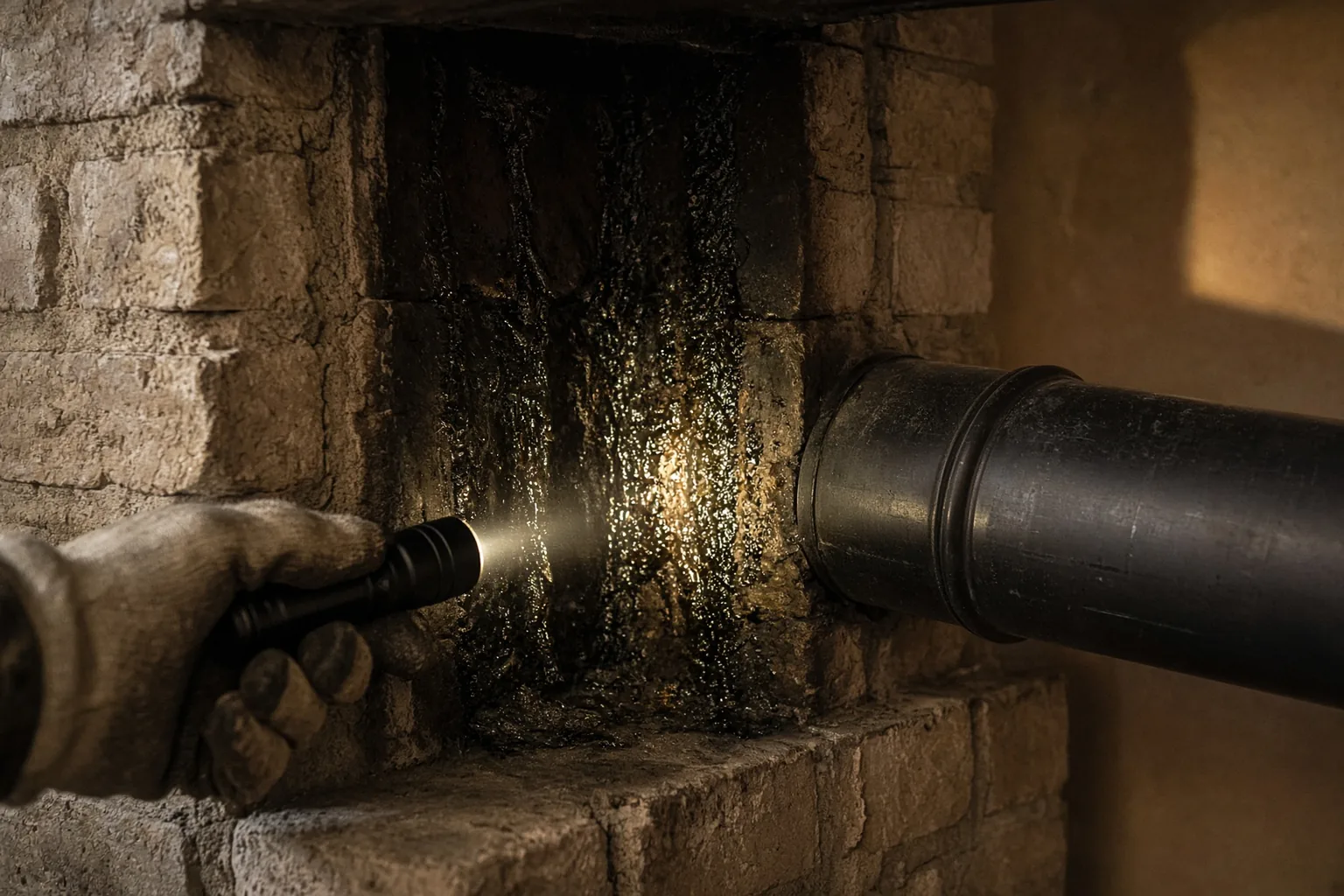
How does a chimney or wood stove fire start?
In two ways. Creosote that has built up inside the flue ignites, or heat passes through the chimney wall or stove pipe to nearby wood. A fire in the flue can lead to the second by cracking the liner.
Massachusetts fire officials described the first path in two recent investigations. After a February 2022 fire in Williamstown, the local fire department and the State Police Fire & Explosion Investigation Unit determined that it started in the chimney, which was fed by a woodstove in use at the time, and spread through the trusses. Fire Chief Craig A. Pedercini said: "When creosote builds up on the flue in a chimney, it can ignite and cause a fire." In January 2023 investigators in Middleton ruled a house fire accidental: it "began in a chimney that was venting a pellet stove within the residence."
The Chimney Safety Institute of America (CSIA) describes creosote in its white paper Chimney Fires: Causes, Effects & Evaluation (fourth printing, 2007). Deposits change as they are heated: a shiny tar glaze, a slag of wood tar without its more volatile components, and well-pyrolized deposits that are "crusty or flaky." The paper cites an estimate that a gas temperature of 1200-1300°F is needed to ignite deposits in a well insulated environment, and it says flue gas outlet temperatures above 700-800°F should be avoided.
The second path needs no fire in the flue. Heat conducted through masonry or metal reaches joists, trusses or sheathing next to the chimney. CSIA writes that "sustained operation, even with relatively low temperature, provides an opportunity for the heat to conduct" through the wall.
How often do chimneys and wood stoves cause house fires?
Massachusetts fire departments reported 539 fires involving chimneys, fireplaces and woodstoves in 2020, with $3.4 million in property losses. They made up 41 percent of the state's fires linked to heating systems.
The figures come from the release of the Massachusetts Department of Fire Services dated February 17, 2022. The same 539 incidents caused 3 civilian injuries and 6 firefighter injuries. State Fire Marshal Peter J. Ostroskey said in that release that "it's important to have your flue cleaned and chimney inspected once a year to prevent fires like this one."
In the January 2023 release on the Middleton fire, the State Fire Marshal said that home heating equipment is the second-leading cause of residential fires and that solid fuel appliances account for a rising share of them. The release shows the trend in a chart and gives no numbers in its text.
In a lawsuit the investigator works from the record of one chimney: when it was built or relined, who installed the stove, when the flue was last swept and what the sweep wrote down.
Can wood next to a chimney ignite after years of heating?
CSIA's white paper says it can. Long heating turns wood into pyrophoric carbon, which studies place at an ignition temperature of 200-250°F, well below that of the wood itself.
The CSIA paper explains that wood exposed to heat "undergoes a gradual change in its molecular structure through a process called pyrolysis." In structural members exposed to long-term heating the solid residue is called pyrophoric carbon, and the paper puts its ignition temperature at 200-250°F. Chimney design criteria cited in the paper require that wood exposed to chimney heating not rise "more than 90°F over ambient temperature."
The paper ties ignition to duration. It reports tests in which wood against an unlined chimney "ignited after only three and one-half hours" with flue gases at 1000°F, and it states that the likelihood of ignition by conducted heat "appears to be most influenced by the duration of the fire rather than its intensity." Elsewhere it records that "a slow undetected chimney fire was a major factor in ignition of the house fire" and that, when pressed, homeowners can often recall minor sounds or changes in how the appliance ran some time before the structure fire was detected.
A fire in a wall or attic next to a chimney can therefore start long after the heating that prepared the wood. The report has to say which mechanism it relies on, what char depth and pattern were found on the framing next to the flue, and why a long, low exposure or a short, intense one fits that evidence.
Which clearances and components does the investigator measure?
The air space between chimney and framing, the flue liner and its gap to the chimney wall, fire stops in the chimney void, and the clearances in the appliance's own installation instructions.
CSIA's paper states that "Chimneys with any part of the chimney wall within the building must have a two-inch clearance" and that chimneys located entirely outside the building need one inch. It warns that filling the clearance space, even with insulation, can raise the temperature that combustibles are exposed to. For flue liners it describes a separation from the chimney wall of a minimum of 1/2 inch and a maximum of four inches of air space, and it quotes NFPA 211: "Masonry chimneys shall be lined."
Dennis K. Haas, a senior investigator with UNIFIED Investigations & Sciences, wrote in Claims Journal in 2012 that "Even 'zero clearance' appliances have some clearance requirements that must be met," that fire stops should be provided within the chimney void, and that "These voids must be free of any material, including insulation." Each manufacturer, he noted, "publishes proper installation and use information with each specific unit," and the information differs between models, so the investigator needs the make and model of the appliance and the name of the installer.
Measurements are compared with the documents that governed the installation: the manufacturer's instructions for that model, the building and fire codes adopted where the house stands, and NFPA 211, which Haas cites as the standard for chimneys, fireplaces, vents and solid-fuel burning appliances.
What evidence tells the investigator that a chimney fire happened?
CSIA lists lightweight, puffed creosote residue, pyrolized creosote below the normal heat source, cracked clay liners, weakened mortar and melted or warped caps. Light damage does not rule out a chimney fire.
In section 2.5.1 of the white paper CSIA writes that "post-fire creosote residue is extremely lightweight and fragile" and in many cases has swelled to nearly block the flue; section 2.3.2 explains that during a chimney fire creosote "will literally foam and expand greatly in volume." Pyrolized creosote on flue walls below the normal heat source is called "a sure sign" of a chimney fire.
CSIA names fracture of the clay flue lining as the damage seen most often in the field, usually as longitudinal cracks. Portland-cement mortar loses strength above about 1000°F and may spall or crumble. "Aluminum rain caps and antennas can be literally melted by a fire, and steel caps can be warped." The paper adds: "It should not be assumed that because damage is not catastrophic, a chimney fire did not occur."
The authors of a PropertyCasualty360 article on a chimney sweep case they litigated described the inspection levels of NFPA 211. A Level I inspection "is limited to easily accessible portions of the venting system," while a Level II inspection is used "after an operating malfunction or external event likely damaged the chimney, such as a fire."
When can the maker of the stove or the chimney pipe be liable?
When the design, the material or the warnings contributed to the fire. In Hegre v. Simpson Dura-Vent Co. (1988) the Washington Court of Appeals sent a wood stove and chimney pipe case to a jury.
Hegre v. Simpson Dura-Vent Co., 50 Wash. App. 388, 748 P.2d 1131, was decided on January 20, 1988. The house was heated by a Blaze King Princess wood stove vented through a 13-foot black iron chimney pipe. Over 20 months the owner replaced the pipe section by section as each section corroded. In March 1985 a fire started in the ceiling or roof around the pipe, and the county fire report described the pipe as in poor condition, with very thin areas and burned-through sections.
The plaintiffs' expert, chemist Dr. Mark Adams, stated that this stove produced a large amount of creosote, that creosote combined with moisture rapidly corrodes black iron pipe, and that pipe from the house measured 0.013-0.018 inches thick against the 0.021 inches stated in the brochure. He added that a catalytic afterburner, available when the stove was made, would have removed the creosote, and that the stove and pipe lacked adequate warnings. Adams did not find creosote itself; he found corrosion on the pipe.
The trial court had dismissed the case on summary judgment. The Court of Appeals reversed: "A reasonable inference is that this particular stove produced creosote," and the evidence supported the plaintiffs' theory that creosote accumulated on, corroded and ignited in the pipe. "There are genuine issues of material fact requiring trial by the jury."
Does the owner's own maintenance defeat the claim?
Not automatically. In Hegre the stove manual called for inspecting the pipe twice a month, the owner had cleaned it about eight weeks before the fire, and the court still left the warnings question to a jury.
The opinion records that there was no evidence the plaintiffs read the manual or followed its instructions. The court held that whether the dangers were obvious or well known was for the jury, and wrote that although the plaintiffs knew the pipe was corroding, "there is no evidence that they knew that continued use of Simpson chimney pipe would or might cause a fire."
Haas advises finding out "if an inspection has been conducted and by whom," and the Massachusetts State Fire Marshal advised an annual cleaning and inspection in 2022. A missing record does not prove that no sweep came; it leaves the investigator to read the creosote condition and the liner damage on the flue itself.
Can a chimney sweep or an installer be liable?
Yes, if the work fell below the standard of care and contributed to the fire. Authors who litigated a sweep case treat NFPA 211 as that standard for sweeps even where a state has not adopted it.
The PropertyCasualty360 article described a Southern California chimney fire case its authors litigated. The sweep had serviced the home "about 10 months before the fire," "could not see into several areas in the smoke chamber," "nor did the chimney sweep use a mirror to check those blind spots." The authors wrote that "states currently do not certify chimney sweeps" and that NFPA 211, where it is not adopted as code, "is still recognized as the standard of care to assess if the chimney sweep performed work properly." For adjusters they recommended retaining an experienced chimney sweep consultant, obtaining all sweep reports, including earlier ones, and that they "Collect photographs and preserve any physical evidence."
Haas wrote that "Many units are not installed or inspected by certified or trained installers" and that units are often installed by general contractors. For solid-fuel losses he recommended involving a qualified expert so that "subrogation is not lost in those instances where product failure or third-party liability is possible."
What should be documented before the chimney is taken down?
The origin, the whole flue with its liner and cap, the clearances, the stove and its labels, and the charred framing around the chimney. A NIOSH report records an investigator killed by a collapsing chimney in 1999.
NIOSH report F99-06, released May 14, 1999, describes a New York fire investigator who died after being struck by a chimney that collapsed during an origin and cause investigation. The section of the free-standing chimney above the roof line appeared to have been an add-on, "The chimney contained no internal liner/flue," and it had been built of single bricks and mortar. A chimney that survived the fire can still fall while the scene is examined.
Haas advises having an origin and cause investigator "document and verify the fire's origin" before the appliance and the venting are examined. Stove pipe sections, caps, the damper and charred framing are evidence. If the other side holds them, Rule 34(a)(1) of the Federal Rules of Civil Procedure lets a party request to "inspect, copy, test, or sample" them, and the written response is due within 30 days after service.
The investigator's opinion reaches the court through a report under Rule 26(a)(2)(B) with "a complete statement of all opinions the witness will express and the basis and reasons for them" and the facts or data considered. Under Rule 702, as amended in 2023, the proponent must establish that the testimony "is based on sufficient facts or data" and "is the product of reliable principles and methods."
What does IAE do in a chimney or wood stove fire case?
A fire investigator from the IAE registry prepares an origin and cause report on your questions or a review of the opposing investigator's report, in up to 5 business days after the format and cost are confirmed.
The IAE fire origin and cause service covers where the fire started, what ignited it, how it spread and whether an appliance, the wiring or a person's act caused it, for subrogation, product liability, arson defense and coverage disputes in US courts. The investigator works from the scene record, photos, removed artifacts and witness accounts, maps char depth and burn patterns, and names the ignition source, the first fuel ignited and the circumstances that brought them together. The investigator also checks whether appliances and debris were photographed in place before removal, logged and examined at a joint lab exam with all interested parties notified.
For a heating appliance case, send the fire department report, photos of the flue, cap, liner and stove with its labels, the installation and sweep records you have, and the opposing report if there is one, and tell us whether the fire scene still exists. The secretariat confirms receipt the same day. Within one business day IAE confirms the format, cost, deadline and the specialist from its registry, and you approve the candidate and the CV before work starts. Cases with tight deadlines have a 48-hour rush.
Every specialist is a member of the public IAE registry and passed the council's attestation under the published Criteria Matrix; the Member ID in the document can be checked by QR code. The specialist confirms in the document that he or she has no interest in the outcome of the case. Neither IAE nor the specialist guarantees the outcome, and IAE is not a law firm.
Sources
- Massachusetts Department of Fire Services, Williamstown Chimney Fire Prompts Heating Season Reminder, press release, February 17, 2022
- Massachusetts Department of Fire Services, Chimney Fire Destroys Middleton Home, press release, January 17, 2023
- Chimney Safety Institute of America, Chimney Fires: Causes, Effects & Evaluation, white paper, fourth printing, 2007 (copy at kensingtonfire.specialdistrict.org)
- Haas D.K. How to Investigate Heating Equipment Fire Losses, Claims Journal, October 15, 2012
- PropertyCasualty360, article on a chimney sweep liability case and NFPA 211 inspection levels
- Hegre v. Simpson Dura-Vent Co., 50 Wash. App. 388, 748 P.2d 1131 (Wash. Ct. App. January 20, 1988), opinion text
- NIOSH Fire Fighter Fatality Investigation Report F99-06, Fire Investigator Dies After Being Struck by a Chimney That Collapsed During an Origin and Cause Fire Investigation (New York), May 14, 1999
- Federal Rules of Civil Procedure, Rule 34, Producing Documents, Electronically Stored Information, and Tangible Things (LII)
- Federal Rules of Civil Procedure, Rule 26, Duty to Disclose; General Provisions Governing Discovery (LII)
- Federal Rules of Evidence, Rule 702, Testimony by Expert Witnesses (LII)
Read also
All articles
Gas explosion investigation: who is liable, and what does the investigator have to establish?
After a gas explosion the claim turns on one physical question: where the gas came from and why nobody noticed it before something ignited it Sergei Voronin
Tenant caused a fire: who is liable, can the landlord's insurer sue, and what must the investigator establish?
When a rented house burns, three questions come up in order: where the fire started, what started it, and who answers for that cause under the leaseSergei Voronin
Fire spread from a neighbor's property: who is liable, and what does the investigator have to establish?
A neighbor is liable for a fire that spreads onto your property when the fire started through his negligence or in violation of law, not merelySergei VoroninExpert examinations
Ready to discuss your case?
Send the materials: the secretariat will confirm the format, cost, deadline and the specialist within one business day.
