
Examinations
Gas explosion investigation: who is liable, and what does the investigator have to establish?
After a gas explosion the claim turns on one physical question: where the gas came from and why nobody noticed it before something ignited it. In Silver Spring, Maryland, the National Transportation Safety Board traced seven deaths to a failed indoor regulator with an unconnected vent line. In a 2026 Michigan case two experts read the same wreckage as natural gas and as butane. The investigator's report has to choose between such readings and give the data behind the choice.
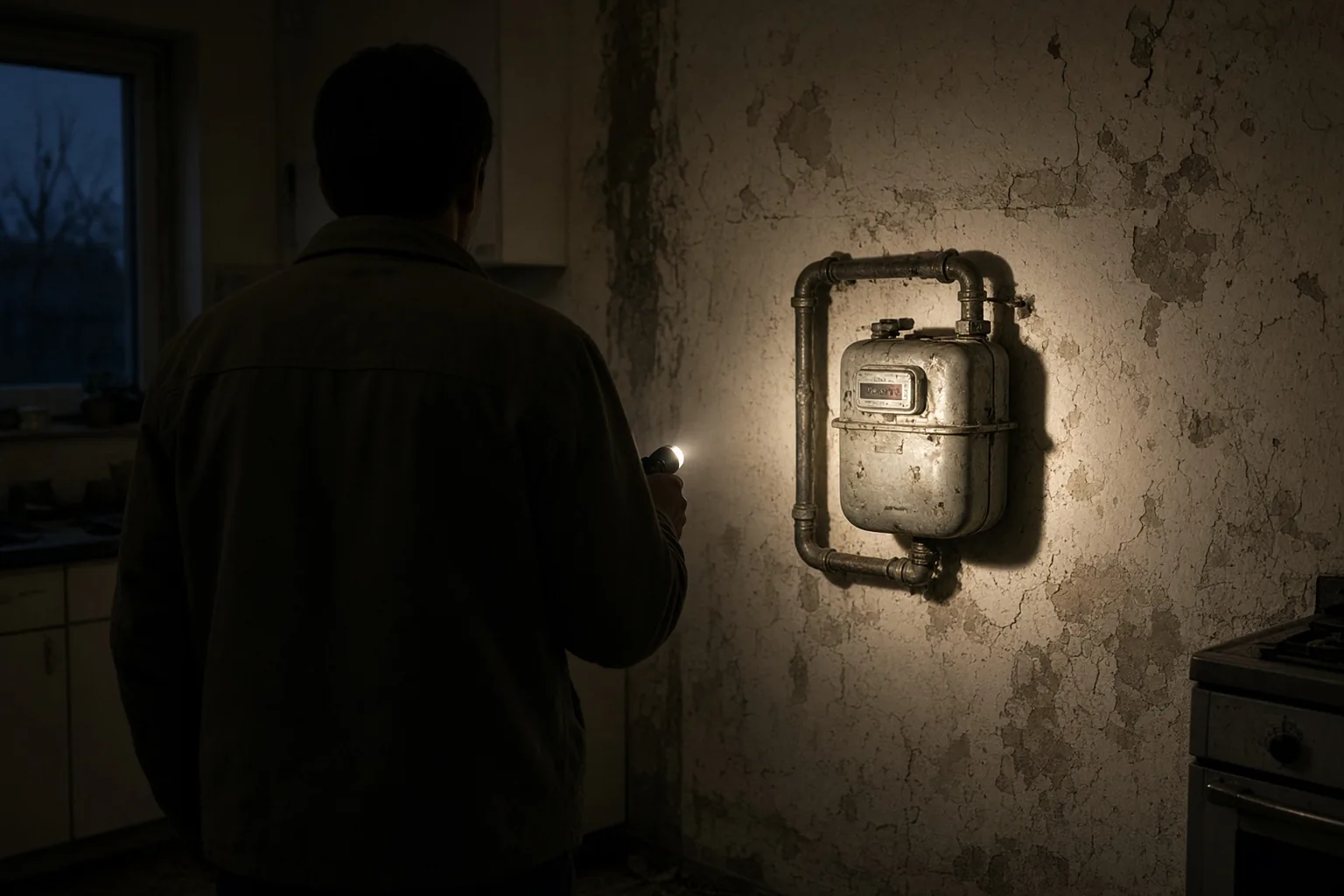
Who is liable for a gas explosion?
The party whose equipment or work released the gas and who did not use the required care: the utility for mains, service lines and meters, the owner for piping behind the meter, a contractor for its work.
Responsibility is usually divided at the meter. In Maksymenko v. Consumers Energy Co., No. 372819 (Mich. Ct. App. Apr. 27, 2026), the utility owned the service line and the meter, and the homeowner owned the fuel line downstream. Federal pipeline rules assume the same division. Under 49 CFR 192.16 an operator that does not maintain the customer's buried piping must notify each customer once in writing that it does not maintain that piping, that unmaintained piping may be subject to corrosion and leakage, and that it should be inspected periodically and repaired if an unsafe condition is found. The notice is due within 90 days after the customer first receives gas at the location.
The second group of defendants is the people who worked on the system. On September 13, 2018, in Lawrence, Andover and North Andover, Massachusetts, a contractor crew working for Columbia Gas of Massachusetts cut an old cast iron main out of service while the regulator sensing lines were still attached to it. The regulators stopped sensing system pressure, opened fully and sent high-pressure gas into a low-pressure system. One person died, 22 were taken to hospitals and 131 structures were damaged. The NTSB placed the probable cause on the utility's engineering management, which did not adequately plan, review, sequence and oversee the construction project (report NTSB/PAR-19/02).
A landlord can stand in the utility's place. In Anderson v. Atlanta Gas Light Co., Nos. A13A1620 and A13A1621 (Ga. Ct. App. Nov. 18, 2013), a mobile home park owner had shut off gas at the master meter so that his employees could install electric heating. They did not cap the line or close the service valve under the home. Months later a resident turned the master meter back on, gas filled the home, and on September 30, 2003 a visitor lit a cigarette inside. The claims against the gas company failed. The claims against the park owner remained pending.
What does federal law require of the gas company?
Gas odorized so that a person can smell it at one-fifth of the lower explosive limit, periodic odorant sampling, leakage surveys at fixed intervals and a written notice about customer-owned buried piping. State commissions add their own rules.
Under 49 CFR 192.625(a) a combustible gas in a distribution line must contain a natural odorant or be odorized so that "at a concentration in air of one-fifth of the lower explosive limit, the gas is readily detectable by a person with a normal sense of smell." Paragraph (f) requires each operator to conduct periodic sampling with an instrument capable of determining the percentage of gas in air at which the odor becomes readily detectable.
Leakage surveys are set by 49 CFR 192.723. In business districts the operator surveys with leak detector equipment at intervals not exceeding 15 months, and at least once each calendar year. Outside business districts the survey is done as frequently as necessary, and at least once every 5 calendar years at intervals not exceeding 63 months. For cathodically unprotected distribution lines where electrical surveys for corrosion are impractical, the interval is 3 calendar years and 39 months.
Compliance with these rules did not end the inquiry in Silver Spring. The odorant levels at the regulator stations and the service lines met federal and Maryland requirements. The NTSB still found that gas odorants alone do not effectively mitigate the risk of death and injury caused by gas system leaks, and it named as a contributing factor the location of the regulators, where leak detection by odor was not readily available. The Board issued 13 safety recommendations, five of them to the utility, Washington Gas. In Anderson the Georgia Public Service Commission found no evidence that the gas company had violated pipeline safety regulations, and the Court of Appeals noted that finding in its opinion.
What does the investigator have to establish after a gas explosion?
The fuel, the point where it escaped, the path it took into the space that exploded and the ignition source if one can be found. The report also states why other fuels and other leak points were ruled out.
The NTSB report on the Flower Branch apartments at 8701 Arliss Street in Silver Spring (NTSB/PAR-19/01) is a worked example. The explosion occurred on August 10, 2016 at 11:51 p.m. Seven residents died, 65 residents were taken to hospitals and three firefighters were treated and released. The pattern of debris and the locations of the victims pointed to the meter room in the basement. The Bureau of Alcohol, Tobacco, Firearms and Explosives concluded that the explosion came out of a natural gas release in that room and found no data supporting explosives or a drug laboratory.
Each alternative source was then tested. The utility pressure-tested the main, and it held. Bar hole tests in the soil near the mains and service lines detected no gas. The vent line showed no obstruction. The only gas appliance in the room was a water heater, and the Board concluded that it did not fail before the explosion: its piping separated by overstress in the blast. What remained was an indoor mercury service regulator whose vent line union was found not connected.
Laboratory and modeling work closed the gaps. The NTSB Materials Laboratory analyzed the alloys of the regulator parts; melted aluminum showed temperatures of at least 1,220 degrees Fahrenheit. Investigators ran exemplar regulators through failure scenarios, including lost mercury, an obstructed valve seat and a perforated diaphragm, and measured the flow at the vent. A computational fluid dynamics model was used to estimate how long the released gas needed to accumulate. Alarm records showed that the meter room was last locked at 8:42 p.m., and the Board found that a low leakage rate could have produced an explosive atmosphere between that time and the explosion at 11:51 p.m.
The probable cause statement names the failed regulator with an unconnected vent line and says the gas ignited "from an unknown ignition source." The Board identified the fuel and the point of release and left the ignition source unnamed.
What happens when the experts disagree about the fuel?
If each opinion rests on tested data, the dispute goes to the fact-finder. In Maksymenko v. Consumers Energy the butane theory and the natural gas theory both survived, and the Court of Appeals reversed summary disposition for the utility.
The house in Commerce Township, Michigan exploded about one month after Consumers Energy replaced the copper service line with plastic. The plaintiff, who was inside, was severely injured. About two weeks after the explosion the utility pressure-tested the gas line and found no leaks. A flow test of the owner's fuel line by Farm Bureau Insurance investigators found three leaks, one of them very small.
The utility's expert, an engineer, attributed the explosion to butane out of tanks kept on the property and the fuel-line leaks to the explosion and the activity after it. She ruled out natural gas because the gas piping inside the house held pressure. The plaintiff's expert, a licensed master plumber, testified that the utility's work disturbed the downstream piping; the court noted that he was not an expert in metallurgy, engineering or gas distribution upstream of the meter. A third witness, an explosion and fire investigator, found a higher probability that natural gas caused the explosion and pointed out that a 3-foot section of the fuel line could not be tested, so nobody knew whether it leaked before or after the blast.
The trial court granted summary disposition and adopted the utility's reasons, including that it had no duty to inspect the customer's fuel line. The Court of Appeals, in an unpublished per curiam opinion, held that the utility undertook a duty to inspect the fuel line when it replaced the service line, and that questions of fact existed on breach and on whether the company caused leaks in the fuel line. The court wrote that the testimony of the plumber and the investigator was more than speculation.
Does a claim against the gas company need an expert on the standard of care?
In Georgia it does. In Anderson v. Atlanta Gas Light Co. the Court of Appeals upheld exclusion of the plaintiffs' expert and held that the gas industry's standard of care is beyond the ken of lay persons.
The plaintiffs' expert in Anderson said that the gas company's standard of care required policies under which a closed meter valve is secured by a lock or another acceptable device. The trial court excluded him, and the Court of Appeals found no abuse of discretion: he had no experience with master meters or with locks and warnings on them, and he cited no industry standard that the company had violated. The court relied on the Georgia Supreme Court's statement in HNTB Georgia, Inc. v. Hamilton-King (2010) that experience, standing alone, does not render reliable all opinions an expert may express. With no admissible expert on the standard of care, the gas company was entitled to summary judgment.
In federal court Rule 702 of the Federal Rules of Evidence puts the burden on the proponent, who must show the court that it is more likely than not that the testimony is based on sufficient facts or data, is the product of reliable principles and methods, and applies them reliably to the facts of the case. The words about the proponent's showing came into the rule with the 2023 amendment.
The rule also limits what a cause and origin witness may borrow. In Goens v. Southern Union Co., No. 09-0422-CV-W-FJG (W.D. Mo. June 23, 2010), a gas service technician relit the pilot of a basement water heater on April 14, 2004, and a fire followed on April 27. The court let the fire investigator testify to the area of origin and to the involvement of a water heater malfunction. It barred him on the specific failure mechanism, because he based that opinion entirely on the opinion of the mechanical engineer.
What evidence has to be kept after a gas explosion?
The meter, regulators, connectors, appliances and every section of piping, photographed in place and tested under a protocol that all parties receive. The utility's odorant, leak survey, notice and call records are requested in discovery.
Rule 34(a)(2) of the Federal Rules of Civil Procedure lets a party request entry onto land or other property possessed or controlled by the responding party, and Rule 34(a)(1)(B) covers designated tangible things. The response is due in writing within 30 days after service. Debris removal and repairs change what an investigator can still see, so the request goes out early.
The tests are the ones the NTSB ran in Silver Spring: a pressure test of each pipe segment, soil gas readings along the buried lines, an odorant test, and a laboratory examination of the regulators and connectors. Each segment that cannot be tested is recorded as untested, with the reason. In Maksymenko a 3-foot section of the fuel line was too damaged to test, and the investigator could not say whether it leaked before or after the explosion.
The paper record comes mostly out of the utility. Section 192.625(f) produces odorant sampling records and section 192.723 produces leakage survey records. Under section 192.16(d) the operator must keep a copy of the customer notice currently in use and evidence that notices were sent within the previous 3 years. Call logs are requested as well. In Silver Spring a resident reported a strong gas odor on July 25, 2016, about two weeks before the explosion. Firefighters could not enter the locked meter room, detected no gas elsewhere and left, and the utility was never notified. The NTSB found that a utility technician may have had the opportunity to enter the meter room and to find and correct the unconnected vent line.
A retained investigator's report under Rule 26(a)(2)(B) contains a complete statement of all opinions with the basis and reasons for them, the facts or data considered, the exhibits, the witness's qualifications and a statement of compensation. The test protocols and the list of untested items belong in the facts or data considered.
What does IAE do in a gas explosion or gas fire dispute?
IAE prepares origin and cause expert reports on the client's questions and reviews of the opposing investigator's report for subrogation, product liability and coverage disputes, up to 5 business days after format and cost are confirmed.
The fire origin and cause page describes the work in three parts. For the origin, the investigator maps char depth, burn patterns on walls and ceilings and arc sites on branch circuits. For the cause, the investigator names the ignition source, the first fuel ignited and the circumstances that brought them together, and tests each hypothesis against the scene and the timeline. For the evidence, the investigator checks whether wiring, appliances and debris were photographed in place before removal, logged and examined at a joint lab exam with all interested parties notified.
A review of the opposing report lists each hypothesis the investigator considered and checks what data excluded the others. A report that only rebuts the opposing investigator on the same subject is due within 30 days after that disclosure under Rule 26(a)(2)(D)(ii), unless the parties stipulate or the court orders otherwise.
The client sends the scene photographs and video, the fire department report, the utility's records if they have been produced, test protocols, witness statements and the opposing report, and states whether the scene still exists. The secretariat confirms receipt the same day. Within one business day IAE confirms the format, the cost, the deadline and the specialist chosen in its registry, and the client approves the candidate and the CV before work starts. Cases with tight deadlines have a 48-hour rush.
Registry members passed the collegial attestation of the council under the published Criteria Matrix, and the Member ID or QR code in the document opens the specialist's record. The specialist confirms in the document that he or she has no interest in the outcome of the case. An expert report is evidence the court weighs with the other materials. Neither IAE nor the specialist guarantees the outcome, and IAE is not a law firm: questions of duty, notice and limitation periods stay with counsel.
Sources
- NTSB, Building Explosion and Fire, Silver Spring, Maryland, August 10, 2016, Pipeline Accident Report NTSB/PAR-19/01
- NTSB news release of April 23, 2019: Failed Gas Regulator, Unconnected Vent Line Led to Maryland Apartment Building Explosion
- NTSB, Overpressurization of Natural Gas Distribution System, Explosions, and Fires in Merrimack Valley, Massachusetts, September 13, 2018, NTSB/PAR-19/02
- NTSB news release of September 24, 2019: Overpressurized Gas Distribution System Caused Explosions, Fires
- 49 CFR 192.625, Odorization of gas (LII, Cornell Law School)
- 49 CFR 192.723, Distribution systems: Leakage surveys (LII, Cornell Law School)
- 49 CFR 192.16, Customer notification (LII, Cornell Law School)
- Maksymenko v. Consumers Energy Co., No. 372819 (Mich. Ct. App. Apr. 27, 2026) (unpublished), Michigan Courts
- Anderson v. Atlanta Gas Light Co., Nos. A13A1620 and A13A1621 (Ga. Ct. App. Nov. 18, 2013), Justia
- Goens v. Southern Union Co., No. 09-0422-CV-W-FJG (W.D. Mo. June 23, 2010), order on motions to exclude experts, Justia
- Federal Rules of Evidence, Rule 702 (LII, Cornell Law School)
- Federal Rules of Civil Procedure, Rule 34 (LII, Cornell Law School)
- Federal Rules of Civil Procedure, Rule 26 (LII, Cornell Law School)
Read also
All articles
Tenant caused a fire: who is liable, can the landlord's insurer sue, and what must the investigator establish?
When a rented house burns, three questions come up in order: where the fire started, what started it, and who answers for that cause under the lease Sergei Voronin

Fire spread from a neighbor's property: who is liable, and what does the investigator have to establish?
A neighbor is liable for a fire that spreads onto your property when the fire started through his negligence or in violation of law, not merelySergei Voronin
Fire loss subrogation: what does the insurer's investigator have to prove?
An insurer that pays a fire claim and sues the party it blames has to prove the same case its insured would have had: where the fire started, whatSergei VoroninExpert examinations
Ready to discuss your case?
Send the materials: the secretariat will confirm the format, cost, deadline and the specialist within one business day.
