
Expert report review
Two toolmark or footwear examiners disagree: how does a court decide, and what does a reviewer compare?
One examiner says the seized pry bar made the mark on the door; another says the comparison is inconclusive. Disagreements of this kind happen inside laboratories, where a verifier can reach a different result, and in court, where the defense calls its own examiner. Before arguing about who is right, a reviewer checks whether the two worked from the same material, used the same scale of conclusions and saw the same features.
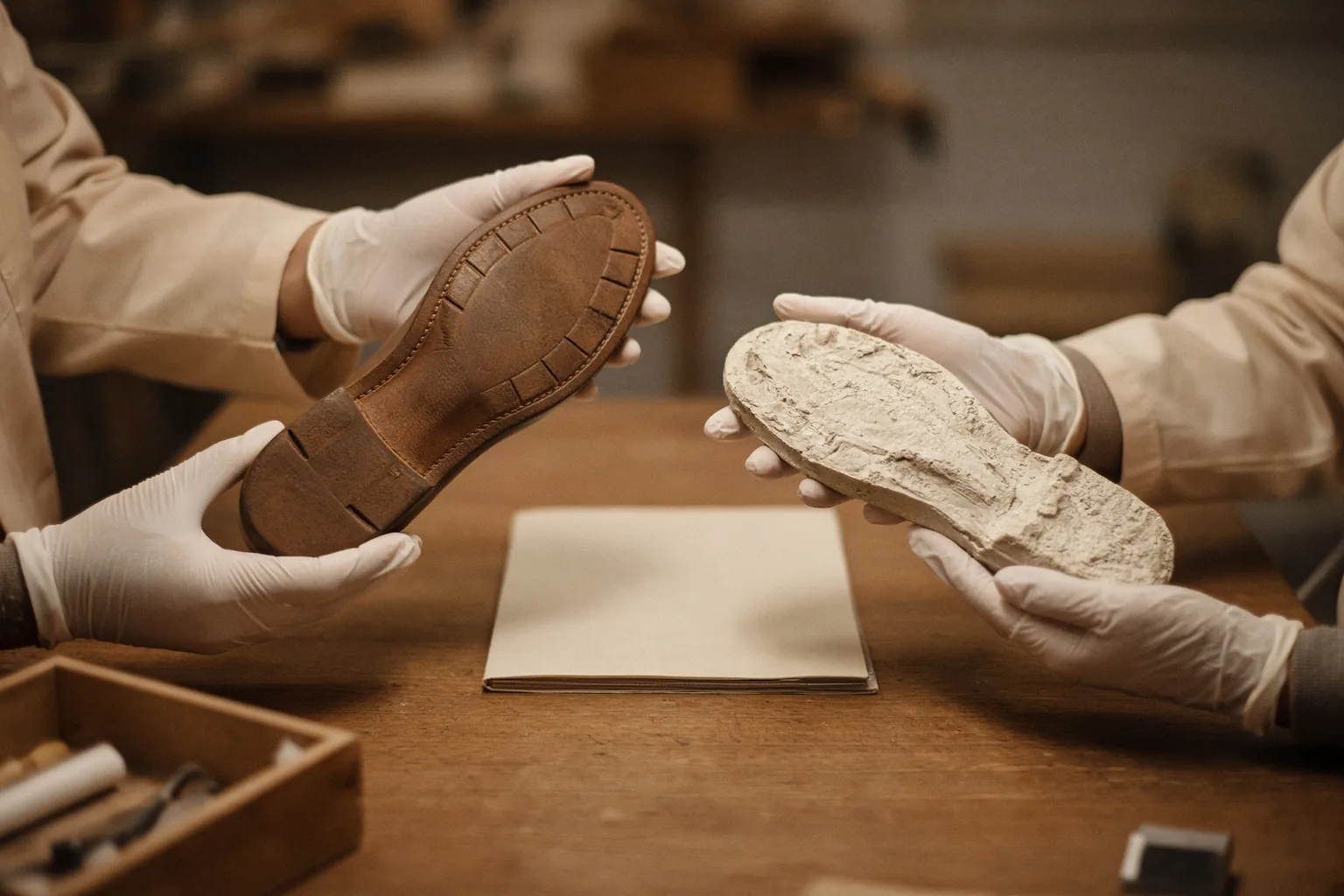
Why do two examiners reach different conclusions on the same mark?
They may have worked from different material, used different conclusion scales or set different thresholds for how much agreement is enough. Footwear and toolmark standards leave the sufficiency of individual characteristics to the examiner's judgment.
The 2006 SWGTREAD Guide for the Examination of Footwear and Tire Impression Evidence ties identification to sufficiency without a number: "When sufficient individual characteristics are present in the questioned impression and correspond with respective features in the known shoe or tire, an identification can be effected."
The Justice Department's supporting documentation for its proposed footwear and tire language quotes the 2009 report of the National Academy of Sciences on this point: "there is no consensus regarding the number of individual characteristics needed to make a positive identification." The same report, as quoted there, was "not aware of any data about the variability of class or individual characteristics."
For toolmarks the Department's 2023 uniform language defines inconclusive as agreement of all observed class characteristics with "insufficient quality and/or quantity of corresponding individual characteristics" to identify or exclude. Where one examiner finds the quantity sufficient and another does not, the two reports state an identification and an inconclusive result from the same mark.
What happens when a verifier in the same laboratory disagrees?
The laboratory follows its conflict resolution path. The OSAC process map lists discussion between the examiners, involvement of a supervisor, quality assurance or a technical lead, consultation, and changed conclusions among the outcomes.
The Footwear and Tire Examination Process Map, published by the NIST Forensic Science Research Program and the OSAC Footwear and Tire Subcommittee on June 8, 2022, records current practice. In its verification stage the map asks whether the two conclusions agree. If they do not, it lists communication between examiners, bringing in others such as a supervisor, quality assurance or a technical lead, consultation and supervisory input. It also asks whether the case will be fully reworked by another examiner or by different methods.
An examiner may consult a colleague before reaching a conclusion. The map records that as its own step in the comparison stage, separate from verification.
A disagreement resolved inside the laboratory does not appear in the final report. It appears in the verification and conflict resolution records. A reviewer asks for those records by name, because a report that says "verified" can rest on a first verifier who disagreed and a second who agreed.
Are the two conclusions really in conflict, or only worded differently?
Sometimes only the words differ. The OSAC map lists seven conclusions under two naming systems, SWGTREAD and the Justice Department's uniform language, and two SWGTREAD levels fall under one federal inconclusive result.
The map pairs the terms. "Limited association of class characteristics" and "Lacks sufficient detail" after a comparison are both inconclusive in federal terms. "Association of class characteristics" corresponds to inclusion based on class characteristics: the known item could have made the impression. "High degree of association" corresponds to inclusion based on class characteristics and randomly acquired characteristics: the known item probably made it.
A report from one laboratory that says "limited association of class characteristics" and a report from another that says "inconclusive" may describe the same observation. A report that says "could have made" and one that says "identification" do not.
For toolmarks the Department of Justice limits its examiners to three conclusions: source identification, source exclusion and inconclusive. A non-federal report with probable wording has no federal equivalent, and a reviewer records that the scales differ before treating the reports as contradictory.
Did both examiners work from the same material?
Not always. One may have examined the original shoe, cast or marked item with test marks, the other only photographs. A difference in material can explain a disagreement, and a reviewer tabulates it first.
The OSAC map routes casts, gel lifts, electrostatic lifts, images of questioned impressions and objects through separate steps, each with its own assessment of quality and limitations. An examiner who had the cast under lighting saw detail that a photograph of the cast may not carry.
Test marks and test impressions are a second source of difference. The map describes test impressions made by two-dimensional or three-dimensional methods. A defense examiner who made new test marks with the seized tool compares against a different set than the government examiner did.
The sample report used in the Firearm Examiner Training course (2008) shows how much depends on the item: chain links that bore pinching cuts gave no identification for "a lack of corresponding microscopic marks," and a padlock shackle bore no microscopic marks of value at all. Two examiners working from different items in the same case can reach different results without either making an error.
Does the judge or the jury resolve the disagreement?
Both, at different stages. The judge decides admissibility under Rule 702 by a preponderance of the evidence, including the sufficiency of each expert's basis. Admitted opinions then go to the jury with cross-examination.
Rule 702 admits expert testimony only if the proponent convinces the court that it is more likely than not that the testimony is based on sufficient facts or data, is the product of reliable principles and methods, and applies them reliably to the case. The 2023 committee note states that rulings treating "the critical questions of the sufficiency of an expert's basis, and the application of the expert's methodology" as questions of weight "are an incorrect application of Rules 702 and 104(a)."
The same standard applies to the defense examiner. A reviewer who contradicts the government's examiner has to meet it too, with a stated basis, a stated method and a record of how it was applied.
The note also says that forensic experts should avoid assertions of absolute or one hundred percent certainty where the method is subjective and potentially subject to error. An examiner who answers a disagreement by claiming certainty runs against that note.
Can the court appoint its own examiner?
Yes. Under Rule 706 the court, on motion or on its own, may appoint an expert the parties agree on or one of its own choosing who consents. Any party may depose, call and cross-examine that expert.
Rule 706(a) lets the court order the parties to show cause why expert witnesses should not be appointed and to submit nominations. The court may appoint any expert that the parties agree on and any of its own choosing, but only one who consents to act.
Under Rule 706(b) the court informs the expert of the expert's duties in writing or at a conference in which the parties have an opportunity to participate. The expert "must advise the parties of any findings the expert makes," may be deposed by any party, may be called to testify by the court or any party, and may be cross-examined by any party, including the party that called the expert.
A court-appointed examiner does not replace the parties' examiners. For a reviewer the appointment changes the work: the review now covers three reports, and the material and questions given to the court's examiner are compared with those of the two parties' examiners.
What does the Justice Department say about error rates when examiners disagree?
In its statement on the PCAST report the Department wrote that all feature comparison analyses have non-zero error rates and that no single error rate applies to all laboratories, examiners and cases.
The statement on the PCAST report, titled "Forensic Science in Criminal Courts: Ensuring Scientific Validity of Feature-Comparison Methods," says that "all laboratory test and feature comparison analyses have non-zero error rates" and that "no single error rate is generally applicable to all laboratories, all examiners, and all cases."
For firearms and toolmarks the statement says that "there have been approximately twenty firearms/toolmarks studies" focused on classification decisions and their error rates, which, according to the statement, all produced false positive error rates between 0% and just over 1.0%. It argues that such rates cannot be carried over to a given laboratory, examiner or case. It names verification by a second examiner, technical review and case controls among the safeguards, and it says that retesting the evidence protects a wrongly accused person.
Rule 702's committee note asks the judge to receive, where possible, an estimate of the known or potential rate of error of the method. The Department itself names verification by a second examiner and technical review among the safeguards, so the verification and technical review records of each laboratory are among the documents a reviewer asks for when two examiners disagree.
How is the disagreement put before the jury?
Through disclosure before trial and cross-examination at trial. Rule 16 requires each side's expert disclosure with opinions, bases and reasons, and Rule 705 lets the other side require the underlying facts or data on cross-examination.
Under Rule 16(a)(1)(G) the government discloses a complete statement of all opinions it will elicit from its expert, the bases and reasons, the witness's qualifications and a list of cases with testimony in the previous 4 years. If the defense requested and received that disclosure, Rule 16(b)(1)(C) requires it to make the same disclosure about its own examiner at the government's request.
Under Rule 703 each examiner may base an opinion on facts or data in the case, including data the expert was made aware of. Under Rule 705 an expert may give the opinion and its reasons without first testifying to the underlying facts or data, but may be required to disclose them on cross-examination. The two reports, the images and the notes therefore become the script of both cross-examinations.
What does a reviewer compare when two reports disagree?
A table with one row per question: the items each examiner had, the test marks or impressions used, the conclusion scale, the features cited and where the images show them, the verification record and the wording.
The table separates three kinds of difference. Some come from material: one examiner had the original cast or marked item, the other had photographs. Some come from wording: the two used different scales. The rest are differences of judgment about the same features, and those are the ones the court has to weigh.
For each cited feature the reviewer gives the page or figure where it appears in each report and whether it is visible there. A feature visible in both reports but counted differently is a disagreement of judgment. A feature that only one examiner could see in the material he or she had is a difference of material.
What does IAE do when two examiners disagree about a mark?
IAE reviews the opposing examiner's report and case file in US criminal defense and cargo loss cases, including whether the verification is recorded and who performed it, in up to 5 business days or 48 hours on rush.
The IAE review of impression and toolmark reports is for cases where the other side's examiner links a shoe, a tire or a tool to a mark. The review checks the case file against the standard for that kind of mark. Each point is tied to a page of the report or the bench notes and to a standard, a Justice Department rule or a ruling.
The client sends both reports, the images and notes received in discovery and the trial date, and describes the task. The secretariat confirms receipt the same day, and within one business day IAE confirms the format, the cost, the deadline and the specialist from its registry. IAE confirms the questions and the specialist with the client before work starts.
Every specialist is a member of the public IAE registry, can be verified by Member ID or QR code and confirms in the document that he or she has no interest in the outcome. A review is evidence that the court weighs with the other materials, and neither IAE nor the reviewer guarantees the outcome. IAE is not a law firm: whether to ask the court for its own expert is counsel's decision.
Sources
- SWGTREAD, Guide for the Examination of Footwear and Tire Impression Evidence (03/2006)
- U.S. Department of Justice, Supporting Documentation for Department of Justice Proposed Uniform Language for Testimony and Reports for the Forensic Footwear and Tire Impression Discipline
- U.S. Department of Justice, Uniform Language for Testimony and Reports for the Forensic Firearms/Toolmarks Discipline, Pattern Examination (approved May 18, 2023, effective August 16, 2023)
- NIST Forensic Science Research Program and OSAC Footwear and Tire Subcommittee, Footwear and Tire Examination Process Map (Current Practice), June 8, 2022
- Sample toolmark laboratory report, Firearm Examiner Training (2008), courtesy of the National Forensic Science Technology Center
- Federal Rule of Evidence 702 and committee notes (LII, Cornell Law School)
- Federal Rules of Evidence, Article VII, Rules 701-706 (28a U.S. Code, LII, Cornell Law School)
- U.S. Department of Justice, Statement on the PCAST Report: Forensic Science in Criminal Courts: Ensuring Scientific Validity of Feature-Comparison Methods
- Federal Rules of Criminal Procedure, Rule 16, Discovery and Inspection (LII, Cornell Law School)
Read also
All articles
Can a footwear or toolmark report be reviewed from its photographs alone?
Defense counsel often receives a footwear or toolmark report with a few pages of photographs and nothing else. A reviewer can test several things Sergei Voronin
Can the prosecution use a toolmark or footwear report without calling the examiner who did the comparison?
A toolmark or footwear report rests on a comparison that a particular examiner made, and the case file can show who else made test marks, verifiedSergei Voronin
Footwear and toolmark conclusion scales: what do identification, probably made and inconclusive mean in the examiner's report?
A footwear report can end with one of seven conclusions under the SWGTREAD standard of 2013 or one of six under the Department of Justice languageSergei VoroninExpert report review
Ready to discuss your case?
Send the materials: the secretariat will confirm the format, cost, deadline and the specialist within one business day.
