
Expert witnesses
Construction defect expert witness: who inspects what?
Under Rule 34(a)(2) of the Federal Rules of Civil Procedure, a party may request entry onto land or a building the other side possesses or controls, to "inspect, measure, survey, photograph, test, or sample" it. A construction defect expert reaches the site through that request. Rule 703 lets the expert rely on data that others collected, even inadmissible data if experts in the field would reasonably rely on it, and Rule 702 requires sufficient data and a reliable method.
What does a construction defect expert witness do?
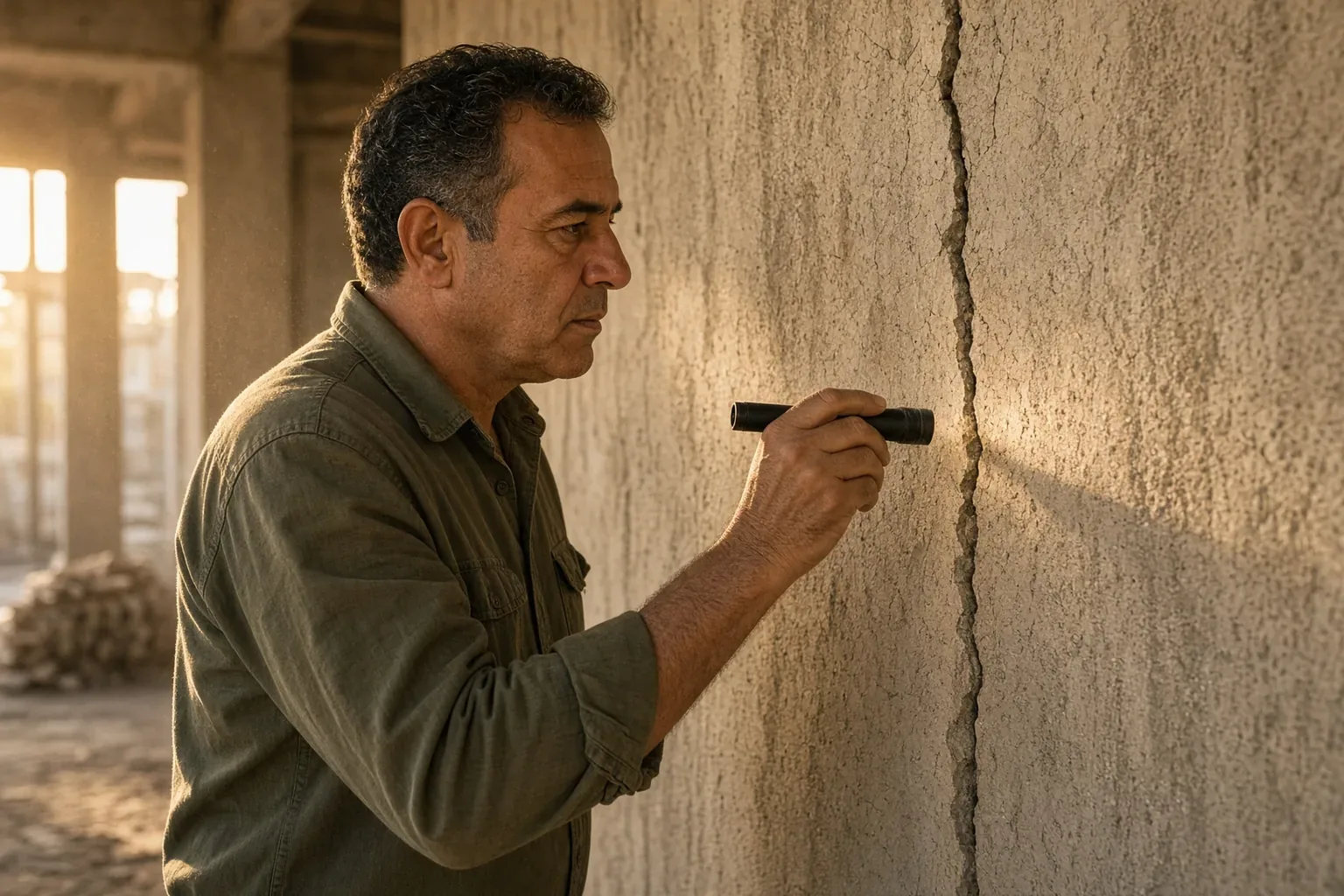
The expert inspects the building, identifies each defect and its cause, compares the work with the plans, the contract and the building code, and gives an opinion on the repair.
Under Federal Rule of Evidence 702, the opinion is admitted only if the party offering it convinces the court that it is more likely than not that the expert's specialized knowledge will help the jury, the testimony rests on sufficient facts or data, it comes from reliable principles and methods, and the expert applied them reliably to the facts of the case. The current wording of Rule 702 comes from the amendment adopted by the Supreme Court order of April 24, 2023, in force since December 1, 2023.
In a construction case the facts are the building and its paper record: drawings and specifications, shop drawings, permits and inspection reports, daily logs, photographs taken during construction, and the history of leaks or cracks after occupancy. The opinion names the defect and its location, gives the cause and links it to a trade, a design document or a material, and describes the repair, which a cost estimator then prices.
The reliability screening covers engineers and architects. In Kumho Tire Co. v. Carmichael, decided on March 23, 1999, the Supreme Court held that the judge's gatekeeping duty "applies to all expert testimony," including testimony based on "technical" and "other specialized" knowledge.
Which specialist inspects which part of a building?
The structural engineer covers foundations and the frame, the geotechnical engineer the soil, the architect the design and code compliance, the envelope consultant water intrusion, MEP engineers the building systems, the cost estimator the repair price.
Cracked slabs, deflected beams, failed connections and settlement go to a structural engineer. When the cause may lie in the ground, a geotechnical engineer tests the soil under the foundation and compares the results with the original soil report.
Leaks through windows, roofs, balconies and exterior walls go to a building envelope consultant, who can test an assembly with a controlled water spray and open it at selected points to see where the water travels.
Design questions go to an architect or to an engineer of the same discipline as the designer. That expert compares the drawings with the building code that applied to the project and with the practice of the profession at the time. Mechanical, electrical, plumbing and fire protection systems are examined by engineers of those disciplines.
The cost of repair is a separate opinion. A cost estimator prices the scope of repair that the engineers and the architect define. When the dispute is also about time, a scheduling expert analyzes the delay. One building can need several of these experts. Under Rule 26(a)(2)(B), each retained testifying expert prepares and signs his or her own written report.
How does an expert get into a building the other side controls?
Through a request under Rule 34(a)(2). A party may request entry onto land or other property that the responding party possesses or controls, to inspect, measure, survey, photograph, test or sample it.
Under Rule 34(a)(2), a party may serve on any other party a request "to permit entry onto designated land or other property possessed or controlled by the responding party, so that the requesting party may inspect, measure, survey, photograph, test, or sample the property or any designated object or operation on it." The party serves the request itself, without a court order.
The request must describe each item or category "with reasonable particularity" and "specify a reasonable time, place, and manner for the inspection and for performing the related acts." In a request to inspect a building, the items are units, rooms, roofs or elevations, and the manner is the list of methods the expert will use on site. The responding party answers in writing within 30 days after service, unless the parties stipulate to another time under Rule 29 or the court orders one.
The Advisory Committee note to the 1970 amendment recorded comments from the bar that "in the preparation of cases for trial it is occasionally necessary to enter land or inspect large tangible things in the possession of a person not a party." Rule 34(c) now sends that situation to Rule 45. Under Rule 45(a)(1)(A)(iii), a subpoena may command a person to "permit the inspection of premises" at a specified time and place. Units owned by people who are not parties to the case are reached this way.
The party or attorney responsible for issuing and serving the subpoena "must take reasonable steps to avoid imposing undue burden or expense" on the person subject to it, under Rule 45(d)(1).
Can the expert open walls and take samples?
Rule 34(a)(2) lists testing and sampling among the permitted acts. The parties set the method in the request or by agreement, and if they disagree the court may set the terms in a protective order.
Testing and sampling entered Rule 34 in 1970, and the Advisory Committee note of that year explained the change as an answer to "a need frequently encountered by parties in preparation for trial."
Opening a wall, cutting a core from a slab or removing a window changes the building. After that, the other side's experts can see the original assembly only in the photographs and video of the opening.
If the parties cannot agree on the protocol, the party or person from whom discovery is sought may move for a protective order. Under Rule 26(c)(1), the court may, for good cause, issue an order to protect a party or person "from annoyance, embarrassment, oppression, or undue burden or expense." The order may specify "terms, including time and place or the allocation of expenses, for the disclosure or discovery."
A repair made before the other side inspects removes the condition that a Rule 34 request would have covered.
Can the expert rely on inspections and tests done by others?
Yes. Under Rule 703 an expert may base an opinion on data that others collected. If experts in the field would reasonably rely on that kind of data, it need not be admissible.
Rule 703 reads: "An expert may base an opinion on facts or data in the case that the expert has been made aware of or personally observed. If experts in the particular field would reasonably rely on those kinds of facts or data in forming an opinion on the subject, they need not be admissible for the opinion to be admitted."
The Advisory Committee took a physician as its model. A physician "bases his diagnosis on information from numerous sources and of considerable variety, including statements by patients and relatives, reports and opinions from nurses, technicians and other doctors, hospital records, and X rays." On a construction project the comparable material is laboratory results on concrete cores, a surveyor's elevation readings and moisture readings taken by another consultant.
Rule 703 limits what the jury hears about that material. If the facts or data would otherwise be inadmissible, the party offering the opinion may disclose them to the jury "only if their probative value in helping the jury evaluate the opinion substantially outweighs their prejudicial effect."
Under Rule 26(a)(2)(B)(ii), the report lists the facts or data the expert considered, and a test report from another firm that the engineer relied on goes on that list.
How does a court test the expert's method?
Under Rule 702 the judge checks that the opinion rests on sufficient data, a reliable method and a reliable application, and since December 1, 2023 the judge must find each point more likely than not.
The Advisory Committee note to the 2023 amendment states that "many courts have held that the critical questions of the sufficiency of an expert's basis, and the application of the expert's methodology, are questions of weight and not admissibility. These rulings are an incorrect application of Rules 702 and 104(a)." The same note says that "each expert opinion must stay within the bounds of what can be concluded from a reliable application of the expert's basis and methodology." When an engineer opens some balconies and states a conclusion about all of them, the choice of openings and the link between the sample and the rest are part of the method the judge reviews.
In Kumho Tire, the Supreme Court described the aim of the screening as making sure that the expert employs "in the courtroom the same level of intellectual rigor that characterizes the practice of an expert in the relevant field," and Justice Breyer measured a tire failure analyst against that standard: no one had argued that the analyst, "were he still working for Michelin, would have concluded in a report to his employer that a similar tire was similarly defective" on the grounds he used in court.
What does the other side learn about the expert?
For a testifying expert, the report, qualifications, publications from 10 years, testimony from 4 years and compensation. A consultant who will not testify is ordinarily protected from discovery under Rule 26(b)(4)(D).
Under Rule 26(a)(2)(B), a retained testifying expert prepares and signs a report with all opinions and their basis, the facts or data considered, exhibits, qualifications with "a list of all publications authored in the previous 10 years," a list of cases with testimony at trial or by deposition in the previous 4 years, and the compensation for the study and testimony. Absent a stipulation or a court order, the disclosure is due at least 90 days before the date set for trial.
An owner or a contractor may hire an engineer to investigate before a suit is filed. Under Rule 26(b)(4)(D), a party ordinarily may not, by interrogatories or deposition, discover facts known or opinions held by an expert retained "in anticipation of litigation or to prepare for trial and who is not expected to be called as a witness at trial." The exceptions are Rule 35(b) and a showing of "exceptional circumstances under which it is impracticable for the party to obtain facts or opinions on the same subject by other means."
Drafts of reports are protected under Rule 26(b)(4)(B), and communications between the attorney and an expert who must provide a report are protected under Rule 26(b)(4)(C), except communications about compensation, facts or data the attorney provided and the expert considered, and assumptions the attorney provided and the expert relied on.
The testifying expert may be deposed after the report is provided, under Rule 26(b)(4)(A). Unless manifest injustice would result, Rule 26(b)(4)(E) requires the party seeking discovery to pay the expert a reasonable fee for the time, and for discovery of a consultant under Rule 26(b)(4)(D) also to pay the other party a fair portion of the fees and expenses it reasonably incurred in obtaining the expert's facts and opinions. Under Rule 30(d)(1), a deposition is limited to 1 day of 7 hours unless the parties stipulate or the court orders otherwise.
What does IAE do in a construction case?
IAE searches for an independent civil engineer or cost estimator for the case. Within 5 business days the firm receives 2-3 candidates with CVs, hourly rates and lists of prior testimony. The search fee is $2,000.
The IAE expert witness page lists civil engineers and cost estimators for construction defects, building codes, delays and costs. A request names the field of expertise, the case type, the state and court, the firm's side, the expert disclosure deadline and the parties with their counsel. For a building dispute the case type is "Construction," and the short description states the type of structure, the state and the question: defect, delay, cost or code compliance.
Within 1 business day IAE replies whether it can search in that field by that deadline. Candidate names and CVs come after the $2,000 search fee is paid in advance.
Each candidate confirms in writing that he or she has no ties to the parties or their counsel, which is why the request asks for the list of parties and counsel. In a construction case that list can include the owner, the general contractor, subcontractors and the design firm. For each candidate the firm receives a CV, hourly rates, testimony in the last 4 years and publications in the last 10 years, the lists that Rule 26(a)(2)(B) requires. If no candidate fits, the second search is free. If IAE finds no candidates, it refunds the fee.
The expert bills the firm directly or through IAE under the agency option. Under that option the firm receives invoices from IAE alone, for hours at the expert's rate plus $100 per hour, for fixed fees, minimum charges and surcharges plus 40%, and for expenses at cost, with a retainer and monthly invoices paid by ACH or wire transfer within 15 days. The search fee is credited to the first invoice. The expert's hourly rate never depends on the outcome of the case or on the content of testimony. IAE is not a law firm: case strategy and the decision to retain an expert stay with the attorney.
Sources
- Federal Rule of Civil Procedure 34, Producing Documents, Electronically Stored Information, and Tangible Things, or Entering onto Land, for Inspection and Other Purposes
- Federal Rule of Civil Procedure 45, Subpoena
- Federal Rule of Civil Procedure 26, Duty to Disclose; General Provisions Governing Discovery
- Federal Rule of Civil Procedure 30, Depositions by Oral Examination
- Federal Rule of Evidence 702, Testimony by Expert Witnesses, with Committee Notes
- Federal Rule of Evidence 703, Bases of an Expert, with Advisory Committee Notes
- Supreme Court of the United States, order amending the Federal Rules of Evidence, April 24, 2023
- Kumho Tire Co. v. Carmichael, No. 97-1709, decided March 23, 1999, opinion of the Court (LII, Cornell Law School)
Read also
All articles
Spearin doctrine: when does the owner bear the cost of defective plans and specifications, and what does the contractor's expert have to prove?
Under the Spearin doctrine, an owner who gives the contractor plans and specifications impliedly warrants that work built to them will be adequate Sergei Voronin
Differing site conditions claim: what must the contractor prove, and which experts carry the proof?
A differing site conditions claim asks the owner to pay for ground the contract did not describe. On federal projects the clause is FAR 52.236-2Sergei Voronin
SB 800 construction defect claims in California: which standards apply, what comes before a lawsuit and what must the expert prove?
SB 800, enacted in 2002, governs construction defect claims against builders of new homes in California. Civil Code section 896 lists buildingSergei VoroninExpert witnesses
Need an expert witness for your case?
Describe the question, the case type and the court. Within 5 business days you receive 2-3 candidates with CVs, hourly rates and lists of prior testimony.
