
Expert witnesses
Differing site conditions claim: what must the contractor prove, and which experts carry the proof?
A differing site conditions claim asks the owner to pay for ground the contract did not describe. On federal projects the clause is FAR 52.236-2, and on June 30, 2026 the Federal Circuit affirmed the denial of a $3,948,833 claim on a Louisiana canal because no boring log covered the bank that failed. The contractor wins or loses on what the bid documents said, and geotechnical, scheduling and cost experts supply most of that proof.
What is a differing site conditions claim?
It is a request for an equitable adjustment of price or time because the physical conditions at the site differed materially from those the contract indicated (Type I) or from those ordinarily encountered in similar work (Type II).
FAR 52.236-2 (Apr 1984) is the federal Differing Site Conditions clause, prescribed in FAR 36.502. Paragraph (a) names two kinds of conditions. The first is subsurface or latent physical conditions at the site which differ materially from those indicated in the contract. The second is unknown physical conditions at the site, of an unusual nature, which differ materially from those ordinarily encountered and generally recognized as inhering in work of the character provided for in the contract. Boards and courts call these Type I and Type II.
Under paragraph (b) the Contracting Officer investigates the site conditions promptly after receiving notice. If the conditions differ materially and cause an increase or decrease in the cost of, or the time required for, performing any part of the work, an equitable adjustment is made and the contract is modified in writing.
The decisions in this article read the federal text. On a state or private project the contract in the case controls: the claim rests on whatever differing site conditions clause that contract contains, and its wording may differ from FAR 52.236-2.
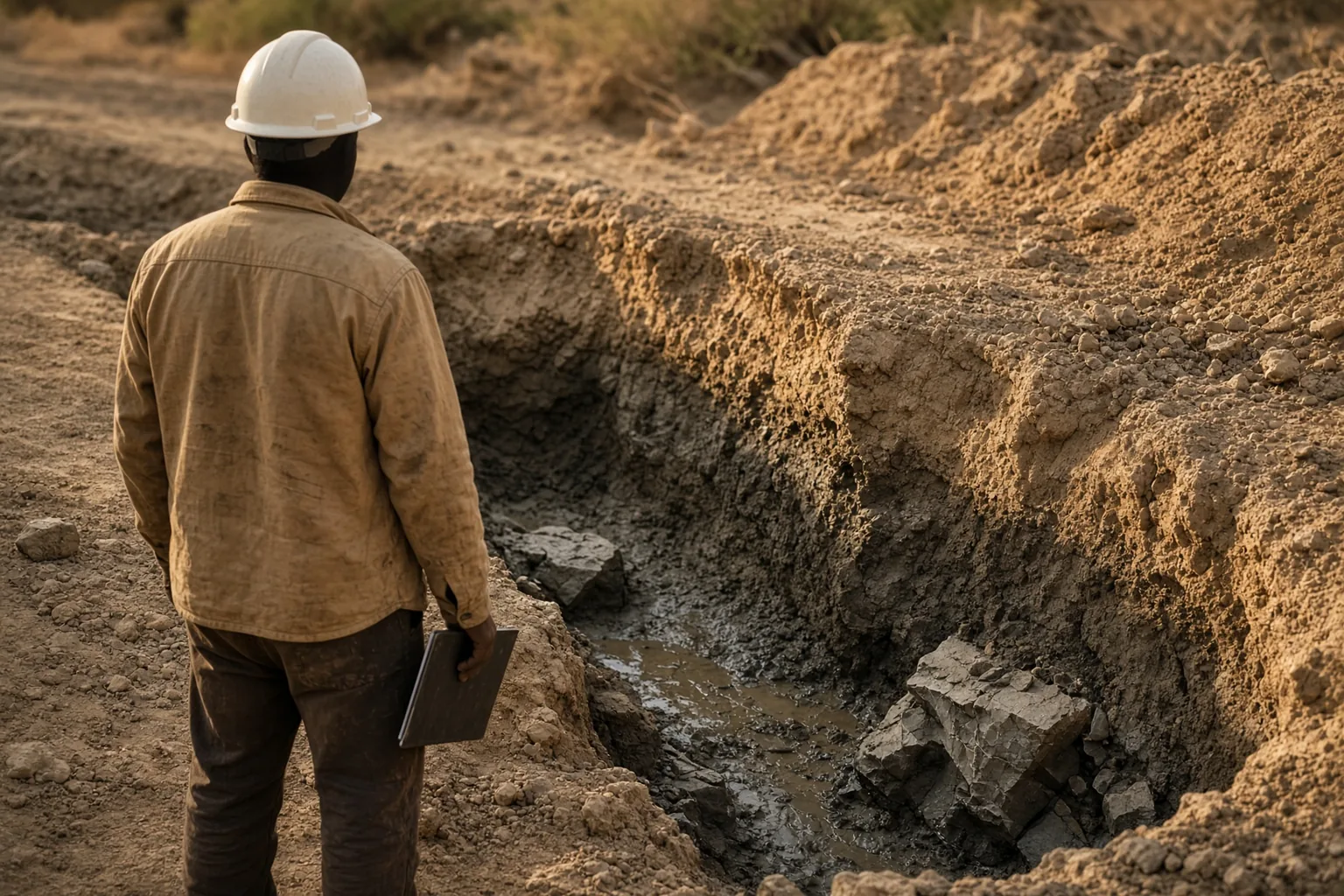
The claim is usually about soil, rock, groundwater, buried structures or debris. In ASBCA No. 53311, decided June 22, 2006, the Armed Services Board of Contract Appeals found a Type I condition on the Keyhole Canal project in Jefferson Parish, Louisiana: the quantity and variability of silt in the concrete segment caused the canal banks to slough. The Board held the contractor entitled to an equitable adjustment for the increased costs, with quantum left for later proceedings.
What must the contractor prove for a Type I claim?
Four elements: the contract indicated conditions that differ materially from those encountered, the encountered conditions were reasonably unforeseeable, the contractor reasonably relied on its reading of the contract, and the contractor was damaged as a result.
The Board in ASBCA No. 53311 took the elements from Comtrol, Inc. v. United States, 294 F.3d 1357, 1362 (Fed. Cir. 2002). The contractor must prove that the conditions indicated in the contract differ materially from those actually encountered during performance, that the conditions actually encountered were reasonably unforeseeable, that it reasonably relied on its interpretation of the contract and contract-related documents, and that it was damaged as a result of the material variation.
In Hamp's Construction LLC v. Secretary of the Army, No. 2024-1528 (Fed. Cir. June 30, 2026), the court stated the threshold question first. Citing Renda Marine, 509 F.3d at 1376, it held that the contractor must show that the contract contained some identification of the conditions to be encountered at the site. Citing P.J. Maffei, the court added that the indication need not be explicit or specific, but there must be "reasonably plain or positive indications" in the contract documents.
The court reads the documents from the position of a reasonable and prudent contractor (H.B. Mac, Inc. v. United States, 153 F.3d 1338, 1345 (Fed. Cir. 1998)). Foreseeability is a separate element, judged in light of all information available to the contractor when it bid, and it is a question of fact. On appeal from a board, findings of fact stand unless they are not supported by substantial evidence (41 U.S.C. 7107(b)(2), as quoted in Hamp's).
Damages follow the material difference. A contractor that proves the condition but cannot separate its extra cost from its own inefficiency recovers little, which is why the cost and schedule experts are retained at the same time as the geotechnical engineer.
Which contract documents count as an indication of site conditions?
Boring logs, soil reports, cross sections, drawings and specifications can all be indications. In Hamp's, logs from other parts of the site did not indicate conditions on the bank that failed, and silence was not a representation.
The Army Corps of Engineers solicited a flood control project on the Trapp Canal in Jefferson Parish, Louisiana, in July 2012. The solicitation included cross sections and ten boring logs from 2008: eight on the east side of the canal and two on the west side. In May 2013, preparing the southern quadrants, the contractor found that part of the southwest bank had collapsed, leaving a depression of approximately 100 to 200 feet by 25 feet, found four more failure areas, and switched to equipment working from barges.
The contractor asked for $3,948,833 and 237 calendar days. The Board denied the appeal on February 2, 2024, and the Federal Circuit affirmed. It held that a reasonable contractor would not read the 2008 logs from other parts of the site as indicating conditions on the southwest bank. It repeated from H.B. Mac that the reasonableness of relying on distant borings cannot be decided by a bright line rule and depends on the geologic and topographic features of each site.
Part of the record against the contractor came from its own geotechnical expert. Dr. Traughber wrote that the Corps presented no boring log information for the west side canal region and that soil conditions were "markedly different on the east and west sides." Those statements supported the finding that the east side logs said nothing about the west bank. The court treated as forfeited the argument that the absence of borings was itself a representation, because the contractor had not raised it before the Board.
The contractor also pointed to a solicitation term that had prohibited barges. An amendment of August 3, 2012 removed it before the bid and said the work may have to be performed from a floating platform, barge or other specialized equipment, so the removed term indicated nothing. The court concluded that the contract documents, read as a whole, gave no indication of conditions on the southwest bank, and it did not need to reach the severity of the bank failures.
What does a Type II claim require?
Proof that the condition was unknown, of an unusual nature, and materially different from what is ordinarily encountered in work of the same character. No contract indication is needed, but the benchmark has to be proved by evidence.
The second category of FAR 52.236-2(a) does not compare the site with the contract. It compares the site with ordinary experience in similar work. The contractor therefore has no contract statement to point to, and it has to prove what is ordinarily encountered and generally recognized as inherent in that kind of work.
That benchmark is proved with evidence about the work and the region: a geotechnical engineer or geologist describes what records and published data showed for similar work, what was encountered and how far it departs from that. The clause text sets the limits. The condition has to be unknown and of an unusual nature, so a condition ordinarily encountered in that kind of work does not qualify under paragraph (a)(2).
In ASBCA No. 53311 the Board quoted the whole clause, including the second category, but decided the appeal as a Type I claim. It found that the borings gave "some indication of silt, but not enough to raise serious concern to a bidder" and that the drawings did not show the quantity or variability of the silt encountered. When both theories are pleaded, the expert report usually addresses both: what the documents indicated, and what an experienced bidder would have expected without them.
When must the contractor give notice?
Promptly, and before the conditions are disturbed, in writing to the Contracting Officer. No adjustment is allowed without the required notice unless the Contracting Officer extends the time, and none after final payment.
Paragraph (a) of FAR 52.236-2 requires the contractor to give written notice promptly and before the conditions are disturbed. The purpose is practical: the Government's investigation under paragraph (b) needs the ground as it was found. Once a slope has been regraded or an excavation backfilled, the parties argue from photographs and logs.
Under paragraph (c) no request for an equitable adjustment is approved unless the contractor has given the required written notice, but the Contracting Officer may extend the time for notice. Paragraph (d) bars any request made after final payment under the contract.
For the expert, the notice period is when the evidence is made. A geotechnical engineer on site at that stage can log the exposed soil, take samples, photograph the face of the excavation with scale and location, record groundwater levels and compare them with the contract borings. Daily reports, equipment logs and survey data from those days become the facts or data that a later expert report under Rule 26(a)(2)(B)(ii) must list.
Does the site investigation clause defeat the claim?
Not by itself. FAR 52.236-3 puts on the contractor what a site inspection would reveal, but in Metcalf (2014) the Federal Circuit held that a duty to investigate after award left pre-bid errors with the Government.
FAR 52.236-3 has the contractor acknowledge that it examined the site, including the surface and subsurface materials or obstacles reasonably ascertainable from an inspection of the site, all exploratory work done by the Government, and the drawings and specifications. Failure to do so does not relieve the contractor from responsibility for estimating properly the difficulty and cost of the work. Paragraph (b) adds that the Government assumes no responsibility for conclusions or interpretations made by the contractor from the information it provides.
In Metcalf Construction Co. v. United States, No. 2013-5041 (Fed. Cir. Feb. 11, 2014), the Navy awarded a contract of just under $50 million to design and build 212 housing units at Marine Corps Base Hawaii. A pre-bid soil report found slight expansion potential, and the request for proposals called it "for preliminary information only." The contractor's own consultant, Geolabs, reported about five months after the post-award soil investigation began in January 2003 that the swelling potential was moderate to high.
The trial court read the contractor's duty to investigate after award as cancelling the Government's pre-bid representations. The Federal Circuit held that reading wrong: the investigation requirement did not tell bidders that they could not rely on the Government's affirmative statements, which were made for use in pricing. It noted that the differing site conditions clause exists to take some of the gamble on subsurface conditions out of bidding, and it vacated the judgment and remanded.
Hamp's turned on a different point: there the contract made no representation about the failed bank at all. Together the two decisions set the expert's first task, which is to read every document the bidders had and state exactly what each one said about the ground where the problem arose.
Which experts does a differing site conditions claim need?
A geotechnical engineer or geologist for the condition and its foreseeability, a scheduling expert for the time, and a cost expert for the price. Each answers a different element, and each report is tested separately.
The geotechnical engineer compares the contract borings, soil reports and cross sections with what was encountered, explains whether the distance between borings and the geology made the borings a fair indication for the area in dispute, and gives the material difference in measurable terms: soil type, strength, moisture, groundwater level, rock elevation or the extent of buried obstructions.
The scheduling expert ties the condition to the delay. The claim in Hamp's asked for 237 calendar days; a claim of that kind needs an analysis of which activities on the critical path the condition affected and for how long, separated from delays the contractor caused. The cost expert separates the extra cost of the changed method, such as moving to barge-mounted equipment, from costs the contractor would have incurred anyway.
In federal court, and in boards that apply similar standards, each opinion must meet Rule 702 of the Federal Rules of Evidence: since the 2023 amendment the proponent must show the court that it is more likely than not that the testimony rests on sufficient facts or data, comes from reliable principles and methods, and applies those methods reliably to the facts of the case. A report under Rule 26(a)(2)(B) states all opinions with their basis, the facts or data considered, exhibits, qualifications with publications from the previous 10 years, testimony from the previous 4 years and compensation.
The record in Hamp's is a reminder that an expert's general statements about the site are read against the client. A statement that the two banks differed markedly helped the Government argue that the east side logs indicated nothing about the west bank. Expert reports on a Type I claim are written element by element, with the contract indication stated first.
How does IAE find an expert for a differing site conditions claim?
Choose the case type Construction and describe the project, the contract clause, the condition encountered and the forum. Within 5 business days IAE sends 2-3 candidates with CVs, hourly rates and testimony lists.
The IAE page on construction expert witnesses lists 7 specialties: structural engineering, geotechnical engineering, architecture, building envelope, MEP systems, cost estimating and scheduling. On that page geotechnical engineers test foundation soil, scheduling experts analyze delay and cost estimators price the scope the engineers define, and home office overhead for delay on a federal contract is computed with the Eichleay formula. Those are the three kinds of proof a differing site conditions claim needs.
The request asks for the field, the case type, the court or board, the firm's side and the expert disclosure deadline, and for the parties and their counsel for the conflict check. Privileged information stays out of the request. IAE replies within 1 business day whether it can search in that field by the deadline. The search costs $2,000 per case, paid in advance, and candidate names and CVs come after payment.
Each candidate confirms in writing that he or she has no ties to the parties or their counsel, and the candidate materials include testimony in the last 4 years and publications in the last 10 years, the lists Rule 26(a)(2)(B) requires. If none of the candidates fits, the second search is free. IAE is not a law firm: the notice, the request for equitable adjustment and the claim stay with the contractor's or the owner's counsel.
Sources
- FAR 52.236-2 Differing Site Conditions (Apr 1984), acquisition.gov
- FAR 52.236-3 Site Investigation and Conditions Affecting the Work (Apr 1984), acquisition.gov
- Hamp's Construction LLC v. Secretary of the Army, No. 2024-1528 (Fed. Cir. June 30, 2026)
- Metcalf Construction Co. v. United States, No. 2013-5041 (Fed. Cir. Feb. 11, 2014)
- Armed Services Board of Contract Appeals, ASBCA No. 53311 (June 22, 2006)
- Federal Rules of Evidence, Rule 702 (LII, Cornell Law School)
- Federal Rules of Civil Procedure, Rule 26 (LII, Cornell Law School)
Read also
All articles
Spearin doctrine: when does the owner bear the cost of defective plans and specifications, and what does the contractor's expert have to prove?
Under the Spearin doctrine, an owner who gives the contractor plans and specifications impliedly warrants that work built to them will be adequate Sergei Voronin
SB 800 construction defect claims in California: which standards apply, what comes before a lawsuit and what must the expert prove?
SB 800, enacted in 2002, governs construction defect claims against builders of new homes in California. Civil Code section 896 lists buildingSergei Voronin
Florida construction defect statute of repose: when does the 7-year period start, and what can still be filed?
In Florida an action founded on the design, planning or construction of an improvement to real property must be commenced within 7 years afterSergei VoroninExpert witnesses
Need an expert witness for your case?
Describe the question, the case type and the court. Within 5 business days you receive 2-3 candidates with CVs, hourly rates and lists of prior testimony.
