
Examinations
Dangerous road condition or driver error: what does an accident expert examine when the road is blamed?
When a crash is blamed on the road, the expert has two tasks: measure the condition and show whether it, rather than speed or inattention, caused the crash. In California a public entity answers for a dangerous condition of its property only if the plaintiff also proves that an employee created it or that the entity had notice in time to fix it. Federal law keeps some highway safety records out of court altogether.
What must a plaintiff prove against a public entity for a dangerous road condition in California?
That the property was in a dangerous condition at the time of the injury, that the condition proximately caused the injury, that it created a reasonably foreseeable risk of that kind of injury, and either employee fault or notice.
California Government Code section 835 sets the elements. Except as otherwise provided by statute, a public entity is liable for injury caused by a dangerous condition of its property if the plaintiff establishes that the property was in a dangerous condition at the time of the injury, that the injury was proximately caused by the dangerous condition, and that the dangerous condition created a reasonably foreseeable risk of the kind of injury which was incurred.
The plaintiff must then prove one of two further facts. Under section 835(a), a negligent or wrongful act or omission of an employee of the public entity within the scope of employment created the dangerous condition. Under section 835(b), the public entity had actual or constructive notice of the dangerous condition under section 835.2 a sufficient time before the injury to have taken measures to protect against it.
Each element has an engineering side. Whether the condition existed at the time of the crash depends on photographs, measurements and repair records. Proximate cause depends on the reconstruction: speed, path and the point at which the vehicle met the defect. Notice depends on how long the condition had been there and what the agency's inspections would have shown.
How is notice of the road condition proved?
Actual notice requires actual knowledge of the condition and knowledge, or reason to know, of its danger. Constructive notice requires a condition that existed long enough and was obvious enough that the entity, with due care, should have found it.
Government Code section 835.2(a) defines actual notice: the public entity had actual knowledge of the existence of the condition and knew or should have known of its dangerous character. Section 835.2(b) defines constructive notice. It applies only if the plaintiff establishes that the condition had existed for such a period of time and was of such an obvious nature that the public entity, in the exercise of due care, should have discovered the condition and its dangerous character.
Section 835.2(b)(1) makes admissible evidence on whether the condition and its dangerous character would have been discovered by an inspection system reasonably adequate to inform the entity whether the property was safe for the uses the entity used or intended others to use it for, and for uses the entity actually knew others were making. Adequacy is measured against the practicability and cost of inspection weighed against the likelihood and magnitude of the potential danger. Section 835.2(b)(2) makes admissible evidence on whether the entity maintained and operated such an inspection system with due care and did not discover the condition.
For the expert this turns notice into a timeline. Photographs from street imaging services, prior complaints, work orders and the agency's inspection schedule show when the defect could have been seen. The age of a pothole or a pavement drop-off can also be estimated from its edges, from debris in it and from weathering, and the expert states how that estimate was made.
What does the expert measure at the scene?
The defect itself, its location in the lane, the sight distance to it, the signs and markings that warned or failed to warn of it, and the lighting and drainage. Each measurement is tied to photographs taken with a scale.
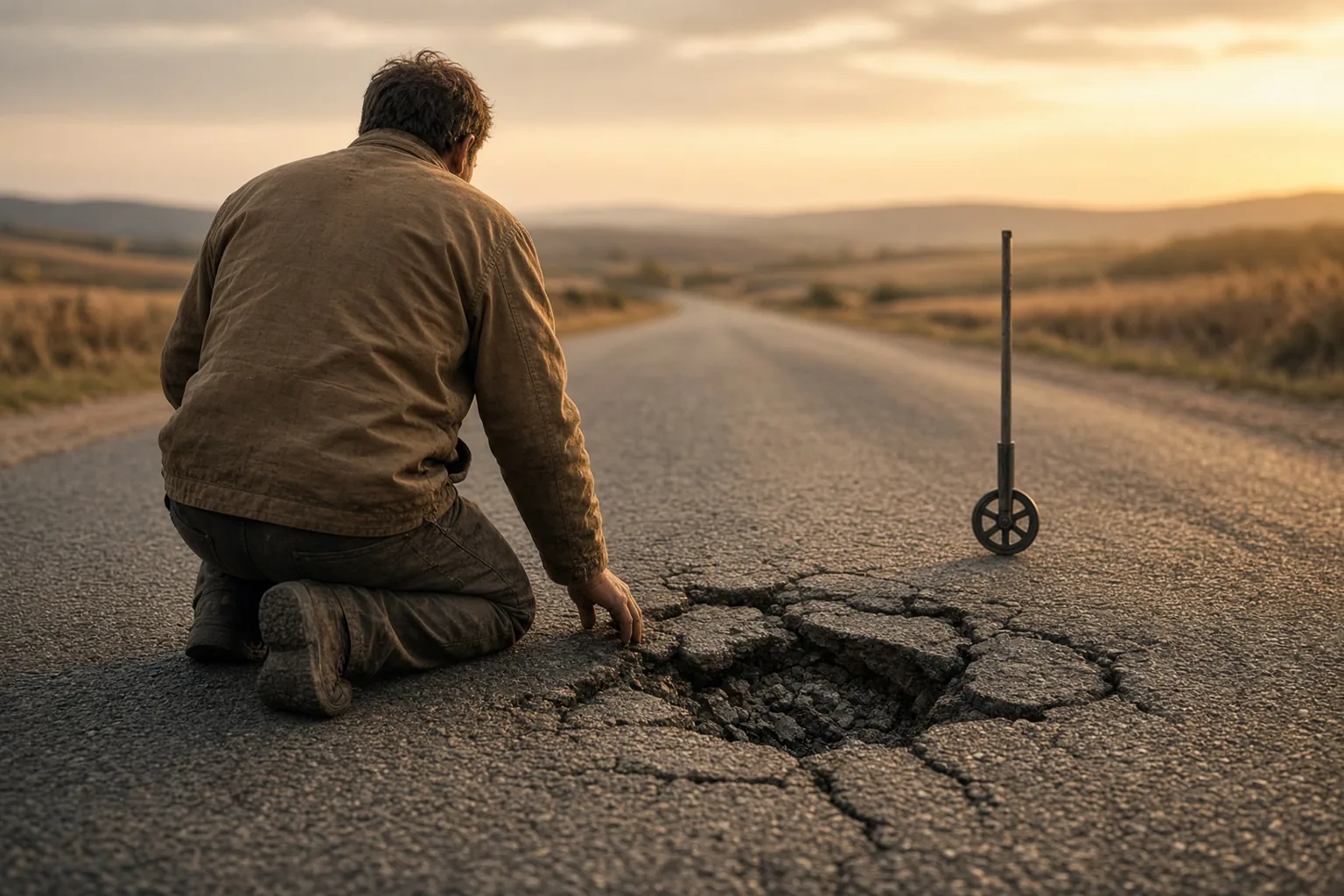
A road condition claim needs dimensions. For a pothole or a pavement drop-off, the expert measures length, width and depth and records the edge profile. For a shoulder drop, the height difference between the travel lane and the shoulder is measured along the run of the defect. For a worn or missing marking, the expert documents what remains and photographs it at the hour of the crash where lighting matters.
Then the expert fixes the defect's position relative to the vehicle's path. A defect in the wheel path of a lane is met by most traffic; one at the edge is met by a vehicle that has already drifted. The tire marks, gouges and final rest positions from the police diagram and the scene photographs place the vehicle at the defect.
Sight distance follows. The expert measures from a driver's eye height along the approach to the point where the defect or the warning sign comes into view, in the light conditions of the crash. These measurements decide whether a driver at a lawful speed could see the hazard in time to react.
Time works against the measurements. Agencies repair defects after a crash, and a repaired pothole cannot be measured. Counsel asks early for the condition to be photographed and measured and, where the agency is a party, for repair records to be kept.
Which standard applies to signs, signals and pavement markings?
The Manual on Uniform Traffic Control Devices. Under 23 CFR 655.603(a) it is the national standard for traffic control devices on roads open to public travel, and state manuals must substantially conform to it.
Under 23 CFR 655.603(a), the MUTCD approved by the Federal Highway Administrator is the national standard for all traffic control devices installed on any street, highway or bicycle trail open to public travel. The rule covers toll roads and roads within shopping centers, airports and similar facilities where the public may travel without access restrictions. It excludes private roads within gated properties where access is restricted at all times, parking areas and the driving aisles within them, and private highway-rail grade crossings.
Under section 655.603(b), state manuals and supplements must be in substantial conformance with the national MUTCD, which means that they meet at least its Standard statements. States must adopt changes issued by the FHWA within two years of the effective date of the final rule. Under section 655.603(d)(1), each state and federal agency maintains a program for the systematic upgrading of substandard traffic control devices, and under (d)(2) federal-aid projects on new or reconstructed highways are not opened to the public for unrestricted use until the appropriate devices are installed and functioning.
In a road condition case the expert compares what was in place with what the manual in force required: whether a warning sign was required for the condition, where it should have stood, whether a marking was required and visible. The comparison uses the edition the state had adopted on the date of the crash.
Can the agency's own safety studies be used against it?
Not those compiled for federal highway safety programs. Under 23 U.S.C. 407, such reports and data are neither discoverable nor admissible in federal or state court in a damages action arising at a location they address.
Section 407 of Title 23 provides that, notwithstanding any other provision of law, reports, surveys, schedules, lists or data compiled or collected for the purpose of identifying, evaluating or planning the safety enhancement of potential accident sites, hazardous roadway conditions or railway-highway crossings under sections 130, 144 and 148, or for developing any highway safety construction improvement project which may be implemented using federal-aid highway funds, are not subject to discovery or admitted into evidence in a federal or state court proceeding, or considered for other purposes, in any action for damages arising from any occurrence at a location mentioned or addressed in them.
The provision was enacted as section 409 in 1987 and renumbered section 407 by Public Law 117-58 on November 15, 2021. The Supreme Court decided its reach under the old number in Pierce County v. Guillen, 537 U.S. 129, on January 14, 2003. Clementina Guillen-Alejandre died in a 1996 crash at the intersection of 168th Street East and B Street East in Pierce County, Washington. The county had sought federal Hazard Elimination Program funds for the intersection, was refused, and was approved three weeks after the crash. Counsel for the Guillen plaintiffs asked for the accident history of the intersection, and the county refused under section 409.
Justice Thomas wrote for the Court. The statute protects information compiled or collected for the federal safety purposes it names. It does not protect information originally compiled or collected for other purposes and held by agencies not pursuing those objectives, even if a copy was later sent to the county for a funding application. The Court also held that section 409 and its 1995 amendment fall within Congress's Commerce Clause power.
Which records can the expert still use?
Records created for other purposes and obtained from the agency that created them, such as crash reports held by a police agency, under the reading in Guillen. The expert's own measurements and photographs are outside section 407 too.
Guillen draws the line by purpose and holder. A crash report written by a law enforcement agency to document a collision was compiled for a purpose other than federal safety planning. The Court held that such information, held by an agency not pursuing the section 409 objectives, is not protected merely because a copy was sent to a county engineering office. Counsel therefore asks the police agency for its reports, not the road agency's safety file.
The same logic applies to records each office keeps for its own work. Whether a particular maintenance log or complaint file falls inside or outside the statute depends on why it was compiled, and the parties litigate that question document by document. The expert lists which records the opinion relies on and where each came from, so that the court can rule on any objection without striking the whole report.
The expert's field work is independent of the agency's files. Measurements of the defect, photographs, sight distance tests and the reconstruction are made for the case and are not records compiled for a federal safety program.
How does the expert separate the road's role from the driver's?
By reconstructing the crash with the defect and without it. If the vehicle would have crashed anyway at its speed, the defect did not cause the crash; if the defect changed the vehicle's path or grip, it did.
The reconstruction establishes speed, path and timing from the tire marks, crush, final positions and any event data recorder download. The expert then asks what the defect did to the vehicle. A wheel dropping off a pavement edge can pull the vehicle; a deep pothole can damage a tire and wheel and change steering; standing water can reduce grip. Each mechanism leaves its own evidence on the vehicle and the road.
The second question is whether a driver could have seen and avoided the hazard. The sight distance measured at the scene, the speed from the reconstruction and a perception-response time are used to compute whether the driver had time to slow or steer. The expert states the reaction time used and its source, because the result depends on it.
Government Code section 835 asks whether the condition created a reasonably foreseeable risk of the kind of injury incurred and whether it proximately caused the injury. The reconstruction supplies the facts for those findings. The jury decides them.
When will a court accept the road expert's opinion?
When the opinion rests on sufficient facts and reliable methods reliably applied. Rule 702 sets that test in federal court, and state courts apply their own rules on expert evidence.
Federal Rule of Evidence 702 requires the proponent to show the court that it is more likely than not that the expert's knowledge will help the trier of fact, that the testimony is based on sufficient facts or data, that it is the product of reliable principles and methods, and that the opinion applies those methods reliably to the facts of the case.
A road condition opinion meets the first conditions with measurements, photographs and a reconstruction. It is open to attack where the expert measured the defect after it was repaired, relied on a manual edition the state had not adopted, or assumed a speed the evidence does not support. The committee note to the 2023 amendment says that some of these challenges go to weight rather than admissibility once the court finds the rule's requirements met.
What does IAE do when a crash is blamed on the road?
IAE prepares an expert report on the client's questions about the crash or a review of the opposing expert's report, in up to 5 business days, with a 48-hour rush for cases with tight deadlines.
The IAE accident reconstruction service answers how the vehicles moved before impact, what the event data recorder shows about speed and braking, and whether the damage on each car fits the claimed crash, for injury and property damage cases in US courts. The engineer matches crush on both vehicles with tire marks, gouges, the police diagram and video, and sets the point of impact, the impact angle and pre-crash speeds. IAE confirms the questions with the client before work starts.
The client sends the report or the case materials and describes the task. The secretariat confirms receipt the same day. Within one business day IAE confirms the format, the cost, the deadline and the specialist from its registry, and the client approves the candidate and the CV before work starts. The draft is checked for facts, and the signed PDF is issued in up to 5 business days.
Every specialist is a member of the public IAE registry and passed the council's attestation under the published Criteria Matrix; the Member ID in the document can be checked by QR code. The specialist confirms in the document that he or she has no interest in the outcome. Neither IAE nor the engineer guarantees the outcome, and IAE is not a law firm.
Sources
- California Government Code section 835
- California Government Code section 835.2
- 23 CFR 655.603, Standards (LII, Cornell Law School)
- 23 U.S.C. 407, Discovery and admission as evidence of certain reports and surveys (LII, Cornell Law School)
- Pierce County v. Guillen, 537 U.S. 129 (2003) (LII, Cornell Law School)
- Federal Rules of Evidence, Rule 702, with committee notes (LII, Cornell Law School)
Read also
All articles
Sideswipe or lane-change crash: how does an expert establish which vehicle left its lane?
Two cars travelling in the same direction touch sides, and each driver says the other drifted over. Traffic codes put the duty on the driver who Sergei Voronin

Motorcycle accident reconstruction: how does the expert find speed, position and visibility without a car's data recorder?
In 2024, 6,228 motorcyclists were killed on US roads, 16 percent of all traffic deaths, according to NHTSA. Many of these crashes turn on threeSergei Voronin
Who ran the red light? How does an accident reconstructionist analyze signal timing?
When two drivers each say the light was green, the answer comes from timing: when each signal phase changed, where each vehicle was at that momentSergei VoroninExpert examinations
Ready to discuss your case?
Send the materials: the secretariat will confirm the format, cost, deadline and the specialist within one business day.
