
Examinations
Deepfake audio in court: how is a recording claimed to be fake authenticated and examined?
A claim that a recording is a deepfake is an authentication dispute under Federal Rule of Evidence 901, and federal courts have no special rule for it. In May 2025 the Advisory Committee on Evidence Rules found an amendment not warranted for now and kept a draft Rule 901(c) in reserve. The party that disputes the recording needs evidence, and that evidence usually comes from an audio examiner.
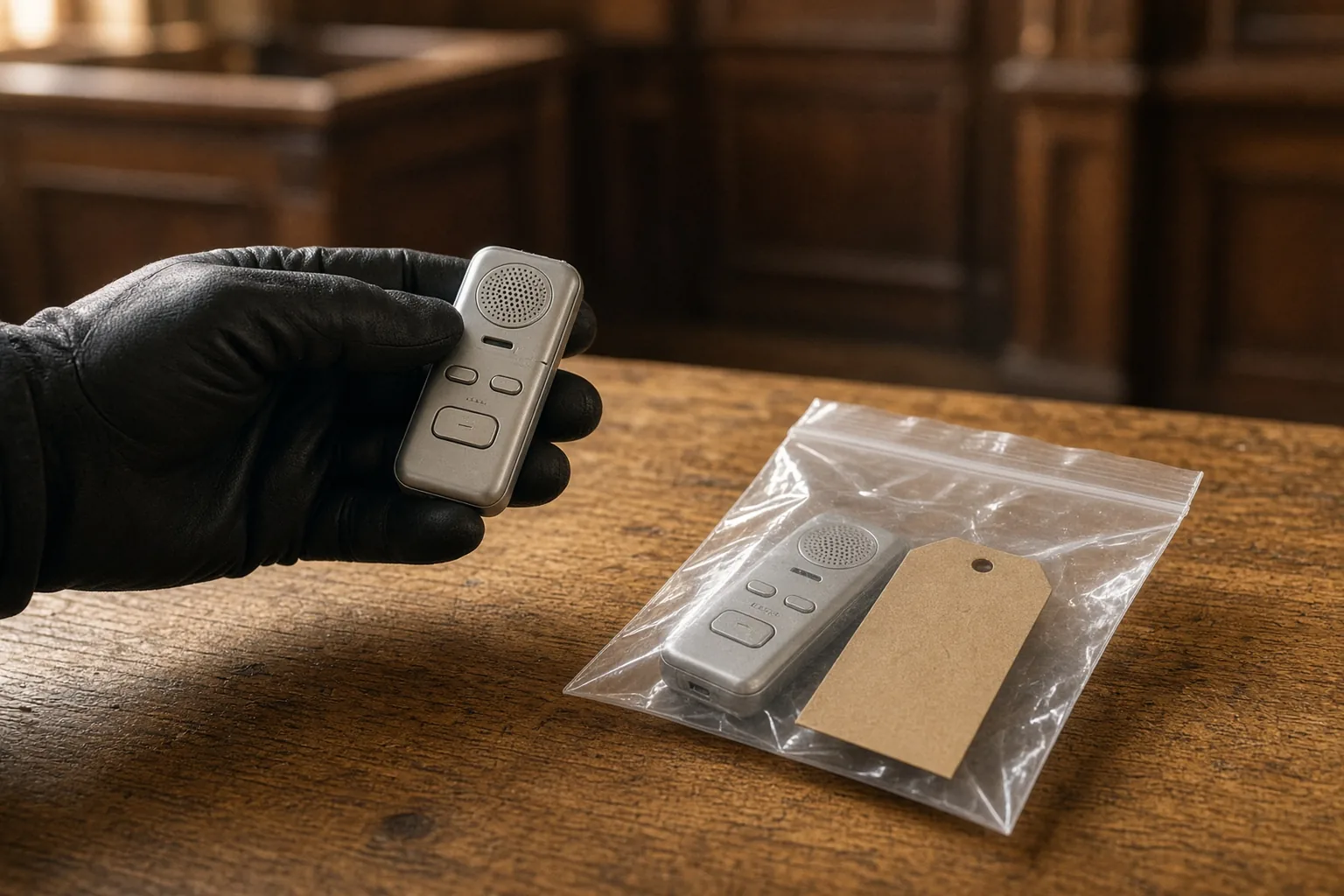
What do parties argue about when a recording is called a deepfake?
Either that the recording offered against them was synthesized or altered to sound like a real person, or, from the other side, that a genuine recording is being called fake to escape it.
A deepfake recording is speech that sounds like a particular person but was not spoken by that person in the conversation the recording claims to capture. The dispute reaches court in two forms. In the first, a party offers a voicemail, a call recording or a voice message, and the other side says the voice was synthesized or the words were assembled from other recordings. In the second, a party offers a genuine recording, and the other side says it is fake because the claim alone may raise doubt.
The Advisory Committee on Evidence Rules, chaired by Judge Jesse M. Furman, addressed both forms in its report of May 15, 2025. For the second form the draft committee note uses the term "liar's dividend" and states that "rules are in place to combat claims that 'you can't believe anything you see.'"
Each form leads to the same factual question: was the recording made by the device, at the time and in the conversation its proponent describes? That is the question a forensic audio examiner answers from the file, the device and comparison recordings.
What does a party need to authenticate a recording under Rule 901?
Evidence sufficient to support a finding that the recording is what the proponent says it is. The 2025 committee report calls this traditionally a low standard of admissibility under Rule 901(a).
Rule 901(a) does not require proof that a recording is genuine. The 2025 report describes the standard as "evidence sufficient to support a finding that the item is what the proponent says it is" and states that authenticity "traditionally is governed by a low standard of admissibility under Rule 901(a)."
That low threshold is the reason a deepfake claim worries courts. A synthesized voice that sounds right to a witness can pass the same threshold as a real one.
The report notes that courts so far have handled the problem with existing tools: "courts have generally been able to address them under the existing rules governing authenticity." In practice the party that disputes the recording brings its own evidence, and in a recording case that is usually an examiner's report.
Is there a special federal rule of evidence for deepfakes?
No. In May 2025 the Advisory Committee concluded that, at least for now, an amendment to Rule 901 to address deepfakes was not warranted, and its report of May 17, 2026 again proposed no amendment.
The 2025 report gives the reasons: "very few examples exist of courts having to address the possibility of deepfakes," and courts have generally addressed them under the existing authenticity rules. The committee decided to "fine tune a possible amendment to hold in abeyance until such time that it concludes an amendment is warranted."
The agenda book for the committee's meeting of May 7, 2026, in Washington, D.C., states that the committee "has prepared, but not approved, a new Rule 901(c)." The minutes of the November 2025 meeting, reproduced in the agenda book, record that some members wanted to publish a proposal in the spring and others wanted a Federal Judicial Center survey first. In its report of May 17, 2026, the committee proposed no amendment and kept the question for further study.
Until a rule is adopted, a deepfake objection in federal court is decided under Rule 901 as it stands, under Rule 403 and under the court's general power to manage the evidence. State courts apply their own evidence codes.
What would the draft Rule 901(c) change?
It would add a two-step test. The challenger must first present evidence sufficient to support a finding of fabrication; then the item is admissible only if the proponent persuades the court it is more likely than not authentic.
The working draft in the 2025 report covers one kind of fabrication: content produced by generative software. A party challenging an item "on the ground that it has been fabricated, in whole or in part," by such software "must present evidence sufficient to support a finding of such fabrication to warrant an inquiry by the court." If the challenger meets that burden, the item is admissible only if the proponent satisfies the court "that it is more likely than not authentic." The draft states: "This rule applies to items offered under either Rule 901 or 902."
The draft committee note explains the higher second step. The judge decides authenticity under the Rule 104(a) standard, and the note says that standard "is justified given that any member of the public now has the capacity to make a deepfake." The note covers content "including text, imagery, audio and synthetic data."
Under the draft, the examiner's report would matter at both steps. At the first step it is the challenger's evidence of fabrication. At the second step the proponent answers with its own examination of the file and the device.
Is it enough to tell the court that a recording is a deepfake?
Not under the committee's approach. The 2025 report says an opponent should not have the right to an inquiry merely by claiming a deepfake, and the draft note states that a broad claim of deepfake is not enough.
The report says that "an opponent should not have the right to an inquiry into whether an item is a deepfake" merely by asserting it. The draft note adds that "a broad claim of 'deepfake' is not enough." A challenger is expected to point to something specific about the recording.
Specific grounds come from the file and from the facts around it. A file format or metadata that does not match the phone the recording supposedly came from, an abrupt change in background noise, a missing original, a recording that appeared only after the dispute began, or a voice that does not match known samples of the speaker are grounds an examiner can document and explain.
The same logic works for the proponent. A party whose genuine recording is attacked answers with the original file, the device, a record of how the file was kept and an examination that compares the file with recordings made on the same device.
What is proposed Rule 707, and how would it reach detection tools?
Proposed Rule 707 would apply the reliability requirements of Rule 702(a)-(d) to machine-generated evidence offered without an expert witness. In May 2026 the committee recommended no action on it, so the rule is not in force.
The text recommended for publication in 2025 provides that when machine-generated evidence is offered without an expert witness and would be subject to Rule 702 if testified to by a witness, the court may admit it only if it satisfies Rule 702(a)-(d). It adds: "This rule does not apply to the output of basic scientific instruments." The Standing Committee later suggested replacing "basic" with "simple."
The report's examples are "machine output analyzing stock trading patterns to establish causation" and "analysis of digital data to determine whether two works are substantially similar in copyright litigation." The draft note describes the concern as "the technician who enters a question and prints out the answer" without any expert to test.
The public comment period on Rule 707 was scheduled to close on February 16, 2026, with hearings set for January 15 and January 29, 2026, and the May 2026 agenda book counted more than 70 written comments. The agenda asked whether the rule should be revised, sent out for another round of comment or submitted for further study. In its report of May 17, 2026, the committee wrote that it "does not recommend action on the proposed Rule 707 at this time." If Rule 707 is adopted in its published form, a score printed by detection software and offered without an expert would have to meet Rule 702(a)-(d). Offered through an examiner who explains the method, its limits and the other tests performed, the same score becomes part of expert testimony under Rule 702.
How does an examiner test a recording claimed to be fake?
By the authentication method SWGDE describes: protect and hash the original, work on a copy, compare the file structure with exemplar recordings from the same device and run all applicable tests, never relying on one.
SWGDE Best Practices for Digital Audio Authentication, document 15-a-001, version 1.3 of September 20, 2018, sets the order of work. "The first removable instance of the original data should be protected from modification," and the original is hashed if possible. The examiner works on a copy.
The file's structure "should be compared with exemplar recordings made from submitted recorders or other test recordings." A recording that a phone app supposedly made should look, inside the file, like other recordings made by that app on that phone. The examiner then listens to and measures the audio itself: breaks in background noise, changes in the acoustic space, signs of re-recording.
SWGDE states that "All applicable tests available to the examiner shall be conducted" and that no "single analysis be relied upon solely." The 2018 document does not address synthetic speech as such, so for a voice the examiner adds a comparison with known recordings of the person, by pitch, formants, speech rate and pronunciation, and states in the report what that comparison can and cannot show.
What does the examiner need to test a recording said to be synthesized?
The file in the form the device first wrote it, the device if possible, exemplar recordings made on that device, known recordings of the speaker, and the account of who recorded the conversation, when and how.
The original file is the starting point. A copy forwarded through a messenger or exported by an app can lose the structure and metadata that the comparison with exemplar recordings depends on. If the original device still exists, the examiner can make test recordings on it under SWGDE's approach.
Known samples of the speaker's voice come from recordings whose origin nobody disputes: other calls, voicemails, videos, depositions. The examiner needs to know when and how each was made, because a comparison across different channels and years has limits the report must state.
The proponent's account of the recording is part of the material. Who pressed record, on which device, in which room or call, and how the file traveled to the lawyer can each be checked against the file. A gap in that account is itself something the report describes.
What can an examiner conclude about a recording said to be a deepfake?
SWGDE lists three outcomes: consistent with an original, inconsistent with an original, or inconclusive. The report documents the test plan, procedures, data, results and the decision criteria used to reach the conclusion.
Under 15-a-001 the "test plan, procedures, data, and results shall be documented," together with the "decision criteria used to reach the conclusion." The three outcomes are "Consistent with an original," "Inconclusive" and "Inconsistent with an original."
The outcomes describe the examined file, not the conversation. A file can be consistent with an original from the stated device and still record words whose context the parties dispute. When the file has been transcoded or the device is gone, the comparison with exemplar recordings has less to work with, and the result may be inconclusive.
Under the draft 901(c), an "inconsistent" finding could be the evidence that triggers the court's inquiry.
What does IAE do when a party says a recording is fake?
IAE prepares an expert report on the client's questions about a recording, or a review of the opposing audio examiner's report, for a federal or state case. The document is issued in up to 5 business days.
The forensic audio page lists three groups of questions: whose voice is on the recording, whether the file was edited and what was said. For authenticity, the examiner checks the file for breaks in background noise, metadata that does not match the device, signs of re-recording and gaps in the chain of copies. For the voice, the examiner compares the questioned voice with known recordings by pitch, formants, speech rate and pronunciation and states the limits of the comparison in the report.
The client sends the recording or the opposing report with the case materials and describes the task, and IAE confirms the questions with the client before work starts. The secretariat confirms receipt the same day. Within one business day IAE confirms the format, the cost, the deadline and the examiner from its registry, and the client approves the candidate and the CV. The signed PDF is issued in up to 5 business days after the format and cost are confirmed, and cases with tight deadlines have a 48-hour rush.
Every examiner is a member of the public IAE registry, and the Member ID in the document opens the examiner's category, specialization and attestation date on the status check page or by QR code. The examiner states in the document that he or she has no interest in the outcome of the case. A report is evidence that the court weighs with the other evidence, and neither IAE nor the examiner guarantees the outcome. IAE is not a law firm and does not advise on case strategy.
Sources
- Report of the Advisory Committee on Evidence Rules, May 15, 2025 (United States Courts)
- Advisory Committee on Evidence Rules, agenda book, meeting of May 7, 2026 (United States Courts)
- SWGDE Best Practices for Digital Audio Authentication, 15-a-001, version 1.3, September 20, 2018
- Report of the Advisory Committee on Evidence Rules, May 17, 2026 (United States Courts)
Read also
All articles

Can a voice recording prove a verbal agreement in court, and what does the recording have to show?
In California all contracts may be oral, except those that a statute requires to be in writing: that is Civil Code section 1622. A recording is Sergei Voronin
Is voice stress analysis admissible in court, and can an audio expert tell from a recording whether someone lied?
Voice stress analysis results are kept from juries as proof that a person lied. In a study funded by the National Institute of Justice, twoSergei Voronin
The court transcript does not match the audio recording: how is the record corrected, and what can a forensic transcript add?
When the official transcript of a federal hearing differs from what the audio recording shows, the transcript is presumed correct until the courtSergei VoroninExpert examinations
Ready to discuss your case?
Send the materials: the secretariat will confirm the format, cost, deadline and the specialist within one business day.
