
Examinations
How is diminished value appraised after a car accident, and how is the appraisal proven?
A diminished value appraisal puts a number on the market value a repaired car lost because of the crash: its value just before the accident minus its value after a proper repair. The figure depends on its inputs, which are the repair records, the comparable sales and the published market data. When the claim reaches a US court, the evidence rules decide who may give the value opinion and what it must rest on.
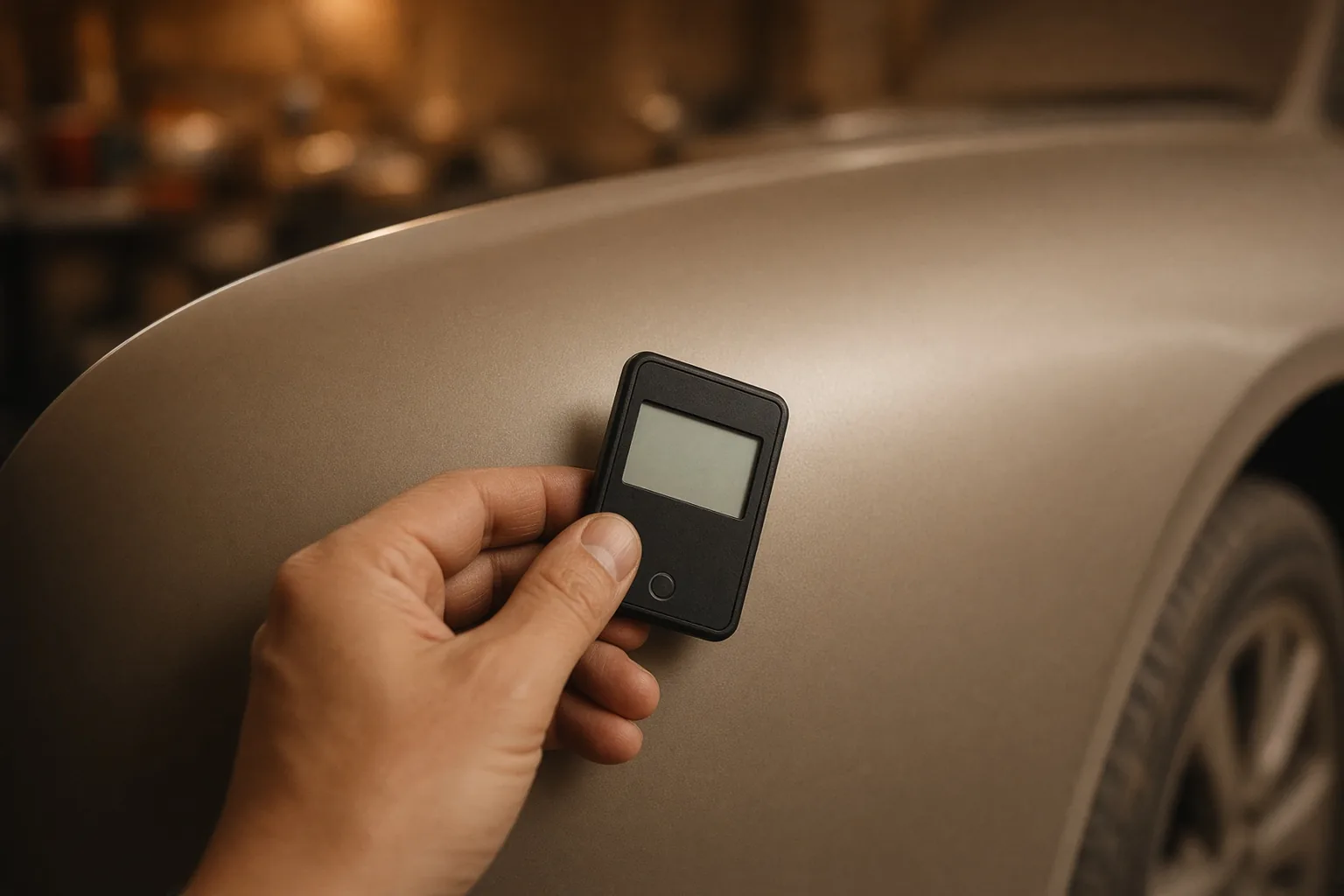
What does a diminished value appraisal measure?
The drop in market value of one repaired vehicle caused by the crash: the price the car would have brought the day before the accident compared with the price it brings after a proper repair.
Two figures carry the report. The first is the pre-loss value: what a buyer would have paid for this car, with its mileage, options and condition, on the day before the crash. The second is the post-repair value: what a buyer pays for the same car once the repair is finished and the accident is part of its history. The appraisal states both figures and the date each one refers to.
Diminished value and the repair cost are two separate numbers. The repair cost is what the shop charges to put the car back in working order. Diminished value is the gap in price that remains after that work is done. A report that adds a repair item to the lost value, or counts the same damage twice, mixes two measures.
Whether a claimant can recover diminished value, and from whom, is decided by state law and by the wording of the insurance policy. The appraisal answers a narrower question: how large the loss is for this car, measured with data another appraiser can check.
Which records does the appraiser need?
The repair estimate and the final invoice, dated photographs of the damage and of the finished repair, the mileage and options of the car, and any vehicle history report a buyer would see. Missing records limit the conclusion.
The repair file tells the appraiser which panels were replaced, which were repaired and refinished, and whether structural parts were straightened or replaced. Photographs taken before the repair show the extent of the impact, and photographs taken after it show the finished work. When the final invoice differs from the first estimate, the appraiser compares them line by line and works from the repair that was actually done.
In federal litigation the parties obtain these materials under Rule 34 of the Federal Rules of Civil Procedure. A request may cover documents and electronically stored information, which the rule says include photographs, sound recordings, images and other data stored in any medium, and any designated tangible things in the responding party's possession, custody or control. A damaged car is a tangible thing, so the other side can ask to inspect it. The written response is due within 30 days after the request is served.
Under Rule 34(b)(1)(C) a request may also specify the form in which electronically stored information is to be produced. For photographs, counsel can ask for the image files as the camera or phone saved them, instead of prints or pictures pasted into a PDF. If the request names no form, Rule 34(b)(2)(E)(ii) lets the responding party produce the information in the form in which it is ordinarily maintained or in a reasonably usable form.
How does an appraiser find the value before and after the crash?
From market evidence: sales and listings of comparable vehicles, dealer quotations and published price compilations, adjusted for mileage, options and condition. Each comparable and each adjustment is listed so another appraiser can repeat the arithmetic.
Comparable sales record what buyers actually paid. For the pre-loss value the appraiser looks for the same model year and trim with similar mileage and no accident history. For the post-repair value the appraiser looks for comparable cars with a reported repair of similar extent, or asks dealers what they would pay for this car as repaired. The report names each source, the date of each sale or quotation and every adjustment applied.
Rule 803(17) of the Federal Rules of Evidence excepts from the rule against hearsay market quotations, lists, directories or other compilations that are generally relied on by the public or by persons in particular occupations. The advisory committee note says the basis of trustworthiness is general reliance by the public or by a particular segment of it, and among the authorities it cites are newspaper market reports. A party that offers a published price guide argues that the guide is such a compilation.
Rule 703 lets an expert base an opinion on facts or data in the case that the expert has been made aware of or personally observed. If experts in the particular field would reasonably rely on that kind of facts or data, they need not be admissible for the opinion to be admitted. For dealer surveys and auction results the appraiser did not collect in person, the question is whether appraisers in the field reasonably rely on that kind of data.
Is a formula-based diminished value figure reliable evidence?
Only when the formula has a stated basis and fits the car. Under Rule 702 the party offering the appraiser must establish that the opinion rests on sufficient facts or data and a reliable method applied reliably to this vehicle.
Rule 702, as amended in 2023, lets a qualified expert testify if the proponent shows the court that it is more likely than not that the expert's knowledge will help the trier of fact, that the testimony is based on sufficient facts or data, that it is the product of reliable principles and methods, and that the opinion applies those principles and methods reliably to the facts of the case. The 2023 committee note says many courts had held that the sufficiency of an expert's basis and the application of the method are questions of weight, and calls those rulings an incorrect application of Rules 702 and 104(a).
A formula gives the same answer for every car with the same inputs. A reviewer asks where each factor in the formula comes from, whether anyone tested it against actual sales, and whether the appraiser compared the result with the market for this model. A percentage produced by a formula with no comparison to sales data leaves a gap between the data and the opinion.
The 2000 committee note lists factors courts have used, among them whether the expert has adequately accounted for obvious alternative explanations and whether the expert is being as careful as he would be in his regular professional work outside his paid litigation consulting. In a diminished value report the first factor covers price differences caused by mileage, condition, earlier damage or a change in the market rather than by this crash.
The 2023 note adds that each expert opinion must stay within the bounds of what can be concluded from a reliable application of the expert's basis and methodology. An appraisal built on two comparable sales of a different trim supports a narrower conclusion than its final percentage suggests, and the reviewer writes down that difference.
Can the owner testify about the car's lost value without an appraiser?
Rule 701 admits lay opinions rationally based on the witness's perception and not based on specialized knowledge within Rule 702. The court decides in each case whether an owner's value opinion meets that test.
Rule 701 limits a lay witness's opinion to one that is rationally based on the witness's perception, helpful to understanding the testimony or to determining a fact in issue, and not based on scientific, technical or other specialized knowledge within the scope of Rule 702.
The 2000 committee note to Rule 701 says that most courts have permitted the owner or officer of a business to testify to the value or projected profits of the business without qualifying as an accountant, appraiser or similar expert. It cites Lightning Lube, Inc. v. Witco Corp., 4 F.3d 1153 (3d Cir. 1993), where the court found no abuse of discretion in letting the plaintiff's owner give lay opinion testimony on damages. The note explains that such testimony is admitted because of the particularized knowledge the witness has by virtue of his or her position in the business.
An owner testifies to what he or she knows firsthand: the condition of the car before the crash, the offers received after the repair and the trade-in quote a dealer gave. Turning a repair history into a percentage of lost value draws on market analysis, and an insurer that disputes the figure argues that this part falls under Rule 702. In state court the state's own evidence rules govern the same question.
What must the appraiser's report contain in federal court?
Under Rule 26(a)(2)(B) a retained expert's report states all opinions with their basis and reasons, the facts or data considered, the exhibits, qualifications and publications, testimony in the previous 4 years and the compensation.
Rule 26(a)(2)(B) requires a written report prepared and signed by a witness retained or specially employed to provide expert testimony. The report must contain a complete statement of all opinions the witness will express and the basis and reasons for them; the facts or data considered in forming them; any exhibits that will be used to summarize or support them; the witness's qualifications, including a list of all publications authored in the previous 10 years; a list of all other cases in which, during the previous 4 years, the witness testified as an expert at trial or by deposition; and a statement of the compensation to be paid for the study and testimony in the case.
In a diminished value report the facts or data considered include each comparable sale with its date and price, each dealer quotation and each price guide with its edition. The exhibits include the adjustment table. A report that gives a final percentage without the comparables behind it leaves the first two items incomplete, and the reviewer asks for the missing data in writing before any deposition.
How do you answer the insurer's diminished value report?
With a rebuttal report on the same subject, due 30 days after the other side's disclosure unless the court sets other dates, and with a deposition of the insurer's appraiser once the report has been served.
Under Rule 26(a)(2)(D)(ii), absent a stipulation or a court order, evidence intended solely to contradict or rebut evidence on the same subject matter identified by another party is due within 30 days after that party's disclosure. A rebuttal appraisal answers the insurer's figures: it recalculates with the comparables the insurer left out and explains each adjustment that differs.
Rule 26(b)(4)(A) lets a party depose any person identified as an expert whose opinions may be presented at trial, and when a report is required, the deposition may be conducted only after the report is provided. Under Rule 26(b)(4)(E)(i), unless manifest injustice would result, the party seeking the deposition pays the expert a reasonable fee for the time spent responding.
Communications between counsel and a reporting expert are protected by Rule 26(b)(4)(C), except to the extent they relate to compensation, identify facts or data that counsel provided and the expert considered, or identify assumptions that counsel provided and the expert relied on. If counsel told the appraiser to assume a pre-loss value or to assume the car had no earlier damage, that assumption is open to discovery.
Rule 705 lets an expert state an opinion and the reasons for it without first testifying to the underlying facts or data, but the expert may be required to disclose them on cross-examination. Under Rule 37(c)(1), a party that fails to provide information or identify a witness as Rule 26(a) or (e) requires may not use that information or witness on a motion, at a hearing or at trial, unless the failure was substantially justified or is harmless.
What does IAE do when vehicle damage and its cost are disputed?
An IAE engineer prepares an expert report on the client's questions about crash mechanics and vehicle damage, or a review of the opposing expert's report, in up to 5 business days after the format and cost are confirmed.
The IAE accident reconstruction service covers how the vehicles moved before impact, what the event data recorder shows about speed and braking, and whether the damage on each car fits the claimed crash. For vehicle damage, the engineer compares each line of the repair estimate with photos and the crash mechanics and marks damage that came from an earlier or a different impact. If the other side holds the vehicle, the engineer lists for the attorney what needs to be measured and downloaded under a Rule 34(a)(1)(B) request. IAE confirms the questions with the client before work starts.
The client sends the materials and describes the task. The secretariat confirms receipt the same day, and within one business day IAE confirms the format, the cost, the deadline and the specialist from its registry. The client approves the candidate and the CV before work starts, the draft is checked for facts, and the signed PDF is issued in up to 5 business days. A 48-hour rush is available for cases with tight deadlines.
Every specialist is a member of the public IAE registry and passed the council's attestation under the published Criteria Matrix, and the Member ID in the document can be checked by QR code. The specialist confirms in the document that he or she has no interest in the outcome of the case, and materials are not passed to third parties without the client's consent. Neither IAE nor the engineer guarantees the outcome, and IAE is not a law firm.
Sources
- Federal Rules of Evidence, Rule 701, Opinion Testimony by Lay Witnesses, with Committee Notes (LII)
- Federal Rules of Evidence, Rule 702, Testimony by Expert Witnesses, with Committee Notes (LII)
- Federal Rules of Evidence, Rule 703, Bases of an Expert's Opinion Testimony (LII)
- Federal Rules of Evidence, Rule 705, Disclosing the Facts or Data Underlying an Expert's Opinion (LII)
- Federal Rules of Evidence, Rule 803, Exceptions to the Rule Against Hearsay, paragraph (17) and advisory committee note (LII)
- Federal Rules of Civil Procedure, Rule 26, Duty to Disclose; General Provisions Governing Discovery (LII)
- Federal Rules of Civil Procedure, Rule 34, Producing Documents, Electronically Stored Information, and Tangible Things (LII)
- Federal Rules of Civil Procedure, Rule 37, Failure to Make Disclosures or to Cooperate in Discovery; Sanctions (LII)
Read also
All articles
Sideswipe or lane-change crash: how does an expert establish which vehicle left its lane?
Two cars travelling in the same direction touch sides, and each driver says the other drifted over. Traffic codes put the duty on the driver who Sergei Voronin

Motorcycle accident reconstruction: how does the expert find speed, position and visibility without a car's data recorder?
In 2024, 6,228 motorcyclists were killed on US roads, 16 percent of all traffic deaths, according to NHTSA. Many of these crashes turn on threeSergei Voronin
Who ran the red light? How does an accident reconstructionist analyze signal timing?
When two drivers each say the light was green, the answer comes from timing: when each signal phase changed, where each vehicle was at that momentSergei VoroninExpert examinations
Ready to discuss your case?
Send the materials: the secretariat will confirm the format, cost, deadline and the specialist within one business day.
