
Profile audit
The exhibitions criterion in EB-1A: why does USCIS read the word "artistic" literally?
Criterion (vii) of 8 CFR 204.5(h)(3) counts the display of an EB-1A applicant's work in the field at artistic exhibitions. The USCIS Policy Manual takes the word "artistic" literally and sends other exhibitions to comparable evidence. In October 2022 the AAO dismissed the appeal of an engineer whose conference paper and trade-show talk had failed this criterion. Online venues pass the same test, because the Policy Manual covers venues "(virtual or otherwise)."
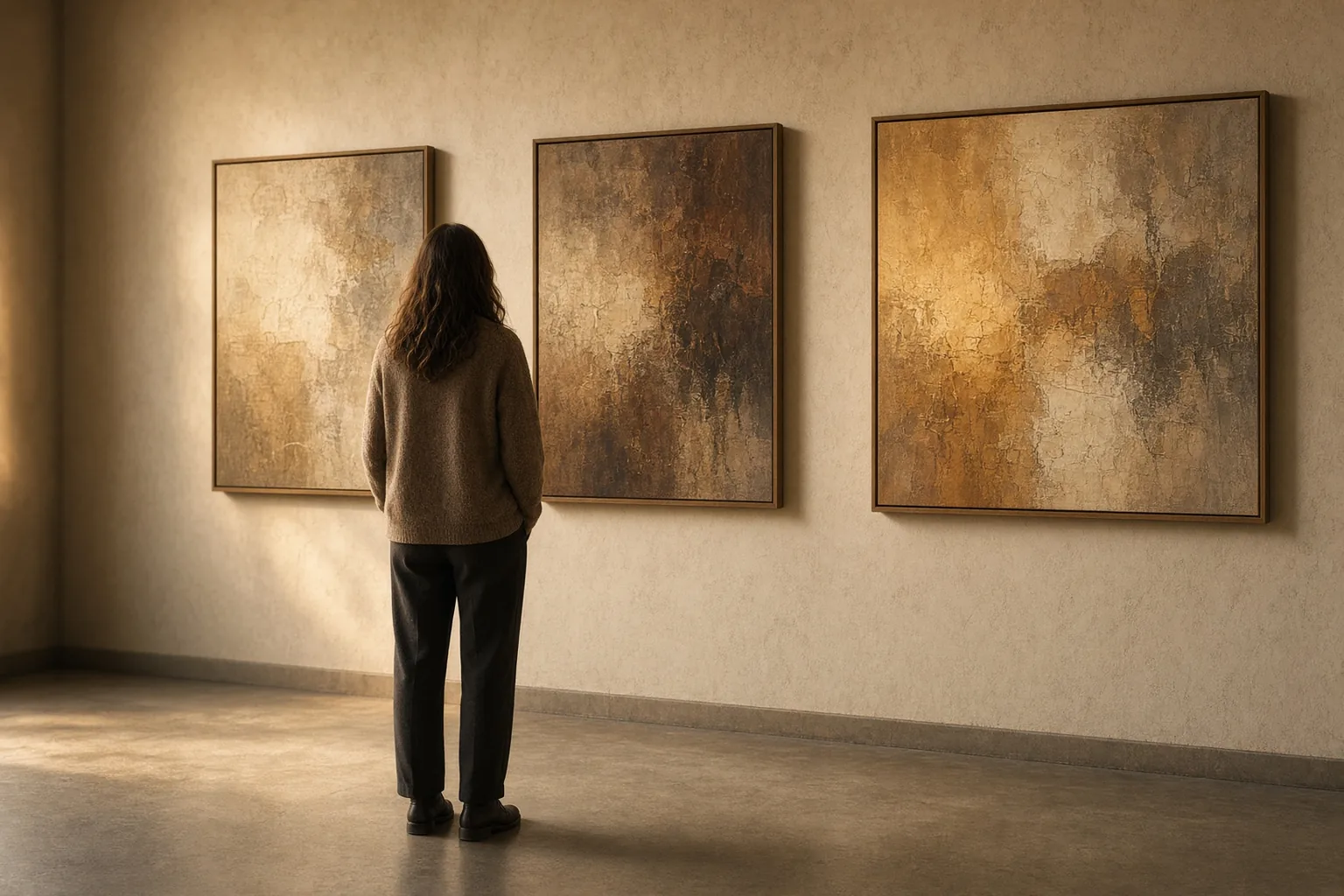
What does the EB-1A exhibitions criterion require?
Evidence that the applicant's own work in the field was displayed at an artistic venue. USCIS checks two points: that the displayed work is the applicant's work product, and that the venue was artistic.
Under 8 CFR 204.5(h)(3), an EB-1A petition must be accompanied by evidence that the applicant "has sustained national or international acclaim" and that his or her achievements "have been recognized in the field of expertise." The same paragraph accepts either "a one-time achievement (that is, a major, international recognized award)" or evidence under at least three of ten criteria. Criterion (vii) reads: "Evidence of the display of the alien's work in the field at artistic exhibitions or showcases."
The USCIS Policy Manual, Volume 6, Part F, Chapter 2 splits the review of this criterion into two questions. "First, USCIS determines whether the work that was displayed is the person's work product." The chapter explains that the regulation itself "provides that the work must be the person's work product." Second, USCIS asks whether the venues where the work was displayed, online or physical, were artistic.
The line of the regulation contains three conditions. The work belongs to the applicant. The work is "in the field" named in the petition. The venue is artistic. A record that proves two of them does not meet the criterion, and the October 2022 AAO decision discussed below turned on the second and the third.
Criterion (vii) counts as one of the three criteria needed at the first step of the review. At the second step the officer decides whether the whole record places the applicant among "that small percentage who have risen to the very top of the field of endeavor," the definition of extraordinary ability in 8 CFR 204.5(h)(2). The order of the two steps is described in the guide on the Kazarian two-step review.
Why does USCIS read the word "artistic" literally?
Because the regulation puts "artistic" before the venue. The Policy Manual accepts that the dictionary meaning of "exhibition" covers any public showing, but reads the criterion as limited to venues artistic in nature.
The Policy Manual starts from Merriam-Webster, which defines "exhibition" as "a public showing (as of works of art, objects of manufacture, or athletic skill)." Under that definition a trade fair and a sports event are exhibitions too. The chapter then states that the plain language of the criterion "includes the modifier "artistic"" and requires exhibitions that are "artistic in nature."
The next sentence of the chapter decides where every other kind of exhibition goes. USCIS considers non-artistic exhibitions only "as part of a properly supported claim of comparable evidence." A conference, a trade fair or a technology expo therefore does not meet criterion (vii) on its own terms, whatever its size.
Section 204.5 does not define "artistic" or "arts," and paragraph (h)(2) defines only extraordinary ability. The O-1 regulation has a definition for its own purposes: under 8 CFR 214.2(o)(3)(ii), arts "includes any field of creative activity or endeavor such as, but not limited to, fine arts, visual arts, culinary arts, and performing arts."
For a painter, a photographer or a sculptor the word raises no question. It matters for applicants whose work reaches the public in other ways: engineers and scientists who present at conferences, designers of industrial products who show them at trade fairs. For them the Policy Manual names one route, comparable evidence under 8 CFR 204.5(h)(4).
Can a scientist or engineer claim conference presentations under this criterion?
Not under criterion (vii). In October 2022 the AAO dismissed an engineer's appeal after the Director had advised, in a request for evidence, that his ASHRAE conference paper and trade-show talk were not artistic exhibitions.
The AAO decision of October 6, 2022 concerned a licensed professional engineer who worked as an HVAC project engineer when the petition was filed. For criterion (vii) he first submitted a 2015 paper presentation at an ASHRAE conference and a speaking engagement at a trade show.
In the request for evidence the Director noted that these items showed research displayed at scientific conferences or symposia and advised that under the plain language of the regulation such venues could not be considered artistic exhibitions. The denial found that no additional evidence had been submitted for this criterion. On appeal the engineer did not pursue the conference evidence, and the AAO dismissed the appeal.
The Policy Manual places this kind of work under a different criterion. In its part on comparable evidence it gives an example for the scholarly articles criterion: if publishing articles is not readily applicable to a person "whose occupation is in an industry rather than academia," the person's "presentation of work at a major trade show" may be "of comparable significance to that criterion." The example ties a trade-show presentation to criterion (vi), scholarly articles.
A petition that lists conference talks under criterion (vii) without a comparable-evidence argument meets the same plain-language reading the Director applied in 2022. The talks can still be part of the record, filed under the criterion or the comparable-evidence claim whose text they meet.
Do online galleries and virtual exhibitions count?
Yes, if the venue is artistic. The second question of the Policy Manual test covers venues "(virtual or otherwise)" where the person's work was displayed, and an online venue answers it with the same kinds of documents.
The second question in the Policy Manual is whether "the venues (virtual or otherwise) where the person's work was displayed" were artistic. The words in brackets put an online venue under the same test as a gallery hall.
For an online venue the record answers the same two questions as for a physical one. A page of the venue names the applicant as the author of the displayed work, and other documents establish that the site belongs to a gallery, a museum, an art fair or another art venue.
Must the displayed work be in the applicant's field?
Yes. The regulation says "work in the field." In the October 2022 decision the AAO rejected a concert in which an engineer took part, because it was unrelated to his engineering work and research.
After the conference evidence failed, the engineer in the October 2022 case argued on appeal that the Director had overlooked his part in a music event. The evidence was a May 2020 university newsroom article about a virtual concert held "to bring comfort to the community through music." The article named him among the student participants.
The AAO did not need to decide whether the concert was an artistic venue. It held that the event did not display his work in the field, because the concert was "unrelated to his field of engineering, his research interests, and his professional duties and cannot be deemed to be in his field." The criterion was not met.
The field is the one the petition names. An applicant who files as a stage designer meets criterion (vii) with displays of stage design. An applicant with a second, artistic occupation files the petition in one field, and under the reasoning of the 2022 decision the criterion counts displays of work in that field.
The first question of the Policy Manual test applies in the same way. When the displayed piece came from a team, a studio or a commissioned project, the record needs a document that names the applicant's part in it: an exhibition catalog, a credit line, a contract with the venue or the commissioning party.
Does the exhibition have to be prestigious to meet the criterion?
No. A footnote in the Policy Manual chapter says that display at an artistic exhibition alone, "regardless of caliber or significance," satisfies criterion (vii). The level of the venue counts at the second step.
At the first step the Policy Manual tells officers to consider "the quality and caliber of the evidence" only "to the extent the criterion has qualitative requirements." The footnote to that sentence compares two criteria. For an award under criterion (i), the officer checks whether it is "nationally or internationally recognized." For criterion (vii) the footnote says: "evidence that the beneficiary's work was displayed at an artistic exhibition alone, regardless of caliber or significance, would satisfy the requirements of 8 CFR 204.5(h)(3)(vii)."
At the first step officers "should not yet make a determination" on whether the person is one of that small percentage at the very top of the field. That question belongs to the second step, where "the officer should consider the petition in its entirety to determine eligibility according to the standard." The chapter adds: "Approval or denial of a petition is based on the type and quality of evidence submitted rather than assumptions about the failure to address different criteria."
A group show at a local gallery and a solo show at a national museum both meet criterion (vii). At the second step the officer asks whether the whole record proves sustained national or international acclaim, and the two shows answer that question at different levels.
Documents about the venue belong to that second question: how the works were selected, who organized the exhibition, attendance, reviews in the press. Published material about the applicant is a separate criterion, (iii), and a review of the exhibition that discusses the applicant's work may be filed there as well.
When can comparable evidence replace the exhibitions criterion?
When the criterion does not readily apply to the applicant's occupation. The petitioner explains why; the Policy Manual calls a general unsupported assertion not probative and accepts a detailed, specific and credible statement.
Under 8 CFR 204.5(h)(4), "If the above standards do not readily apply to the beneficiary's occupation, the petitioner may submit comparable evidence to establish the beneficiary's eligibility." The Policy Manual adds that "a criterion need not be entirely inapplicable to the person's occupation." The officer considers comparable evidence once the petitioner establishes that a criterion is "not easily applicable to the person's job or profession."
The explanation is evidence in its own right. "A general unsupported assertion that the listed evidentiary criterion does not readily apply to the petitioner's occupation is not probative." A statement from the petitioner can be sufficient "if that statement is detailed, specific, and credible." For criterion (vii) such a statement names the occupation, describes how work in it is presented to the public and explains why that presentation is not an art exhibition.
A trade fair, an industry exhibition or a technology show can then be filed as comparable evidence, with documents on how exhibitors were selected and on the applicant's own work shown there. The Policy Manual names this route for non-artistic exhibitions and no other.
Letters do not take the place of those documents. In the same part of the chapter the Policy Manual says that "general claims that USCIS should accept witness letters as comparable evidence are not persuasive." A letter from the organizer can confirm the facts of the display, and the record still needs the catalog, the exhibitor list or the program in which the applicant's work appears.
Which documents prove a display at an artistic exhibition?
Dated documents that answer the two Policy Manual questions: that the displayed piece is the applicant's work and that the venue is an art venue, plus full certified translations of foreign-language pages.
For the first question the record needs a document from the venue that names the applicant as the author of the displayed work: a catalog page, a program, the venue's page about the exhibition, a dated photograph of the installation with its label. An invitation or a contract from the venue adds the dates and the terms of the display.
For the second question the record needs evidence of what the venue is: a gallery, a museum, an art fair, a festival, or the website of such a venue.
Under 8 CFR 204.5(g)(1), "ordinary legible photocopies" of documents are acceptable for initial filing and approval, and the director may require originals in individual cases. A catalog in another language goes in with "a full English language translation which the translator has certified as complete and accurate," and with the translator's certification of competence, under 8 CFR 103.2(b)(3).
The exhibit for each display is easier to check when it follows one order: the document naming the work and its author, then the document about the venue, then the translation and its certification.
Is there an exhibitions criterion for O-1A or O-1B?
No O-1A criterion mentions exhibitions. O-1B, the category for the arts, has six criteria of its own; the first concerns lead or starring participation in productions or events with a distinguished reputation.
The USCIS Policy Manual, Volume 2, Part M, Chapter 4 lists the eight O-1A criteria of 8 CFR 214.2(o)(3)(iii)(B): nationally or internationally recognized prizes, membership in associations, published material about the beneficiary, judging the work of others, original contributions of major significance, scholarly articles, employment in a critical or essential capacity, and a high salary. None of them mentions exhibitions.
O-1B covers the arts, which 8 CFR 214.2(o)(3)(ii) defines to include fine arts, visual arts, culinary arts and performing arts. Its six criteria in 8 CFR 214.2(o)(3)(iv)(B) cover performance as a lead or starring participant in productions or events with a distinguished reputation, national or international recognition for achievements, a lead, starring or critical role for organizations, major commercial or critically acclaimed successes, significant recognition from organizations, critics and other experts, and a high salary.
For beneficiaries in motion picture or television productions, the Policy Manual says that petitioners "may not rely on comparable evidence" and must submit evidence under the listed criteria.
An applicant who holds an O-1B and plans an EB-1A petition files the same shows under different wording: under criterion (vii) of 8 CFR 204.5(h)(3) the question is the display of the work, under O-1B it is the role, the recognition and the success. Awards in the O-1B category are covered in the article on O-1B awards and nominations.
How does the IAE audit check the exhibitions criterion?
An IAE registry expert marks each EB-1A criterion, including (vii), as met, partly met or not met, names the documents behind each mark and sends a written report within 5 business days for $350.
On the profile audit page one report covers one category, EB-1A, EB-2 NIW, O-1A or O-1B, for $350. The assessment follows the criteria of 8 CFR 204.5(h), the Dhanasar test and 8 CFR 214.2(o). For EB-1A the expert goes through the ten criteria and the option of one major internationally recognized award.
The report has four parts. The criteria map marks each criterion as met, partly met or not met and names the documents behind each mark. The gaps part lists missing or weak evidence, such as a single source, no independent confirmation or the wrong form of document. The collection plan says what to obtain before filing, in what order and from whom. The last part names the category closest to the profile now and what changes in six to twelve months if the plan is followed.
The request form takes a CV and up to 10 files or one archive in .pdf, .docx, .jpg, .png or .zip, up to 25 MB each. Exhibition catalogs, invitations, photographs of the installation and gallery web pages go in as supporting documents. A request for evidence, a NOID or a denial can be attached, and the report then addresses the weak criteria it names. If the documents are not enough for the criteria map, the expert asks for the missing items in one email within 1-2 business days.
The report names the expert and the registry record number. Questions about the report are answered by email for 14 days after delivery. The audit is an expert assessment against published criteria. It is not legal advice and not a forecast of the USCIS decision, and the petition is filed by the applicant or the applicant's attorney.
Sources
- 8 CFR 204.5, Petitions for employment-based immigrants (LII)
- USCIS Policy Manual, Volume 6, Part F, Chapter 2, Extraordinary Ability
- AAO non-precedent decision, I-140 extraordinary ability, engineer, October 6, 2022
- USCIS Policy Manual, Volume 2, Part M, Chapter 4 (O-1 classification)
- 8 CFR 214.2, Special requirements for admission, extension, and maintenance of status (LII)
- 8 CFR 103.2, Submission and adjudication of benefit requests (eCFR)
Read also
All articles
EB-2 NIW or EB-1A as a PhD student: can you file before you graduate, and what happens to F-1 status?
No rule makes a PhD student wait for the diploma. EB-2 NIW and EB-1A are self-petitions, and neither regulation asks for a particular immigration Sergei Voronin

O-1 visa salary requirement: is there a minimum, and how do you prove high remuneration?
An O-1 petition does not have to meet a salary threshold. The O-1A regulation lists high pay as one of eight criteria, and a petition needs threeSergei Voronin
O-1 or H-1B: which visa fits a specialist with a U.S. job offer?
H-1B is limited to 65,000 new workers a year plus 20,000 with U.S. master's degrees, chosen in a selection that now gives more chances to higher wageSergei VoroninProfile audit
Is your profile ready for the petition?
A report on the EB‑1A, EB‑2 NIW, O‑1A or O‑1B criteria within 5 business days of receiving the materials and payment: what is proven, what is missing and what to collect before filing.
