
Examinations
Fire scene spoliation: how is evidence preserved before the investigation?
In 1995 the Seventh Circuit upheld the dismissal of an insurer's subrogation suit because its investigators had discarded the frame of a gas grill and a second propane cylinder before the cause of the fire was known. Federal courts sanction the loss of fire scene evidence under their inherent power. A party that cannot keep the scene still owes the other side notice of access to the evidence or of its possible destruction.
What counts as spoliation of fire scene evidence?
The destruction or material alteration of evidence, or the failure to preserve property for another's use as evidence in pending or reasonably foreseeable litigation. After a fire this covers debris removal, demolition, repairs and discarded artifacts.
The Fourth Circuit stated the rule in Silvestri v. General Motors Corp., 271 F.3d 583, decided in November 2001: "Spoliation refers to the destruction or material alteration of evidence or to the failure to preserve property for another's use as evidence in pending or reasonably foreseeable litigation." The same opinion says that "the power to sanction for spoliation derives from the inherent power of the court."
At a fire scene the evidence is the building itself: burn patterns on walls and ceilings, the remains of wiring and appliances, the position of switches and valves. The National Institute of Justice guide Fire and Arson Scene Evidence, published in June 2000, warns that moving "knobs, switches, and controls on appliances and utilities" can threaten evidence. In Hoog v. Dometic Corp. the federal court in Oklahoma quoted section 8.6 of NFPA 921: "[c]are should be taken to preserve all evidence . . . . The loss or alteration of an item may have a significant consequence on the investigation and any litigation that may ensue."
Rule 37(e) of the Federal Rules of Civil Procedure covers only electronically stored information. Its 2015 committee note says: "The new rule applies only to electronically stored information, also the focus of the 2006 rule." Alarm panel logs and camera recordings kept in electronic form fall under that rule. A burned outlet, a grill or a pile of debris does not, and for physical evidence the court relies on its inherent power and on the state law that governs the duty to preserve. In Allstate Insurance Co. v. Sunbeam Corp. the Seventh Circuit applied Illinois law to the duty that arose before suit.
When does the duty to preserve a fire scene begin?
Before suit is filed, once a party reasonably should know the evidence may be relevant to anticipated litigation. In Allstate v. Sunbeam the insurer's duty applied when its adjuster and engineer examined the scene two days after the fire.
Under Silvestri the duty to preserve material evidence "extends to that period before the litigation when a party reasonably should know that the evidence may be relevant to anticipated litigation." The car Silvestri was driving hit a utility pole in 1994, and the airbag did not deploy. Two accident reconstructionists retained by his lawyer inspected the car, the first of them about a week later. They concluded that the airbag should have deployed and advised that General Motors needed to see the car. The car was repaired and sold, and General Motors learned of the claim when suit was filed nearly three years after the crash.
In Allstate the fire destroyed the Garcia home on July 4, 1990. On July 6, 1990 an Allstate adjuster and an engineer examined the scene. Before they knew the cause, they decided that the grill's fuel system was the only significant evidence. They kept the L.P. operating cylinder, the main burner, the primary control valves and the gas regulator remains, and discarded the grill frame, the planking, the control panel, the side burner and the second propane cylinder. Allstate sued Sunbeam as subrogee on February 1, 1993.
The Seventh Circuit held that because Allstate had not yet determined the cause of the fire, "Allstate had a duty under Illinois law to preserve all evidence of alternate causes thereof." The magistrate judge had found that a reasonable investigator would have recognized the risk posed by the second tank and that Allstate relied unreasonably on the insureds' statements that the tank was empty and stored away from the grill.
The NIJ guide lists the same concern for public investigators. It tells them to "Recognize and consider the interests of parties that may be affected by the outcome of the investigation" and names spoliation, subrogation and third-party claims among those issues.
Who has to be notified before a fire scene is altered?
Each party that may later be sued over the fire, such as the maker of a suspected appliance. Under Silvestri a party that cannot keep the evidence must still give the opposing party notice of access or of possible destruction.
The Fourth Circuit wrote that a party who does not own or control the evidence "still has an obligation to give the opposing party notice of access to the evidence or of the possible destruction of the evidence if the party anticipates litigation involving that evidence." Silvestri's experts told his side that General Motors needed to see the car, and nobody told General Motors before the car was repaired.
For apparently accidental fires the NIJ guide says: "In cases where the fire appears to be accidental, evidence should not be needlessly disturbed, but the property owner or insurer should be notified to avoid issues of spoliation." Before the scene is released, "associated legal, health, and safety issues must be articulated to the party receiving the scene."
A notice letter that names the date and place of the planned examination, the items to be removed or tested and a deadline to respond gives the recipient the information a Rule 34 request would later give: Rule 34(b)(1)(B) requires a request to "specify a reasonable time, place, and manner for the inspection and for performing the related acts." The addressees are the parties that may be blamed for the fire, for example the property owner, the tenant, the utility, the makers of appliances in the area of origin and their insurers.
What has to be documented before anything is moved?
The scene as found: photographs before any disturbance, photo logs, a sketch with dimensions and areas of origin, and the positions of switches, valves and controls. The NIJ guide sets out these steps for fire scenes.
The NIJ guide was written by the Technical Working Group on Fire/Arson Scene Investigation and issued as NCJ 181584. It says: "The scene should be photographed prior to the disturbance or removal of any evidence and throughout the scene investigation." Photo and video logs record the date, the photographer and the subject. The sketch shows dimensions, fuel packages, doors, windows and areas of origin, and a detailed diagram can be prepared later.
Controls are recorded before anyone touches them. The guide tells investigators to note the position of timers, switches, valves and control units for utilities and for detection and suppression systems, and any changes made by first responders. Access is limited: "Establish and maintain strict control of access to the scene." Fuel-powered tools are avoided, and their use is documented when it cannot be avoided.
In Hoog the scene had changed before the defense examined it. The report of the plaintiffs' investigator states that investigators from the Edmond Fire Department and at least two investigators for the owner's insurers had processed the scene before the joint inspection on June 15, 2018, and he testified that the scene "had been partially cleaned up." The defense investigator placed the origin at a lumber pile that was "removed or spoliated, either intentionally or accidentally, prior to him completing his inspection," and gave no opinion on the cause because he could not test the pile.
How are fire artifacts removed, packaged and stored?
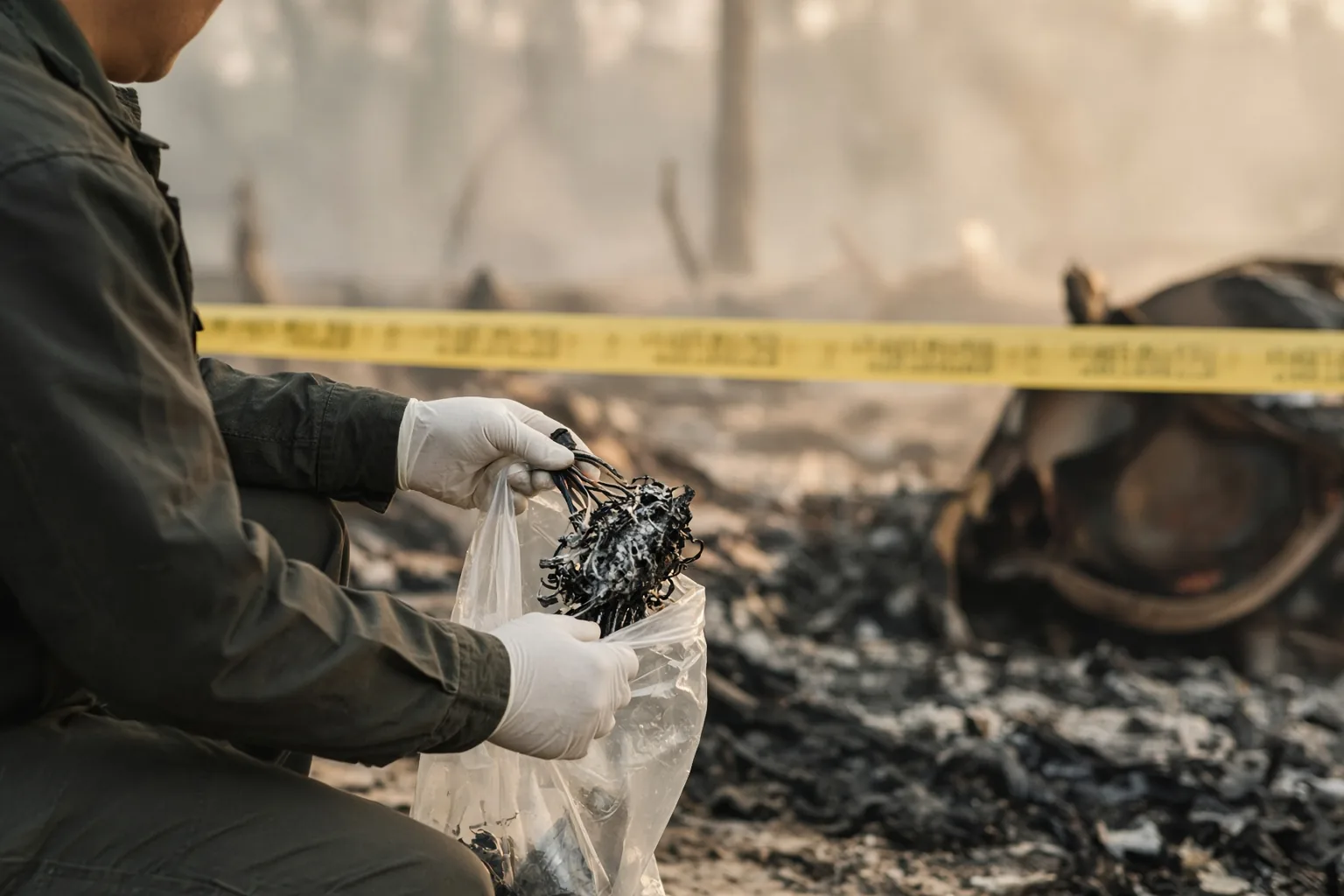
Each item is photographed in place, labeled, packaged and logged with every transfer of custody. Debris samples for ignitable liquid analysis go into clean, unused, vapor-tight containers that are sealed at once.
The NIJ guide calls for "clean, unused, vaportight containers" for samples that may hold ignitable liquids: unused paint cans, glass jars and laboratory-approved nylon or polyester bags. Each container is sealed immediately and labeled with the investigator's name, the date and time, the case and sample numbers and the location. Comparison samples are collected where they exist.
Liquids are packaged so they cannot leak and are shipped separately, and fire debris is stored and shipped apart from other evidence. Investigators use clean disposable gloves and clean tools and change gloves between unrelated items.
The chain of custody is written down. The guide lists the sample number, description, location, collector and comments for each item, and says: "Document all transfers of custody, including the name of the recipient and the date and manner of transfer." The final disposition of the evidence is documented as well.
ASTM E1188-23, Standard Practice for Collection and Preservation of Information and Physical Items by a Technical Investigator, applies to "an incident that can be reasonably expected to be the subject of litigation." Its scope adds: "Deviations from this practice should be based on specific articulable circumstances." Its significance section notes that "The quality of evidence may change with time" and that evidence collected and preserved is "identified with, and traceable to, the incident."
What can a court do when a fire scene was not preserved?
Federal judges act under inherent power and can dismiss the claim, as in Silvestri and Allstate v. Sunbeam. A court can also treat the dispute as a matter of weight for cross-examination, as in Hoog v. Dometic.
Dismissal is the heaviest sanction. Silvestri says it "is usually justified only in circumstances of bad faith or other like action," and that even without bad faith "dismissal may be necessary if the prejudice to the defendant is extraordinary, denying it the ability to adequately defend its case." The majority found the prejudice to General Motors severe enough and affirmed the dismissal. Judge Traxler agreed that the duty had been breached and dissented on the sanction, saying the district court should have considered lesser measures.
In Allstate the Seventh Circuit reviewed the findings for clear error and affirmed the dismissal. It framed the test as "whether the Defendant manufacturer was deprived of the ability to establish its case." The court distinguished H & H Sand & Gravel, where the destroyed evidence was irrelevant and there was only one causal theory, and followed Shelbyville, which did not rest on a finding of bad faith.
In Hoog, decided on March 22, 2024, the court denied a motion to exclude the defense investigator. It found that "spoliation is a contested issue with conflicting testimony on both sides, and it does not render Mr. Oliveaux's opinions unreliable. It raises a matter of weight and not admissibility and can be adequately challenged on cross-examination."
For electronic records Rule 37(e) sets its own ladder. On a finding of prejudice the court "may order measures no greater than necessary to cure the prejudice." A presumption that the lost information was unfavorable, an adverse jury instruction, dismissal or default judgment are available "only upon finding that the party acted with the intent to deprive another party of the information's use in the litigation."
How does the other side get to inspect the scene or the artifacts?
After suit is filed, through a Rule 34 request: entry onto land to inspect, measure, survey, photograph, test or sample, and inspection or testing of tangible things such as wiring or an appliance. The answer is due in 30 days.
Rule 34(a)(1) lets a party ask another party to permit it "to inspect, copy, test, or sample the following items in the responding party's possession, custody, or control," including "any designated tangible things." Rule 34(a)(2) covers entry onto land or other property the responding party possesses or controls, "so that the requesting party may inspect, measure, survey, photograph, test, or sample the property or any designated object or operation on it."
Under Rule 34(b)(2)(A) the responding party "must respond in writing within 30 days after being served." Artifacts held by someone outside the case are reached through Rule 34(c): "As provided in Rule 45, a nonparty may be compelled to produce documents and tangible things or to permit an inspection." An evidence storage company or an insurer that is not a party falls in that group.
Rule 34 does not set a protocol for a test that changes or consumes an item, such as cutting open a burned appliance. The parties agree on the method and the attendees, or one of them asks the court. Before suit, the notice rule from Silvestri covers the same ground: an examination announced in advance, with time for others to attend.
What does IAE do when fire scene evidence is in dispute?
IAE prepares fire origin and cause expert reports and reviews of the opposing investigator's report, including how the scene and artifacts were documented, removed and examined. Up to 5 business days after format and cost are confirmed.
The fire origin and cause page covers subrogation, product liability, arson defense and coverage disputes in US courts. The investigator answers the questions agreed with the client, working from the scene record, photos, removed artifacts and witness accounts. In a review the investigator checks whether wiring, appliances and debris were photographed in place before removal, logged and examined at a joint lab exam with all interested parties notified.
The client sends the scene photos and video, the fire department report, evidence logs and chain of custody forms, notice letters to interested parties and the replies, and any joint examination protocol, and states whether the fire scene still exists. The secretariat confirms receipt the same day. Within one business day IAE confirms the format, the cost, the deadline and the specialist from its registry, and the client approves the candidate and the CV before work starts. The draft is checked for facts. Cases with tight deadlines have a 48-hour rush.
A rebuttal report limited to the same subject as the other side's expert disclosure is due within 30 days after that disclosure under Rule 26(a)(2)(D)(ii), unless the parties stipulate or the court orders otherwise. Every specialist is a member of the public IAE registry and passed the council's attestation under the published Criteria Matrix, and the Member ID from the document opens the specialist's category, specialization, attestation date and record status by QR code.
Materials go through the contact form or to info@iaexperts.com and are not passed to third parties without the client's consent. An expert report is evidence that the court weighs together with the other materials. Neither IAE nor the investigator guarantees the outcome. IAE is not a law firm and does not advise on case strategy or on sanctions motions.
Sources
- Silvestri v. General Motors Corp., 271 F.3d 583 (4th Cir. 2001) (Justia)
- Allstate Insurance Co. v. Sunbeam Corp., 53 F.3d 804 (7th Cir. 1995) (Justia)
- Hoog v. Dometic Corp., No. CIV-20-00272-JD (W.D. Okla. Mar. 22, 2024), copy of the order
- National Institute of Justice, Fire and Arson Scene Evidence: A Guide for Public Safety Personnel, NCJ 181584, June 2000
- ASTM E1188-23, Standard Practice for Collection and Preservation of Information and Physical Items by a Technical Investigator (ASTM store page)
- Federal Rules of Civil Procedure, Rule 34, Producing Documents, Electronically Stored Information, and Tangible Things, or Entering onto Land (LII)
- Federal Rules of Civil Procedure, Rule 37, Failure to Make Disclosures or to Cooperate in Discovery; Sanctions, with Committee Notes (LII)
- Federal Rules of Civil Procedure, Rule 26, Duty to Disclose; General Provisions Governing Discovery (LII)
Read also
All articles
Gas explosion investigation: who is liable, and what does the investigator have to establish?
After a gas explosion the claim turns on one physical question: where the gas came from and why nobody noticed it before something ignited it Sergei Voronin
Tenant caused a fire: who is liable, can the landlord's insurer sue, and what must the investigator establish?
When a rented house burns, three questions come up in order: where the fire started, what started it, and who answers for that cause under the leaseSergei Voronin
Fire spread from a neighbor's property: who is liable, and what does the investigator have to establish?
A neighbor is liable for a fire that spreads onto your property when the fire started through his negligence or in violation of law, not merelySergei VoroninExpert examinations
Ready to discuss your case?
Send the materials: the secretariat will confirm the format, cost, deadline and the specialist within one business day.
