
Examinations
Sprinkler or fire alarm failure: who is liable, and what does the investigator have to establish?
When a sprinkler system or fire alarm does not work during a fire, the claim reaches the companies that installed, inspected or maintained it. The investigator has to show whether the system operated, why it did not and whether a working system would have reduced the loss. In Davis v. Brickman Landscaping (N.J. 2014) claims against three sprinkler inspection companies failed for lack of an admissible expert on the standard of care.
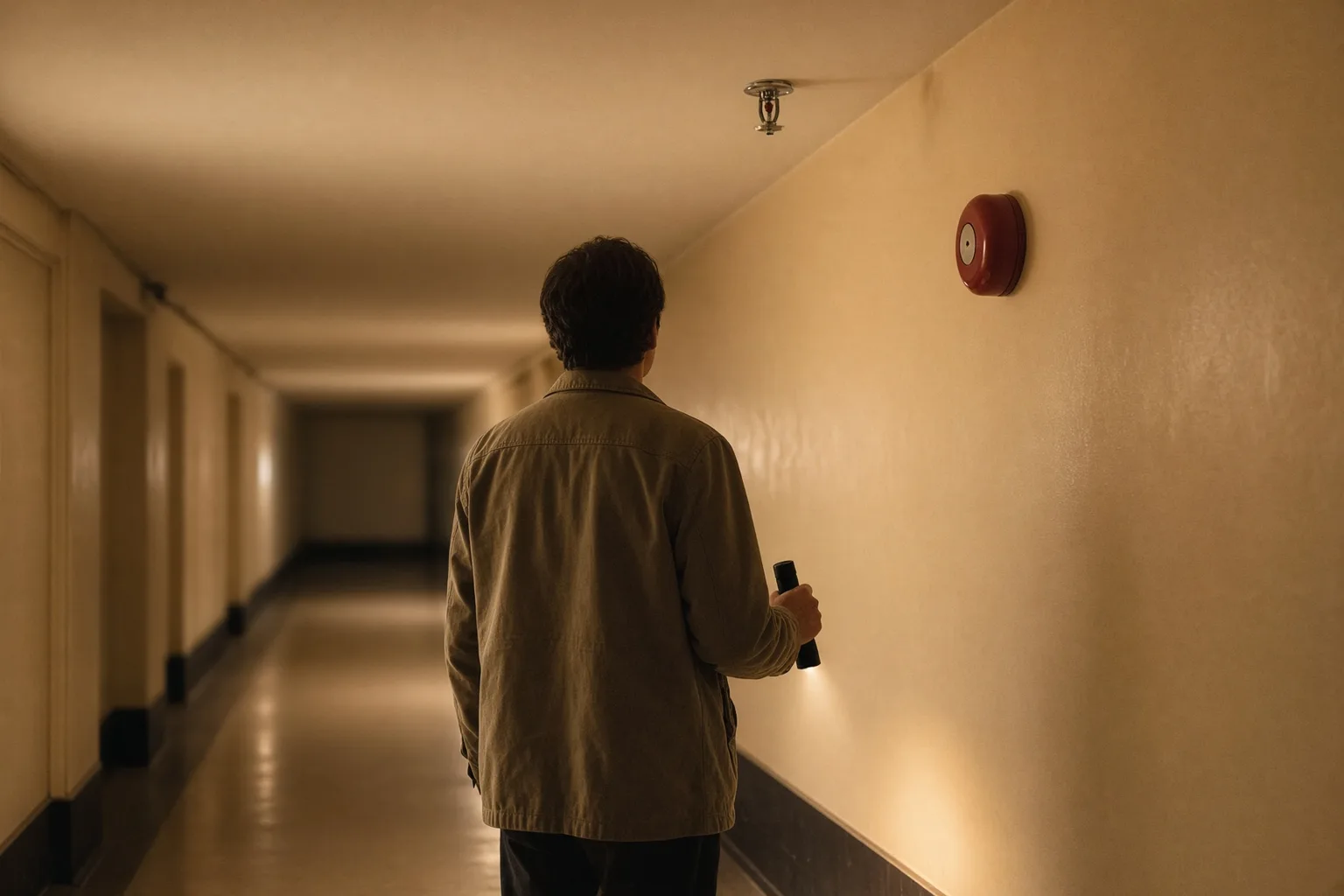
Who can be liable when a sprinkler system or fire alarm fails?
The owner or tenant who controls the system, the company that inspects or maintains it and the contractor that installed it. Each answers for its own duty under the contract, the fire code and the standard of care.
Davis v. Brickman Landscaping is the leading New Jersey example. On May 13, 2005, a lit cigarette butt thrown into landscaping mulch started a fire beside the Staybridge Suites Hotel in Somerset. The fire spread into a storage closet that the hotel had built beneath an exterior combustible staircase without a sprinkler, and then up the stairs to the second floor. Irene Davis's two children died. She was rescued with serious smoke-inhalation injuries.
Three companies had inspected the hotel's sprinkler system in the years before the fire: FireMaster in 1992-1997, Atlantic Fire Service in 1997-2004, and Cintas, which bought Atlantic and inspected from November 2004 until the fire. The plaintiffs alleged that the inspectors negligently failed to tell the owner that the closet needed a sprinkler.
In All American Moving & Storage, Inc. v. Andrews (N.Y. Sup. Ct. Bronx County 2010) the moving party was a sprinkler inspection company. A suspicious fire broke out on June 6, 2005 in a warehouse at 495 Walton Avenue in the Bronx. The lessee, D'Agostino Supermarkets, had hired Allstate Sprinkler Corporation for monthly inspections. Allstate moved for summary judgment, and the insurers of adjacent owners and tenants opposed the motion.
A contract that covers one system does not reach another. In Jordan v. Lehigh Construction Group (N.Y. App. Div. 4th Dept. Feb. 16, 2000) ATI Services had contracted with FMC Corporation to inspect, test and repair or replace the smoke and fire alarm systems at FMC's Tonawanda plant. An employee, Nabil M. Ibrahem, saw smoke in a hallway, broke out a second-story window and jumped or fell, suffering fatal injuries. The Appellate Division affirmed summary judgment for ATI, which showed that it "had no duty to design, maintain or install the sprinkler system that failed to perform during the fire."
What standard of care applies to a sprinkler inspection company?
The fire code standard, unless an expert proves that a different standard is generally recognized. In Davis the New Jersey Supreme Court applied NFPA 25 through the state's Uniform Fire Code and required expert testimony on the standard.
As the court described it, NFPA 25 sets requirements for the inspection, testing and maintenance of water-based fire protection systems. It defines inspection as a visual check that a system appears to be in operating condition and is free of physical damage. It does not require inspectors to identify or report design flaws, such as the need for an additional sprinkler. The defense expert, Russell Fleming, testified that the inspectors complied with NFPA 25, which New Jersey's Uniform Fire Code incorporates.
The plaintiffs' expert, Jack Mawhinney, agreed that NFPA 25 does not require inspectors to report design flaws. He said the standard was "written wrong" and that reasonable care required them to report the need for another sprinkler, and he admitted that he was not familiar with New Jersey law. The court treated an opinion as a net opinion when the expert "cannot offer objective support for his or her opinions, but testifies only to a view about a standard that is 'personal,'" and found that his opinion "lacked objective support."
The holding has two parts. "Compliance with NFPA 25 does not, as a matter of law, prevent a finding of negligence." But the Uniform Fire Code or the current State Fire Prevention Code provides the standard of care absent competent expert testimony that a different standard is generally recognized in the fire prevention field. The court wrote: "we hold that plaintiffs were required to establish the applicable standard of care through expert testimony." On September 15, 2014 it reversed the Appellate Division and reinstated summary judgment for the three inspection companies.
The same rule binds defendants. In St. Paul Mercury Insurance Co. v. Capitol Sprinkler Inspection, Inc. (D.D.C. June 15, 2009) the inspection company's expert disclosure had been excluded, and Judge Colleen Kollar-Kotelly held that it "cannot set forth the appropriate standard of care required by NFPA 25 in the absence of expert testimony." That covered its reading of the NFPA 25 standard of "ready accessibility."
What does the investigator have to establish when a system failed during a fire?
Five things: the origin and cause of the fire, whether a system was required and installed, whether it operated, why it did not, and whether a working system would have reduced the injuries or the loss.
Origin and cause stay first. In Davis the fire started in mulch, and the system question concerned the spread through an unsprinklered closet. In All American the Fire Department's incident report reached no conclusion about the origin or cause, and the court wrote that "the fire's cause remains a mystery." The claim went on, but any analysis of spread still needs an area of origin to start from.
Whether a system was required is a separate question. In Bardsley v. Great Lakes Industrial Development, LLC (N.Y. Sup. Ct. Erie County, Mar. 17, 2023) a fire broke out on November 9, 2016 in Building B, a cold mill building on the former Bethlehem Steel site in Lackawanna. The tenant used about 100,000 square feet for plastics recycling and stored ground plastic in stacked cardboard boxes. The building had no sprinkler system and no hard-wired smoke or heat detectors.
The experts split. Peter Klemann, the chief building inspector for the City of Buffalo, said the applicable codes required a fire protection system that included sprinklers, and the defense fire protection engineer, Stephen Olenick, said that no fire protection system was required. The Lackawanna fire inspector, William Tojek, had inspected the building in August 2014 and warned that a sprinkler might be required depending on the business. His affidavit stated: "A sprinkler was needed."
Whether the system operated and why it did not is the third step. In All American "the parties remain in dispute whether the sprinklers were in operation before or during the fire." The physical record answers that question: the position of each control valve, which heads fused, the water flow alarm and the signals received by any monitoring company.
The last step is the effect of a working system. In Bardsley the court denied summary judgment and left to the jury "whether the lack of one caused and/or exacerbated Plaintiffs' damages." In All American the insurers of the neighboring properties filed an expert affidavit arguing that factual issues existed as to whether the sprinkler malfunction increased the fire damage, and the court denied the inspection company's motion in most respects.
Does an inspection-only contract protect the inspection company?
Not by itself. In All American Moving & Storage the court denied summary judgment to an inspection company that said it had only inspected, because it was disputed whether it properly reported that the sprinklers were shut off.
Allstate argued that its contract was limited to inspection, that it had no duty to maintain or repair the system and that D'Agostino had agreed to indemnify it. Its position was summed up in one sentence: "The contract was limited to inspection which Allstate fully performed." Allstate said its employees repeatedly could not reach the sprinklers, found them turned off when they could, and had no access for six months before the fire.
The subtenant disputed that it had blocked the inspections, pointed to a 24-hour entrance on Walton Avenue and said that a properly performed inspection would have revealed the shutdown. Allstate offered no expert evidence on the conditions that caused the fire. Justice Dominic R. Massaro found factual issues on the cause, on whether the sprinklers were operating, on the reporting obligation and on Allstate's negligence, and denied Allstate's claim for full indemnity because it was disputed whether Allstate had properly reported the deficiencies to D'Agostino.
A written task list can also decide the case for the plaintiff. The inspection agreement in St. Paul Mercury obliged Capitol Sprinkler to "open condensation drains on drum drip connections and drain low points during fall and winter inspection[s]." The court granted the insurer partial summary judgment and found liability for breach of contract established.
For the investigator the contract is part of the data. The report quotes the duties the contract assigned, compares them with the inspection reports and states which deficiency was or was not reported, and to whom.
What if the sprinkler system itself caused the loss?
Then the investigator traces the failed component to whoever installed or serviced it. In St. Paul Mercury a tee froze because a drum drip was not drained, and in Westfield a 155-degree head sat in a hot attic.
On January 25, 2003, a tee fitting froze and burst in the dry sprinkler system of the Kellogg Conference Center in Washington, D.C. On January 9, Capitol Sprinkler inspectors Michael Bowlin and Tom Scott had drained every drum drip except the one above conference room 5200, because their escort did not have immediate possession of the key card for that room. Their report noted no deficiencies. The court found that "the tee fitting froze and burst because the drum drip had not been drained during the January 9, 2003 inspection."
In Westfield Insurance Group v. Chattanooga Fire Protection, Inc., No. 1:19-CV-36-SKL (E.D. Tenn.), a sprinkler in an uninsulated attic activated on June 29, 2018 with no fire present. The head was rated to 155 degrees. All parties agreed that this rating was insufficient for an uninsulated, non-air-conditioned attic and that a head rated to 200 degrees should have been installed.
The head was engraved "2016." Chattanooga Fire Protection had serviced the system until December 2016 and Century Fire Protection from May 2017, and neither admitted installing the head. Magistrate Judge Susan K. Lee dismissed all claims against Chattanooga Fire Protection and the installation claims against Century, quoting the rule that "it is not enough for a plaintiff to prove that he or she was injured by some unidentified person's negligence." The inspection claims against Century remained for the trial set for June 8, 2021.
The date on the head and the dates of each company's visits decided who stayed in the case. According to the plaintiff's expert, Chattanooga Fire Protection made five visits in 2016 and Century twelve between May 19, 2017 and June 5, 2018.
What evidence should be kept when a fire protection system failed?
Valve positions and tags, the sprinkler heads and fittings, the alarm control panel and its event memory, monitoring records, the design drawings, the service contract and every inspection report.
Valves are photographed in the position the fire department found them, before anyone opens or closes them. Fused and unfused heads near the origin are kept with their location marked, and the year and temperature rating on each head are recorded. In Westfield the year on one head narrowed the companies that could have installed it.
The alarm control panel and the central station records show when the system detected the fire, whether a water flow signal was sent and who was notified. The panel is read out before it is reset or repaired.
Inspection and service reports are collected for the full period, by company. Davis turned on what three successive inspection companies had and had not reported between 1992 and 2005, and St. Paul Mercury on an inspection report that noted no deficiencies although one drum drip was left undrained.
Destructive testing of heads, valves or fittings is done with notice to the installer, the inspection company and the manufacturer, because each may later be a party.
What does IAE do when a sprinkler system or fire alarm failed?
IAE prepares fire origin and cause expert reports on the client's questions and reviews of the opposing investigator's report for subrogation, product liability and coverage disputes in US courts, up to 5 business days after format and cost are confirmed.
The fire origin and cause page describes the work in three parts. For the origin, the investigator maps char depth, burn patterns on walls and ceilings and arc sites on branch circuits. For the cause, the investigator names the ignition source, the first fuel ignited and the circumstances that brought them together, and tests each hypothesis against the scene and the timeline. For the evidence, the investigator checks whether wiring, appliances and debris were photographed in place before removal, logged and examined at a joint lab exam with all interested parties notified.
A review of the opposing report lists each hypothesis the investigator considered, checks what data excluded the others and traces every artifact to its examination. In a system failure case the client sends the scene photographs, the fire department report, the system drawings, the service contract and inspection reports, the panel and monitoring records if they have been produced, and the opposing report, and states whether the scene and the removed heads and valves still exist.
The secretariat confirms receipt the same day. Within one business day IAE confirms the format, the cost, the deadline and the specialist from its registry, and the client approves the candidate and the CV before work starts. Cases with tight deadlines have a 48-hour rush.
Registry members passed the collegial attestation of the council under the published Criteria Matrix, and the Member ID or QR code in the document opens the specialist's record. The specialist confirms in the document that he or she has no interest in the outcome. Materials are not passed to third parties without the client's consent. An expert report is evidence the court weighs with the other materials. Neither IAE nor the specialist guarantees the outcome, and IAE is not a law firm: questions of contract, indemnity and limitation periods stay with counsel.
Sources
- Davis v. Brickman Landscaping, Ltd., A-22/23/24 September Term 2012 (N.J. Sept. 15, 2014), New Jersey Courts
- All American Moving & Storage, Inc. v. Andrews, 2010 NY Slip Op 33860(U) (Sup. Ct. Bronx County 2010), New York Official Reports
- Bardsley v. Great Lakes Industrial Development, LLC, 2023 NY Slip Op 35316(U) (Sup. Ct. Erie County Mar. 17, 2023), New York Official Reports
- Jordan v. Lehigh Construction Group, Inc. (N.Y. App. Div. 4th Dept. Feb. 16, 2000) (FindLaw)
- St. Paul Mercury Insurance Co. v. Capitol Sprinkler Inspection, Inc., No. 05-2115 (CKK) (D.D.C. June 15, 2009) (Justia)
- Westfield Insurance Group v. Chattanooga Fire Protection, Inc., No. 1:19-CV-36-SKL (E.D. Tenn.), Document 85 (Justia)
Read also
All articles
Power surge fire: how does an investigator prove an overvoltage, and when is the utility liable?
A power surge can reach a building at many times its rated voltage, and the claim that follows turns on two findings: where the abnormal voltage came Sergei Voronin
Gas explosion investigation: who is liable, and what does the investigator have to establish?
After a gas explosion the claim turns on one physical question: where the gas came from and why nobody noticed it before something ignited itSergei Voronin
Tenant caused a fire: who is liable, can the landlord's insurer sue, and what must the investigator establish?
When a rented house burns, three questions come up in order: where the fire started, what started it, and who answers for that cause under the leaseSergei VoroninExpert examinations
Ready to discuss your case?
Send the materials: the secretariat will confirm the format, cost, deadline and the specialist within one business day.
