
Examinations
Power surge fire: how does an investigator prove an overvoltage, and when is the utility liable?
A power surge can reach a building at many times its rated voltage, and the claim that follows turns on two findings: where the abnormal voltage came from and whether it, and not a fault inside the building, started the fire. In a 2013 Pennsylvania case a failed neutral connection left 215 volts on one leg of the service. Courts in several states then treat the electricity as a defective product once it has passed the meter.
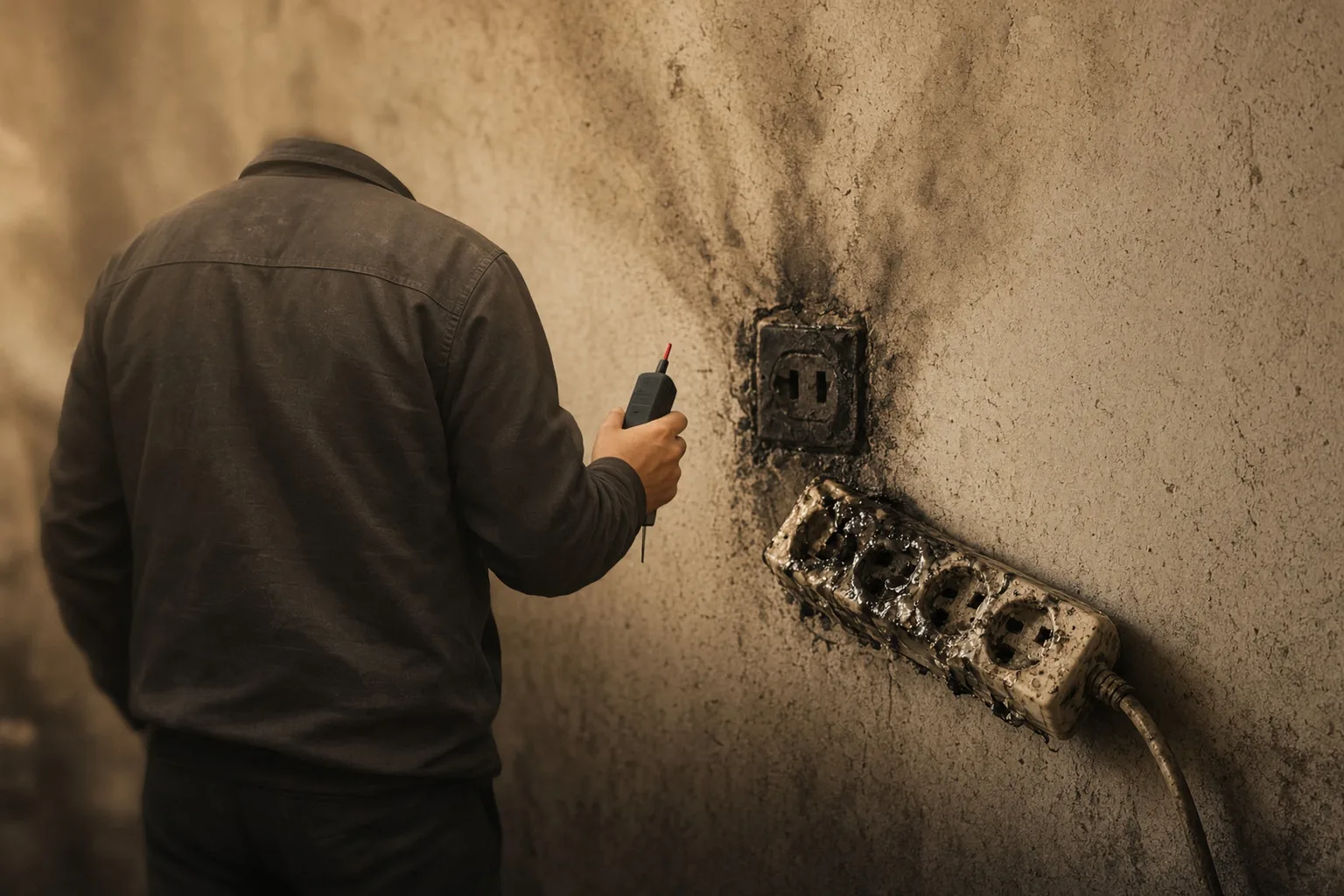
Can a power surge start a fire?
Yes. Voltage far above a home's 120/240-volt rating overheats wiring and equipment. In Ransome v. Wisconsin Electric Power Co. (Wis. 1979) high-voltage electricity passed through the meter into a house and set it on fire.
Ralph and Dorothy Ransome owned a two-family rental house in the Town of Waukesha, Wisconsin. Wisconsin Electric Power Company supplied it at 120-240 volts through a pole transformer that stepped down 4,800-volt line power, and the utility owned the equipment up to and including the meter. About four days before the fire, lightning struck the line near the transformer. On September 28, 1974, during heavy rain, the transformer exploded, and high-voltage electricity passed through the meter into the house and caused a fire.
The Wisconsin Supreme Court found that the electricity entering the house "had a voltage between 1000 and 4000 volts." The opinion notes that ordinary homes have "circuit breakers or fuses with a maximum voltage rating of only 600 volts."
In Pierce v. Pacific Gas & Electric Co. (Cal. Ct. App. 1985) a lightning storm on November 21, 1978 damaged several transformers in Sutter County, California, two of them on the Pierces' property. A crew came back at about 1:30 a.m. on November 22 to replace them. One replacement was a used transformer that had not been tested before connection, and it exploded as a lineman made the third connection. The house, wired for 120 and 240 volts, received about 7,000 volts. A fire broke out in a storage shed near a ruptured propane line, and Gail Pierce was severely shocked when she grabbed the propane shutoff valve.
Surge fires also reach court as subrogation claims. On September 29, 2008, a fire was found burning on top of a wooden bookshelf in a second-floor office of the Wright Veterinary Medical Center in Bethlehem, Pennsylvania. Cincinnati Insurance paid its insured $805,559.08 and sued the utility as subrogee in the Eastern District of Pennsylvania, case No. 10-4960.
What is a lost neutral, and what does it do to the voltage?
A failed neutral connection leaves the two hot legs of the service unbalanced. In Cincinnati Insurance Co. v. PPL Corp. the utility's troubleman measured 215 volts on one hot lead and 40 volts on the other.
The court set out the event in a few lines. On the night of September 29, 2008, a problem developed with the neutral connection of a 100 kVA transformer that the defendants owned and operated. The troubleman, Raymond Bringhurst, measured the voltage on both hot leads and wrote the readings on the transformer itself.
The plaintiff's fire investigator, John F. Goetz, concluded that the surge from the malfunctioning transformer caused both the fire and the damage to electrical equipment. Citing NFPA 921, his report explained that "the higher voltage can overheat or burn out some equipment and the lower voltage can damage some electronic equipment." The local fire marshal, Bernard Roecker, reached the same conclusion.
The defense did not offer another cause. Its electrical engineer, Allan Magee, P.E., wrote that "the circumstances of the fire are consistent with an electrical failure," found that the fire and the equipment damage came from the same event and found that the transformer had failed internally. The court noted that the defendants' experts did not dispute that the voltage imbalance caused the fire and the equipment damage.
The dispute moved to a narrower question: why the transformer failed. The defendants contended that a manufacturing defect was to blame. The transformer had been made by McGraw-Edison, now Cooper Power Systems, which was in the case as a third-party defendant. In a lost neutral case the cause can therefore lie with the utility that delivered the voltage, with the maker of the equipment that failed or, if the break was on the customer's side of the meter, with the owner of the building's wiring.
What does the investigator have to establish in a power surge fire?
Four things: an origin at energized electrical equipment, proof that abnormal voltage reached the building, the point where it entered and the cause there, and data that exclude a fault that began in the building's own wiring or appliances.
The origin comes first, as in any fire. A surge explains a fire only if the area of origin contains wiring, a panel or an appliance that was energized at the time. In Cincinnati Insurance the fire was on a bookshelf in an office with electrical equipment. In Pierce it broke out in a storage shed next to a propane line that had ruptured.
Proof of the abnormal voltage is the second step. A measurement taken before anything is repaired is direct evidence, like the troubleman's readings in Cincinnati Insurance. Physical evidence on the supply side comes next. In Ransome the inspection after the fire found a missing insulator, a broken primary fuse and a spent lightning arrester. In Pierce the crew had connected an untested used transformer, which exploded during the connection.
The third step locates the event. The report states whether the abnormal condition arose in the utility's equipment, in the service conductors or at the meter, because the answer decides which legal theory is open. Fong v. Pacific Gas & Electric Co. (Cal. Ct. App. 1988) turned on this point. The plaintiffs' garage on their Fairfield farm burned to the ground on January 26, 1984. They claimed that PG&E's triplex service lines had lost their insulation through faulty installation, so that arcing dropped molten aluminum onto the shingled roof. A PG&E troubleman found the voltage normal on each wire, and arcing and melted insulation on the last two or three feet of wire, which lay on the ground.
The last step excludes the ordinary electrical causes. A surge does not stand as the cause if a loose connection, a damaged cord or an appliance failure at the origin accounts for the fire on the same data. In Fong PG&E argued that the fire began inside the garage, possibly at a battery charger, and the first firefighters reported the lines intact. The report lists each such hypothesis and the data that excluded it.
Is the utility strictly liable for a fire caused by a surge?
In several states it can be once the electricity has passed the customer's meter. Wisconsin in Ransome, California in Pierce and Pennsylvania under Schriner treat electricity as a product subject to strict liability.
The Ransome jury answered no to the question whether the electricity was unreasonably dangerous when it left the utility's control, and set damages at $25,000. The Wisconsin Supreme Court reversed on February 27, 1979, in Ransome v. Wisconsin Electric Power Co., 87 Wis. 2d 605. It held that "electricity can be a product within the meaning of sec. 402A" of the Restatement (Second) of Torts, and that "such voltage as applied to an ordinary private residence is 'defective' and 'unreasonably dangerous.'"
In Pierce the jury found PG&E not negligent, and the trial court had removed the strict liability claim by nonsuit. The Court of Appeal reversed the nonsuit and held that a commercial supplier can be strictly liable for injuries caused by electricity delivered at dangerously high voltage because of a defective transformer. It relied on the statement that "Electricity is a commodity which, like other goods, can be manufactured, transported and sold." It also said that in most cases "the electricity must be delivered to the customer's premises, to the point where it is metered."
In Cincinnati Insurance Judge Eduardo C. Robreno applied Schriner v. Pennsylvania Power & Light Co. (Pa. Super. Ct. 1985), under which electricity becomes a product once it "passes through the customer's meter and into the stream of commerce." The insurer had to show five elements: a product, a sale of that product, a user or consumer, a defective condition unreasonably dangerous, and causation. The defendants argued that the harm occurred during transmission, which is a service, that they do not sell surges of electricity and that the transformer, and not the electricity, caused the damage.
The defendants did not dispute that the electricity passed through the veterinary center's meter, and the court found that a sale occurred at that point. On October 25, 2013 it granted the insurer partial summary judgment on the strict liability count. The opinion does not rule on the negligence and contract counts.
Strict liability changes what the investigator has to prove on that count. Fault in the utility's work drops out. The report has to show that the electricity delivered through the meter carried an abnormal voltage and that this voltage caused the fire. In Pierce the jury had rejected negligence, and strict liability was still open on appeal.
When does strict liability not reach the utility?
When the electricity had not yet reached the point of consumer use, or when the defect lay in the lines and not in the current. Colorado decided the first in Smith, California the second in Fong.
On March 19, 1977 a dairy farm manager and his son were killed when they and a companion pulled a portable grain auger into an uninsulated 7,200-volt overhead line that Home Light and Power had built to supply a dairy barn. In Smith v. Home Light and Power Co., 734 P.2d 1051 (Colo. Mar. 30, 1987), the Colorado Supreme Court held that "at least until the electricity reaches a point where it is made available for consumer use, it is not a 'product'" under section 402A. The electricity in that line had not yet passed through the utility's transformer near the barn.
The court added that transmission lines "generally remain in the control of the supplier and are not placed in the stream of commerce." The negligence claim stays open: Colorado holds an electric utility to the "highest degree of care which skill and foresight can attain." In Smith the jury was instructed on that duty and found for the utility.
Fong set the second limit. The Court of Appeal wrote that "electricity can be a product" but that "The claimed defect was not in the electrical current but in the insulation of the wire itself," and that a strict liability claim could not lie against PG&E for that defect. It restated the California test: "the test is whether the electricity has been metered." The judgment was reversed with directions to enter judgment for PG&E.
Together the two cases give the report a question to answer in plain terms: was the defect in the voltage delivered, or in the equipment that carried it? In Fong the lines arced at normal voltage, and the claim was a line defect. In Cincinnati Insurance a transformer failure sent abnormal voltage through the meter. When the evidence cannot separate the two, the report says so and names the missing data.
Does lightning relieve the utility of liability?
Not automatically. In Ransome the Wisconsin Supreme Court refused the act-of-God defense, calling lightning strikes a foreseeable problem for electric utilities. The investigator still documents what the lightning damaged and when.
The utility in Ransome argued that the lightning strike four days before the fire was an act of God. The court answered that "Lightning strikes are a fairly frequent, foreseeable, and recurring problem" for electric companies and that the defense "should not be available to the electric company to relieve it of strict liability."
After the fire the utility's troubleman found the insulator on top of the cross bar missing, the primary fuse broken and the lightning arrester spent. The last scheduled inspection of that pole had taken place on December 14, 1973.
In Pierce the storm came first and the surge came during the repair. The lightning of November 21, 1978 damaged the transformers, the crew returned at about 1:30 a.m. on November 22, and the explosion happened while a used, untested replacement was being connected. The investigator builds the same kind of timeline from utility records: the time of the storm or outage, the arrival of the crew, the equipment replaced, the time of re-energizing and the time the fire was reported.
A strike on the building itself is a different event from high voltage arriving through the service and the meter, and Ransome and Pierce both concern the second. The report states which one the physical evidence supports.
What evidence should be kept after a surge fire?
The transformer and its connections, the service conductors, the meter and panel, the damaged appliances and surge protectors, and the utility's field notes, readings and repair orders. In Cincinnati Insurance the readings were written on the transformer.
Utilities restore service quickly, and the failed equipment is often the only physical proof of what happened. The transformer, its neutral connection, the service drop and the meter are photographed in place and kept with a record of who held them. The request to the utility goes out before the failed unit is scrapped or put back into service.
Inside the building the investigator lists every damaged device and the circuit it was on. Goetz's point in Cincinnati Insurance was that high voltage and low voltage damage different equipment, so the pattern of damage across circuits is part of the data. The experts in that case tied the fire and the equipment damage to one event.
The maker of the failed equipment receives notice before any destructive examination. In Cincinnati Insurance the transformer's manufacturer was a third-party defendant, and the defendants' claim against it depended on proof of a manufacturing defect inside the unit. An examination done without the manufacturer gives it an argument against the result.
The utility's paper record covers the troubleman's notes and readings, outage and switching logs and repair orders. In Pierce the facts on appeal included that the replacement transformer was used and had not been tested before connection. In Fong the troubleman's finding of normal voltage on each wire went against the theory of a defect in the current.
What does IAE do in a power surge fire dispute?
IAE prepares fire origin and cause expert reports on the client's questions and reviews of the opposing investigator's report for subrogation, product liability and coverage disputes in US courts, up to 5 business days after format and cost are confirmed.
The fire origin and cause page describes the work in three parts. For the origin, the investigator maps char depth, burn patterns on walls and ceilings and arc sites on branch circuits. For the cause, the investigator names the ignition source, the first fuel ignited and the circumstances that brought them together, and tests each hypothesis against the scene and the timeline. For the evidence, the investigator checks whether wiring, appliances and debris were photographed in place before removal, logged and examined at a joint lab exam with all interested parties notified.
A review of the opposing report lists each hypothesis the investigator considered, checks what data excluded the others and traces every artifact to its examination. In a surge case the client sends the scene photographs, the fire department report, the utility's field notes and readings if they have been produced, the list of damaged equipment and the opposing report, and states whether the scene, the transformer and the meter still exist.
The secretariat confirms receipt the same day. Within one business day IAE confirms the format, the cost, the deadline and the specialist from its registry, and the client approves the candidate and the CV before work starts. Cases with tight deadlines have a 48-hour rush.
Registry members passed the collegial attestation of the council under the published Criteria Matrix, and the Member ID or QR code in the document opens the specialist's record. The specialist confirms in the document that he or she has no interest in the outcome. Materials are not passed to third parties without the client's consent. An expert report is evidence the court weighs with the other materials. Neither IAE nor the specialist guarantees the outcome, and IAE is not a law firm: questions of tariffs, duty and limitation periods stay with counsel.
Sources
- The Cincinnati Insurance Co. v. PPL Corp., No. 10-4960 (E.D. Pa. Oct. 25, 2013), Document 55 (Justia)
- Ransome v. Wisconsin Electric Power Co., 87 Wis. 2d 605, No. 76-301 (Wis. Feb. 27, 1979) (Justia)
- Pierce v. Pacific Gas & Electric Co. (Cal. Ct. App. 1985) (Justia)
- Smith v. Home Light and Power Co., 734 P.2d 1051, No. 85SC39 (Colo. Mar. 30, 1987) (Justia)
- Fong v. Pacific Gas & Electric Co. (Cal. Ct. App. 1988) (Justia)
Read also
All articles
Sprinkler or fire alarm failure: who is liable, and what does the investigator have to establish?
When a sprinkler system or fire alarm does not work during a fire, the claim reaches the companies that installed, inspected or maintained it Sergei Voronin
Gas explosion investigation: who is liable, and what does the investigator have to establish?
After a gas explosion the claim turns on one physical question: where the gas came from and why nobody noticed it before something ignited itSergei Voronin
Tenant caused a fire: who is liable, can the landlord's insurer sue, and what must the investigator establish?
When a rented house burns, three questions come up in order: where the fire started, what started it, and who answers for that cause under the leaseSergei VoroninExpert examinations
Ready to discuss your case?
Send the materials: the secretariat will confirm the format, cost, deadline and the specialist within one business day.
