
Expert witnesses
Florida chapter 558 notice of claim: what must it say, and what happens to the expert's presuit inspection?
Before suing a Florida contractor, subcontractor, supplier or design professional over a construction defect, the owner serves a notice of claim under chapter 558 of the Florida Statutes, at least 60 days before suit, or 120 days for an association representing more than 20 parcels. The notice starts an inspection, a written response and, on request, an exchange of documents that includes expert reports. A suit filed without it is stayed.
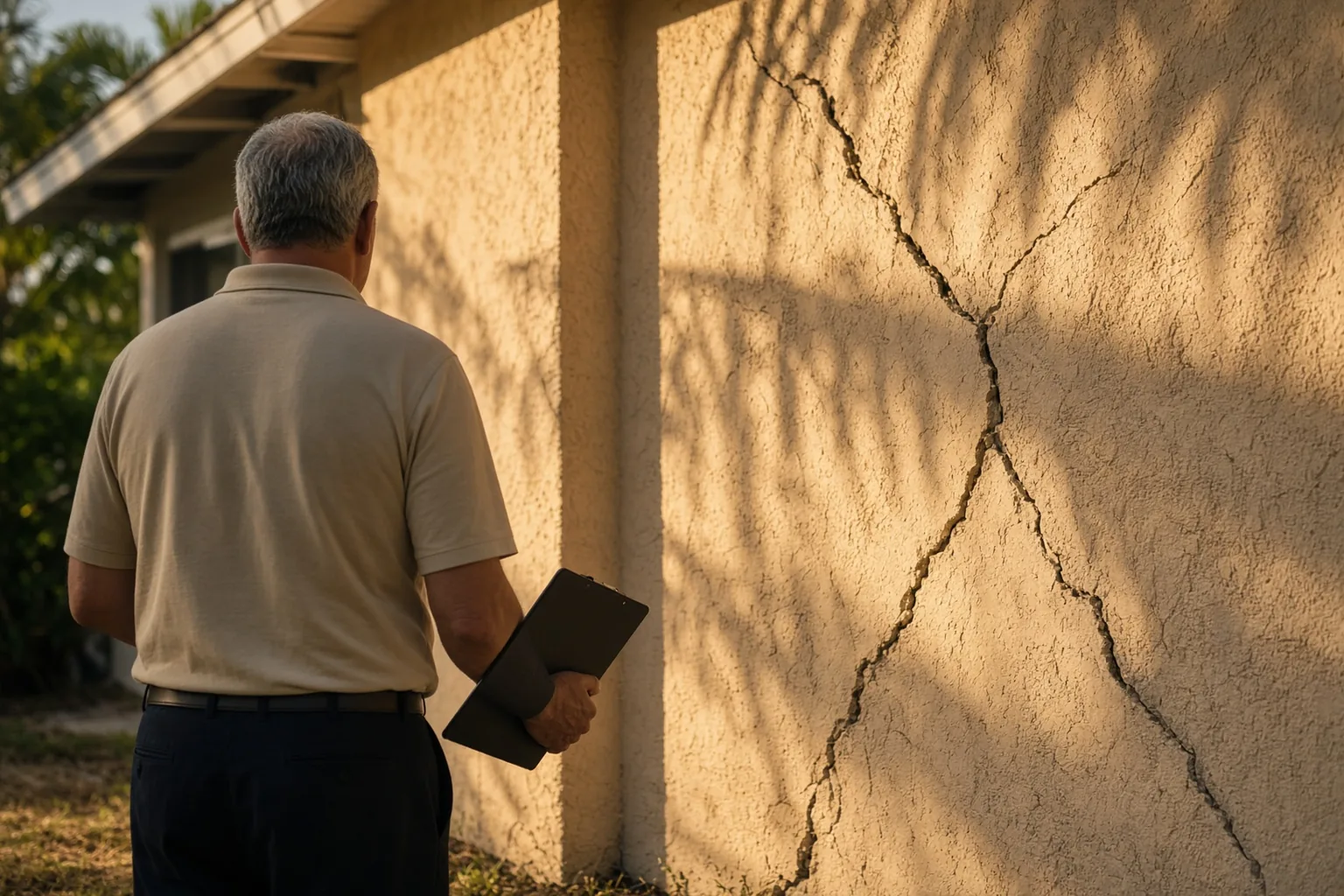
What is a chapter 558 notice of claim?
A written notice the owner serves on the party it holds responsible for a construction defect before filing suit or arbitration. It gives that party and its insurer a chance to inspect and to offer repair or payment first.
Section 558.001 states the Legislature's purpose: an alternative method of resolving construction disputes that protects property owners, under which the claimant notifies the party it believes responsible, and that party and its insurer have an opportunity to resolve the claim before any court action.
Section 558.002 defines the terms. An "action" is a civil action or arbitration for damages to property caused by an alleged construction defect; administrative proceedings and claims for personal injury are excluded. A "claimant" is a property owner, including a subsequent purchaser or an association, who asserts such a claim. A contractor, subcontractor, supplier or design professional cannot be a claimant.
The process is mandatory. Under section 558.003, a claimant may not file an action subject to the chapter without first complying with it. If the claimant files anyway, on timely motion by a party the court must stay the action without prejudice, and the action may not proceed until the claimant complies.
What counts as a construction defect under chapter 558?
A deficiency in design, specifications, surveying, planning, supervision, observation or construction that results from defective materials, a code violation actionable under section 553.84, a design below professional standards or work below accepted trade standards.
The definition in section 558.002 covers deficiencies in, or arising out of, the design, specifications, surveying, planning, supervision, observation of construction, or construction, repair, alteration or remodeling of real property. The deficiency must result from one of four causes: defective material, products or components used in the construction or remodeling; a violation of the applicable codes that gives rise to a claim under section 553.84; a failure of the design to meet the applicable professional standards of care at the time of governmental approval; or a failure to construct or remodel in accordance with accepted trade standards for good and workmanlike construction.
Each cause is proved by a different comparison. Defective materials are compared with the specifications and the product standards. A code claim compares the completed building with the code in force. A design claim compares the plans with the professional standard of care at the date the government approved them. A workmanship claim compares the installed work with trade standards.
The definition of "design professional" lists persons licensed in Florida as architects, engineers, surveyors and geologists, among other professions, and registered interior designers. "Completion of a building or improvement" means issuance of a final or temporary certificate of occupancy, or an equivalent authorization to occupy or use the whole project, and where none is issued, substantial completion under the plans and specifications.
When must the notice be served, and what must it contain?
At least 60 days before filing an action, or 120 days for an association representing more than 20 parcels. It refers to chapter 558 and describes each defect, its location and any known damage in reasonable detail.
Section 558.004(1) requires a written notice of claim served on the contractor, subcontractor, supplier or design professional at least 60 days before filing an action, or at least 120 days before filing for an association representing more than 20 parcels. The notice must refer to chapter 558. If the construction defect claim arises from work under a contract, the notice goes to the person with whom the claimant contracted.
The notice must describe in reasonable detail the nature of each alleged defect and, if known, the damage or loss resulting from it. "Based upon at least a visual inspection by the claimant or its agents," the notice must identify the location of each alleged defect sufficiently for the recipient to locate it without undue burden. Destructive testing is not required for the notice.
Service has a defined meaning: delivery by certified mail with proof of delivery or attempted delivery from the U.S. Postal Service, by hand, or by courier with written proof of delivery (section 558.002). The statute encourages service within 15 days after discovery of a defect, but a later notice does not bar the action. The notice does not toll any statute of repose under chapter 95.
Who may inspect the property after the notice, and when?
The served party may inspect within 30 days after service, or 50 days for a large association. It may forward the notice within 10 days to others it holds responsible, and they may inspect as well.
Under section 558.004(2), the person served with the notice is entitled to a reasonable inspection of the property, or of each unit subject to the claim, to assess each alleged construction defect. The inspection takes place within 30 days after service, or within 50 days for an association representing more than 20 parcels. The claimant provides that person and its contractors or agents reasonable access during normal working hours, and the parties coordinate inspections so their number is kept down.
Within 10 days after service, or 30 days for such an association, the served party may forward a copy of the notice to each contractor, subcontractor, supplier or design professional it reasonably believes responsible, naming the specific defect for which each is believed responsible (section 558.004(3)). Forwarding is not an admission, and each recipient may inspect under subsection (2).
Each recipient of a forwarded notice must answer in writing within 15 days, or 30 days for such an association. The answer includes a report, if any, of the scope of any inspection and the findings and results, and one or more of the offers listed in subsection (5) (section 558.004(4)).
What rules apply to destructive testing during a chapter 558 inspection?
Destructive testing requires mutual agreement and a written notice describing the test, the tester, the expected damage and repair, the time needed and who pays. A claimant who unreasonably refuses loses damages the test would have avoided.
Section 558.004(2) sets the terms. The party that believes destructive testing is necessary notifies the claimant in writing. The notice describes the nature and type of the testing, the person who will perform it, the expected damage and repairs, the time required and who will pay for them. If the claimant objects to the proposed tester, the responding party offers three qualified alternatives and the claimant chooses one; the tester acts as the agent or subcontractor of the responding party.
The testing takes place at a mutually agreeable time, the claimant or its representative may be present to observe, and the property must remain habitable during the testing and restoration. Testing and restoration create no construction lien rights under part I of chapter 713 unless the owner has contracted for them.
The refusal rule gives the testing request weight. "If the claimant refuses to agree and thereafter permit reasonable destructive testing, the claimant shall have no claim for damages which could have been avoided or mitigated had destructive testing been allowed when requested and had a feasible remedy been promptly implemented."
What must the written response to a chapter 558 notice offer?
Within 45 days after service, or 75 days for a large association, the served party offers to repair, to pay, or both, disputes the claim, or states that its insurer will decide on payment within 30 days.
Section 558.004(5) lists five forms of response, and the response may combine them: a written offer to remedy the defect at no cost, with a detailed description of the repairs and a timetable; a written offer to settle by payment of money, with a timetable, which does not obligate the insurer; a written offer to settle by a combination of repairs and payment; a written statement that the party disputes the claim and will not remedy or settle it; or a written statement that a monetary payment will be determined by the insurer within 30 days after notification to the insurer. If the insurer does not respond within those 30 days, the claimant is deemed to have satisfied the preconditions to suit.
If the response disputes the claim or no response arrives in time, the claimant may proceed with the action without further notice (section 558.004(6)). A claimant who receives a timely offer must accept or reject it in writing within 45 days; a suit filed before that answer is stayed on timely motion (section 558.004(7)). If the offeror does not pay or repair as agreed, the claimant may sue without further notice; if it does, the claimant is barred from suing on that claim except as the accepted offer provides (section 558.004(8)).
The claimant may make emergency repairs needed to protect health, safety and welfare. An offer, or the absence of one, is not an admission of liability and is not admissible in an action under the chapter (section 558.004(9)).
Which documents, including expert reports, do the parties exchange?
On a written request citing section 558.004(15), within 30 days: plans and specifications, photographs and videos, expert reports describing the defects, subcontracts, purchase orders and maintenance and investigation records. Privileges still apply.
Either the claimant or the served party may request the documents, and the party making the request offers to pay the reasonable costs of reproduction. The list covers design plans, specifications and as-built plans; photographs and videos of the alleged defect; expert reports "that describe any defect upon which the claim is made"; subcontracts and purchase orders for the work that is the subject of the claim, or parts of it; and maintenance records and other documents related to the discovery, investigation, causation and extent of the alleged defect and any resulting damages.
A party may assert any claim of privilege recognized under Florida law. "In the event of subsequent litigation, any party who failed to provide the requested materials" is subject to the sanctions the court may impose for a discovery violation.
The statute limits what happens to the reports later. "Expert reports exchanged between the parties may not be used in any subsequent litigation for any purpose," unless the expert, or a person affiliated with the expert, testifies as a witness, or the report is used or relied upon by an expert who testifies on behalf of the party for whom the report was prepared.
Does the chapter 558 notice stop the statute of limitations?
It tolls the statute of limitations until the later of 90 days after service, or 120 days where that period applies, and 30 days after an accepted offer's repair or payment period ends. Repose keeps running.
Under section 558.004(10), service of the notice tolls the applicable statute of limitations for the persons covered by the chapter and for any bond surety. By stipulation the parties may extend the period, and the statute of limitations is tolled during the extension.
Section 558.004(1) says separately that the notice does not toll any statute of repose period under chapter 95. The repose period keeps running while the parties inspect and negotiate.
The notice also limits the later trial. Section 558.004(11) applies the procedure to each alleged defect, permits one notice to list several defects and to be amended as new ones are found, and provides that trial proceeds only on defects that were noticed in compliance with the chapter, together with defects reasonably related to them or caused by them.
Is the chapter 558 process a suit for the contractor's liability insurer?
Under the policy language in Altman Contractors v. Crum & Forster (Fla. 2017), yes: the process is an alternative dispute resolution proceeding, so the duty to defend can arise if the insurer consents.
Altman Contractors was the general contractor for Sapphire Condominium, a high-rise in Broward County. Crum & Forster Specialty Insurance Company insured it under seven consecutive one-year commercial general liability policies. The condominium owner served chapter 558 notices that together identified more than 800 construction defects. The insurer denied that the notices triggered its duty to defend and later retained counsel under a reservation of rights. Altman settled without a lawsuit and sued the insurer in federal court, and the Eleventh Circuit certified the question to the Florida Supreme Court.
The policy defined "suit" as a civil proceeding in which covered damages are alleged, including any other alternative dispute resolution proceeding in which such damages are claimed and to which the insured submits with the insurer's consent. On December 14, 2017, in an opinion by Justice Polston, the court held that the chapter 558 process is not a civil proceeding, because participation is voluntary, no court or adjudicator takes part and the result is not binding, but that it is an alternative dispute resolution proceeding. The insurer's consent is still required, and the court did not decide whether the insurer had consented.
Section 558.004(13) adds the statutory rule: sending a copy of the notice to an insurer is not a claim for insurance purposes unless the policy says otherwise, and the chapter does not excuse compliance with policy conditions to coverage.
Do construction contracts have to mention chapter 558?
Written contracts for improvement of real property between an owner and a contractor or design professional, entered into after October 1, 2009, must contain a notice that construction defect claims are subject to chapter 558.
Section 558.005(1) begins: "Unless a claimant and a potential defendant have agreed in writing to opt out of the requirements of this section, the provisions of this chapter shall apply to any claim for legal relief for which the agreement to make the improvement was made after October 1, 2009," where the claim rests on a construction defect that arose after completion of the building or improvement. Under subsection (6), a written contract for improvement of real property entered into after October 1, 2009 between an owner and a contractor, or between an owner and a design professional, "must contain substantially the following notice": "ANY CLAIMS FOR CONSTRUCTION DEFECTS ARE SUBJECT TO THE NOTICE AND CURE PROVISIONS OF CHAPTER 558, FLORIDA STATUTES."
At any time, the claimant and the person served with the notice "may agree in writing to preaction mediation or otherwise alter the procedure for the notice of claim process described in this chapter" (section 558.005(4)). If an arbitration clause in a contract for the sale, design, construction or remodeling of real property conflicts with section 558.004, section 558.004 controls (section 558.004(14)).
What standard will the expert's opinion meet if the case goes to court?
Section 90.702 of the Florida Evidence Code: the testimony must rest on sufficient facts or data, come from reliable principles and methods, and apply those methods reliably to the facts of the case.
The 2026 text of section 90.702 sets three conditions: "The testimony is based upon sufficient facts or data;" "The testimony is the product of reliable principles and methods;" and "The witness has applied the principles and methods reliably to the facts of the case." The history line lists the last amendment as chapter 2013-107.
The presuit stage builds the factual record for those conditions. The inspection under section 558.004(2), the results of any destructive testing and the documents exchanged under subsection (15) are the facts and data a testifying expert may later rely on. Under subsection (15), an exchanged expert report enters the litigation only through a testifying expert, and that expert's opinion then has to meet section 90.702.
How does IAE find a construction expert for a chapter 558 dispute?
Choose the case type Construction and describe the building, the state and the question, such as a defect or a code issue. Within 5 business days IAE sends 2-3 candidates with CVs, hourly rates and testimony lists.
The IAE page on construction expert witnesses lists 7 specialties: structural engineering, geotechnical engineering, architecture, building envelope, MEP systems, cost estimating and scheduling. It notes that envelope consultants water-test windows under ASTM E1105 and that cost estimators price the repair scope the engineers define. The page's questions section summarizes what a Florida notice of construction defect must contain under section 558.004.
The request form asks for the field of expertise, the state and court, the firm's side, the parties and their counsel for the conflict check and a short description of the case, without privileged or sealed information. The expert disclosure deadline is an optional field. Within 1 business day IAE replies whether it can search in that field, and the search costs $2,000 per case, paid in advance.
Within 5 business days the firm receives 2-3 candidates with CVs, hourly rates, testimony in the last 4 years and publications in the last 10 years. Each candidate confirms in writing that he or she has no ties to the parties or their counsel. If no candidate fits, the second search is free. The expert's hourly rate never depends on the outcome of the case or on the content of testimony, and IAE is not a law firm: case strategy and the decision to retain an expert stay with the attorney.
Sources
- Florida Statutes, chapter 558, Construction Defects, sections 558.001-558.005 (2024 edition, Florida Senate)
- Florida Statutes, section 558.004, Notice and opportunity to repair (2026 edition, Florida Senate)
- Florida Statutes, section 558.005, Contract provisions; application (2026 edition, Florida Senate)
- Altman Contractors, Inc. v. Crum & Forster Specialty Insurance Co., No. SC16-1420 (Fla. Dec. 14, 2017) (Justia)
- Florida Statutes, section 90.702, Testimony by experts (2026 edition, Florida Senate)
Read also
All articles
Spearin doctrine: when does the owner bear the cost of defective plans and specifications, and what does the contractor's expert have to prove?
Under the Spearin doctrine, an owner who gives the contractor plans and specifications impliedly warrants that work built to them will be adequate Sergei Voronin

Differing site conditions claim: what must the contractor prove, and which experts carry the proof?
A differing site conditions claim asks the owner to pay for ground the contract did not describe. On federal projects the clause is FAR 52.236-2Sergei Voronin
SB 800 construction defect claims in California: which standards apply, what comes before a lawsuit and what must the expert prove?
SB 800, enacted in 2002, governs construction defect claims against builders of new homes in California. Civil Code section 896 lists buildingSergei VoroninExpert witnesses
Need an expert witness for your case?
Describe the question, the case type and the court. Within 5 business days you receive 2-3 candidates with CVs, hourly rates and lists of prior testimony.
