
Examinations
Footwear impression evidence: what may the examiner conclude, and how does a defense expert check the report?
A footwear examiner compares a print from the scene with a known shoe and reports one of a fixed set of conclusions. The Department of Justice Uniform Language for Testimony and Reports (ULTR), in effect since August 15, 2020, lists six and bars claims of uniqueness, a zero error rate or 100 percent certainty. A defense expert checks the case file against ANSI/ASB Standard 137 and the disclosure the government makes under Criminal Rule 16.
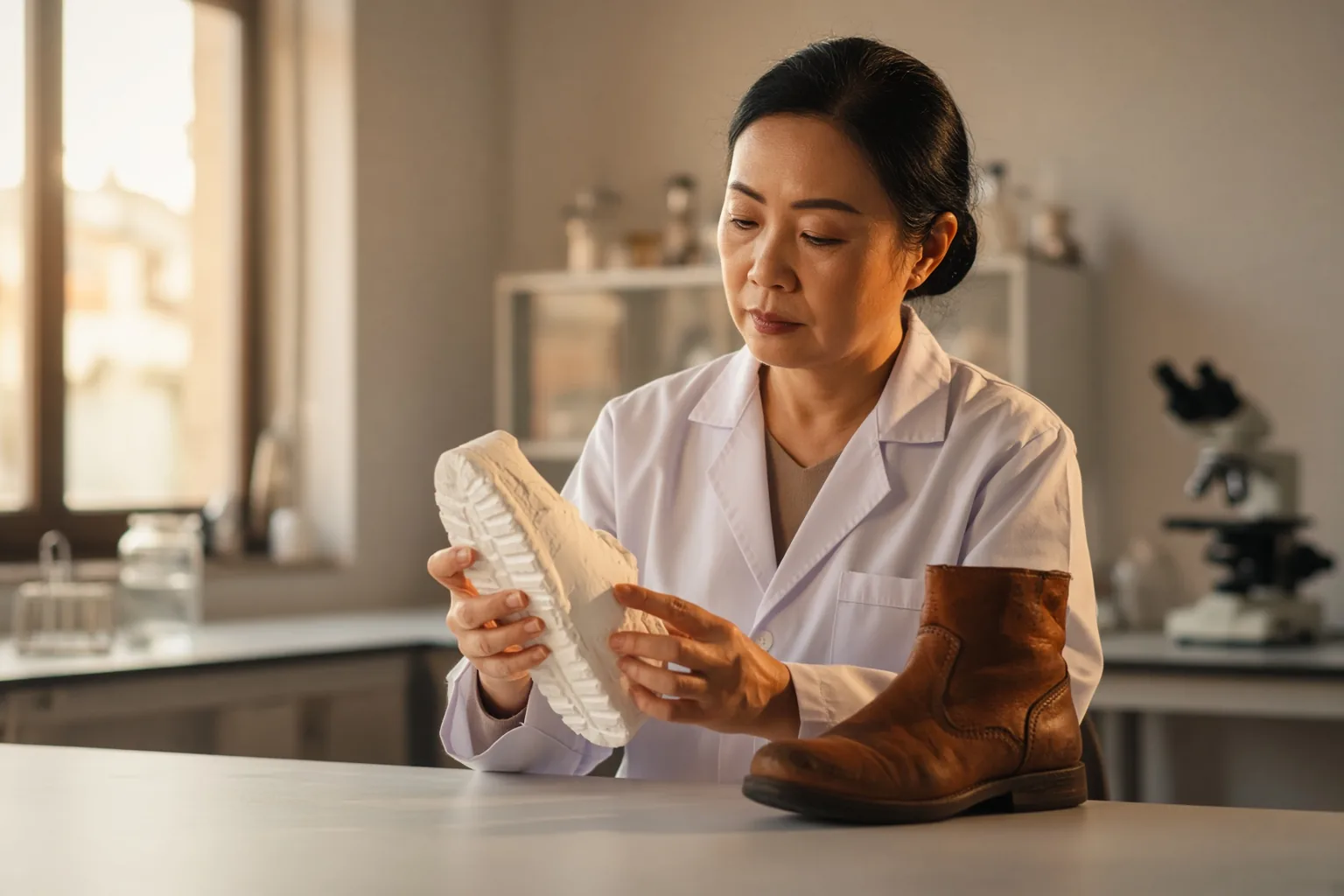
What does a footwear impression examiner compare?
The questioned impression from the scene and the known shoe. The examiner records class characteristics, such as the outsole design, and characteristics of use, such as wear, and compares both with test impressions made from the shoe.
ANSI/ASB Standard 137, Standard for Examination and Documentation of Footwear and Tire Impression Evidence, sets the examination process and the minimum documentation for footwear and tire tread examinations. The ASB approved the first edition in April 2022, and ANSI approved it in May 2023.
Section 4.3.1 fixes the order of work. The examiner analyzes and documents the unknown impression before analyzing the known shoe. If the examiner saw the known shoe first, the notes must record that exposure.
For each suitable unknown impression the examiner annotates the quality of the impression, its class characteristics (manufacturing information and the observed features, shapes and patterns), any interferences and limitations, and characteristics of use. The known shoe gets a separate record: the date of collection, photographs of the whole shoe and examination-quality photographs, the condition of the outsole, and the same two groups of characteristics.
The comparison takes in the unknown impression, the known shoe and all available test impressions. For each test impression the file states how it was prepared, the matrix and the substrate. Notes are made at the time of the work, the features used in the comparison are annotated, and the record must be complete enough for another footwear examiner to interpret the data and the basis of the opinion. The evaluation records the examiner's identity, the date, the items used and the conclusion reached.
ANSI/ASB Best Practice Recommendation 052, Detection and Collection of Footwear and Tire Impression Evidence, first edition 2022, is on the OSAC Registry. ANSI/ASB Best Practice Recommendation 049, Lifting of Footwear and Tire Impressions, first edition 2020, covers lifting. The Texas Forensic Science Commission lists BPR 052 as partially implemented by three Texas Department of Public Safety laboratories since November 18, 2024.
Standard 137 requires the examiner to account for observed impressions and to state whether each one is suitable for comparison. When the scene photographs, lifts or casts are poor, the ULTR provides the inconclusive conclusion for limitations in the evidence that prevent inclusion or exclusion, and the reviewer compares the reported conclusion with what the questioned impression actually shows.
What must the prosecution disclose about its footwear examiner?
At the defendant's request, a written disclosure with all opinions, their bases and reasons, the examiner's qualifications with publications from the previous 10 years, and testimony from the previous 4 years. The examiner approves and signs it.
Criminal Rule 16(a)(1)(G), amended effective December 1, 2022, covers testimony the government intends to use in its case-in-chief or in rebuttal to counter timely defense disclosures. The court sets the deadline by order or local rule, and it must be "sufficiently before trial to provide a fair opportunity for the defendant to meet the government's evidence." The disclosure contains a complete statement of all opinions, the bases and reasons for them, the witness's qualifications, including all publications authored in the previous 10 years, and a list of all other cases in which the witness testified as an expert during the previous 4 years. The witness must approve and sign it, unless the government explains why it could not obtain the signature or a signed report under (F) already contains the information.
If a party fails to comply, Rule 16(d)(2) lets the court order the discovery, grant a continuance, prohibit the party from introducing the undisclosed evidence or enter any other just order.
How does the defense get the shoes, casts and test reports?
Through Criminal Rule 16(a)(1)(E) and (F). On request the government must permit inspection of photographs and tangible objects material to the defense and of results or reports of scientific tests and examinations.
The defense also needs the physical evidence. Under Rule 16(a)(1)(E), on request the government must permit inspection and copying of documents, photographs and tangible objects in its possession, custody or control if the item is material to preparing the defense, the government intends to use it in its case-in-chief, or the item belongs to the defendant or was obtained from the defendant. That covers the shoes, casts, lifts and scene photographs. Rule 16(a)(1)(F) covers results or reports of scientific tests and examinations.
A reviewer also needs the bench notes, the photographs taken during the examination and the test impressions, because ANSI/ASB Standard 137 places the analysis and the comparison in those records. Counsel lists them by name in the discovery request.
What may the examiner not say in a report or on the stand?
The examiner may not claim uniqueness or individualization, exclusion of all other shoes, a zero error rate or 100 percent certainty, and may not use a career case count as a measure of accuracy.
Section IV of the footwear ULTR lists the qualifications and limitations. An examiner shall not assert that a source identification or a source exclusion is based on the "uniqueness" of an item of evidence, shall not use the terms "individualize" or "individualization" when describing a source conclusion, and shall not assert that the known footwear item made the questioned impression to the exclusion of all other footwear items.
The same section bars assertions that forensic footwear examinations are infallible or have a zero error rate. A conclusion may include a statistic or a numerical degree of probability only when it is based on relevant and appropriate data. The number of examinations performed in a career may be cited to describe qualifications or experience, but not as a direct measure of the accuracy of a conclusion.
The examiner may not assert absolute or 100 percent certainty and may not use the phrases "reasonable degree of scientific certainty" or "reasonable scientific certainty" unless a judge or applicable law requires it.
The committee note to the 2023 amendment of Federal Rule of Evidence 702 states that "forensic experts should avoid assertions of absolute or one hundred percent certainty" and that "each expert opinion must stay within the bounds of what can be concluded" from a reliable application of the expert's basis and methodology.
What conclusions may a footwear examiner report?
Under the Department of Justice uniform language, one of six: source identification, two levels of inclusion, inconclusive, support for exclusion and source exclusion. Each conclusion has a written definition.
The Uniform Language for Testimony and Reports for the Forensic Footwear Discipline was approved on June 8, 2020 and took effect on August 15, 2020. The FBI Laboratory document IMPRS-901-03, issued January 14, 2022, lists the same six conclusions for footwear and tire impressions.
The two inclusion conclusions sit between identification and inconclusive. One rests on class characteristics alone and says the shoe could have made the print. The other adds randomly acquired characteristics and says the shoe probably made it.
In both cases the ULTR requires the examiner to explain that there may be other footwear items with characteristics indistinguishable from the known item, and that those items could also have made the questioned impression. A defense review checks the report and the trial testimony for that sentence. A report that says the shoe "matched" the print and omits the caveat does not use the ULTR wording. The ULTR definitions of all six conclusions are listed below.
- Source identification means the examiner concluded that the known footwear item made the questioned impression.
- Inclusion based on class and randomly acquired characteristics means the known footwear item probably made the questioned impression.
- Inclusion based on class characteristics means the known footwear item could have made the questioned impression.
- Inconclusive means no determination can be reached as to whether the known footwear item could or could not have made the questioned impression.
- Support for exclusion means the known footwear item probably did not make the questioned impression.
- Source exclusion means the known footwear item did not make the questioned impression.
How strong is the science behind a footwear source identification?
In September 2016 PCAST found no appropriate black-box studies supporting the association of shoeprints with particular shoes based on specific identifying marks. It did not address class characteristics.
The President's Council of Advisors on Science and Technology published Forensic Science in Criminal Courts: Ensuring Scientific Validity of Feature-Comparison Methods in September 2016. Its executive summary states: "PCAST finds that there are no appropriate black-box studies to support the foundational validity of footwear analysis to associate shoeprints with particular shoes based on specific identifying marks." It adds that such associations "are unsupported by any meaningful evidence or estimates of their accuracy" and so are not scientifically valid.
The report limits that finding. "PCAST has not addressed the question of whether examiners can reliably determine class characteristics," because determining class characteristics is not an inherently hard measurement problem. PCAST looked at conclusions that an impression was likely to have come from a specific piece of footwear.
In ULTR terms, the PCAST finding concerns conclusions built on specific identifying marks: source identification and inclusion based on randomly acquired characteristics. An inclusion based on class characteristics says only that the shoe could have made the print. A defense expert reads the report to see which of the two kinds of conclusion it reaches and whether the data in the notes support that level.
Do courts admit footwear impression testimony?
Courts decide under Rule 702 case by case. The First Circuit upheld admission in United States v. Mahone in 2006 and treated the challenge to verification as going to weight, not admissibility.
In United States v. Mahone, No. 05-1492, decided July 5, 2006, the government's examiner testified that the defendant's shoe had made impressions found on a stairway and a teller counter. The First Circuit found her qualified and wrote that "it is not required that experts be blue-ribbon practitioners with optional certifications." She was subject to annual proficiency testing by an outside agency.
The opinion records that the examiner "offered a potential error rate of zero for the method, stating that any error is attributable to examiners." The court wrote that "there is no evidence that ACE-V mandates blinded verification" and that the defendant's first verification argument "goes only to weight, not admissibility." Fourteen years later the Department of Justice ULTR barred its own footwear examiners from asserting a zero error rate.
In State v. Habersham, unpublished opinion No. 2024-UP-191 filed May 29, 2024, the South Carolina Court of Appeals found no abuse of discretion in qualifying two State witnesses as footwear impression experts. They testified that the methodology "had been extensively peer reviewed" and that their conclusions "must be reviewed and agreed upon by another examiner before they could issue a report." The opinion has no precedential value under the South Carolina appellate rules.
Since December 1, 2023, Rule 702 requires the proponent to establish to the court that it is more likely than not that the testimony is based on sufficient facts or data, is the product of reliable principles and methods, and applies those principles and methods reliably to the facts of the case. A defense objection names the condition that fails and the page of the report where the gap appears.
What does a defense review of a footwear report check?
Whether the case file meets the documentation rules of ANSI/ASB Standard 137, whether the conclusion uses permitted wording with its caveats, and whether the notes contain enough data for the level of conclusion reported.
The reviewer needs the bench notes, photographs and test impressions in addition to the report. The checks follow the standard section by section.
- The notes were made during the examination and include examination-quality photographs of the impression and of the shoe.
- The questioned impression was analyzed before the known shoe, or the notes record the earlier exposure as Section 4.3.1 requires.
- Every feature used in the comparison is annotated and labeled as a class characteristic or a characteristic of use.
- Each test impression is documented with its method of preparation, matrix and substrate.
- The conclusion is one of the permitted categories, and an inclusion carries the statement about indistinguishable footwear.
- The file shows who verified the conclusion and when, if the laboratory procedure or the testimony says verification took place.
What happens when the defense uses its own footwear examiner?
If the defense requested the government's expert disclosure and the government complied, the defense must, at the government's request, disclose its own examiner's opinions, bases, qualifications and prior testimony in writing.
Disclosure runs both ways. If the defense requested disclosure under (a)(1)(G) and the government complied, Rule 16(b)(1)(C) requires the defense, at the government's request, to disclose its own expert's opinions, bases, qualifications and prior testimony in writing, signed by the witness.
Rule 16(b)(1)(B) covers reports of examinations and tests. If the defendant requested disclosure under (a)(1)(F) and the government complied, the defendant must, on request, permit inspection and copying of results or reports in the defendant's control, but only if the defendant intends to use the item in the case-in-chief at trial or intends to call the witness who prepared the report and the report relates to that witness's testimony.
Under Rule 16(b)(1)(C)(iii) the defense disclosure contains a complete statement of all opinions the defendant will elicit from the witness in its case-in-chief, the bases and reasons for them, the witness's qualifications with publications from the previous 10 years, and a list of cases from the previous 4 years. The witness approves and signs it.
What does IAE do in a footwear impression case?
IAE prepares an expert report on the client's questions or a review of the opposing examiner's report for criminal defense and cargo loss cases in US courts. Up to 5 business days, or 48 hours on rush.
The trace evidence page lists the questions: whether a shoe, tire or tool could have left the mark, how strong the association is, and whether a lock or seal was defeated. For footwear, the reviewer checks whether the examiner analyzed the questioned print before the known shoe, documented class characteristics and characteristics of use, and recorded the conclusion, as ANSI/ASB Standard 137 requires. IAE confirms the questions with the client before work starts.
The client sends the report or the case materials and describes the task. The secretariat confirms receipt the same day. Within one business day IAE confirms the format, the cost, the deadline and the specialist from its registry, and the client approves the candidate and the CV before work starts. The signed PDF is issued in up to 5 business days.
Every specialist is a member of the public IAE registry and passed the council's attestation under the published Criteria Matrix. The Member ID in the document opens the specialist's category, specialization, attestation date and record status on the status check page or by QR code. The specialist confirms in the document that he or she has no interest in the outcome of the case.
Materials go through the contact form or to info@iaexperts.com and are not passed to third parties without the client's consent. The court decides whether the examiner's testimony is admitted and what weight it gets. Neither IAE nor the reviewer guarantees the outcome. IAE is not a law firm and does not advise on case strategy.
Sources
- U.S. Department of Justice, Uniform Language for Testimony and Reports for the Forensic Footwear Discipline, effective August 15, 2020
- FBI Laboratory, IMPRS-901-03, FBI Approved Standards for Scientific Testimony and Report Language for Forensic Examination of Footwear and Tire Impression Evidence (2022)
- ANSI/ASB Standard 137, Standard for Examination and Documentation of Footwear and Tire Impression Evidence, 1st Ed. 2023
- ANSI/ASB Best Practice Recommendation 052, Detection and Collection of Footwear and Tire Impression Evidence (Texas Forensic Science Commission listing)
- ANSI/ASB Best Practice Recommendation 049, Lifting of Footwear and Tire Impressions (Texas Forensic Science Commission listing)
- PCAST, Forensic Science in Criminal Courts: Ensuring Scientific Validity of Feature-Comparison Methods, September 2016
- Federal Rules of Evidence, Rule 702, Testimony by Expert Witnesses, with Committee Notes (LII)
- Federal Rules of Criminal Procedure, Rule 16, Discovery and Inspection (LII)
- Supreme Court of the United States, order of April 11, 2022 amending Federal Rule of Criminal Procedure 16, effective December 1, 2022
- Supreme Court of the United States, order of April 24, 2023 amending Federal Rules of Evidence 106, 615 and 702, effective December 1, 2023
- United States v. Mahone, No. 05-1492 (1st Cir. July 5, 2006)
- State v. Habersham, South Carolina Court of Appeals, Unpublished Opinion No. 2024-UP-191 (May 29, 2024)
Read also
All articles
Was the window broken from inside or outside? How does a glass fracture examination answer, and how far can the answer be trusted?
After a reported burglary, a shooting or a fire, one broken pane can decide which account is true: forced entry or a staged scene, a shot fired into Sergei Voronin
No signs of forced entry: how is a door, lock or window examined after a reported burglary?
Some commercial burglary policies pay only for entry by force that leaves visible marks, and police reports often carry the line "no signs of forcedSergei Voronin
Safe burglary: how does an examiner tell whether a safe was forced, drilled or opened with the combination?
An examination of a safe after a theft answers how it was opened: by force on the door or body, by drilling, or with the combination or keySergei VoroninExpert examinations
Ready to discuss your case?
Send the materials: the secretariat will confirm the format, cost, deadline and the specialist within one business day.
